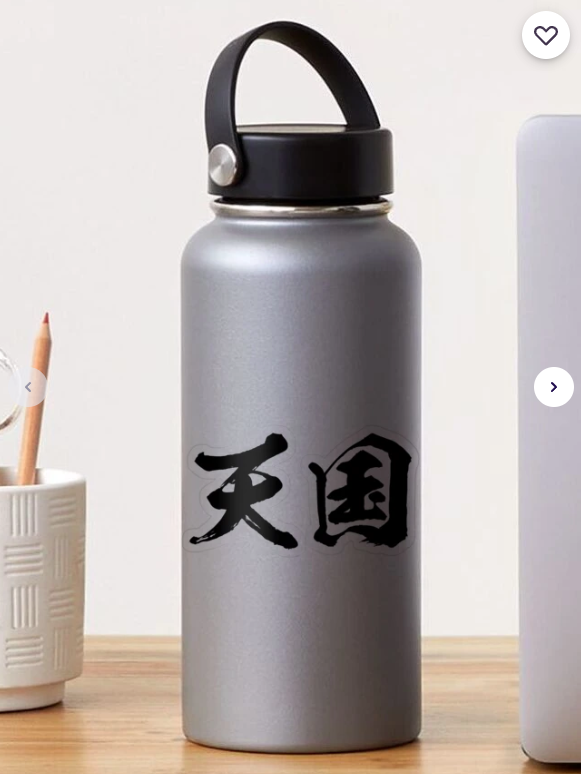
天国
Heaven, Paradise
Two characters that combine “what’s above human heads” with “jade enclosed in walls” to create the concept of a divine realm where treasure lives beyond reach.
When a Japanese person dies, family members might say 天国に行った (tengoku ni itta)—”they went to heaven.” When describing a perfect beach vacation, someone exclaims ここは天国だ (koko wa tengoku da)—”this place is heaven!” The same two characters describe both the afterlife where souls find eternal rest AND that moment when you bite into perfect sushi and everything feels right with the universe.
天国 (tengoku) combines 天 (ten, heaven/sky) with 国 (koku, country/nation) to create “heavenly country” or “kingdom of heaven.” It’s a Buddhist-influenced concept that merged with Christian vocabulary when missionaries arrived in the 16th century, creating terminology flexible enough to describe paradise across religious traditions. The compound works because it’s simultaneously concrete (a place, a kingdom) and abstract (spiritual perfection, ultimate peace).
But here’s what makes 天国 interesting: Japanese has multiple words for heaven-like concepts. 極楽 (gokuraku) specifically means Buddhist Pure Land paradise. 浄土 (jōdo) describes the purified realm where enlightened beings dwell. 天堂 (tendō) offers an alternative “heaven hall” that sounds more Chinese. Yet 天国 became the dominant everyday term because its components—sky and country—create imagery anyone can grasp regardless of religious background. It’s heaven democratized through language accessible to believers and skeptics alike.
✨ Kanji Styles Gallery
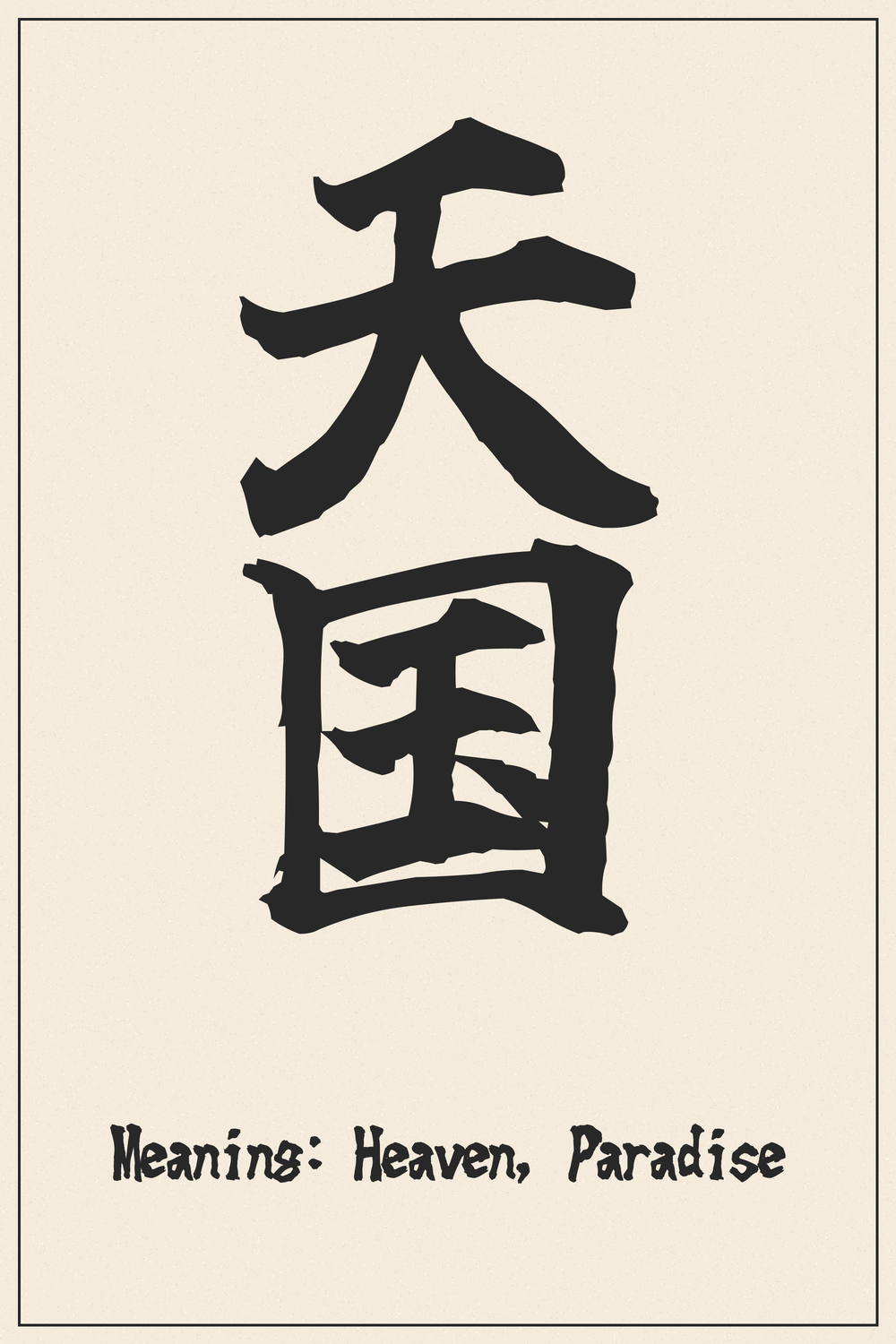
🖌️ Calligraphy Style
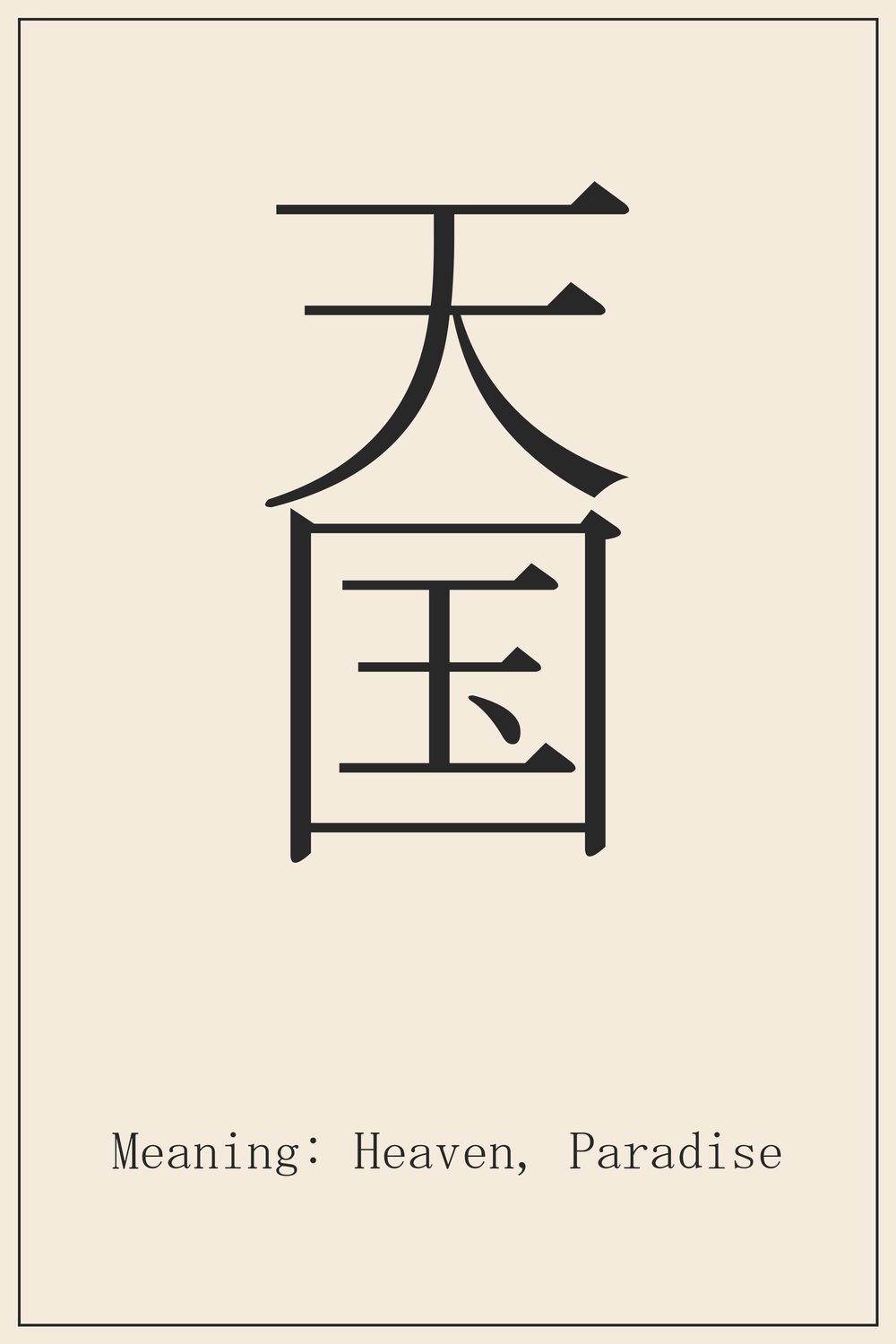
📝 Mincho Style
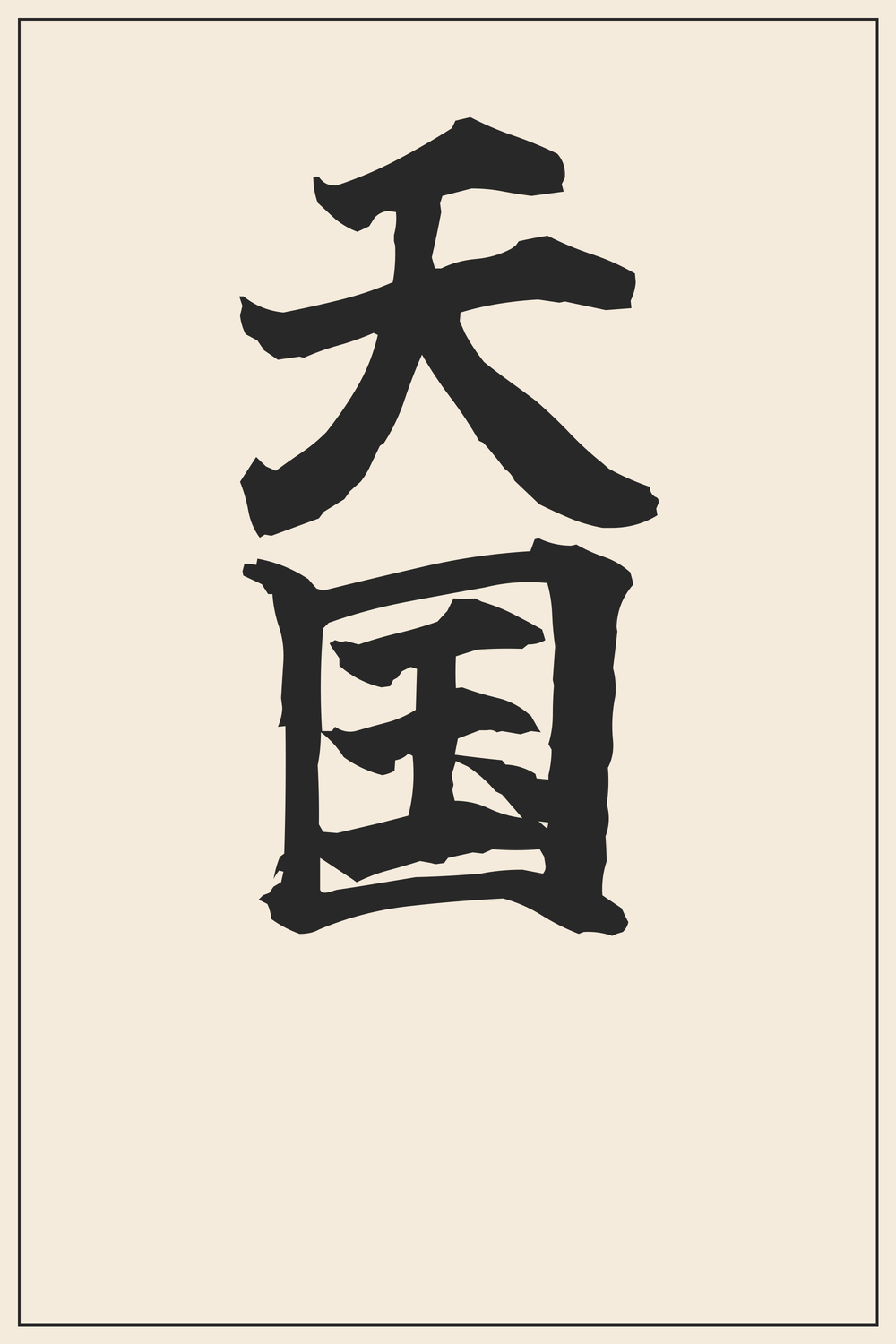
📜 Vertical Writing
⚡ Quick Facts
Breaking Down 天 (Ten)
The character 天 started as a pictograph showing a person with an emphasized head—specifically, a horizontal line above a human figure indicating what exists above the crown of the head. That’s the sky. That’s heaven. That’s everything beyond human reach. Ancient scribes captured the concept of “what’s higher than the highest part of humans” through one simple image.
Over millennia, 天 accumulated layers of meaning: the physical sky, the heavens as divine realm, nature’s power, fate or destiny, supreme authority. In ancient China, emperors ruled under 天命 (tenmei, “heaven’s mandate”)—legitimacy granted by cosmic forces. If natural disasters struck or rebellions succeeded, people interpreted it as heaven withdrawing its mandate. The character represented ultimate power beyond human control.
In modern Japanese, 天 appears everywhere: 天気 (tenki, weather—literally “heaven’s energy”), 天才 (tensai, genius—”heaven-given talent”), 天災 (tensai, natural disaster—”heaven-sent calamity”), 天皇 (tennō, emperor—”heavenly sovereign”). The character always points upward, suggesting forces or qualities beyond ordinary human capacity, achievement, or understanding.
Japanese uses 空 (sora) for the physical sky you see when looking up—clouds, blue atmosphere, weather. 天 (ten) carries more abstract, elevated meaning—the cosmic realm, divine authority, fate itself. Both mean “sky/heaven,” but 空 is what airplanes fly through while 天 is where gods dwell. The distinction matters for understanding 天国 as divine realm rather than literal clouds.
Breaking Down 国 (Koku/Kuni)
The character 国 combines an enclosure 囗 (the outer square representing walls or borders) with 玉 (tama, jade or jewel) inside. The imagery is straightforward: a precious treasure protected within defined boundaries. That’s what a country is—a bounded territory protecting valuable things (people, resources, culture) within its borders.
The jade component 玉 connects to royalty and sovereignty in ancient East Asian culture. Jade seals authorized imperial decrees. Jade artifacts symbolized political authority. Including 玉 within the enclosure suggests not just any walled area but specifically a sovereign realm—a kingdom, a nation, a domain under unified rule. The character depicts political organization: treasure plus boundaries plus authority equals country.
Modern usage extends beyond political borders. 国 appears in 外国 (gaikoku, foreign country), 帰国 (kikoku, returning to one’s homeland), 国民 (kokumin, citizens). In 天国, it transforms from earthly territory to celestial kingdom—the walls become the boundary between mortal and divine realms, the jade represents souls or spiritual treasures, and the sovereign authority shifts from emperor to gods or cosmic forces.
The kingdom beyond the sky, where precious souls find eternal rest
Buddhist vs. Christian Heaven
Traditional Buddhism doesn’t have “heaven” in the Christian sense—an eternal paradise where good souls live forever with God. Instead, Buddhist cosmology describes multiple heavenly realms (天界, tenkai) within the cycle of rebirth. Even heavenly existence is temporary. Eventually, you’re reborn again. The goal isn’t reaching heaven—it’s escaping the cycle entirely through enlightenment, reaching nirvana where rebirth stops.
Pure Land Buddhism (浄土宗, Jōdo-shū) offers something closer to Christian heaven: 極楽浄土 (gokuraku jōdo), the Pure Land of Ultimate Bliss. Devotees who chant Amida Buddha’s name are reborn there after death into a paradise where achieving enlightenment becomes easy. This teaching gained massive popularity in Japan because it offered accessible salvation—no complex meditation required, just sincere devotion.
When Christian missionaries arrived in the 1500s, they needed Japanese vocabulary for “heaven.” They adopted 天国 and similar terms, creating overlap between Buddhist and Christian concepts. Modern Japanese use 天国 flexibly—it might mean Christian heaven, Buddhist pure lands, generic afterlife, or just “really nice place.” The ambiguity works because the compound’s components (sky + country) remain concrete enough to adapt across belief systems.
Secular Paradise
Walk through Tokyo’s Akihabara district on Sunday and you’ll encounter 歩行者天国 (hokōsha tengoku)—literally “pedestrian heaven,” the streets closed to cars so shoppers can walk freely. The term has nothing to do with afterlife or spirituality. It just describes a really pleasant situation: streets without traffic = pedestrian paradise. The metaphor works because everyone understands 天国 means “ideal state.”
This secular usage appears constantly. Food lovers declare a famous ramen shop 味の天国 (aji no tengoku, “flavor heaven”). Cat enthusiasts call cat cafés 猫好きの天国 (neko-zuki no tengoku, “cat lovers’ paradise”). The expression この世の天国 (kono yo no tengoku, “heaven in this world”) describes earthly perfection—tropical beaches, hot springs, perfect meals, moments of complete satisfaction.
The metaphorical flexibility distinguishes 天国 from more religiously specific terms. 極楽 (gokuraku) sounds explicitly Buddhist. 天国 works anywhere because its components—sky and country—create mental imagery accessible without theological commitment. You don’t need to believe in literal heaven to understand “heavenly country” as shorthand for “perfect place.” The secularization makes the term more useful, not less.
天国’s opposite is 地獄 (jigoku, hell)—literally “earth prison.” The contrast is perfect: heaven = sky + country (freedom, openness, elevation), hell = earth + prison (confinement, suffering, being trapped below). The linguistic symmetry reflects cultural assumptions about up=good, down=bad, open=blessed, confined=cursed. The characters encode cosmic geography.
🎨 Tattoo Design Ideas
- ✨ Traditional Horizontal Format – Two characters arranged side-by-side in classic calligraphy creates balanced, readable composition. The brushwork should feel elevated and peaceful—no aggressive strokes, maintaining the concept’s serene quality. Perfect for upper back, chest, or shoulder blade placements (4-6 inches wide).
- ✨ Vertical Column Style – Traditional top-to-bottom arrangement honors authentic Japanese writing direction while creating elegant vertical flow. Ideal for spine, forearm, or outer thigh placements where the characters stack naturally (5-7 inches tall). The vertical orientation suggests upward movement toward heaven.
- ✨ Cloud Integration – Place 天国 with subtle cloud wisps or mist surrounding the characters, suggesting the heavenly realm without becoming literal illustration. Keep cloud elements minimal and atmospheric—the kanji dominate, clouds provide context. Works beautifully for ribcage or upper arm.
- ✨ Minimalist Modern Line – Clean, precise strokes without decorative flourish for contemporary aesthetic. Despite the spiritual meaning, the design can feel modern through execution simplicity. Perfect for smaller placements (3-5 inches) on wrist, ankle, or behind ear where subtlety matters.
- ✨ Memorial Design – Pair 天国 with dates, initials, or small symbolic element (dove, angel wing, specific flower) commemorating someone who passed. The characters provide spiritual context while additional elements personalize the memorial. Keep additions minimal so kanji remain focal point.
- ✨ Celestial Accents – Add subtle stars, sun rays, or gentle light gradient behind the characters suggesting divine illumination. The celestial imagery reinforces heaven concept without overwhelming the kanji. This approach works especially well for upper back or shoulder placements where light seems to emanate from behind.
Who Chooses This Tattoo
People grieving lost loved ones frequently choose 天国 as memorial tattoo. It honors the deceased while affirming belief (or hope) that they’ve reached peace. The characters become permanent reminder that someone you loved exists somewhere beyond suffering, whether you interpret that literally as religious afterlife or metaphorically as memory and legacy living on.
Religious individuals—Christians, Buddhists, or people blending spiritual traditions—select 天国 expressing faith in divine realm or ultimate peace awaiting after death. The tattoo becomes visible declaration of spiritual beliefs, permanent reminder during difficult times that earthly suffering is temporary, paradise awaits. It’s hope made visible, faith declared through skin.
Others choose it purely aesthetically or philosophically without literal religious belief. They might interpret 天国 as representing ideals worth pursuing—peace, perfection, escape from suffering—rather than actual place you reach after death. The characters work because they’re beautiful, culturally resonant, and philosophically flexible enough to carry personal meaning without requiring theological commitment.
天国 carries religious weight for many people even if it’s also used casually in everyday Japanese. If you’re getting this as memorial or spiritual statement, be prepared to explain your beliefs respectfully when asked. If you’re choosing it purely aesthetically without religious connection, consider whether that might feel disrespectful to people for whom heaven represents sacred concept central to their faith.
Why These Characters Endure
Humans have imagined paradise across every culture and era because life contains suffering, and suffering demands imagining its opposite. We need the concept of a place—or state—where pain ends, where peace prevails, where everything finally makes sense and feels right. 天国 names that universal human longing through two simple characters: sky and country.
The compound works across belief systems because it’s simultaneously specific (a kingdom, a place) and abstract (whatever perfection means to you). Christians can see God’s throne. Buddhists can envision Pure Land. Atheists can interpret it as metaphor for peak human experience. The characters accommodate interpretation while maintaining core meaning: somewhere/somehow, perfection exists.
天国 endures because grief endures, because hope endures, because humans keep needing language for what lies beyond suffering. Whether you believe literal heaven awaits or you’re seeking earthly paradise or you’re honoring someone who’s gone, these characters hold space for that longing. They name the thing everyone wants and nobody can quite grasp—perfect peace, complete joy, home at last. That’s worth carrying permanently, whether as prayer, promise, or memorial to beauty we glimpse but can’t yet fully reach.
Comments