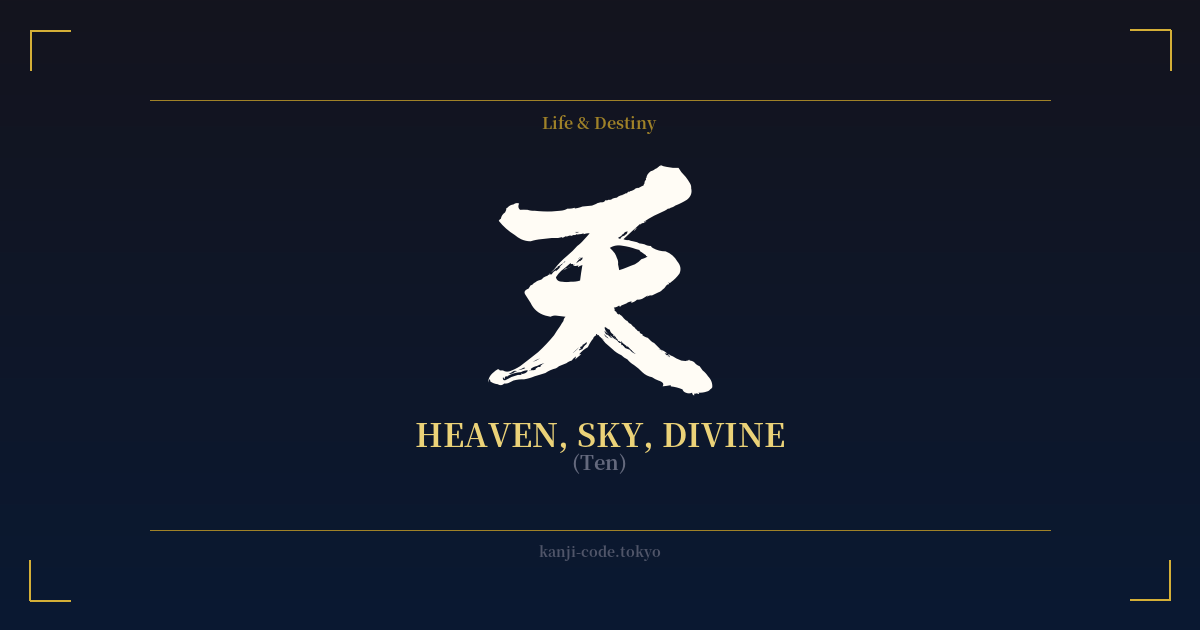
✍️ 天 (Ten) — Cultural Context
The kanji 天 (Ten) is one of the most fundamental and profound characters in the Japanese language, encapsulating concepts that range from the physical sky to the divine heavens and ultimate authority. Its simple, elegant form belies a deep well of cultural and philosophical significance, making it a powerful symbol that has resonated through Japanese history for centuries.
Visually, the character's origin is a pictograph. It depicts a large, great person (大, dai) with a single horizontal stroke above their head. This top stroke represents the heavens or the sky, symbolizing that which is above humanity—the ultimate, the vast, the divine. This simple construction immediately establishes a hierarchy: the realm of the gods, fate, and nature exists above the realm of mortals.
In Japan's native Shinto religion, 'Ten' is intrinsically linked to the celestial realm of the gods, known as Takamagahara (高天原), the 'High Plain of Heaven.' This is the dwelling place of the Amatsukami (天津神), the heavenly deities, led by the sun goddess Amaterasu Ōmikami. The very legitimacy of the Japanese imperial line is traditionally traced back to this divine, heavenly origin, making 'Ten' a symbol of sacred authority and celestial mandate.
With the arrival of Buddhism, the concept of 'Ten' was integrated and expanded. In Buddhist cosmology, 'Ten' refers to the heavenly realms of the Devas—beings who enjoy long lives of immense pleasure and bliss. However, this heaven, often called Tengoku (天国), is not a final destination like in some Western religions. It is a temporary, blissful state within the cycle of reincarnation (samsara), from which one will eventually be reborn. Thus, in a Buddhist context, 'Ten' represents a high state of being but not the ultimate goal of enlightenment.
Beyond religion, 'Ten' permeates Japanese philosophy and everyday language. The term Tenmei (天命) means 'Heaven's Will' or 'Divine Mandate,' a concept influential among the samurai class, suggesting that one's destiny and the course of history are guided by a higher, natural order. Acting in accordance with Tenmei meant embracing one's fate with integrity and purpose.
This powerful kanji is a building block for many common words. Tenki (天気) means 'weather,' literally the 'spirit of the sky.' Tensai (天才) means 'genius,' a person with 'heaven-sent talent.' Even the famous dish Tempura (天ぷら) has etymological theories linking it to the heavens. This constant presence in the language showcases how the concept of 'Ten' is woven into the fabric of Japanese thought—as the sky above, the fate that guides, and the divine potential within.
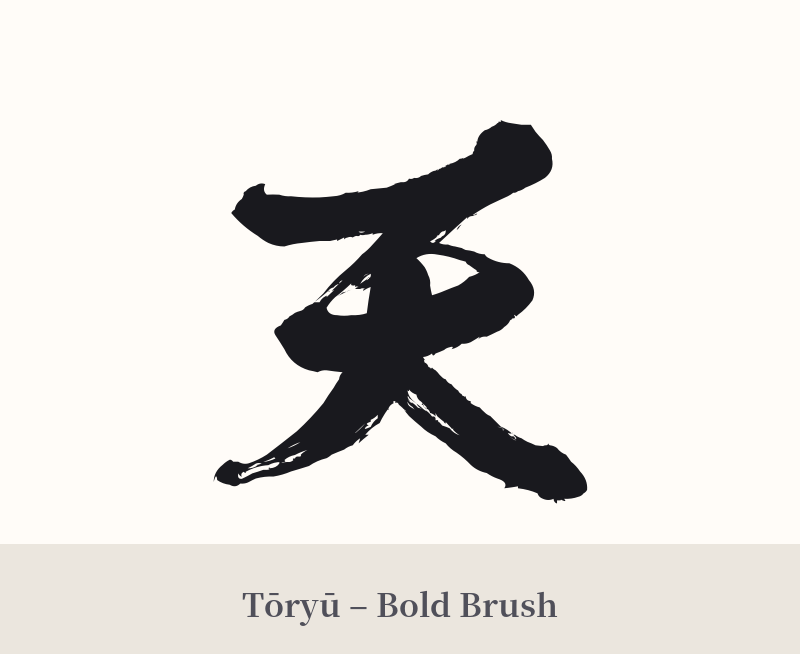
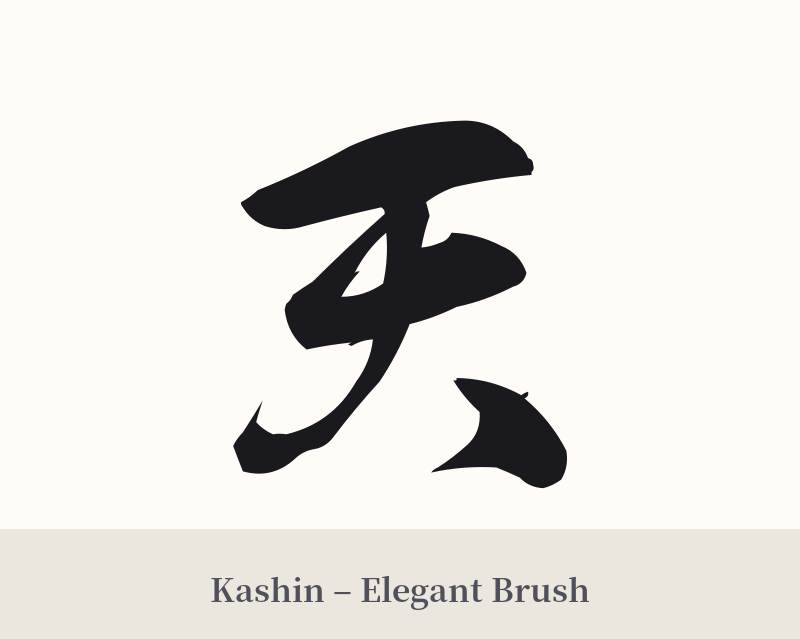
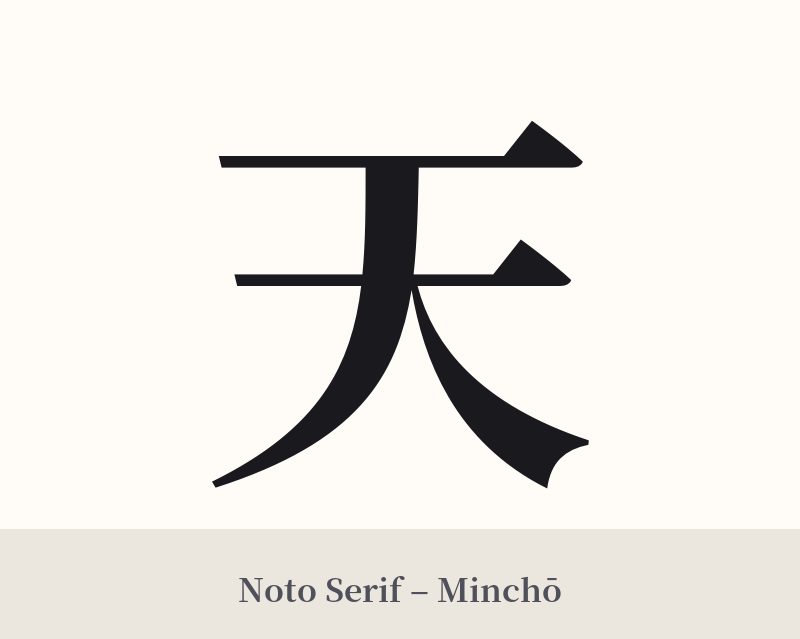
🖌️ Font Styles for 天
The same kanji can look dramatically different depending on the calligraphy style. Choose a font that matches the mood you want for your tattoo or design.
🎨 Tattoo Suitability
📐 Tattoo Design Guide
The kanji 天 is a classic and versatile choice for a tattoo, thanks to its powerful meaning and balanced form. Its simplicity allows for a wide range of artistic interpretations.
– Placement: Due to its vertical symmetry, 天 works exceptionally well in central locations. Consider the back of the neck, the center of the chest, or between the shoulder blades to emphasize its sense of authority and balance. It's also a strong choice for a forearm or calf.
– Font Style: A bold, angular, or block-style font (like a Kaishotai script) can highlight the character's strength and stability. For a more spiritual or artistic feel, a flowing semi-cursive (Gyōsho) or cursive (Sōsho) calligraphy style can add movement and grace, evoking the feeling of clouds or wind in the sky.
– Visual Complements: While 天 is powerful enough to stand alone, it can be beautifully integrated with other elements. Pairing it with an Ensō (Zen circle) can symbolize the universe or enlightenment. Incorporating clouds, wind bars, or a subtle sun or moon in the background can enhance the 'sky' and 'celestial' aspects of its meaning.
Comments