侍
Samurai
Before the sword, before the armor, there was service—a character built on loyalty that became a warrior class that shaped Japan for 700 years.
The word samurai didn’t start with battlefield glory. It came from an ancient verb—saburafu (侍ふ)—meaning “to wait upon” or “to serve nearby.” Picture attendants hovering near Heian-era nobles around 900 CE, ready to fulfill any request. These weren’t warriors yet. They were glorified servants, bodyguards at best.
But over centuries, those servants learned to fight. As Japan fractured into warring provinces during the Kamakura period (1185-1333), the people skilled at protecting their lords became more valuable than the bureaucrats managing paperwork. Service transformed into martial mastery. The character 侍 absorbed that evolution—literally showing a person (亻) beside a temple/bureau (寺), representing someone attending to important matters with disciplined dedication.
By the Edo period (1603-1868), samurai dominated Japanese society as the ruling warrior class—roughly 7-10% of the entire population. They didn’t farm or trade. They trained, governed, and lived by an ethical code called Bushido that made death preferable to dishonor. When the Meiji Restoration ended their reign in 1868, samurai became illegal overnight, but the mystique never died.
✨ Kanji Styles Gallery
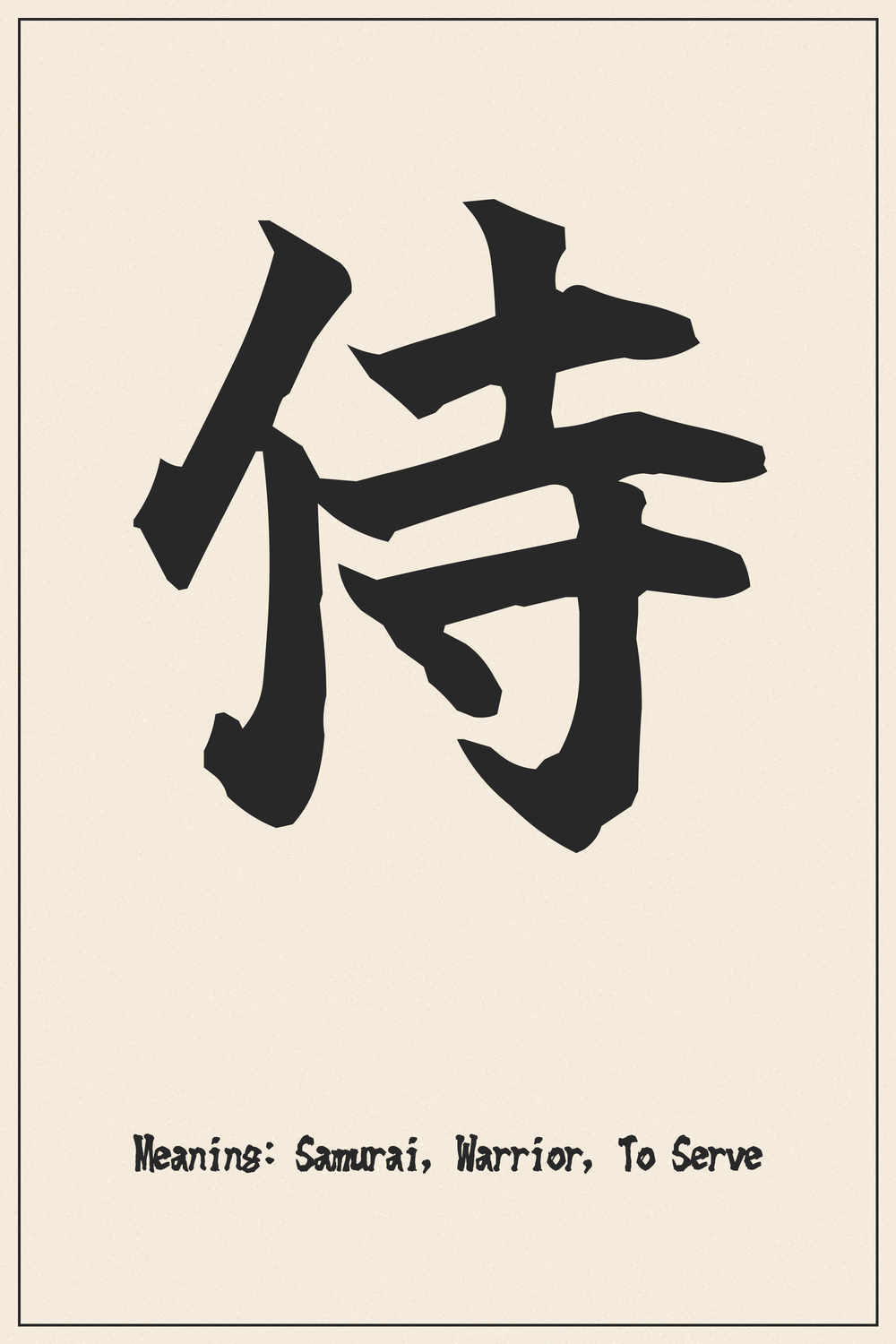
🖌️ Calligraphy Style
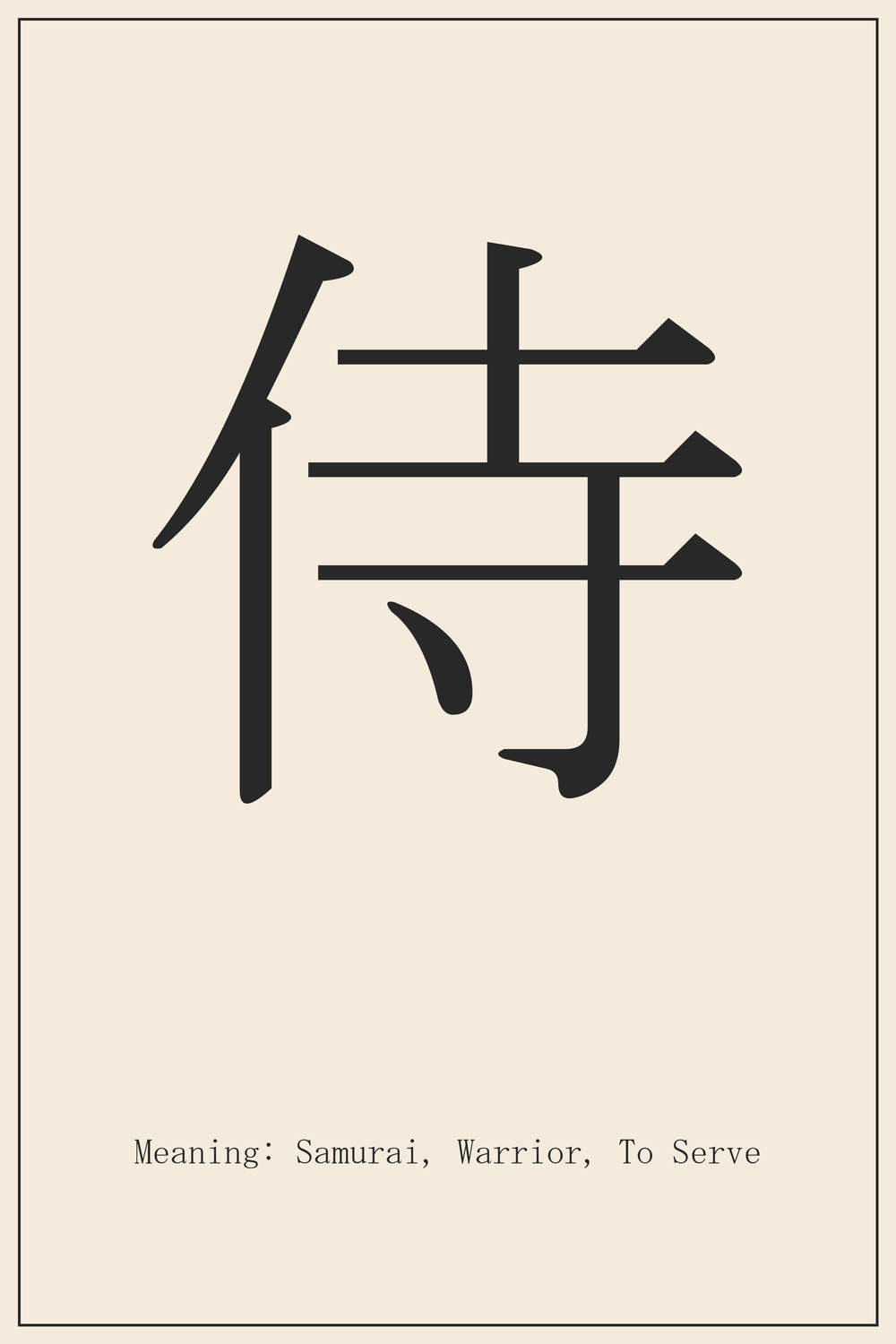
📝 Mincho Style
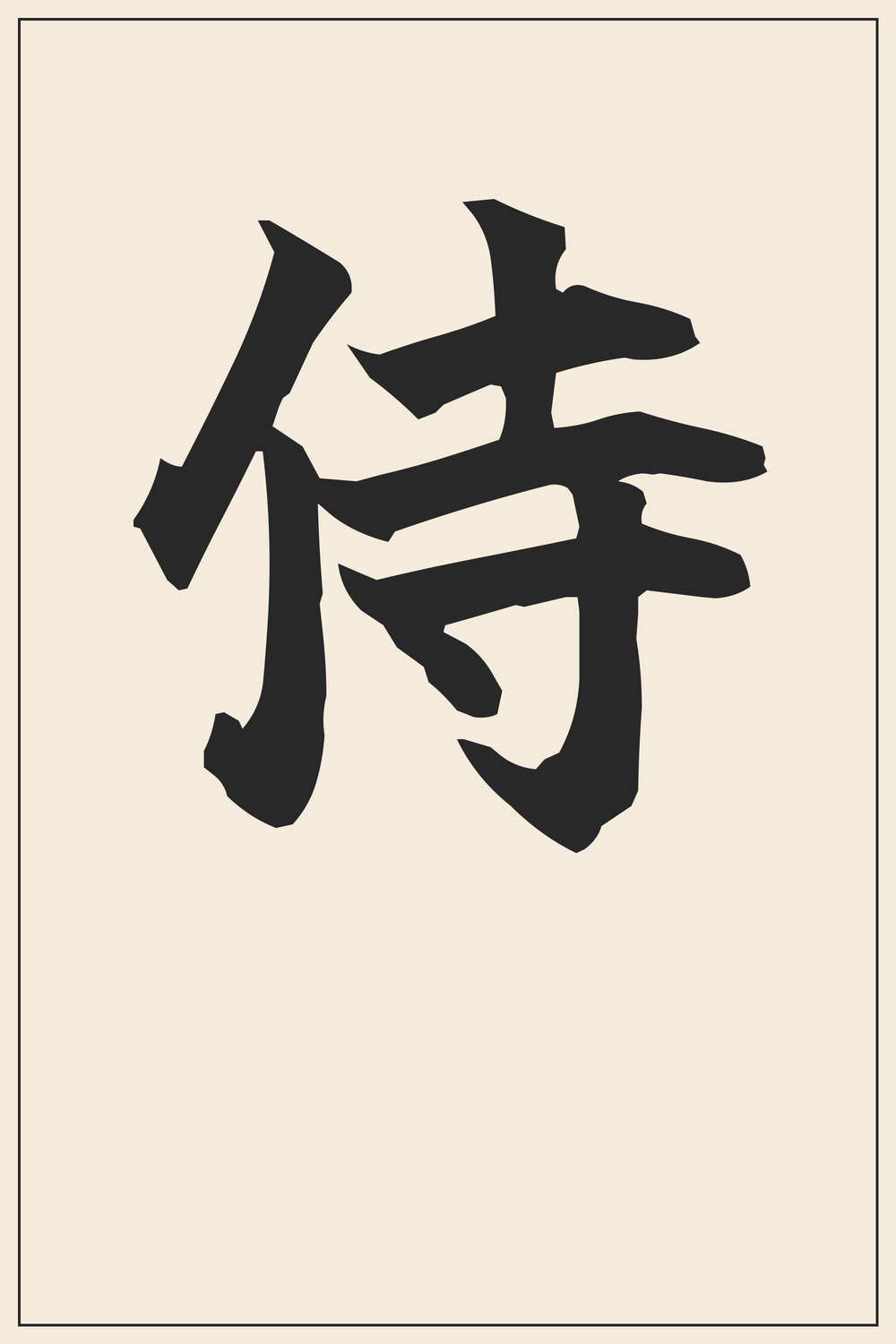
📜 Vertical Writing
⚡ Quick Facts
Breaking Down the Character
The left radical 亻(ninben) means “person” and appears in thousands of kanji related to human activities, roles, and relationships. It anchors 侍 in the realm of human identity—this isn’t an abstract concept, it’s about actual people doing actual work.
The right component 寺 (tera/ji) typically means “temple” in modern Japanese, but its older meanings included “government bureau” or “administrative office.” Ancient China used 寺 for places where officials worked—not necessarily religious spaces. This component originally combined 土 (earth/foundation) and 寸 (hand/measure), suggesting steady hands performing important tasks with precision.
Put them together: a person attending to matters in an official capacity. The kanji’s structure perfectly captures the samurai’s original role—not freelance mercenaries but retainers bound to specific lords through formal service relationships. That’s why the character literally shows someone standing beside institutional authority, ready to act.
The pronunciation shift from saburafu → samurai happened through women’s language in the Heian period. Court ladies softened the “b” sound to “m,” creating the word we recognize today. So “samurai” technically comes from medieval Japanese women’s speech patterns—a detail most warrior fantasies conveniently ignore.
From Servant to Legend
In the Heian period (794-1185), samurai were basically high-end security. Wealthy nobles hired them to guard estates, collect taxes, and intimidate rivals. They held respectable but not prestigious positions—skilled workers, not aristocrats. The real power belonged to court nobles who wrote poetry and played politics while samurai stood nearby, literally waiting to be useful.
Everything changed when the Minamoto clan won the Genpei War (1180-1185) and established Japan’s first military government in Kamakura. Suddenly, warriors weren’t just guards—they were the government. Political power shifted permanently from aristocratic bloodlines to those who could fight and command. The servant class became the ruling class practically overnight.
This transformation created a problem: warriors needed an ideology justifying their dominance over traditional nobility. Enter Bushido, the “Way of the Warrior”—a moral framework emphasizing loyalty, courage, honor, and discipline. It wasn’t ancient tradition; it was constructed over centuries to legitimize samurai rule and distinguish them from common soldiers. By the time it was codified in texts like Hagakure (1716), Bushido had become the samurai’s defining mythology.

When brush meets paper, the samurai charges forward through time itself
The Bushido Code Unpacked
Bushido wasn’t a single rulebook everyone followed. Different samurai clans, different time periods, different interpretations—but certain values consistently appeared. Seven core virtues formed the foundation: righteousness (義, gi), courage (勇, yū), benevolence (仁, jin), respect (礼, rei), sincerity (誠, makoto), honor (名誉, meiyo), and loyalty (忠義, chūgi).
These weren’t suggestions. They were survival requirements in a society where reputation determined whether you lived comfortably or died penniless. A samurai accused of cowardice might be ordered to commit seppuku (ritual suicide) to restore his family’s honor. One who betrayed his lord faced execution if caught, or a lifetime as a masterless ronin—a wandering outcast stripped of status and income.
Westerners often romanticize Bushido as pure warrior zen, but it served practical political purposes. Lords used it to ensure absolute loyalty from retainers who possessed deadly combat skills. The code transformed potential threats into devoted servants willing to die on command. That’s harsh, but feudal Japan wasn’t about individual freedom—it was about maintaining rigid social hierarchies where everyone knew their place and stayed there.
Ritual suicide wasn’t romantic. It was excruciating. The samurai cut his own abdomen open while a trusted assistant (kaishakunin) stood ready to decapitate him the moment pain became unbearable—ideally before he flinched or cried out. Maintaining composure while disemboweling yourself was the ultimate test of Bushido discipline. Most modern samurai fantasies skip this part.
The Edo Peace Paradox
The Tokugawa shogunate unified Japan in 1603 and promptly ended all major warfare. For the next 265 years, Japan experienced unprecedented peace. Great news for farmers and merchants. Awkward news for a warrior class whose entire identity centered on combat readiness and martial valor.
Samurai during the Edo period mostly pushed paper. They became bureaucrats, administrators, and occasionally police. Sure, they still trained with swords and practiced martial arts, but most never experienced actual battle. They were professional warriors in a society without war—like fighter pilots who never see combat but maintain the mystique through constant training and rigid adherence to tradition.
This created a strange cultural contradiction. Edo-era samurai idealized battlefield heroism they’d never experienced, wrote extensively about warrior codes their grandfathers barely followed, and developed elaborate theories of swordsmanship tested only in controlled duels or against peasants who couldn’t fight back. The samurai class became simultaneously more philosophical and less relevant—warrior-poets managing rice stipends while dreaming of glorious deaths they’d never face.
The Sudden End
When Commodore Perry’s American warships arrived in 1853 demanding Japan open to foreign trade, the shogunate’s weakness became undeniable. The 1868 Meiji Restoration restored imperial rule and systematically dismantled samurai privileges to modernize Japan rapidly. By 1876, wearing swords in public became illegal. The government converted samurai stipends to bonds that lost value through inflation.
Some samurai adapted, becoming businessmen, educators, or military officers in the new conscript army. Others rebelled. The Satsuma Rebellion (1877) led by legendary samurai Saigo Takamori ended in catastrophic defeat when traditional swordsmen charged against modern rifles and artillery. That battle marked the symbolic death of the samurai class—literally, since most rebel survivors committed seppuku rather than surrender.
Within one generation, samurai went from untouchable elites to historical curiosities. But their cultural influence exploded globally. The Meiji government promoted Bushido values to the general population as “the Japanese spirit,” useful for building nationalist fervor. Meanwhile, Western fascination with samurai culture—fed by early films, novels, and orientalist romanticism—created the mythology we consume today.
Most Western samurai imagery comes from 1950s-60s Japanese films by directors like Kurosawa, which already romanticized and simplified Edo-era samurai life. Then Hollywood adapted those adaptations. So the samurai you see in movies are twice-filtered fiction—entertaining, but about as historically accurate as medieval knights in shining armor rescuing damsels from dragons.
侍 vs 武士: The Kanji Distinction
Japanese has two primary kanji for “warrior”—侍 (samurai) and 武士 (bushi). They’re often used interchangeably, but subtle differences exist. 侍 emphasizes the service aspect, the personal loyalty to a specific lord. It highlights the relationship between retainer and master, the social bond that defined samurai identity.
Meanwhile, 武士 literally combines “martial/military” (武, bu) with “scholar/person” (士, shi), creating “military person” or “warrior.” This term emphasizes combat skills and martial knowledge rather than service relationships. When Japanese texts discuss samurai class structure or military history broadly, they often use 武士. When focusing on individual loyalty or specific retainer stories, 侍 appears more frequently.
For tattoos, 侍 carries stronger associations with the popular image of samurai—the lone warrior with unwavering loyalty, bound by honor codes, living and dying by the sword. It’s more poetic, more personal. 武士 sounds more academic, like reading a history textbook. If you want the mystique, 侍 delivers it in a single elegant character.
🎨 Tattoo Design Ideas
- ✨ Classic Brush Calligraphy – Bold, flowing strokes with visible texture capture traditional warrior aesthetics. The imperfect edges show authentic brush movement, not computer fonts. Best for 4-6 inch placements on shoulder, chest, or upper back where detail stays sharp.
- ✨ Vertical Placement – Traditional Japanese writing flows top-to-bottom. Placing 侍 vertically along your spine, forearm, or ribcage honors authentic reading direction and creates dramatic visual impact, especially combined with subtle background elements like cherry blossoms or waves.
- ✨ Minimalist Modern Line – Clean, precise strokes without decorative flourishes work for smaller wrist or ankle placements (2-3 inches). The character’s 8-stroke simplicity maintains readability even at reduced sizes, making it versatile for discreet or prominent placement.
- ✨ Combined with Bushido Virtues – Pair 侍 with one of the seven Bushido virtue kanji like 義 (righteousness), 忠 (loyalty), or 勇 (courage). This creates a personalized warrior code statement—your values inked permanently. Ensure proper spacing and balance between characters.
- ✨ Integrated with Warrior Imagery – Combine the kanji with traditional samurai elements like katana, armor pieces, or cherry blossoms. The character becomes the conceptual heart of a larger composition, anchoring the visual story in authentic Japanese warrior culture.
- ✨ Red Seal Style Accent – Traditional Japanese artists stamped their work with red seals (hanko). Adding a red square or circle border around 侍 mimics this aesthetic—bold black character on skin, contained within a crimson seal. Distinctive without being overwhelming.
Cultural Sensitivity Checkpoint
Here’s the uncomfortable question: is getting a 侍 tattoo as a non-Japanese person cultural appropriation or appreciation? The answer depends entirely on how you wear it—both literally and metaphorically. Japanese opinions vary wildly, from “cool that foreigners appreciate our culture” to “foreigners trivialize sacred traditions.”
What generally earns respect: understanding what you’re wearing, being able to explain the character’s meaning and history, avoiding stereotypes (no, all samurai weren’t stoic honor-robots), and recognizing that real samurai culture involved uncomfortable realities alongside the noble ideals. What causes problems: treating samurai as generic “badass warrior” aesthetic divorced from Japanese context, mixing random kanji because they “look cool,” or claiming you “live by Bushido” after reading one Wikipedia article.
The fact that you’re reading an in-depth article about the character’s etymology, historical context, and cultural meaning puts you ahead of most people who get kanji tattoos. Intent matters. Effort matters. If you genuinely connect with the values samurai represented—loyalty, discipline, service to something greater than yourself—and you’re willing to learn the real history (not just the Hollywood version), most Japanese people will view your tattoo as respectful appreciation rather than shallow appropriation.
Many traditional Japanese hot springs (onsen) and public baths still ban visible tattoos due to historical yakuza associations. Your historically accurate, culturally respectful 侍 tattoo might still get you denied entry. Some places now allow small tattoos covered with patches, and attitudes are slowly changing, but it’s worth researching before planning a Japan trip centered on onsen experiences.
Why This Kanji Endures
Samurai have been obsolete for 150 years, yet the character 侍 carries more cultural weight than ever. Part of this comes from Japan’s successful export of samurai mythology through anime, manga, films, and video games. Characters wielding katanas and spouting honor codes populate global entertainment, keeping the archetype alive for new generations who never crack a history book.
But the deeper reason is universal appeal. Every culture has warrior traditions, but few elevated the warrior’s internal struggle—balancing violence with virtue, power with restraint, individual skill with absolute loyalty—to the philosophical level Japan achieved with Bushido. The samurai represents a paradox people find compelling: the disciplined fighter who could kill effortlessly but chose not to without just cause.
Getting 侍 tattooed isn’t about pretending you’re a warrior. It’s about connecting to values that transcend specific historical contexts—dedication, loyalty, self-mastery, honor. The character offers a visual shorthand for “I strive to serve something greater than myself with discipline and integrity.” That message resonates whether you’re a martial artist, military veteran, first responder, or someone who simply believes commitment and honor matter in an increasingly cynical world.
Comments