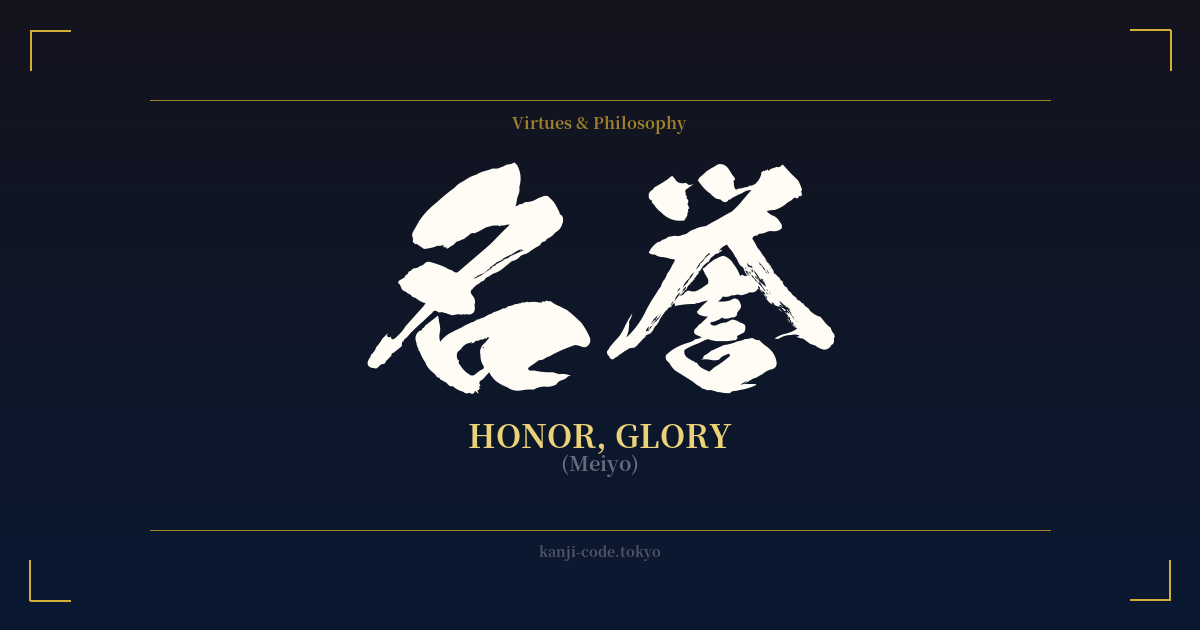
✍️ 名誉 (Meiyo) — Cultural Context
名誉 (Meiyo) translates to 'honor' or 'glory,' but its cultural depth extends far beyond a simple dictionary definition. In Japan, Meiyo is a cornerstone concept, representing not just personal integrity but also one's public reputation, social standing, and the dignity of the groups one belongs to—family, company, or country.
Historically, Meiyo is inextricably linked with the samurai and their code of Bushido. For a warrior, honor was more valuable than life itself. It was built upon a foundation of loyalty (忠義, Chūgi), righteousness (義, Gi), and sincerity (誠, Makoto). A samurai's name (名) was the vessel of his honor, and any action that brought praise (誉) enhanced it. Conversely, losing honor, or bringing shame upon one's name, was the ultimate failure, a fate from which the ritual of seppuku was often seen as the only escape to restore it in death.
The very structure of the word reveals this nuance. The first kanji, 名 (na), means 'name' or 'reputation.' The second, 誉 (yo), means 'praise,' 'glory,' or 'acclaim.' Together, they form a concept that can be understood as 'the glory and praise associated with a distinguished name.' This highlights the external, social aspect of Japanese honor; it is something that is perceived and acknowledged by others.
This contrasts with some Western notions of honor, which can be more individualistic and internal—a matter of personal conscience. In Japan, while personal integrity is vital, Meiyo is fundamentally tied to how one is viewed within the community. An action is honorable not just because it feels right, but because it upholds the standards and expectations of society.
In modern Japan, the concept of Meiyo persists, though its expression has evolved. It's seen in the deep sense of responsibility an employee feels towards their company's reputation, the pride taken in national achievements, and the legal concept of 'meiyo kison' (名誉毀損), or defamation—literally 'injury to honor.' It is a word that commands respect, evoking a sense of dignity, duty, and the enduring weight of one's name in the world.
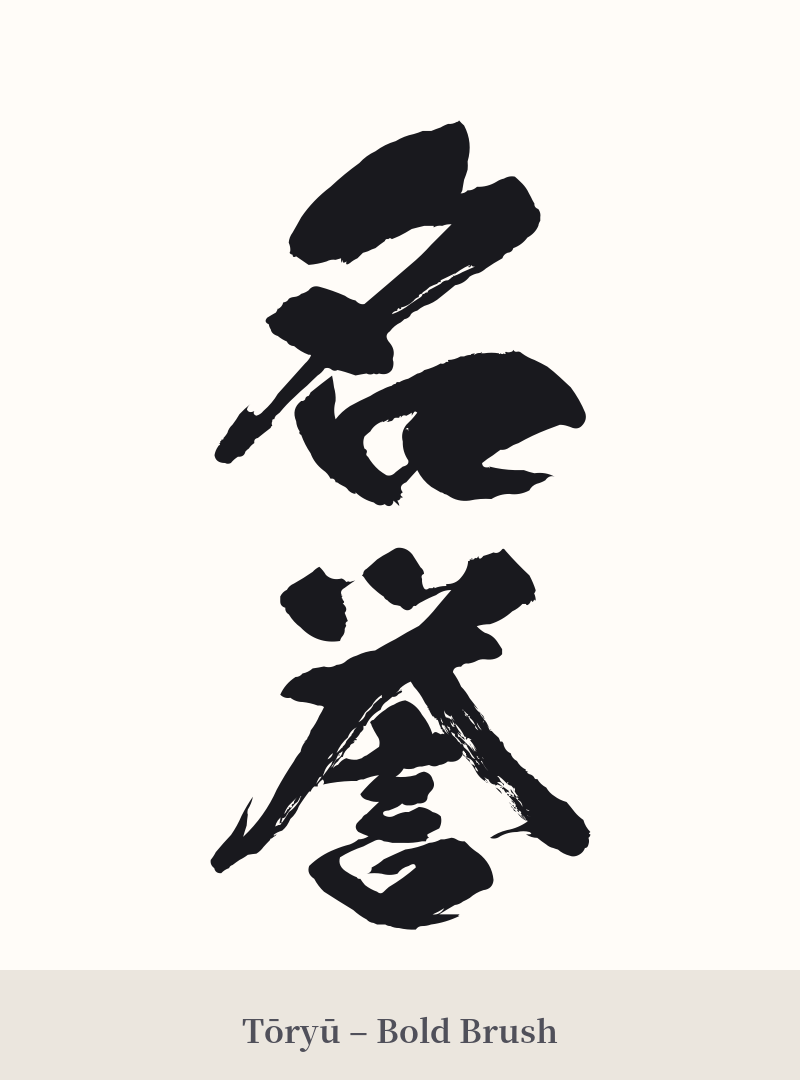
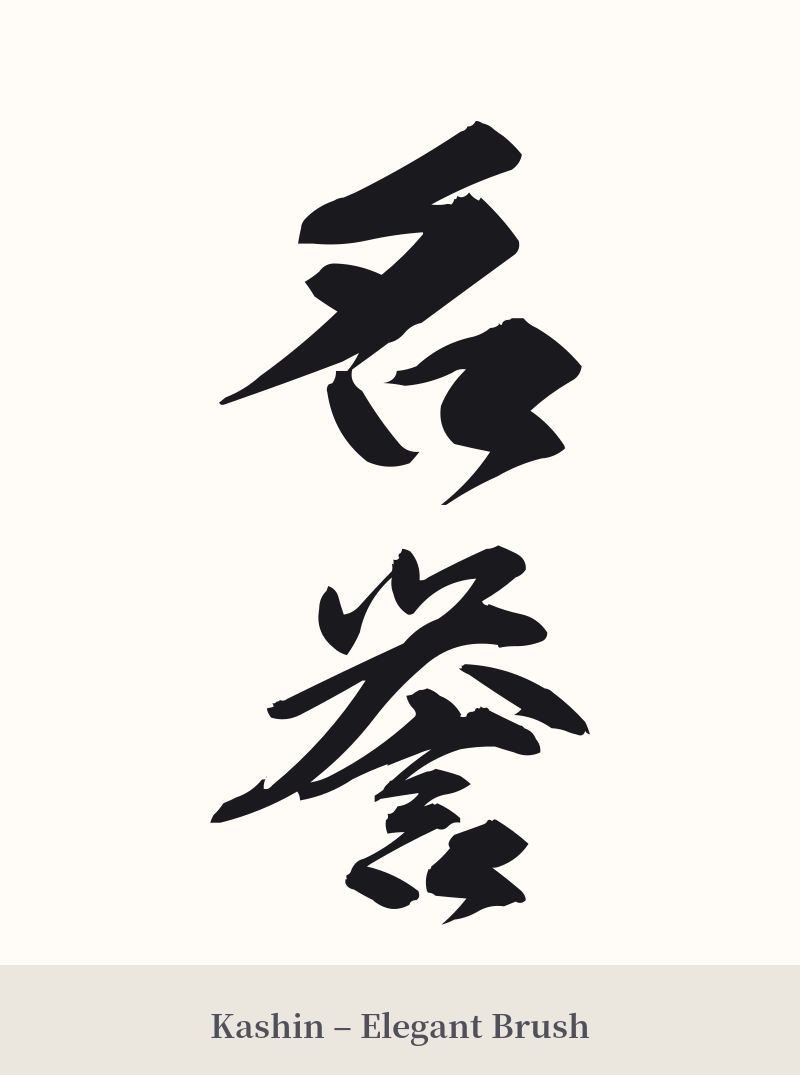
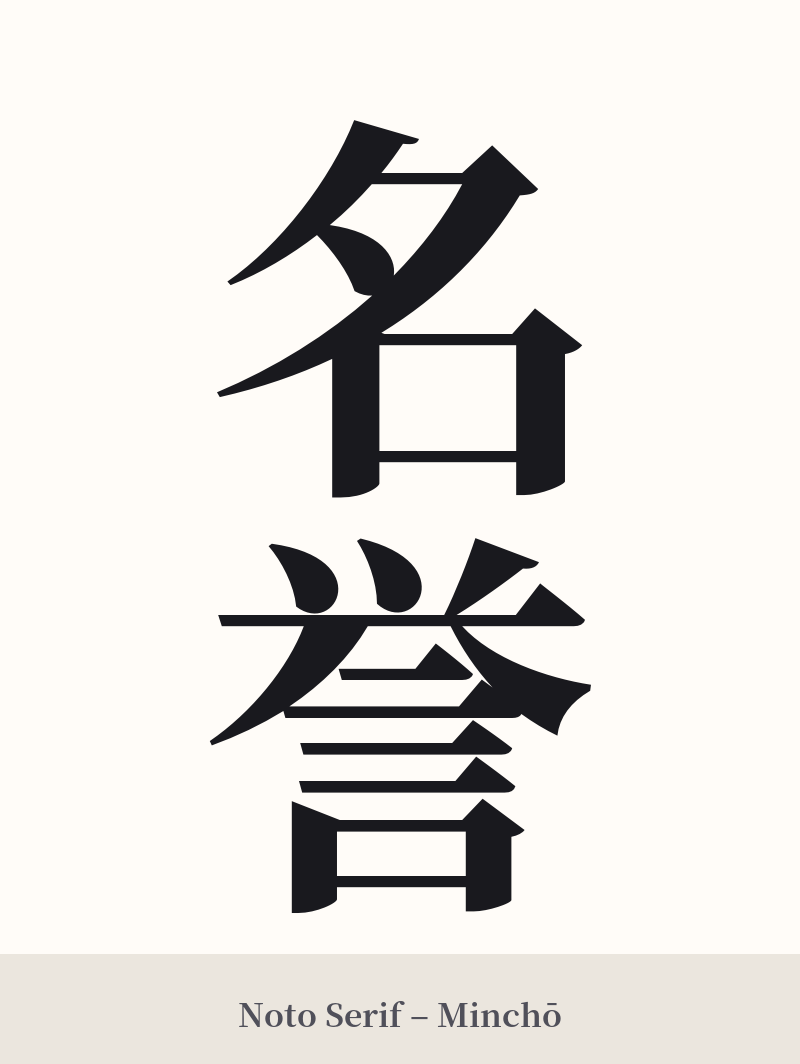
🖌️ Font Styles for 名誉
The same kanji can look dramatically different depending on the calligraphy style. Choose a font that matches the mood you want for your tattoo or design.
🎨 Tattoo Suitability
📐 Tattoo Design Guide
The two-character nature of 名誉 (Meiyo) offers great design flexibility. It is a word that looks powerful in both traditional and modern styles.
– Placement: For a traditional look, a vertical orientation is classic. This works well along the forearm, bicep, calf, or flowing down the spine. A horizontal placement is also strong across the chest, upper back, or below the collarbone.
– Font Style: To honor its historical roots, consider a dynamic brush script like Gyosho (semi-cursive) or Sosho (cursive). These styles evoke a sense of movement and artistry. For a bolder, more stoic statement, a crisp Kaisho (block script) font provides clarity and strength.
– Visual Elements: Meiyo pairs well with other classic Japanese motifs. Consider incorporating it with a samurai helmet (kabuto) to directly reference Bushido, a branch of cherry blossoms to symbolize the transient but beautiful nature of life and honor, or a stoic dragon to represent strength and wisdom.
Comments