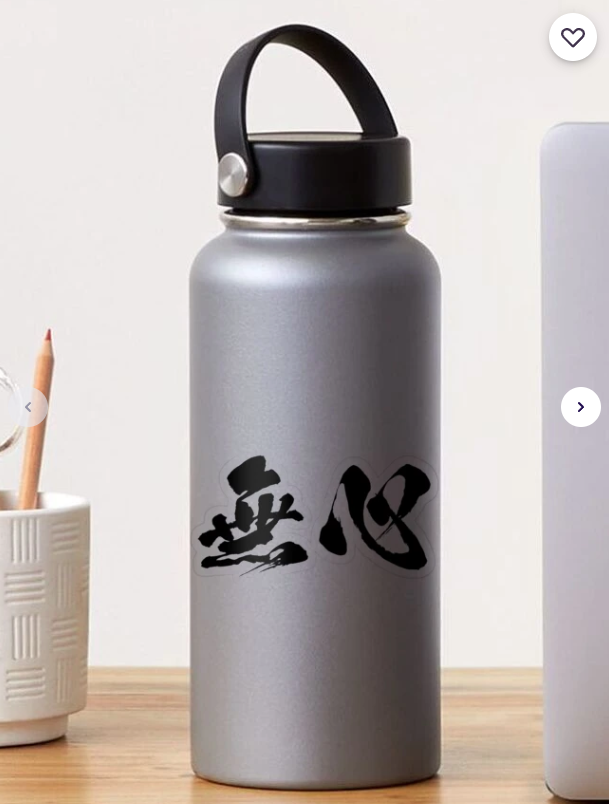
無心
No Mind
The paradox that masters spend lifetimes chasing: a mind so completely present it disappears, leaving only pure action flowing like water.
Imagine standing before an opponent, blade raised, your survival depending on the next half-second. Your conscious mind—the voice analyzing, predicting, fearing—would get you killed. Thought takes time. Time you don’t have. The only path to victory requires something that sounds impossible: acting without thinking, responding without deciding, moving before your brain catches up.
That’s 無心 (mushin). Not mindlessness or unconsciousness, but a state where the analyzing, judging, ego-driven aspects of mind temporarily vanish, leaving awareness so clear and reactions so immediate that action and perception merge. Zen masters brought this concept from meditation halls into martial arts training, creating a philosophy where spiritual enlightenment and deadly combat technique use identical mental states.
The compound combines 無 (mu, nothingness) with 心 (shin, heart/mind), but the translation “no mind” misleads Western ears. It doesn’t mean your mind shuts off. It means your mind stops interfering with itself—no fear blocking courage, no analysis paralyzing instinct, no ego distorting perception. You become a perfect mirror reflecting reality instantly, responding without the lag time conscious thought introduces. Athletes call it “the zone.” Psychologists call it “flow state.” Samurai called it the difference between living and dying.
✨ Kanji Styles Gallery
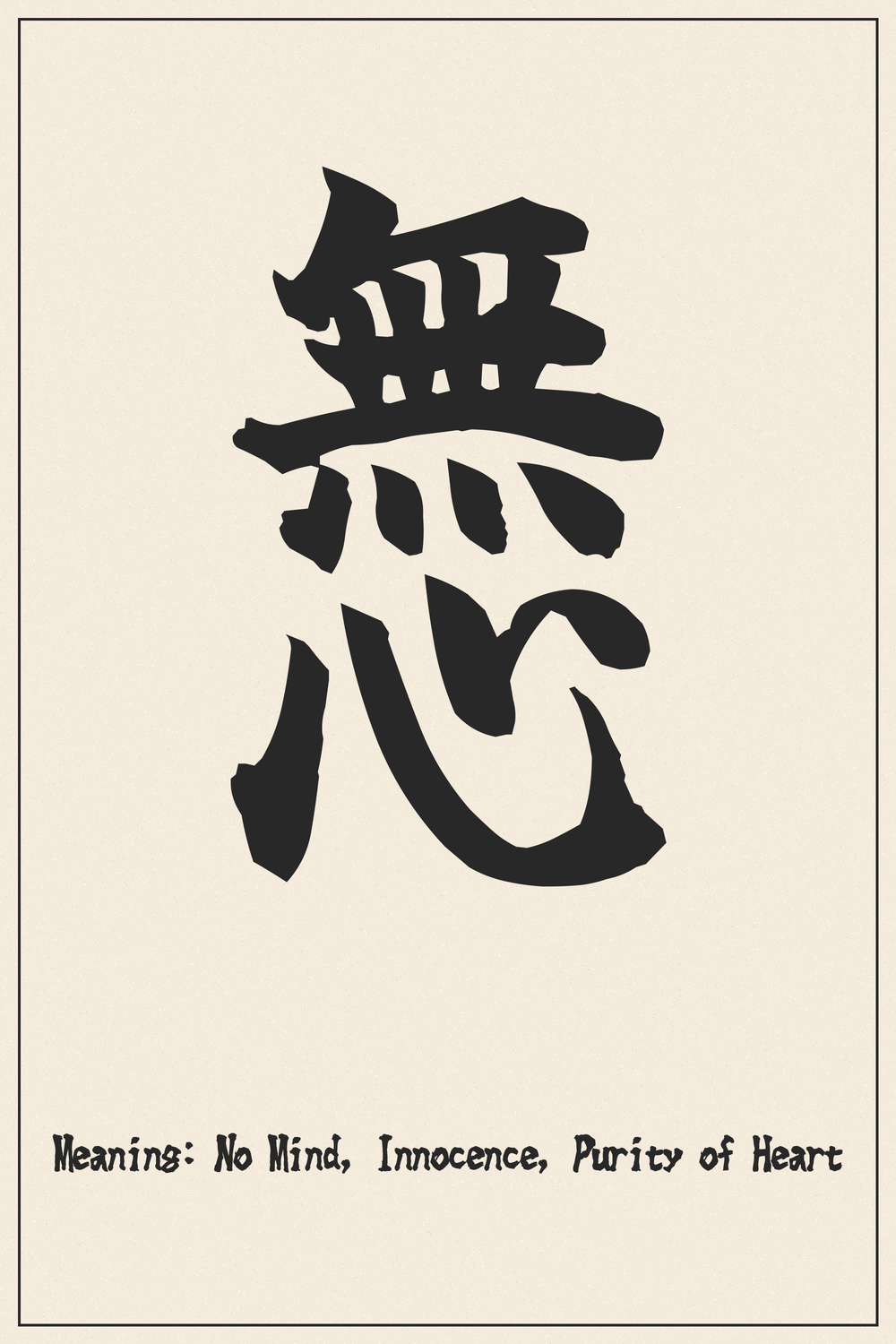
🖌️ Calligraphy Style
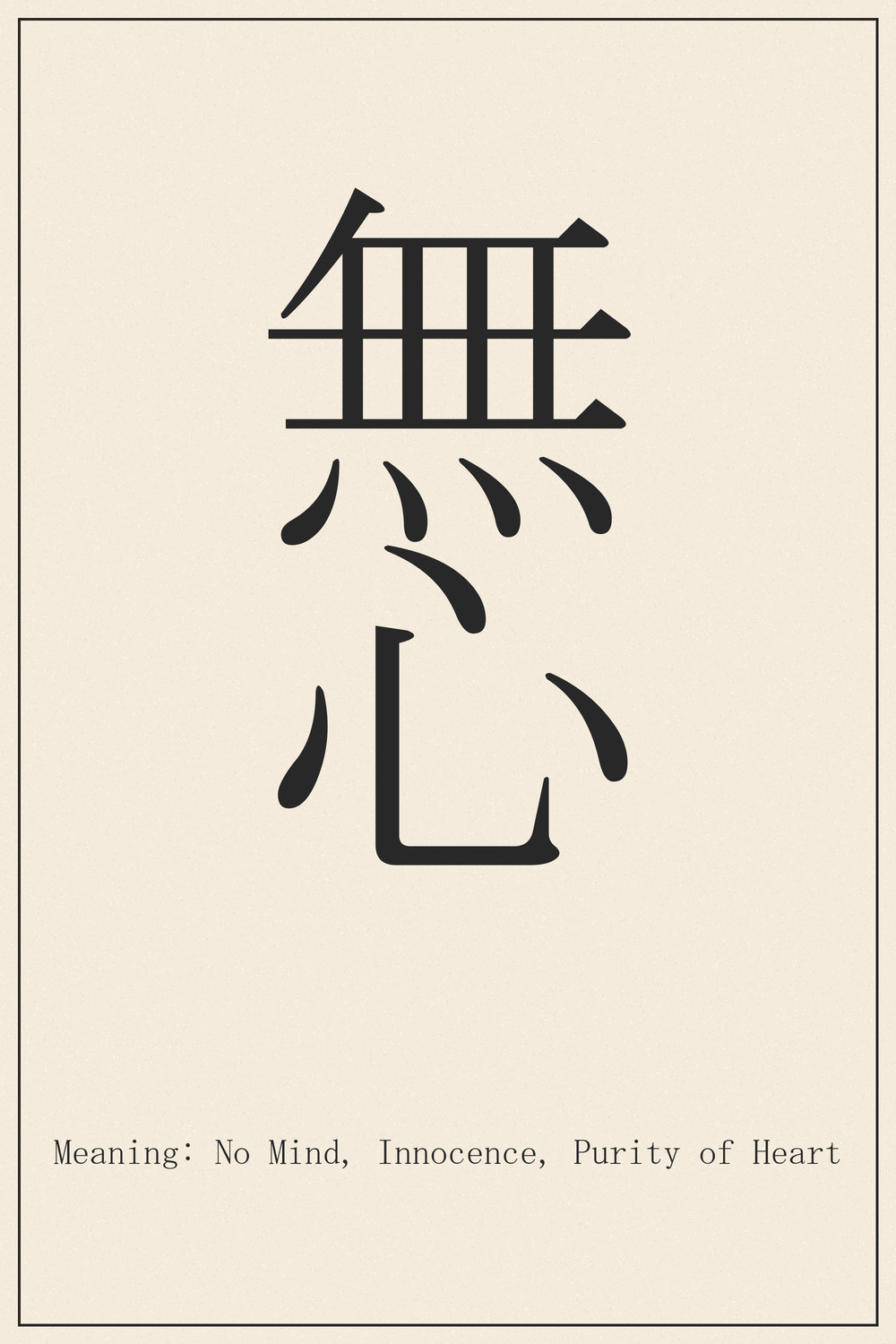
📝 Mincho Style
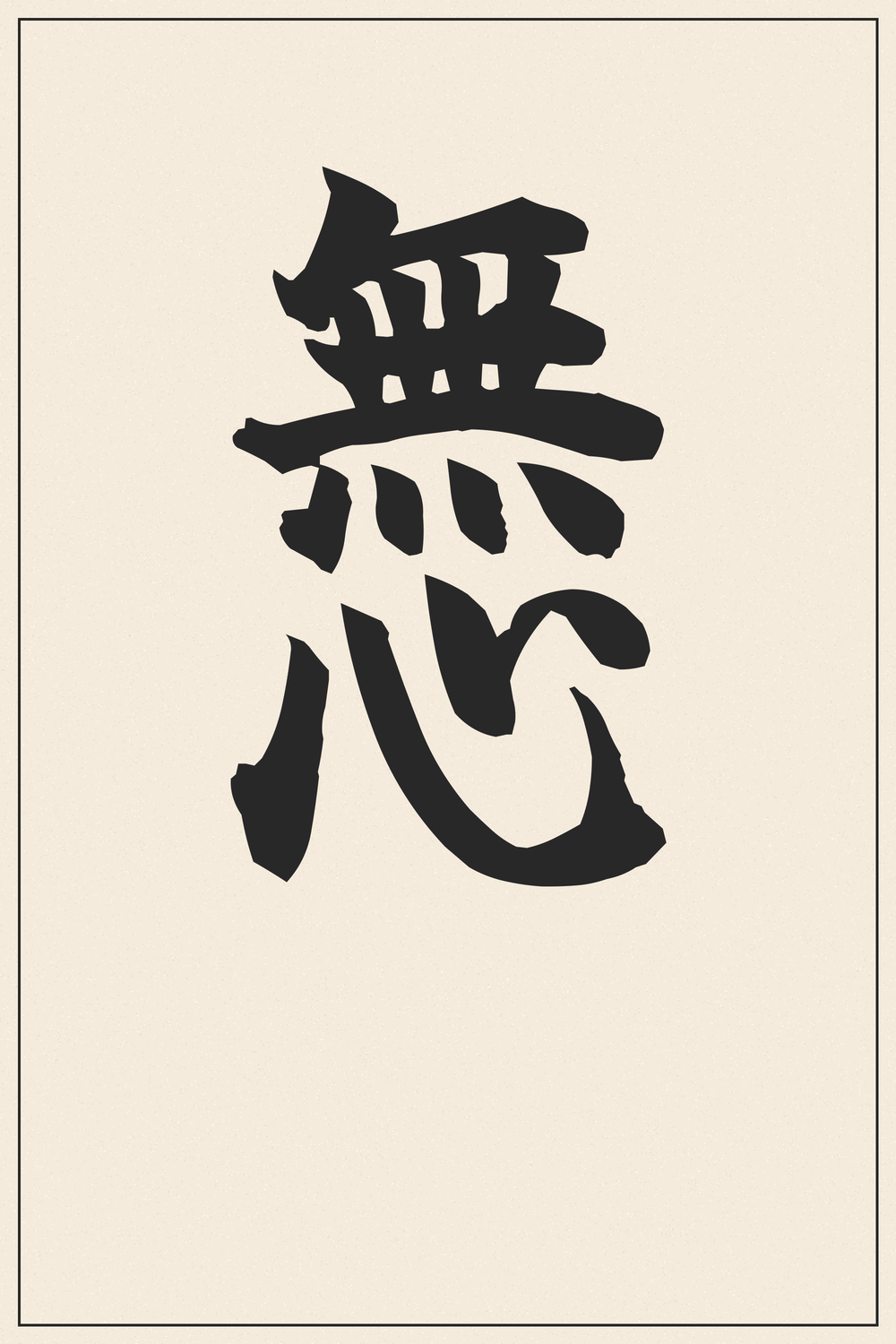
📜 Vertical Writing
⚡ Quick Facts
Breaking Down 無 (Mu)
The character 無 ranks among the most philosophically loaded kanji in Japanese writing. Its ancient form showed a shaman or dancer performing rituals with ceremonial implements over fire—actions causing things to disappear, vanish, or transform into absence. That concrete image of making something cease to exist evolved into representing the abstract concept of nothingness itself.
But 無 in Zen Buddhism doesn’t mean simple emptiness or void. It represents a state beyond binary opposites of existence and non-existence, presence and absence. The famous Zen koan “Does a dog have Buddha nature? Mu!” uses this character not as “no” but as a rejection of the question’s framework—Buddha nature exists outside categories where “yes” and “no” make sense.
In practical terms, 無 appears in countless compound words: 無理 (muri, impossible), 無限 (mugen, infinite), 無意味 (muimi, meaningless). Each suggests absence—of reason, limits, or meaning respectively. But in 無心, it points to the productive absence of mental interference, the liberating emptiness where ego and fear usually sit, leaving room for pure awareness and spontaneous action.
Zen masters emphasize that 無 doesn’t mean “nothing exists.” It means attachment to fixed ideas of existence creates suffering. When you achieve mu-mind, you don’t become a vegetable. You become fully awake—more aware than when your consciousness was cluttered with running commentary about everything happening.
Breaking Down 心 (Shin)
The character 心 is a pictogram—ancient scribes literally drew a heart, the organ they believed housed consciousness, emotion, and spirit. Unlike Western tradition separating mind (rational) from heart (emotional), Japanese philosophy treats them as unified. 心 represents the totality of consciousness: thoughts, feelings, intentions, awareness, the entire subjective experience of being human.
This character appears in emotional vocabulary throughout Japanese: 安心 (anshin, peace of mind), 決心 (kesshin, determination), 感心 (kanshin, admiration), 親切 (shinsetsu, kindness—literally “parent-heart”). Each compound uses 心 to access different aspects of inner experience. The character acknowledges that consciousness isn’t just cold logic—it’s the warm, messy, complicated totality of being aware and alive.
In 無心, this rich, complex heart-mind temporarily releases its usual patterns—the narratives, judgments, fears, and desires that normally drive behavior. What remains isn’t emptiness but pure presence: awareness without the filter of self-centered thinking, perception without distortion from expectation or anxiety. The heart still beats. The mind still processes. But the interference pattern causing hesitation and doubt dissolves.
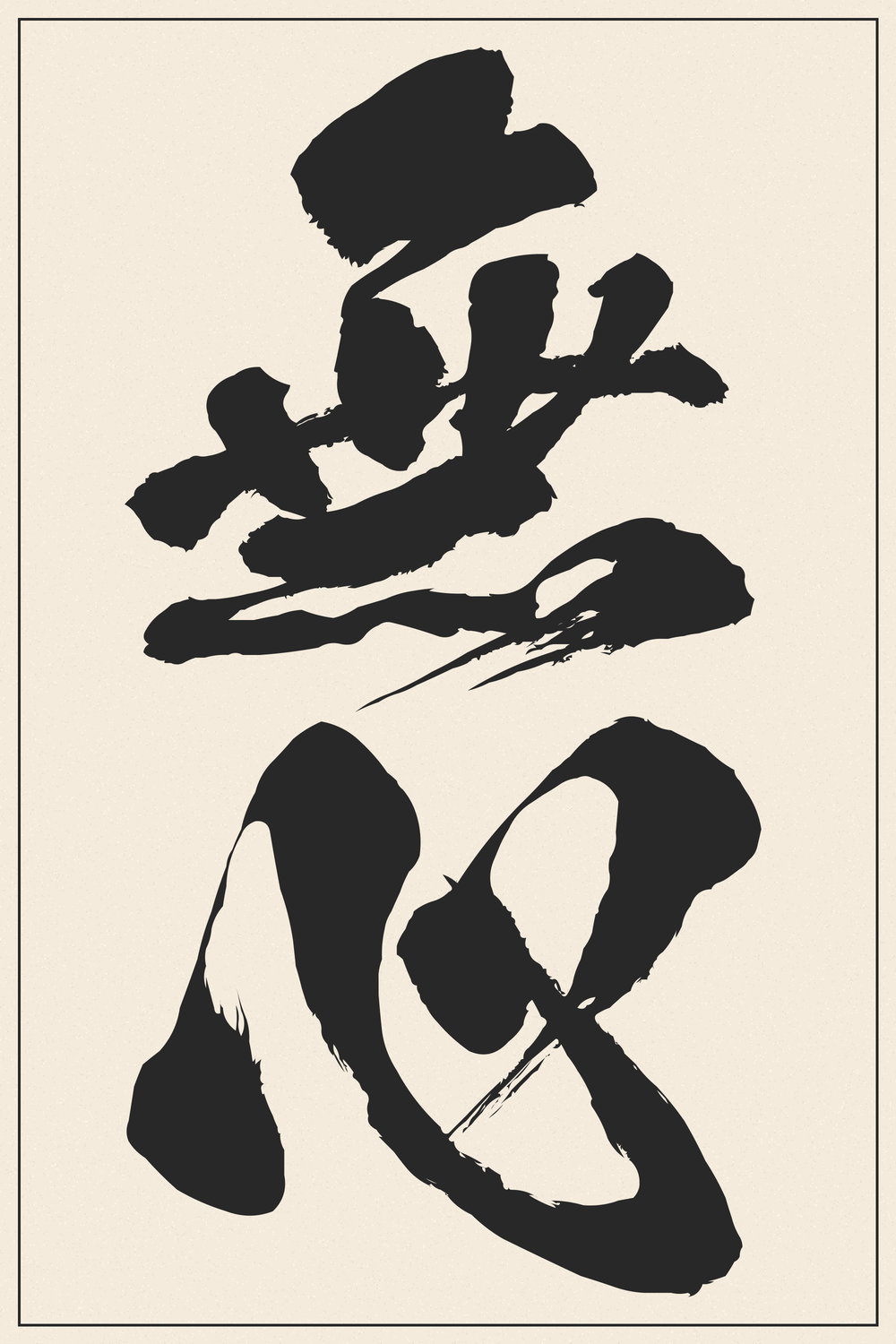
The paradox written in ink: emptiness that contains everything
Mushin in the Martial Arts
Sword master Takuan Soho wrote to samurai swordsman Yagyu Munenori in the 1600s explaining mushin through combat scenarios. If you focus on your opponent’s sword, you become blind to his feet. If you watch his eyes, you miss his hands moving. If your mind “stops” anywhere—fixating on any single element—you create vulnerability. The solution? Mushin—a mind that flows everywhere simultaneously, attaching nowhere specifically.
In kendo (Japanese fencing), students train for years to achieve mushin in combat. Beginners think about each movement: “Should I strike? Is my stance correct? What if he counters?” That internal dialogue creates fatal delays. Advanced practitioners move before deciding to move. The opening appears, the strike happens, then conscious awareness catches up a fraction of a second later recognizing “I struck.” Action precedes thought.
This isn’t mystical magic. It’s neuroscience. Conscious decision-making routes through the prefrontal cortex, introducing processing delays. Well-trained muscle memory stored in the basal ganglia and cerebellum bypasses that bottleneck, allowing reactions faster than conscious thought permits. Mushin training essentially rewires your brain to trust unconscious competence, letting practiced responses emerge without executive interference.
Martial arts texts compare mushin to water—perfectly reflecting what’s in front of it without distortion, flowing around obstacles without resistance, powerful yet adaptable. Water doesn’t “think” about how to fill a container. It just does. That’s the quality mushin cultivates: natural, effortless response to whatever reality presents.
Beyond Combat: Mushin Everywhere
Japanese calligraphers chase mushin when they brush characters onto paper. The moment you think “This stroke needs to curve more,” you’ve already ruined it. The brush moved while you were thinking. Perfect calligraphy emerges when years of training condense into spontaneous gesture—hand, brush, ink, and paper becoming one fluid motion without the artist’s ego directing traffic.
Tea ceremony masters pursue mushin through ritualized movement. Hundreds of precise actions—heating water, scooping tea powder, whisking, serving—must flow seamlessly without conscious direction. Students practice until the ceremony performs itself through them. The practitioner becomes a channel for tradition, ego stepping aside, allowing perfect form to manifest naturally.
Modern athletes describe identical experiences without using Japanese terms. Basketball players talk about the ball feeling like it’s on a string, every shot dropping effortlessly. Rock climbers describe becoming the rock, no separation between climber and wall. Musicians discuss disappearing into the music, hands playing while consciousness watches in wonder. They’re all describing mushin—that state where skill becomes so embodied that conscious control becomes unnecessary and counterproductive.
The Paradox of Trying
Here’s where mushin gets philosophically tricky: you can’t achieve it by trying to achieve it. The moment you think “I’m going to enter mushin now,” you’ve created the exact mental interference mushin dissolves. It’s like trying to relax by commanding yourself to relax—the trying itself prevents the state you’re seeking.
Zen masters handle this paradox through indirect methods. They don’t teach mushin directly. They assign impossible koans that exhaust rational thinking. They enforce brutal physical training that pushes students beyond conscious control into instinctive response. They create conditions where mushin becomes the only option, then step back and let it emerge naturally when the ego finally gives up trying to force outcomes.
Western psychology stumbled into similar territory studying flow states. Researcher Mihaly Csikszentmihalyi found people enter flow through challenging activities matching their skill level—tasks difficult enough to demand full attention but achievable enough to avoid overwhelming anxiety. Flow emerges from conditions, not from wanting it. Mushin works identically. You prepare through training, then surrender to the moment and let competence express itself.
Zen teaches shoshin (初心, beginner’s mind)—approaching everything with fresh eyes, no preconceptions. This connects to mushin because experts often accumulate mental baggage that blocks flow. Sometimes mastery requires returning to the openness you had as a beginner, before you knew enough to be afraid or self-conscious.
🎨 Tattoo Design Ideas
- ✨ Bold Minimalist Statement – Two characters in stark, clean brushwork with no embellishment. The simplicity mirrors the concept—no unnecessary elements, just essential form. Perfect for 3-5 inch placements on inner forearm, chest, or upper back where the characters command attention through clarity.
- ✨ Flowing Calligraphy Style – Traditional brushwork with visible texture and natural imperfections captures the spontaneous, unforced quality of mushin itself. The strokes should feel effortless, not labored. Best for larger placements (5-7 inches) where calligraphic nuance remains visible.
- ✨ Circular Ensō Integration – Place 無心 inside or beside a Zen ensō circle (the single brushstroke circle representing enlightenment). The circle contextualizes the characters within Zen philosophy while creating balanced composition. The ensō should complement, not overpower the kanji.
- ✨ Vertical Scroll Format – Traditional top-to-bottom arrangement along spine or outer forearm. Consider adding subtle water imagery (flowing lines, gentle waves) suggesting the water-mind metaphor without becoming literal or busy. Characters remain focal point.
- ✨ Negative Space Design – Instead of solid black characters, outline the strokes and fill background, creating 無心 in skin-tone negative space. This plays with the concept of emptiness/presence and creates unique visual interest while maintaining readability.
- ✨ Combined with Personal Symbol – Pair 無心 with imagery from your own practice—sword for martial artists, climbing rope for climbers, musical note for musicians. This personalizes the universal concept, showing your specific path to no-mind while honoring traditional meaning.
Who Chooses This Tattoo
Martial artists—particularly those studying Japanese arts like karate, aikido, kendo, or iaido—gravitate toward 無心 as representation of their training’s ultimate goal. It’s not about collecting techniques. It’s about reaching a state where technique disappears into spontaneous, appropriate response. The tattoo becomes permanent reminder that mastery means transcending conscious thought.
Athletes and performers across disciplines choose 無心 because they recognize the state from their own peak experiences. That moment when everything clicks, when you stop trying and start flowing, when performance becomes effortless—they know that feeling even if they never learned the Japanese term for it. The characters give language to experiences beyond language.
But people also select 無心 for psychological and spiritual reasons disconnected from performance. Anyone who’s struggled with anxiety, overthinking, or self-consciousness might choose these characters as aspiration. They represent freedom from the tyranny of the internal critic, the voice constantly judging, analyzing, and second-guessing. 無心 says “I’m working toward a state where I trust myself enough to stop interfering with myself.”
無心 carries serious philosophical weight in Japanese culture. It’s not casual vocabulary—it references deep Zen concepts and high-level martial arts training. Getting this tattoo signals you’re engaging with sophisticated Japanese philosophy, not just picking cool-looking characters. That’s either authentic if you walk the walk, or pretentious if you don’t. Choose accordingly.
Why These Characters Endure
Modern life weaponizes consciousness against itself. We’re encouraged to constantly monitor, optimize, and curate our every action. Social media trains us to view our lives from outside, always conscious of how we appear. Self-help culture pushes relentless self-improvement through willpower and effort. The result? Epidemic levels of anxiety, depression, and burnout from minds that never stop interfering with themselves.
無心 offers counternarrative developed centuries before Instagram and productivity apps. It suggests the path forward isn’t more control but strategic surrender—learning when to get out of your own way, trusting unconscious competence, allowing trained responses to emerge without micromanagement. That wisdom grows more relevant as technology increases our capacity for self-monitoring and self-criticism.
The characters endure because the fundamental human challenge hasn’t changed. Whether you’re a medieval samurai facing death or a modern professional facing a presentation, the obstacle remains identical: your own mind creating interference through fear, doubt, and self-consciousness. 無心 points toward the solution—not eliminating mind but temporarily suspending its tendency to obstruct itself. That’s a skill worth pursuing in any era, worth tattooing as permanent commitment to the practice.
Comments