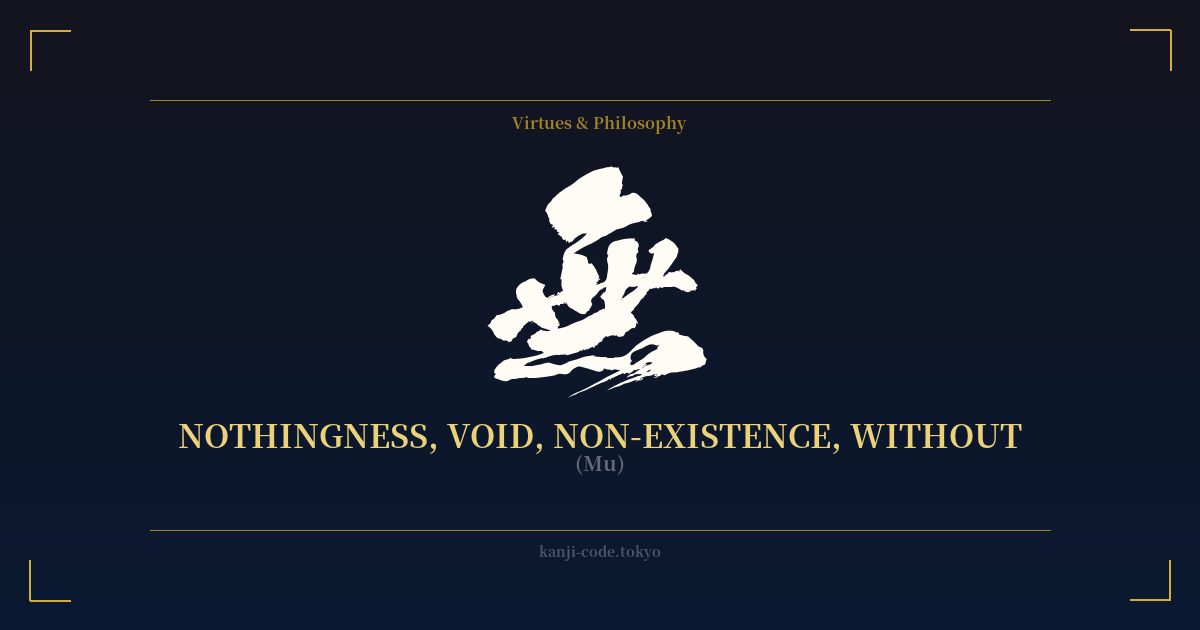
✍️ 無 (Mu) — Cultural Context
The kanji 無, read as 'Mu,' is one of the most profound and philosophically charged characters in the Japanese language. On the surface, it functions as a prefix meaning 'without,' 'non-,' or 'un-,' appearing in everyday words like 無料 (muryō, free of charge) or 無理 (muri, impossible). However, its true power lies in its role as a cornerstone of Zen Buddhist thought.
In Zen, 無 is not simply a negation or an absence. It is an answer that transcends the limits of language and dualistic thinking. This is famously illustrated in a foundational kōan (a paradoxical riddle used for meditation) from the 12th-century text, the Mumonkan (The Gateless Gate). A monk asks the great master Jōshū, 'Does a dog have Buddha-nature?' Jōshū’s reply is a single, powerful word: '無 (Mu)!'
This 'Mu' is not 'no.' It is a rejection of the question itself, which is based on the false premise of a 'yes' or 'no' reality. It's a conceptual hammer intended to shatter the student's ordinary patterns of thought, which categorize the world into opposites: being and non-being, having and not having, good and bad. Mu points to a reality that exists before and beyond these labels—a state of pure, unconditioned potential.
This concept is closely related to, but distinct from, 空 (kū), or emptiness (śūnyatā in Sanskrit). While Kū describes the fundamental nature of reality as being empty of inherent, independent existence, Mu is often the practice, the gate, or the very tool used to achieve the realization of that emptiness. It is the act of 'un-asking' the question, 'un-thinking' the thought, and resting in the silent awareness that remains.
Beyond Zen, this idea permeates other aspects of Japanese culture, particularly in the martial arts. The concept of 無心 (mushin), or 'no-mind,' describes the ideal state for a warrior. It is a state of fluid action and reaction without the interference of the conscious, hesitating ego. The mind is empty of fear, anger, and calculation, allowing the body to move with perfect instinct and grace. In this context, 無 is not an emptiness of ability, but an emptiness of the thoughts that hinder it.
Therefore, to embrace the kanji 無 is to embrace a philosophy of letting go. It is a symbol for transcending the ego, freeing oneself from the prison of dualistic thought, and tapping into a deeper, more intuitive state of being. It represents not a desolate void, but a fertile emptiness from which all things can arise.
🖌️ Font Styles for 無
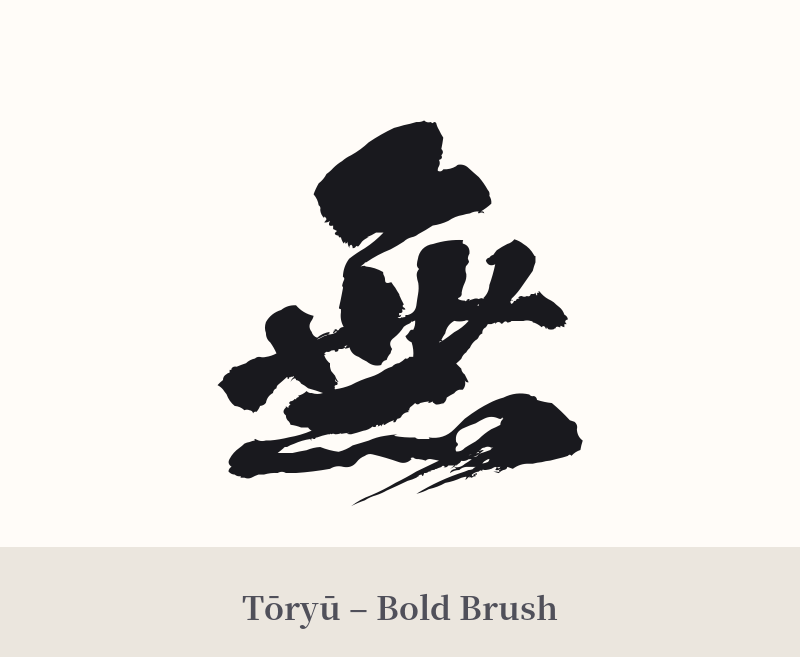
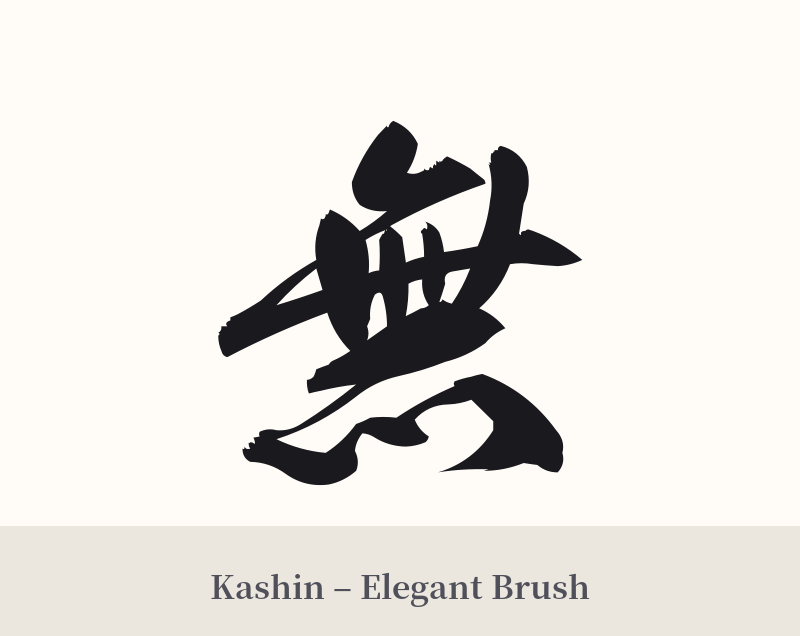
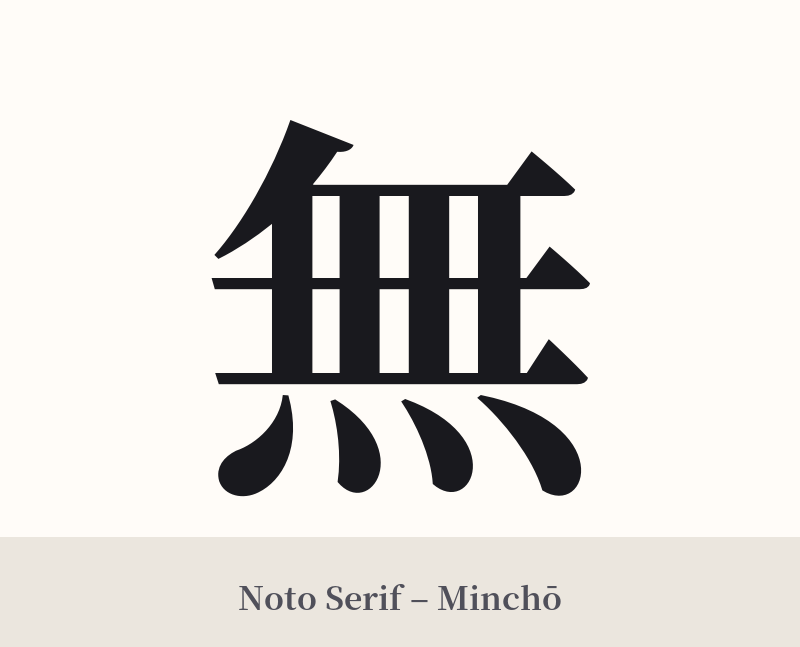
The same kanji can look dramatically different depending on the calligraphy style. Choose a font that matches the mood you want for your tattoo or design.
🎨 Tattoo Suitability
📐 Tattoo Design Guide
The kanji 無 is a powerful and visually striking character, making it an excellent centerpiece for a tattoo. Its balance of straight lines and the distinctive four dots at the bottom offers a lot of stylistic flexibility.
– Placement: For a personal and contemplative tattoo, consider the inner forearm, the ribs, or over the heart. For a bolder statement of philosophy, the center of the back or the chest allows for a larger, more impactful rendering.
– Font Styles: The style you choose can dramatically alter the feeling of the tattoo. A strong, clear Kaisho (block) script emphasizes its definitive and absolute nature. In contrast, a fluid and expressive Sōsho (cursive) style can capture the elusive, transcendent quality of the concept, making the character feel like a fleeting thought captured in ink.
– Visual Complements: While 無 stands powerfully on its own, it can be paired with other elements. Placing it within an Ensō (Zen circle) is a classic choice, visually linking the 'nothingness' of Mu with the 'everythingness' and perfection of the circle. Another idea is to have the ink look as if it were applied with a single, powerful brushstroke, fading or splashing at the edges to evoke a sense of impermanence and motion.
Comments