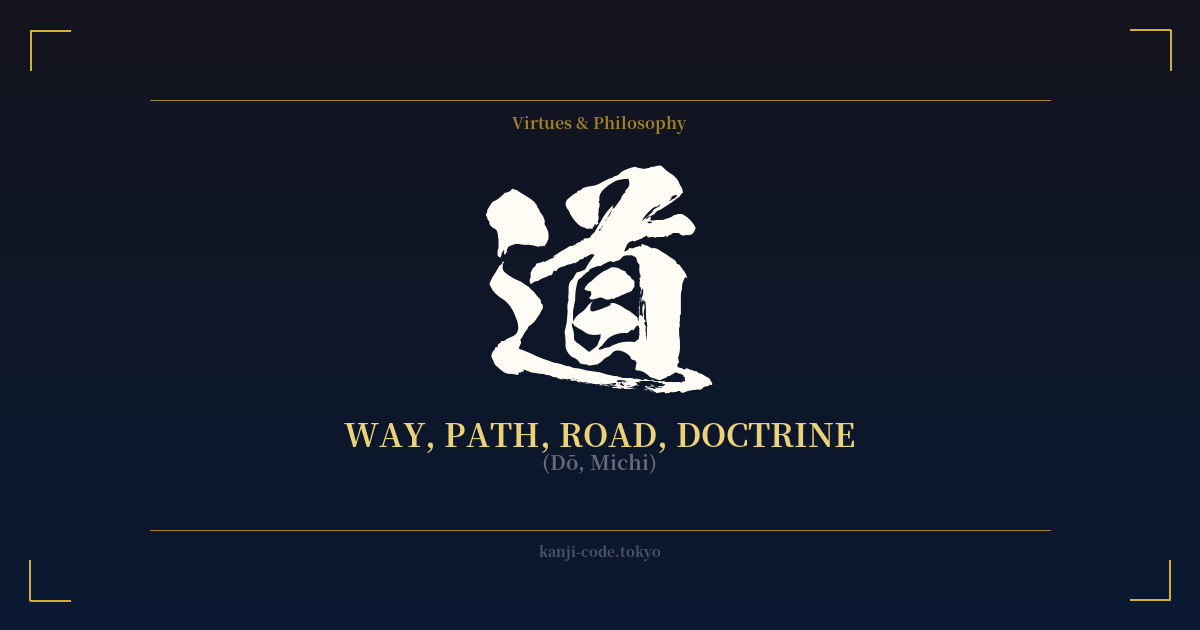
✍️ 道 (Dō, Michi) — Cultural Context
The kanji 道 is one of the most significant and layered characters in the Japanese language, carrying a weight that extends far beyond its literal translation. At its most basic, read as 'michi,' it means a physical road, path, or street. It’s the 'michi' you walk on every day, the route you take to work, the trail you follow through a forest. This tangible meaning provides the foundation for its much deeper, philosophical significance.
When read as 'Dō,' the character transforms into a concept central to East Asian philosophy, largely inherited from Chinese Taoism (the character is the same for 'Tao'). In this context, 'Dō' is the 'Way'—an underlying natural order of the universe, a principle that is the source, pattern, and substance of everything that exists. It is a path of enlightenment, a spiritual journey, and a code of conduct.
In Japan, this concept of 'Dō' was seamlessly integrated into various cultural and spiritual practices, most notably in the martial arts. The suffix '-dō' is attached to numerous disciplines to signify that they are not merely combat techniques but a 'Way' of life and self-development. For example, Jūdō (柔道) is the 'Gentle Way,' Kendō (剣道) is the 'Way of the Sword,' and Aikidō (合気道) is the 'Way of Harmonizing with Spirit.' The goal is not just to defeat an opponent, but to perfect one's character through rigorous training and discipline.
This principle extends beyond the dojo. Sadō (茶道), the 'Way of Tea,' elevates the simple act of preparing and serving tea into a meditative art form focused on harmony, respect, purity, and tranquility. Shodō (書道), the 'Way of Calligraphy,' is a spiritual practice where the artist connects with the characters through breath, movement, and ink. Even Bushidō (武士道), the 'Way of the Warrior,' was a comprehensive code that governed the samurai's entire existence, emphasizing loyalty, honor, and self-discipline.
Choosing the kanji 道 is to embrace this duality. It represents both the physical journey and the spiritual one. It is a symbol of purpose, discipline, and the continuous search for a higher understanding of oneself and the world. It reminds us that the path itself is as important, if not more so, than the destination.
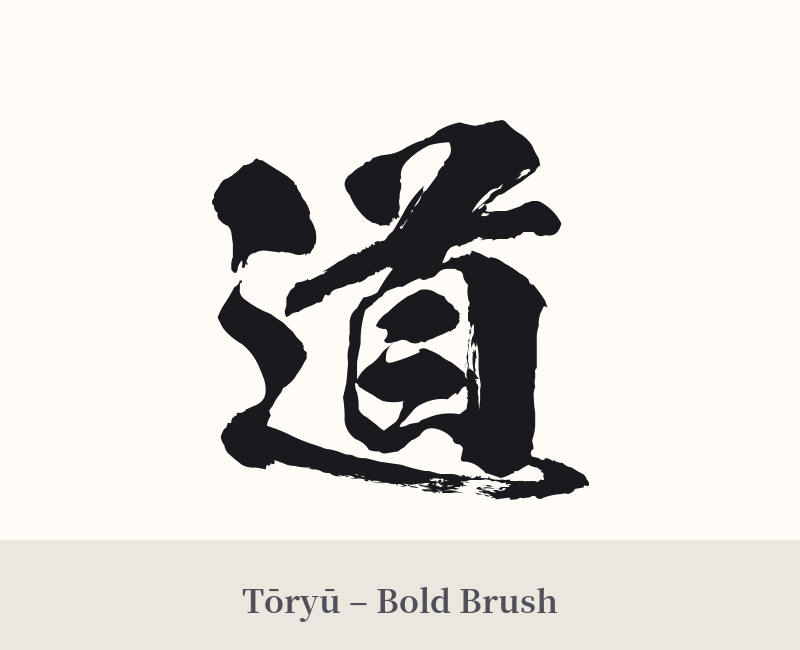
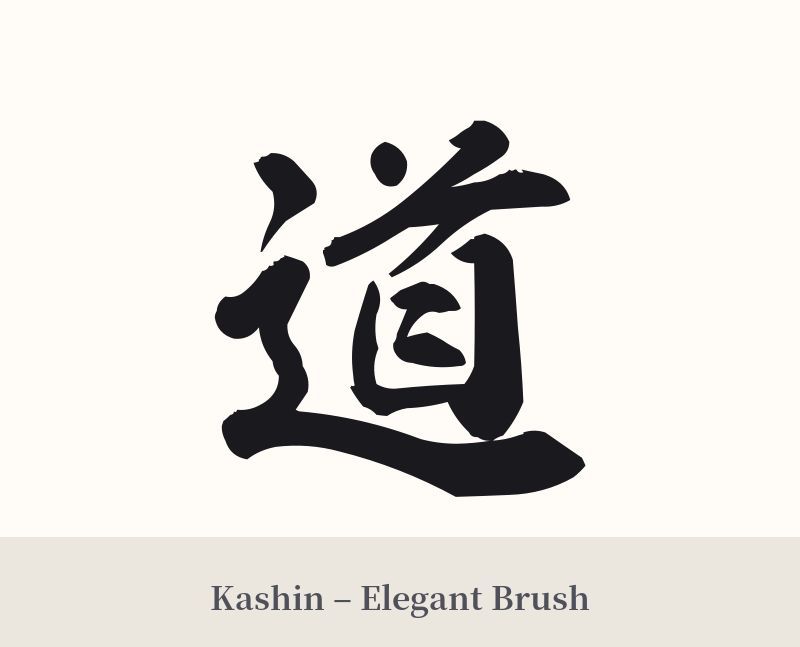
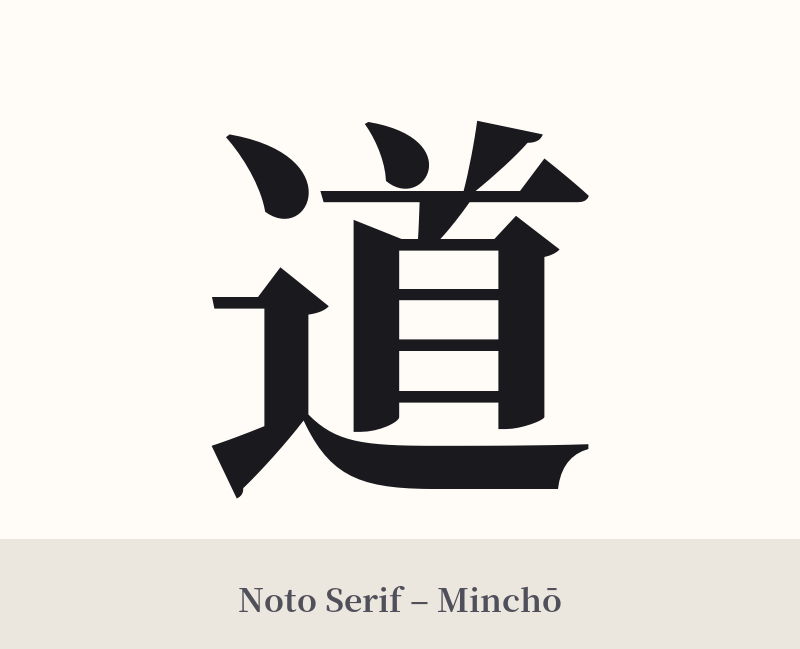
🖌️ Font Styles for 道
The same kanji can look dramatically different depending on the calligraphy style. Choose a font that matches the mood you want for your tattoo or design.
🎨 Tattoo Suitability
📐 Tattoo Design Guide
The kanji 道 is a powerful and versatile choice for a tattoo, suitable for various placements and styles.
– Placement: It works exceptionally well in vertical orientations. Consider the forearm, allowing the character to flow with the arm's length. The calf is another excellent choice. For a more central and impactful statement, the space between the shoulder blades or the center of the chest provides a strong canvas.
– Font Style: The choice of script can dramatically alter the feeling. A bold, clean Kaisho (block) style emphasizes its meaning of 'doctrine' and 'discipline.' A more fluid Gyōsho (semi-cursive) style can represent the idea of a 'journey' or 'path' in motion. For a highly artistic and abstract feel, a Sōsho (cursive) script can be beautiful, though it may be less legible to the untrained eye.
– Visual Tips: While 道 is powerful enough to stand alone, it can be integrated into a larger piece. It pairs well with an Enso circle (symbolizing enlightenment and the void), natural elements like mountains or a winding river to represent the physical path, or a lotus flower to signify purity and spiritual growth.
Comments