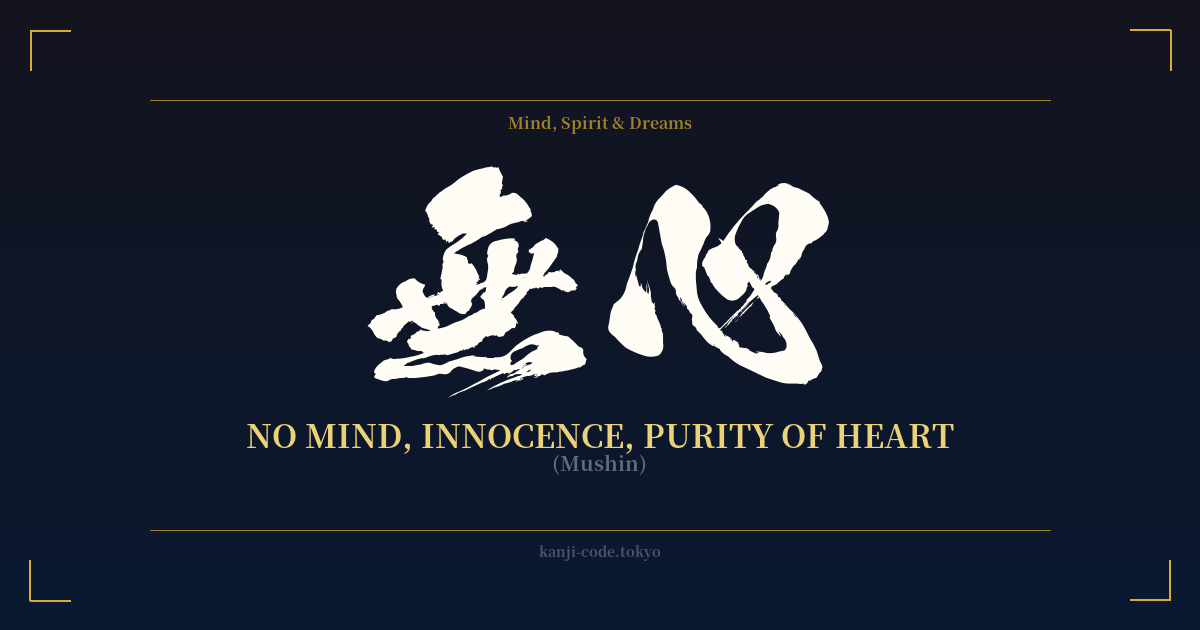
✍️ 無心 (Mushin) — Cultural Context
無心 (Mushin) is a Japanese concept that translates literally as 'no mind.' However, this simple translation is deeply misleading. It does not mean an empty head or a lack of thought, but rather a mind free from the distractions of anger, fear, or ego. It is a state of effortless action and pure, instinctual response, where the conscious, analytical mind steps aside.
This idea has its roots in Zen Buddhism, where it represents a mind unattached to thoughts and emotions, allowing one to perceive reality as it truly is. A mind in the state of Mushin is not fixed or occupied by any one thing; it flows freely, like water, adapting and responding to the moment without hesitation or internal conflict. It is the mind of a child, open and without prejudice, yet possessed by the master.
Nowhere is the concept of Mushin more critical than in the world of Japanese martial arts, or Budo. For a samurai facing a life-or-death duel, the slightest hesitation born from thought or fear would be fatal. The master swordsman Miyamoto Musashi wrote extensively about achieving a state of 'void' (空, Kū), a concept intrinsically linked to Mushin. In this state, the warrior's body reacts perfectly and instantaneously, their training having become so ingrained that it bypasses conscious deliberation.
The Zen monk Takuan Sōhō, a spiritual advisor to swordsmen, famously described this as the 'unfettered mind.' He warned that if the mind 'stops' on the opponent's sword, on the thought of striking, or on the fear of being struck, it becomes 'fettered' and loses its freedom. Mushin is the liberation of the mind from these fetters, allowing it to permeate the entire body and act with total spontaneity.
In the modern world, this concept is often compared to the 'flow state' or being 'in the zone.' Athletes, musicians, artists, and even programmers describe moments of peak performance where they lose their sense of self and time, becoming completely absorbed in the activity. Their actions feel effortless and perfect. This is the universal experience that Japanese culture has elegantly encapsulated in the word Mushin for centuries.
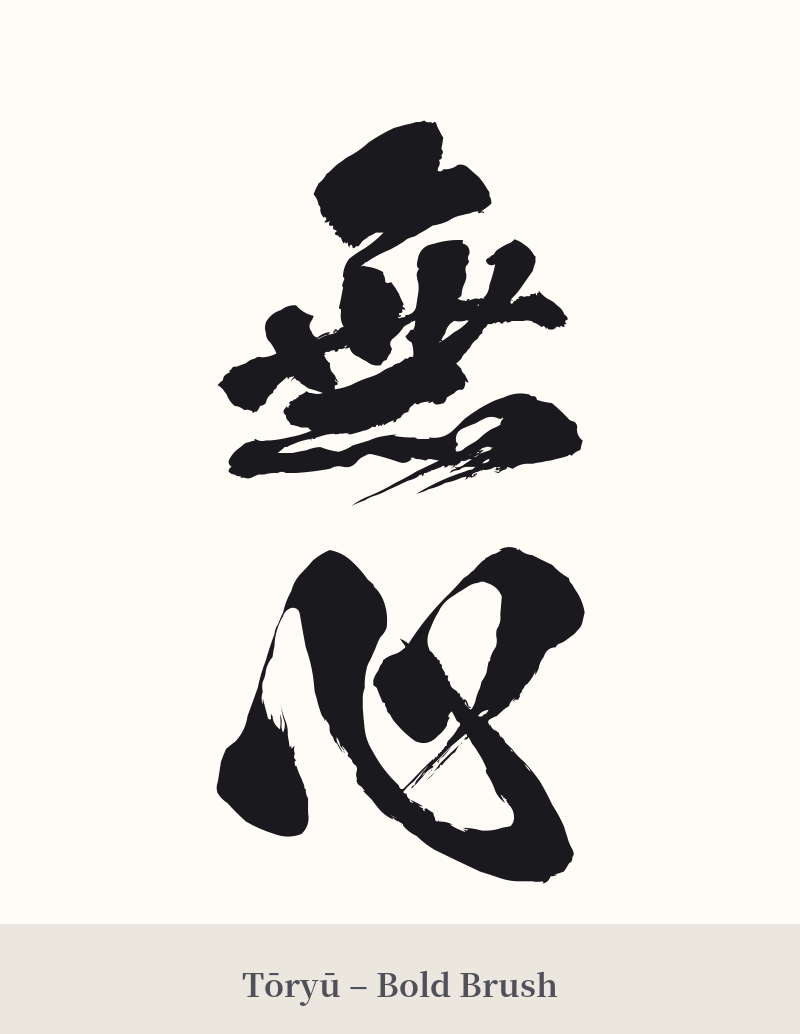
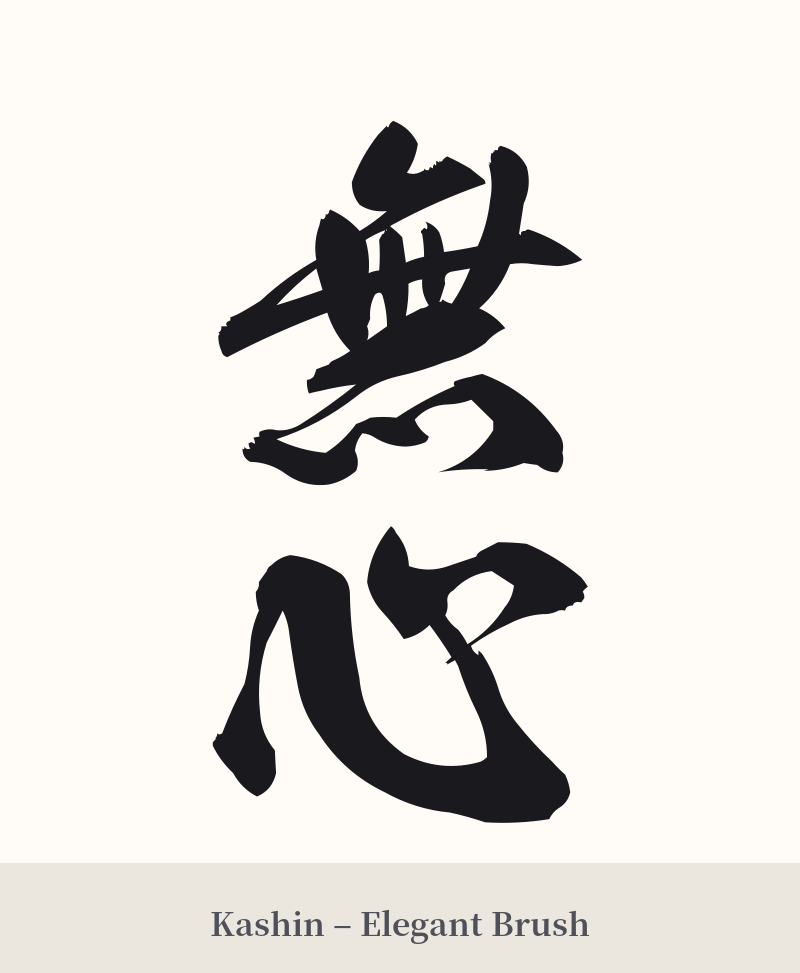
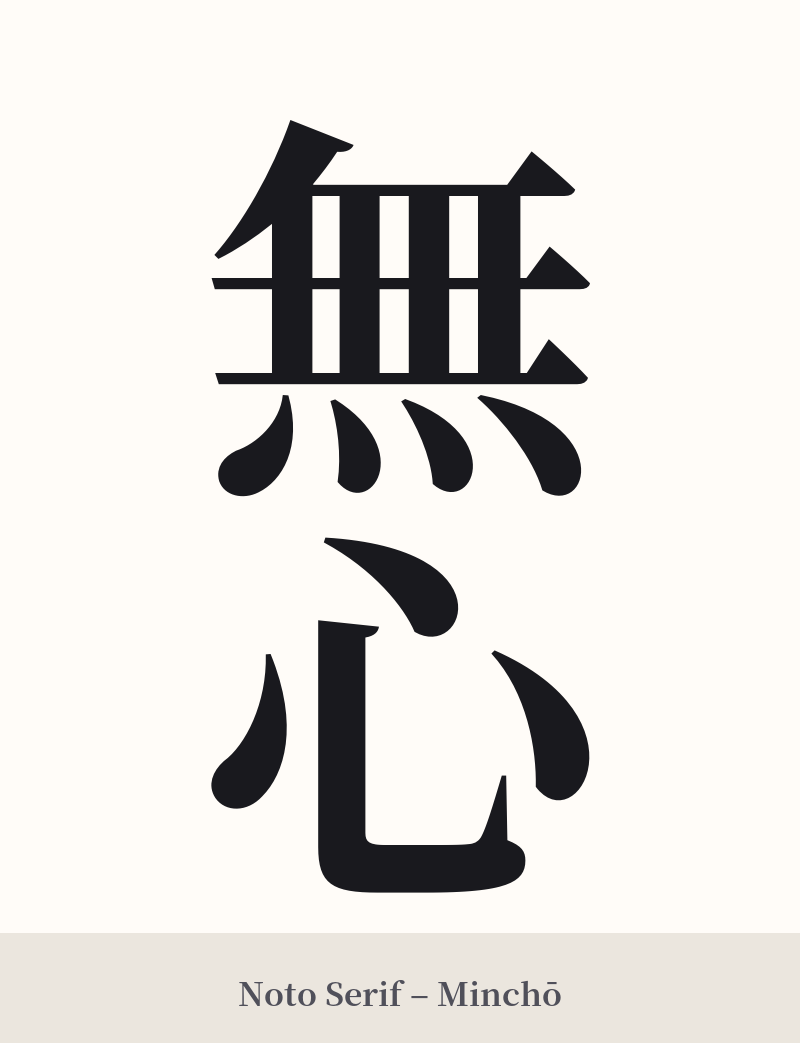
🖌️ Font Styles for 無心
The same kanji can look dramatically different depending on the calligraphy style. Choose a font that matches the mood you want for your tattoo or design.
🎨 Tattoo Suitability
📐 Tattoo Design Guide
The concept of Mushin, meaning 'no mind' or 'flow state,' lends itself to designs that feel both disciplined and fluid.
– Placement: Vertical alignment is very popular for Mushin, looking powerful along the forearm, bicep, calf, or even down the spine. This orientation emphasizes the idea of flow. For a more grounded look, a horizontal placement across the chest or upper back works well.
– Font Style: The choice of script can dramatically alter the feeling of the tattoo. A formal, clean Kaisho (block) script can represent the discipline and training required to achieve Mushin. A flowing Gyosho (semi-cursive) or highly expressive Sōsho (cursive) script can visually represent the 'flow state' itself, with brushstrokes that feel energetic and unrestrained.
– Visual Elements: Consider pairing Mushin with an Ensō, the Zen circle of enlightenment, which shares the same philosophical DNA of spontaneity and perfection in a single moment. Other complementary imagery could include flowing water, a single falling leaf, or a simple bamboo stalk to evoke the Zen aesthetic.
Comments