夢
Dream
The visions you see with closed eyes and the goals you chase with open ones—both live in these 13 strokes.
Ancient scribes carved this character onto oracle bones 3,000 years ago, trying to capture something nobody could see but everyone experienced: the strange theater playing behind sleeping eyelids. They drew a person lying in bed with prominent eyes or eyebrows emphasized, suggesting sight without waking. Above floated symbols for unclear vision, and below sat 夕—evening, the time when dreams arrive.
The Japanese word yume (夢) evolved from Old Japanese “ime,” a compound meaning “sleep” plus “eye”—literally, what your eyes see while sleeping. But somewhere between ancient China and modern Tokyo, this character absorbed a second meaning that makes it irresistible for tattoos: not just sleeping visions, but waking aspirations, the future you’re determined to build, the impossible goals that keep you moving forward.
Walk through Japan and 夢 appears everywhere ambitious people gather—art school banners, startup office walls, sports team slogans, graduation speeches. The first dream of the New Year (初夢, hatsuyume) supposedly predicts your fortune for the next twelve months. Dream interpretation books fill bookstore shelves. The character bridges the unconscious realm and conscious determination, making it one of Japanese culture’s most philosophically loaded symbols.
✨ Kanji Styles Gallery

🖌️ Calligraphy Style
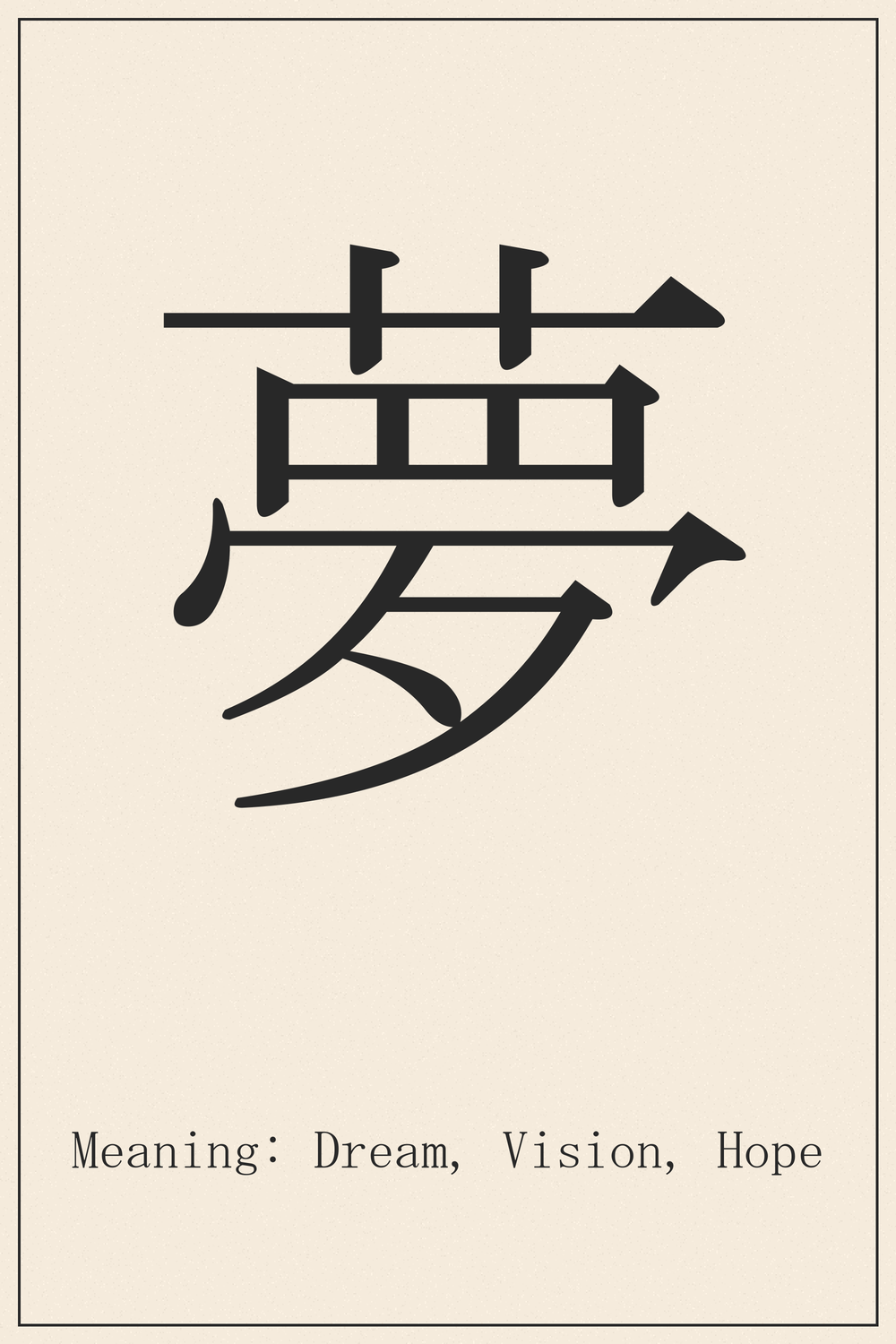
📝 Mincho Style
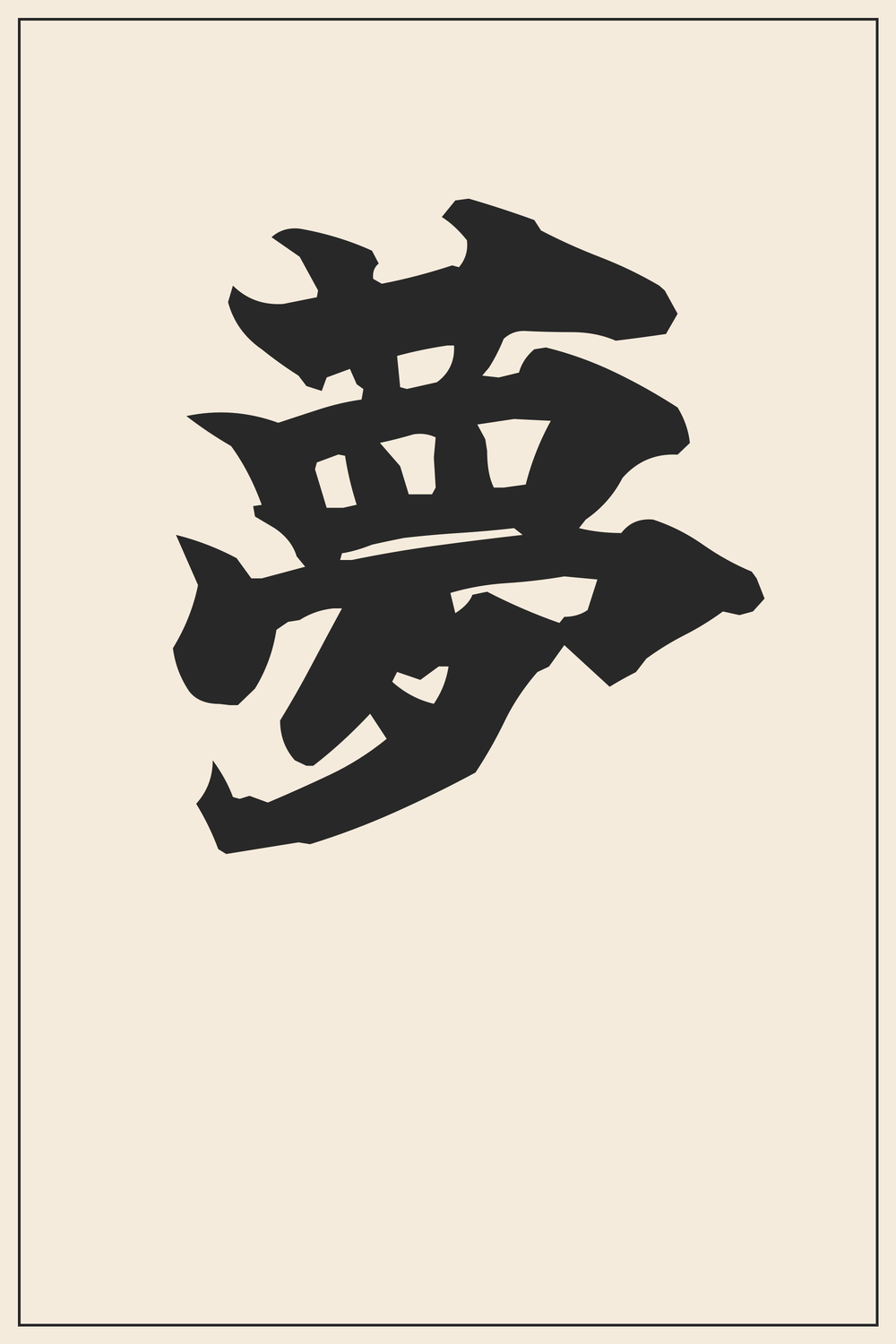
📜 Vertical Writing
⚡ Quick Facts
Decoding the Character
The top component that looks like 艹 (grass radical) isn’t actually grass in this character’s original meaning. In ancient forms, it represented eyebrows or eyelashes—those hairs framing the eye, suggesting vision or the act of seeing. It marked the face of someone experiencing something visual.
The middle section 罒 depicts the eye itself, though written in a stylized net-like form. This wasn’t just any eye—it represented the “inner eye,” the perception happening inside the mind rather than through physical sight. When your actual eyes close, this eye opens, showing you impossible landscapes, conversations with the dead, flying without wings, or whatever bizarre content your brain manufactures nightly.
At the bottom sits 夕 (evening/night), grounding the entire character in darkness. This component answers the “when” question—dreams happen at night, in that vulnerable space between consciousness and oblivion. The character’s structure literally stacks up the scene: nighttime arrives, eyes with prominent lashes see visions despite being closed, and you experience an alternate reality your waking mind can barely remember upon sunrise.
In oracle bone script, scribes sometimes drew the sleeping person with restless hands waving above the bed—capturing that twitching movement people make during REM sleep when dreams are most vivid. That detail eventually simplified out, but the original artists tried to show motion even in static carved bone.
The Two Faces of 夢
Japanese distinguishes between sleeping dreams and waking dreams through context, not separate words. When someone says “昨日変な夢を見た” (kinō hen na yume wo mita), they mean “I had a weird dream last night”—the sleeping kind with impossible physics and your middle school teacher somehow involved.
But say “私の夢はパイロットになることです” (watashi no yume wa pairotto ni naru koto desu)—”My dream is to become a pilot”—and suddenly 夢 means aspiration, goal, life ambition. Same character, completely different realm of meaning. The connection? Both involve seeing something that doesn’t exist in your current reality. One you experience passively while unconscious. The other you actively pursue while awake.
This dual meaning makes 夢 tattoos interpretively rich. You’re not just saying “I value dreams” (which dreams? random nonsense about flying toasters?). You’re saying “I honor both the mysterious visions my subconscious produces and the deliberate future I’m fighting to create.” It bridges the uncontrollable and controllable aspects of human experience in one elegant character.

Where night visions and future aspirations merge into one symbol
Dream Culture in Japan
The first dream of the New Year carries special weight in Japanese culture. On January 1st or 2nd, whatever you dream supposedly predicts your luck for the coming year. The best possible hatsuyume features three specific images: Mount Fuji (富士), a hawk (鷹), and an eggplant (茄子). Why? Ancient wordplay—”Fuji” suggests immortality, “taka” connects to “high,” and “nasu” links to achievement. If you dream all three, prepare for an exceptional year.
Dream interpretation books flood Japanese bookstores, organized by dream symbol—what does dreaming of snakes mean? How about flying? Losing teeth? Falling? These guides blend psychology, folklore, and cultural symbolism. Some people take them seriously enough to alter major life decisions based on dream content. Others treat them like horoscopes—entertaining superstition with possible insights.
The phrase 夢中 (muchū) literally means “inside a dream” but describes being so absorbed in an activity you lose track of time and surroundings. It’s that flow state where hours feel like minutes because you’re completely immersed. Japanese culture values this state highly—whether you’re 夢中 for art, work, sport, or love, being fully present in passionate pursuit is seen as a form of temporary enlightenment.
Not all dreams inspire. The word 悪夢 (akumu) means “nightmare”—literally “bad dream.” Japanese folklore features the baku, a mythical creature that devours nightmares. After waking from something terrible, tradition says you should call out “Baku, come eat my dream!” three times to prevent the bad omen from manifesting in real life.
Dreams in Japanese Expression
The phrase “夢にも思わなかった” (yume ni mo omowanakatta) literally translates as “didn’t think of it even in dreams,” meaning something was so unexpected you couldn’t have imagined it in your wildest fantasies. It captures the idea that dreams represent the absolute limit of human imagination—if something exceeds even dream logic, it’s truly beyond conception.
When something proves impossible, Japanese might say “夢物語” (yumemonogatari)—a “dream story,” meaning fantasy tale or pipe dream. It’s usually dismissive: “That plan is just yumemonogatari” means “You’re delusional if you think that’ll work.” The expression acknowledges that dreams, while inspiring, don’t follow reality’s rules. Beautiful to imagine, foolish to pursue.
But then there’s “夢を追う” (yume wo ou)—”to chase dreams”—a phrase carrying zero negative connotation. It celebrates people who pursue seemingly impossible goals with determination. The cultural message isn’t “dreams are foolish.” It’s “dreams are unlikely, which makes chasing them brave.” That tension between acknowledging long odds and pursuing anyway defines the character’s philosophical depth.
The Science and Mysticism
Modern neuroscience explains dreams as brain maintenance—memory consolidation, emotional processing, random neural firing creating narrative from noise. The rational explanation strips away mystery, reducing nightly cinema to biological housekeeping. But knowing the mechanism doesn’t diminish the experience. You still wake from vivid dreams feeling like you visited other worlds, lived other lives, spoke with people long dead.
Japanese culture historically treated dreams as portals—messages from gods, ancestors, or the future trying to communicate. Before battles, samurai paid attention to dreams for strategic omens. Heian-era aristocrats recorded dreams in diaries, analyzing them for political and romantic significance. Some Buddhist sects practiced dream yoga, training to maintain awareness while dreaming to prepare for the death experience.
This creates interesting cognitive dissonance: modern Japanese people know dreams are neurological phenomena, yet the cultural habit of finding meaning in them persists. It’s like reading horoscopes—you understand it’s not literally predictive, but the interpretive framework offers useful self-reflection. The 夢 tattoo captures that balance between rational understanding and mystical possibility.
The concept of controlling your dreams while knowing you’re dreaming has its own term: 明晰夢 (meiseki-mu), literally “clear dream.” Practitioners claim you can train yourself to recognize dream states and then manipulate dream content consciously—flying, shapeshifting, confronting fears. It’s the ultimate expression of taking control of your unconscious realm.
🎨 Tattoo Design Ideas
- ✨ Ethereal Calligraphy Flow – Soft, flowing brushwork with deliberate imperfections captures the dreamlike quality. The strokes should feel like they’re floating slightly, not grounded—matching how dreams feel untethered from physical laws. Best for 4-6 inch placements on shoulder blade or upper back.
- ✨ Minimalist Modern Line – Clean, precise strokes without decorative flourishes work for smaller wrist or ankle placements (2-3 inches). The 13-stroke complexity maintains visual interest even at reduced size while keeping the design uncluttered and contemporary.
- ✨ Integrated with Moon/Stars – Since 夢 contains the “evening” component and dreams happen at night, pairing it with crescent moon or constellation imagery creates natural thematic unity. The kanji becomes the center with celestial elements orbiting around it.
- ✨ Watercolor Dream Wash – Bold black kanji with subtle watercolor washes in blues, purples, or soft pinks behind it suggests the surreal quality of dreams bleeding into reality. Keep the color subtle—the character should remain the focus, not get overwhelmed by background.
- ✨ Vertical with Cloud Motif – Traditional vertical placement along forearm or spine with minimal cloud wisps incorporated creates visual storytelling—dreams float above reality like clouds above earth. Subtle integration prevents it from looking busy.
- ✨ Paired with Personal Symbol – Combine 夢 with imagery representing your specific dream—musical note for aspiring musicians, mountain peak for climbers, open book for writers. This personalizes the universal concept, making it uniquely yours while maintaining cultural authenticity.
Who Gets This Tattoo
Artists gravitate toward 夢 because their entire profession involves manifesting internal visions into external reality. The character represents the core creative process—seeing something that doesn’t exist yet, then making it real through skill and persistence. It’s both inspiration and commitment captured in one symbol.
Athletes choose it as a reminder of the goals driving brutal training schedules. When you’re running wind sprints until you vomit or practicing the same technique thousands of times, the dream of championship, podium, or personal record keeps you pushing past immediate pain toward distant triumph. The tattoo becomes a permanent motivational poster you can’t avoid.
But the character also appeals to people who simply value imagination and possibility—those who believe the ability to dream (both types) is what separates mere existence from meaningful life. Parents get it commemorating the dreams they hold for their children. Survivors ink it after achieving something doctors said was impossible. Entrepreneurs wear it as a badge for betting everything on a vision others dismissed as fantasy.
Some Japanese people find 夢 tattoos slightly cliché—it’s extremely popular among foreigners getting their first kanji ink. That doesn’t make it invalid, but if you’re aiming for unique rather than classic, consider pairing it with less common characters or developing a distinctive artistic treatment that makes the common character feel fresh.
Why This Character Endures
In an age of data-driven decision making and algorithmic prediction, dreams remain stubbornly unquantifiable. You can’t optimize them, monetize them, or reduce them to metrics. They exist in the last truly private space—your own sleeping consciousness—completely beyond external control or surveillance. That makes them symbolically precious.
The character 夢 has survived three millennia because it addresses something fundamental: humans need to imagine beyond present circumstances. We require visions of different futures, alternate realities, impossible scenarios to maintain hope and motivation. Without the capacity to dream—both literally and figuratively—we’d be trapped in perpetual now with no capacity for change or growth.
Getting 夢 tattooed isn’t about naïve optimism or refusing to accept reality. It’s acknowledging that reality isn’t fixed—that what seems impossible today might become inevitable tomorrow if enough people dream it and work toward it. Every human achievement started as someone’s unrealistic fantasy. The tattoo says “I’m someone who sees what could be, not just what is, and I’m willing to chase visions others dismiss.” That message never goes out of style.
Comments