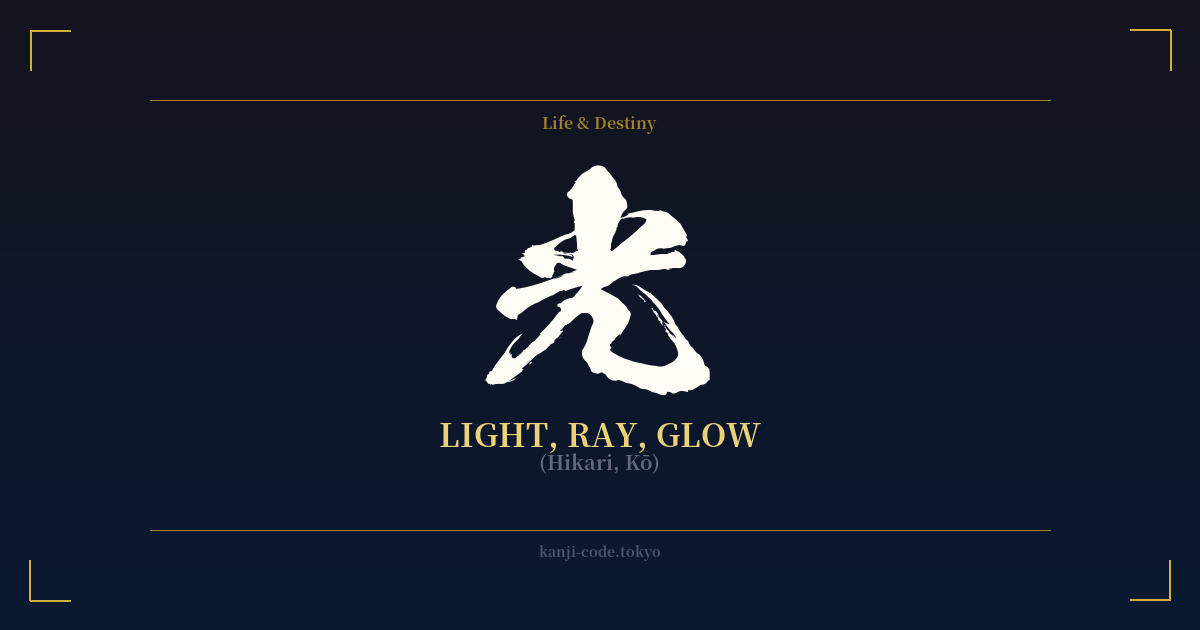
✍️ 光 (Hikari, Kō) — Cultural Context
The kanji 光 (hikari) is one of the most fundamental and resonant characters in the Japanese language, embodying concepts far beyond simple illumination. Its power lies in its dual representation of both the physical and the metaphysical, making it a cornerstone of Japanese philosophy, religion, and art.
The character's origin is beautifully illustrative. The ancient pictograph depicts a person kneeling with a fire held aloft, a powerful image of humanity bringing light into the darkness. This single image captures the essence of discovery, safety, and the primal importance of light to human existence. It is not a passive light, but one actively carried and offered.
In Japan's native Shinto religion, light is central to creation and divinity. The most revered deity, Amaterasu Ōmikami, is the goddess of the sun. The foundational myth of her retreating into a cave, plunging the world into darkness, and her eventual return, represents the cyclical nature of life and the ultimate triumph of light over despair. Thus, 'hikari' is intrinsically linked to life, purity, and the divine order of the universe.
Buddhism, which arrived in Japan later, integrated this reverence for light into its own teachings. Here, light symbolizes enlightenment (bodhi), wisdom, and the dispelling of ignorance. Buddhas and Bodhisattvas are often depicted with halos or emitting rays of light, signifying their awakened state and compassionate wisdom. The Buddha Amitābha, for instance, is known as the "Buddha of Infinite Light," promising rebirth in his Pure Land, a realm of light.
In everyday language, 光 has a poetic and profound feel. It's the light of the sun (太陽の光, taiyō no hikari) or the moon (月の光, tsuki no hikari). This is distinct from 灯 (akari), which typically refers to artificial light from a lamp or candle. This distinction gives 'hikari' a more natural, elemental, and powerful connotation. It's the light of hope (希望の光, kibō no hikari) or the light of glory (栄光, eikō).
This symbolism permeates Japanese culture, from classic literature like 'The Tale of Genji,' where characters' beauty is often described in terms of radiance, to modern anime and video games where 'hikari' represents a hero's pure heart, special power, or the force of good. To understand 光 is to understand a core pillar of the Japanese aesthetic and worldview: that in darkness there is the potential for light, and that light itself is a symbol of all that is good, true, and beautiful.
🖌️ Font Styles for 光
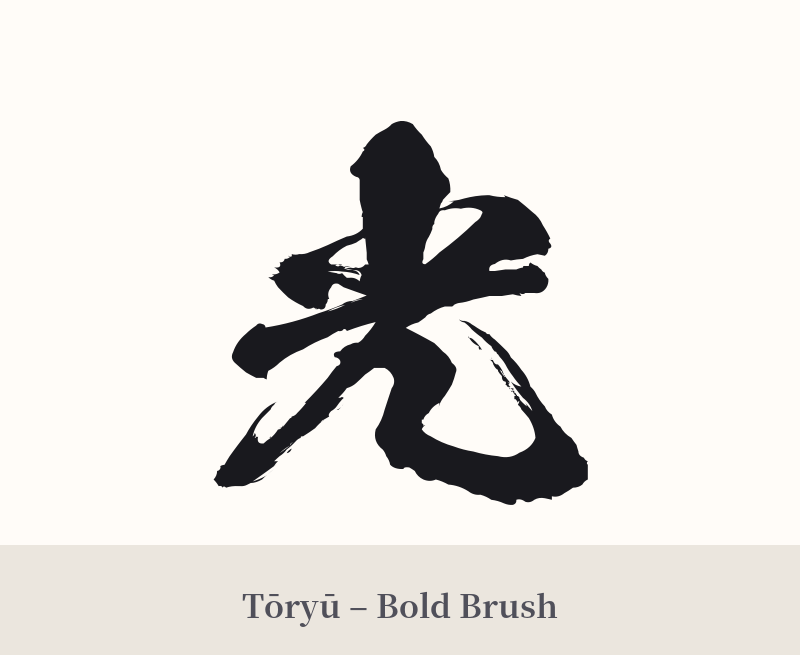
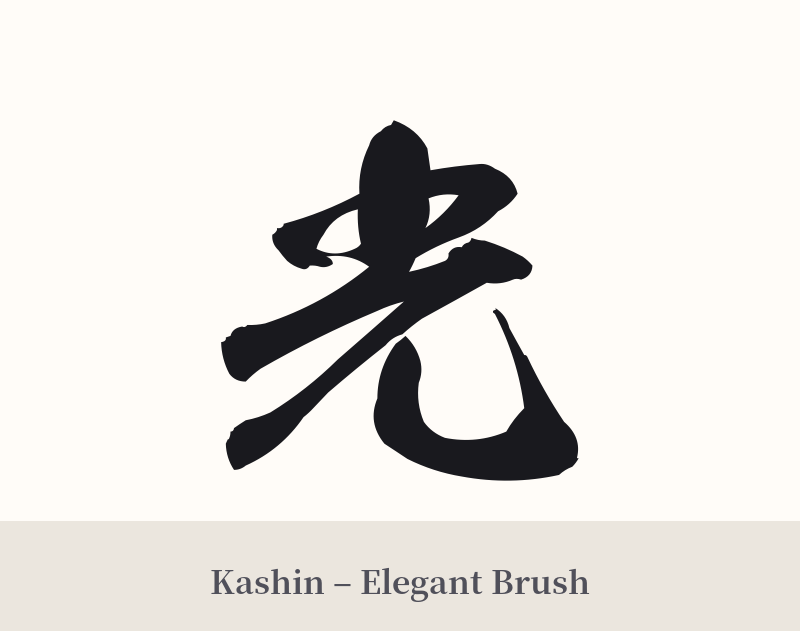
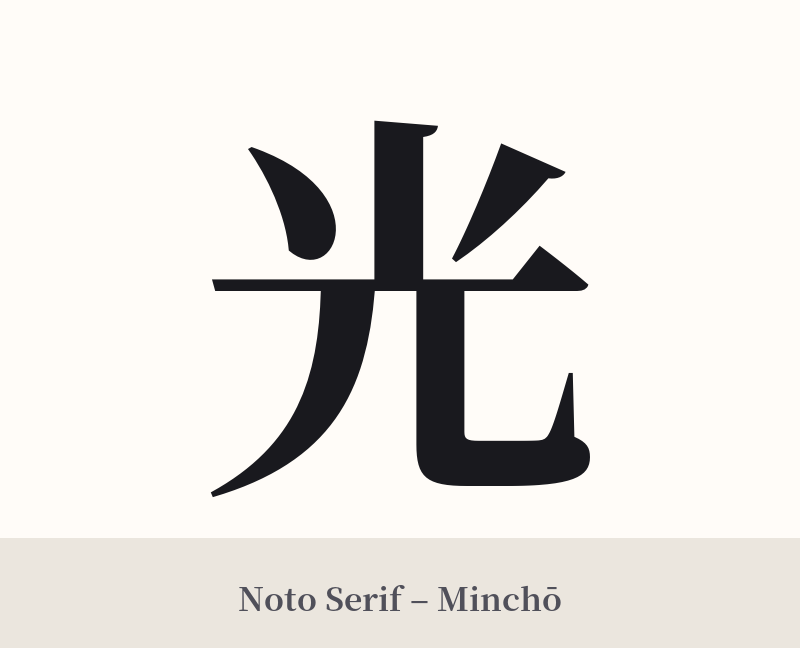
The same kanji can look dramatically different depending on the calligraphy style. Choose a font that matches the mood you want for your tattoo or design.
🎨 Tattoo Suitability
📐 Tattoo Design Guide
The kanji 光 is exceptionally versatile for tattoo design due to its simple elegance and powerful meaning.
– Placement: Its clean lines work well in a variety of sizes and locations. For a subtle piece, consider the inner wrist, behind the ear, or on the ankle. For a more prominent statement, it makes a striking centerpiece on the forearm, calf, or back of the neck. A larger, more detailed version can anchor a design on the chest or shoulder blade.
– Font Style: The character's form lends itself to many artistic interpretations. A bold, crisp Kaisho (block) script emphasizes strength and clarity. A flowing, semi-cursive Gyōsho script can give it a sense of movement and energy, as if the light itself is dynamic. For a more traditional and artistic feel, a fully cursive Sōsho style can render the character abstractly and beautifully.
– Visual Tips: While 光 is powerful on its own, it can be integrated with other elements to enhance its meaning. Consider having rays of light emanating from the character itself. It pairs beautifully with a lotus flower to symbolize enlightenment, or with a sun or moon. A popular modern technique is to use a watercolor style with yellows, golds, or whites bleeding out from the black ink of the kanji, creating a literal glowing effect.
Comments