真
Truth, Reality, Authenticity
A character whose ancient form showed either a ladle filling a pot to fullness or a body transformed beyond deception—both paths leading to the same destination: unchangeable reality.
Japanese philosophy distinguishes between 本音 (honne, true feelings) and 建前 (tatemae, public facade). Social harmony requires presenting appropriate faces in different situations—agreeing when you disagree, smiling through discomfort, maintaining politeness that conceals honest reactions. This isn’t considered lying. It’s sophisticated social lubrication, the oil keeping communal gears turning smoothly without grinding against each other’s edges.
真 (shin/ma) cuts through that complexity. It means truth in the absolute sense—reality that exists regardless of social performance, authenticity that can’t be faked, the genuine article underneath all presentation. When photographers take 写真 (shashin, “copied truth”—literally capturing reality onto film), when scientists pursue 真理 (shinri, “truth principle”—universal laws), when people speak 真実 (shinjitsu, “true reality”—facts as they actually occurred), they’re invoking this character’s promise: something real exists beyond the performance.
The character’s etymology remains debated among scholars—different ancient forms suggest different origins. One interpretation shows a ladle filling a cooking pot until completely full, suggesting truth as completeness, nothing lacking, perfect sufficiency. Another shows a transformed body, perhaps deceased, something that’s undergone final change and can no longer deceive or alter. Both arrive at similar meaning: truth as unchangeable reality, the state where transformation stops, where things reveal their essential nature without possibility of further concealment or modification.
✨ Kanji Styles Gallery
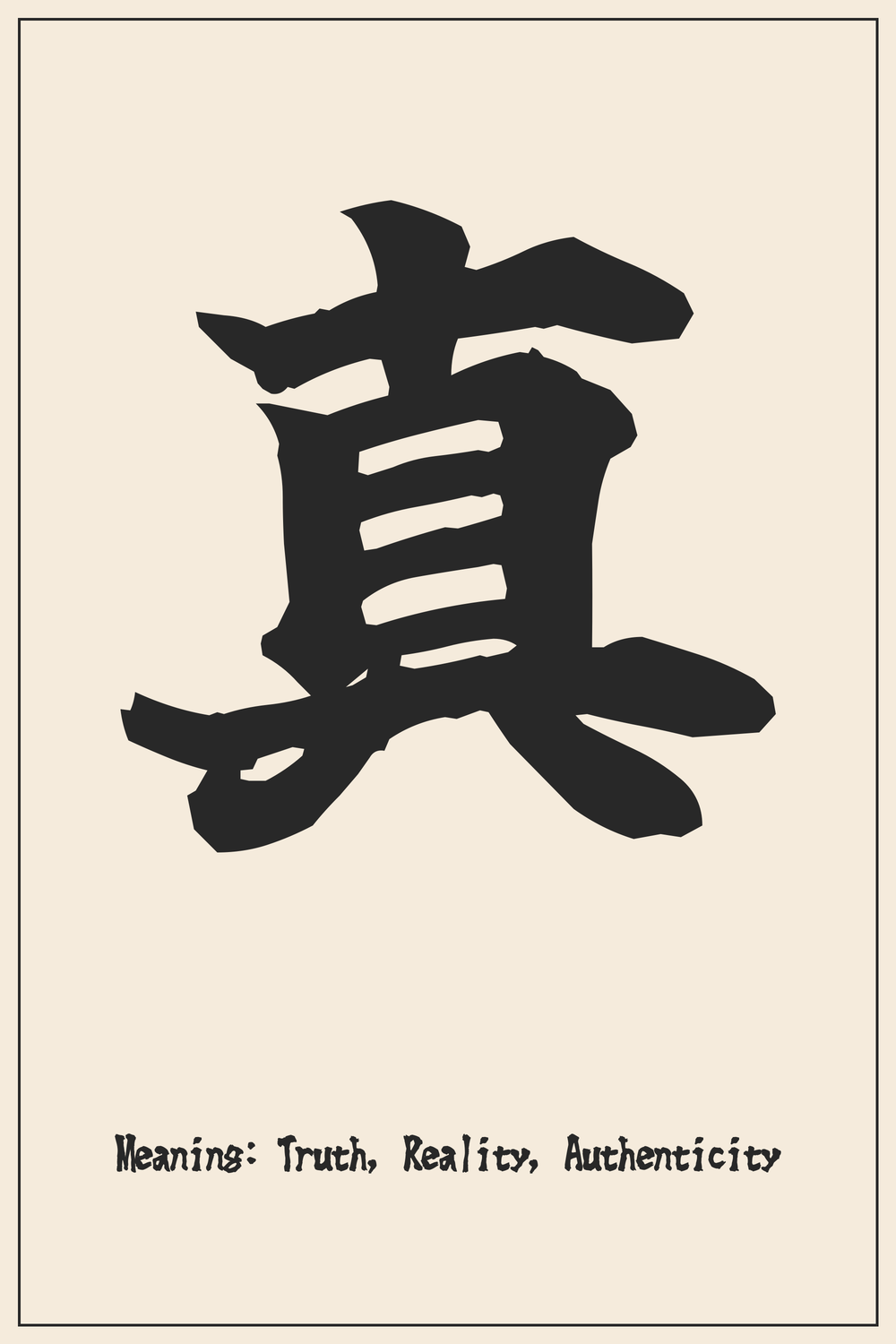
🖌️ Calligraphy Style
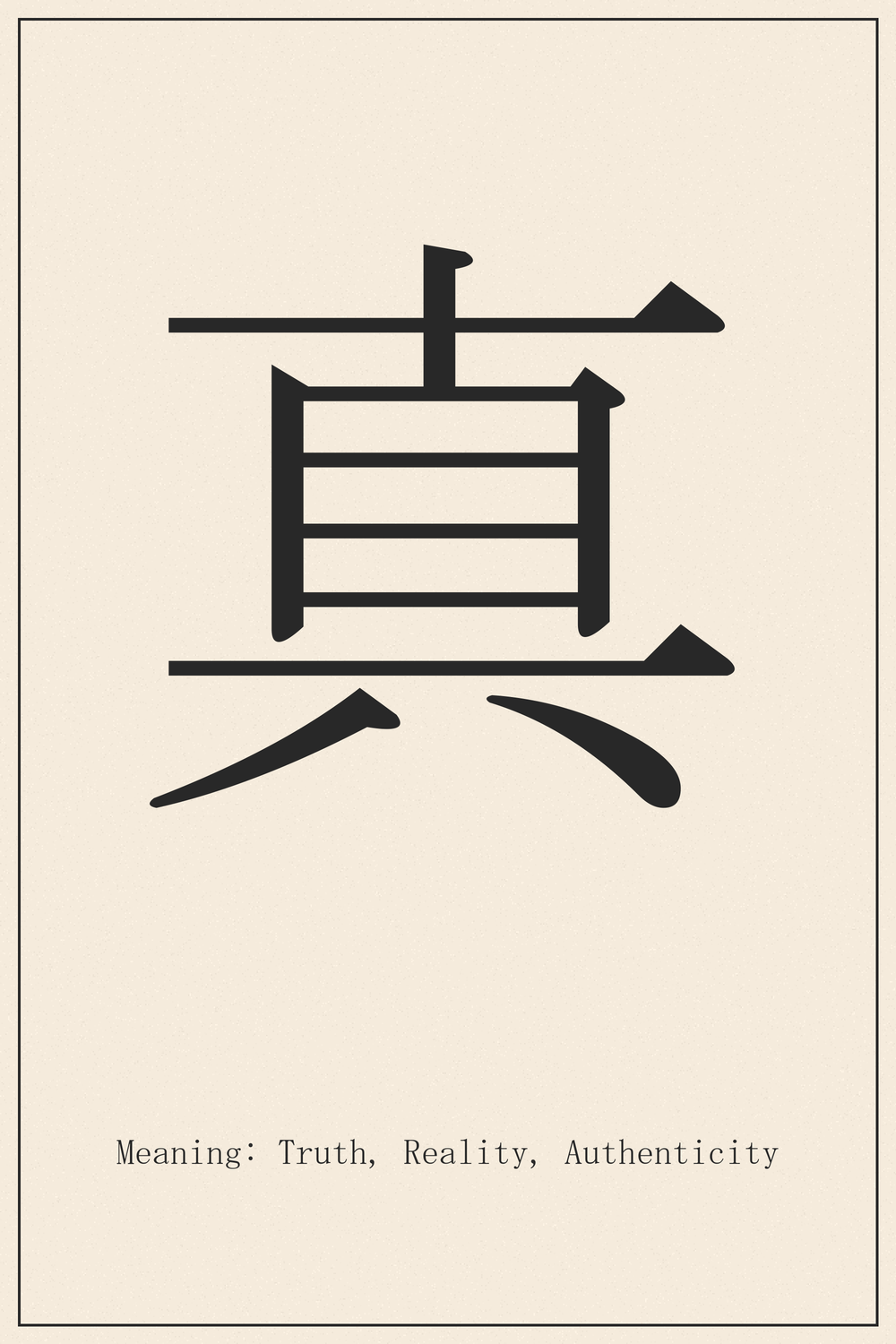
📝 Mincho Style
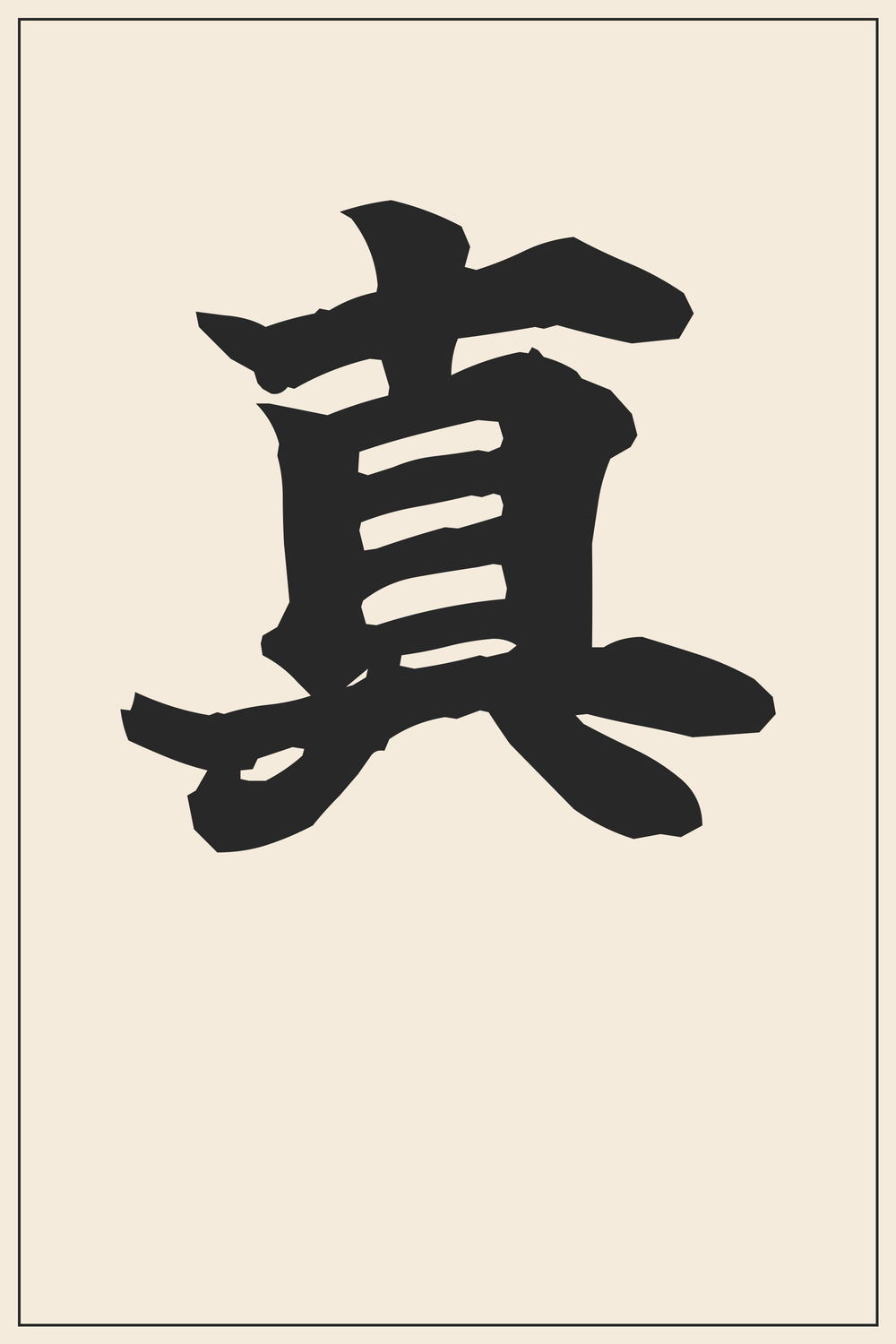
📜 Vertical Writing
⚡ Quick Facts
The Ladle Interpretation
One etymological school interprets 真’s ancient forms as depicting a ladle or spoon positioned above a cooking pot or vessel. The top component (which evolved into 十 in modern writing) represented the ladle handle and bowl. The bottom (which became 目 with additional strokes) showed the container receiving the contents. The act captured: filling something completely, pouring until full, achieving total sufficiency.
This interpretation connects truth to completeness—nothing missing, nothing lacking, full realization of what something is meant to be. A pot filled to proper capacity contains true amount. A ladle scooping completely transfers true portion. Truth becomes the state where reality matches intention perfectly, where what exists corresponds exactly to what should exist, where measurement aligns with standard.
This philosophical framework appears throughout East Asian thought: things possess true nature (本性, honsei) waiting to be fully realized. Education doesn’t add knowledge artificially but helps students achieve their true potential. Artisans don’t impose designs on materials but reveal the wood’s true grain, the stone’s true shape. Truth exists as completeness, as bringing something to its proper fullness without addition or subtraction.
If 真 indeed originated from ladle imagery, it’s beautifully mundane—truth emerging from everyday kitchen action, philosophical concepts grounded in cooking practice. Ancient scribes watching someone fill pots recognized universal principle: truth means proper fullness, complete measure, nothing lacking or excessive. The profound emerges from the ordinary when you observe carefully enough.
The Transformation Interpretation
Alternative etymological analysis suggests 真’s ancient forms depicted a person transformed—specifically, a body inverted or a person who has died and undergone final transformation. The top showed a person upside down. The bottom indicated a stand or base. Together they meant: something that has completed its transformation, reached its final state, can no longer change or deceive.
This interpretation connects truth to finality—the state where all changes have completed, where concealment becomes impossible, where essential nature reveals itself permanently. The dead cannot lie; corpses display truth brutally. Bodies transformed beyond deception show what remains when all pretense falls away. It’s darker etymology than the ladle version, but philosophically profound.
Buddhist philosophy embraces this understanding: truth emerges when transformation ceases, when we stop grasping at changing phenomena and recognize the unchanging reality beneath. 真如 (shinnyo, “suchness” or “thusness”) describes reality as it actually is, before concepts and categories distort perception. Truth isn’t what we wish or imagine—it’s what remains when all wishful transformation stops.
Reality unchanging beneath all deception—truth as final, complete, genuine
Common Compounds and Usage
真 appears throughout Japanese vocabulary describing truth, authenticity, and reality. 真実 (shinjitsu) combines 真 with 実 (reality/truth) creating emphatic “truth” or “fact”—used in legal contexts, journalism, investigations. 真理 (shinri, “truth principle”) describes universal laws, scientific principles, philosophical truths that transcend individual perspective or cultural variation.
写真 (shashin, “photograph”) literally means “copied truth”—capturing reality’s image accurately. Before photography, this term described realistic paintings. The concept: truth can be transferred, copied, preserved through accurate representation. 真剣 (shinken) means “serious” or “earnest”—literally “true sword,” suggesting authentic commitment rather than practice or pretense.
真面目 (majime) describes serious, earnest, diligent personality—literally “true face,” the authentic self rather than social mask. 真心 (magokoro, “true heart”) means sincerity, genuine feeling untainted by calculation or performance. As prefix, 真 intensifies meanings: 真っ白 (masshiro, “pure white”), 真っ赤 (makka, “bright red”), 真っ直ぐ (massugu, “perfectly straight”)—the authentic, complete version of qualities.
Truth in Japanese Names
真 appears frequently in Japanese given names, especially for boys. 真一 (Shinichi, “true one” or “first truth”), 真也 (Shinya, “true also”), 真人 (Masato or Makoto, “true person”), 真理 (Mari, “truth principle”)—parents embed authenticity and sincerity into their children’s identities through naming. The character becomes aspiration: may you live truthfully, may you be genuine.
女性名で真由美 (Mayumi), 真奈美 (Manami), 真紀 (Maki) blend 真 with other characters creating names suggesting “beautiful truth,” “truthful beauty,” “true record.” The character softens when paired appropriately, losing harsh philosophical weight and gaining graceful authenticity. Parents choose it hoping daughters will possess inner truth, genuine qualities, authentic beauty beyond surface appearance.
As standalone name, 真 (Makoto) works for both genders—literally naming someone “Truth” or “Sincerity.” It’s bold choice, establishing expectation that the person will embody these qualities. Names function as prayers, hopes, identity frameworks. Carrying 真 as given name means carrying permanent reminder that authenticity matters, that truth-seeking defines character, that genuineness remains worth pursuing.
The tension between 真 (authentic truth) and 建前 (social facade) creates fascinating cultural dynamic. Japanese society highly values both—harmonious social performance AND authentic private self. Maturity means knowing when each applies. Children who always speak their truth are rude; adults who never reveal authentic feelings are cold. Wisdom involves navigating between truth and performance with grace.
🎨 Tattoo Design Ideas
- ✨ Traditional Bold Calligraphy — Single character in confident, decisive brushwork captures 真’s direct, uncompromising nature. The strokes should feel clear and honest—visual embodiment of truth itself. Perfect for medium placements (4-6 inches) on forearm, upper back, or shoulder blade where the character makes unambiguous statement.
- ✨ Minimalist Modern Line — Clean, precise strokes without decorative flourish for contemporary aesthetic. Despite ancient meaning, modern execution creates sophisticated declaration. Ideal for smaller placements (3-5 inches) on wrist, ankle, or behind ear where simplicity enhances philosophical weight.
- ✨ Vertical Column Format — Traditional top-to-bottom placement honors authentic Japanese writing direction while creating strong visual line. The vertical orientation suggests searching upward toward truth or plumbing downward toward reality’s depths. Works beautifully for 5-7 inch placements along spine, forearm, or outer thigh.
- ✨ With Personal Symbol — Pair 真 with personally significant element—specific date when you committed to living authentically, symbol representing your truth-seeking journey, minimalist imagery reflecting what truth means to you. Keep additions subtle, ensuring 真 remains dominant. The supporting element personalizes universal concept.
- ✨ Circular Seal Design — Place 真 within traditional circular seal (hanko format) suggesting official verification, authenticated reality, truth stamped and certified. This format creates enclosed, unified composition while honoring how seals convey authenticity in Japanese culture. The circle suggests completeness—truth as whole, nothing lacking.
- ✨ Mirror Placement — Consider placement visible in mirrors—inner wrist, chest, areas you see when examining yourself. This creates private dialogue between you and the character, constant reminder during self-reflection that truth matters, that authenticity requires daily commitment, that genuine self deserves acknowledgment.
Who Chooses This Tattoo
People who’ve survived situations requiring deception—closeted LGBTQ individuals who finally came out, those who escaped abusive relationships built on lies, anyone who lived false identities protecting themselves—choose 真 marking their return to authenticity. They’ve experienced the cost of concealment and the liberation of truth. The character becomes declaration: “I no longer hide, I show my genuine self, I choose truth despite risk.”
Truth-seekers—journalists, scientists, philosophers, investigators—select 真 honoring their vocational commitment. They dedicate lives to uncovering reality beneath appearances, to distinguishing fact from fabrication, to pursuing accuracy despite difficulty or danger. The tattoo becomes professional oath made permanent, visible reminder that truth-seeking justifies sacrifices it demands.
Those valuing authenticity as philosophical principle wear 真 declaring that genuineness matters more than acceptance, that real beats fake even when fake proves easier, that truth-telling defines integrity. They’ve watched social media create performance cultures, watched people curate false identities, watched authenticity become rare commodity. The character becomes counterstatement: “I value what’s real, I choose genuine over glossy, I build life on truth.”
真 as tattoo carries weight. It announces commitment to truth-telling and authentic living—standards difficult to maintain consistently. People will judge you against your declared value when you inevitably fall short. Consider whether you’re prepared for that scrutiny, whether truth-commitment remains worth defending publicly. The character functions as accountability mechanism, not just decoration.
Why This Character Endures
We live in era of unprecedented information access and unprecedented deception. Deepfakes make video untrustworthy. AI generates convincing text without human authorship. Social media incentivizes performance over authenticity. Political tribalism makes even basic facts contested territory. Distinguishing truth from convincing fabrication requires more effort than ever while mattering more than ever.
真 offers philosophical anchor when reality itself becomes negotiable. The character insists that truth exists—not just your truth or my truth, but actual truth, reality independent of perspective or preference. Things happened or didn’t happen. Statements align with reality or don’t. Authenticity can be recognized and valued. The character refuses postmodern dissolution of truth into competing narratives.
The character endures because humans keep needing truth as concept and commitment. Whether through ladle’s fullness or body’s final transformation, 真 describes state where deception ends, where reality reveals itself, where what is and what appears finally align. Getting it tattooed becomes permanent stake claiming truth matters—in personal life, in public discourse, in how we navigate world increasingly blurred between authentic and artificial. That commitment, that refusal to surrender truth to convenience or comfort, remains worth marking permanently.
Comments