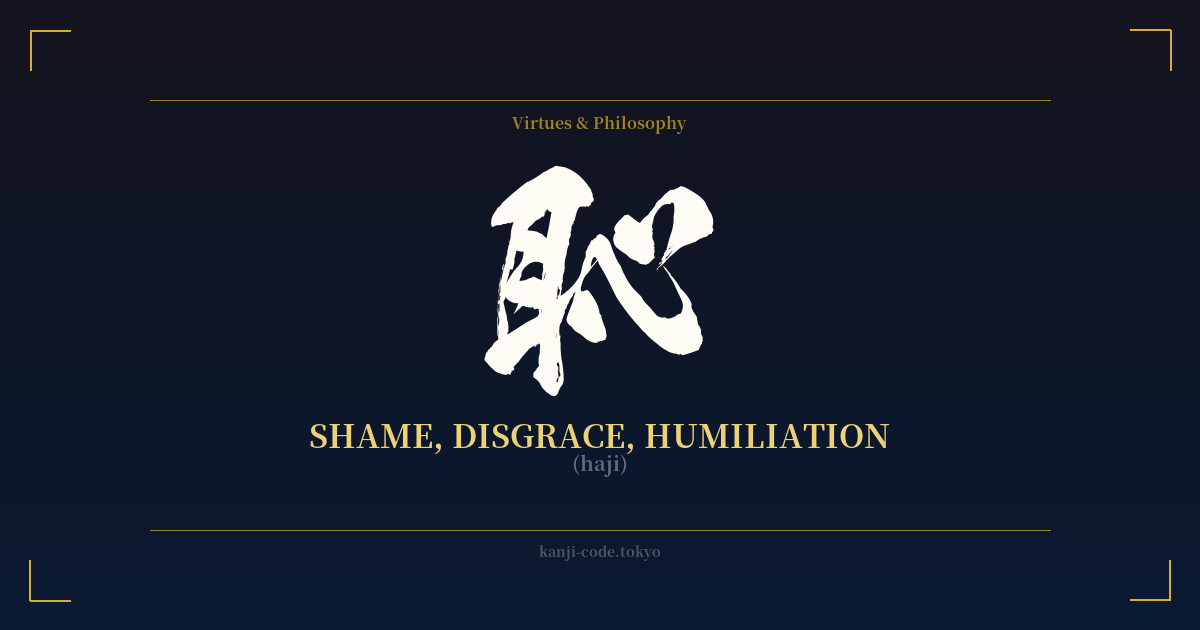
✍️ 恥 (haji) — Cultural Context
The kanji 恥 (haji) is one of the most culturally significant and emotionally charged characters in the Japanese language. It doesn't just mean 'shame' in the simple, private sense of guilt; it embodies a deeply social concept tied to honor, reputation, and one's place within a group.
Visually, the character is a powerful combination of two radicals: 耳 (mimi) on the left, meaning 'ear,' and 心 (kokoro) on the right, meaning 'heart.' This composition beautifully captures the physical sensation of shame: the burning ears that flush red when one is embarrassed, and the racing or heavy heart that accompanies the feeling of disgrace. It's a visceral, whole-body experience of social exposure.
In Western cultures, morality is often framed around the concept of guilt—an internal feeling of wrongdoing based on one's own conscience. Japan, however, is often described as a 'shame culture,' a term popularized by anthropologist Ruth Benedict. In this context, 'haji' is a paramount emotion. It is the painful feeling that arises from being seen negatively by others, from failing to meet social expectations, or from bringing dishonor to one's family, company, or community. The fear of 'haji' is a powerful force that maintains social harmony and encourages individuals to act in accordance with group norms.
This concept was central to the samurai code of Bushido, where losing face was considered worse than death. A samurai who brought shame upon their lord or themselves would be expected to commit seppuku (ritual suicide) to restore their honor. While such extremes are a thing of the past, the underlying principle of avoiding shame remains a potent motivator in modern Japanese life.
You can see it in the public apologies of politicians or corporate executives after a scandal. Their deep bows and somber press conferences are rituals designed to acknowledge their 'haji' and begin the process of restoring public trust. On a personal level, a student might feel 'haji' for failing an exam not just because of personal disappointment, but because they have let down their parents and teachers.
Therefore, 恥 (haji) is not merely a negative feeling to be avoided. It is a complex social mechanism, a moral compass oriented by the eyes of others. It underscores the importance of interdependence and responsibility to the collective, making it a cornerstone of Japanese ethics and identity.
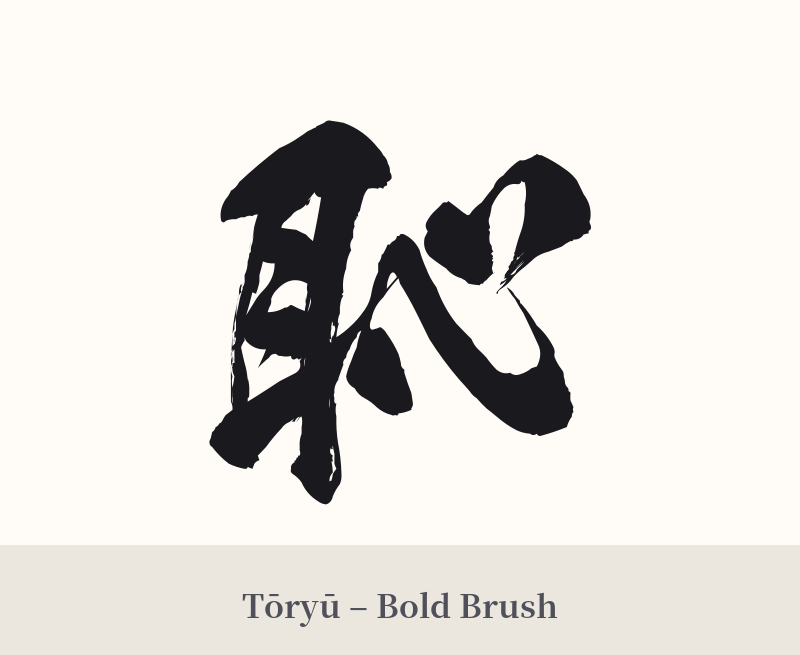
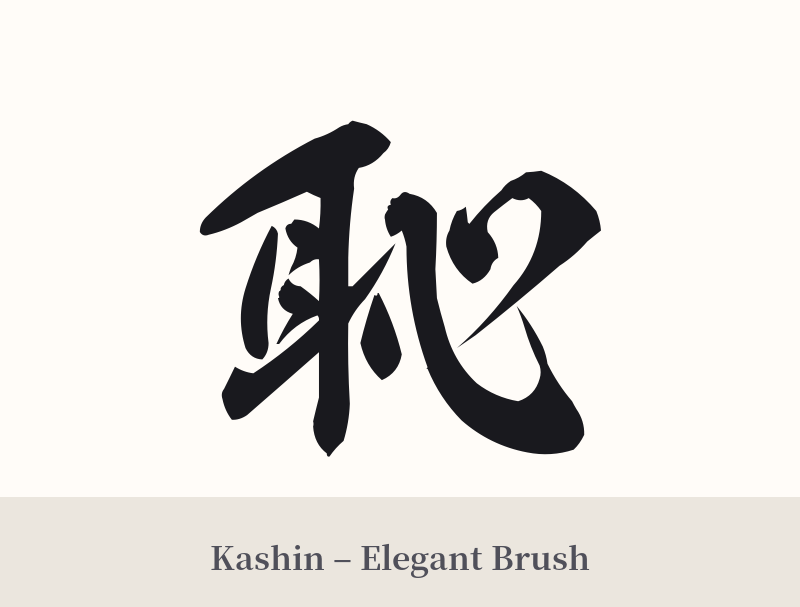
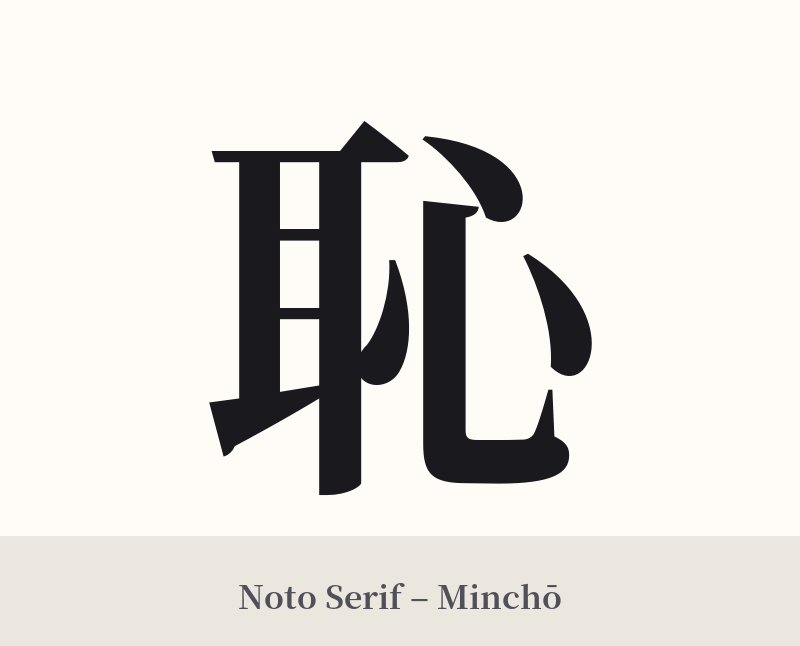
🖌️ Font Styles for 恥
The same kanji can look dramatically different depending on the calligraphy style. Choose a font that matches the mood you want for your tattoo or design.
🎨 Tattoo Suitability
📐 Tattoo Design Guide
Given the heavy meaning and high potential for misunderstanding, this kanji is a difficult choice for a tattoo. If you are set on it for personal reasons, the design should be handled with intention and care.
– Placement: Consider a more private location like the ribs, inner bicep, or back of the shoulder. Placing 'Shame' in a highly visible area like the forearm or neck is a very bold and potentially alarming statement.
– Font Style: The choice of script can dramatically alter the feeling. A crisp, formal Kaisho (block) style can convey the heavy, unyielding weight of disgrace. Conversely, a flowing, almost frantic Gyosho (semi-cursive) or Sosho (cursive) script could represent the internal turmoil and emotional chaos of feeling shame.
– Visual Elements: It is difficult to pair this kanji with other imagery without creating a confusing or overly bleak design. If you must, consider subtle elements that suggest introspection or consequence, such as a single falling leaf or a cracked surface. Avoid pairing it with beautiful or powerful symbols like a dragon or lotus, as the contradiction would be jarring.
Comments