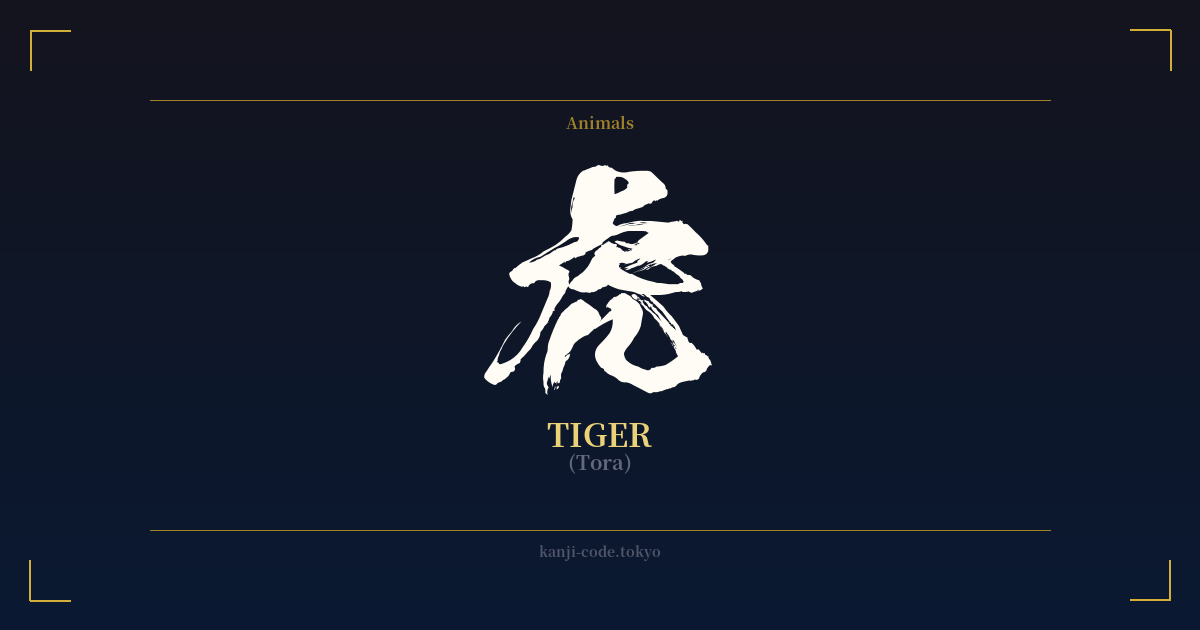
✍️ 虎 (Tora) — Cultural Context
The kanji 虎 (Tora) embodies the raw power and majestic presence of the tiger. Interestingly, tigers are not native to Japan; their image and folklore were imported from mainland China and Korea, where the animal was a potent symbol of strength, royalty, and martial prowess. This cultural importation meant that the tiger arrived in Japan not as a creature of the natural world, but as a legendary beast, a figure of myth and immense power.
In Japanese culture, the tiger is revered as a symbol of courage, ferocity, and protection. It is believed to ward off evil spirits, disease, and misfortune. This protective quality made the tiger a popular motif in art and on talismans. The tiger is often depicted as the ultimate land animal, the earthly counterpart and rival to the dragon (龍, Ryū), the master of the skies and seas. The pairing of these two, known as 龍虎 (Ryūko), represents the fundamental balance of yin and yang, a dynamic tension between two supreme forces.
The tiger is also the third animal in the East Asian zodiac (known as 寅 in this context). Those born in the Year of the Tiger are said to inherit its traits: bravery, confidence, and a competitive spirit. They are seen as natural leaders, though sometimes prone to impulsiveness and unpredictability, mirroring the wild nature of the great cat.
This rich symbolism is woven into the Japanese language through various proverbs. A famous example is 「虎穴に入らずんば虎子を得ず」 (koketsu ni irazunba koji o ezu), which translates to "If you do not enter the tiger's den, you will not get the tiger's cub." It is the Japanese equivalent of "nothing ventured, nothing gained," highlighting the courage required to achieve great rewards.
In visual arts, particularly in ukiyo-e woodblock prints and on folding screens (byōbu), tigers are frequently shown in bamboo groves. This classic pairing is symbolic: the powerful tiger represents strength, while the flexible bamboo represents resilience. Together, they signify the ability to be strong yet adaptable, bending without breaking in the face of adversity.
🖌️ Font Styles for 虎
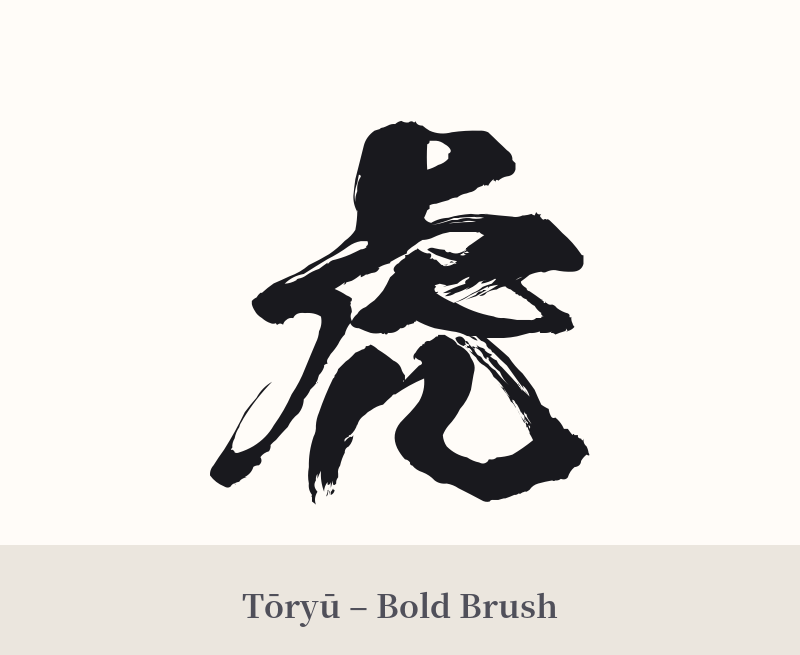
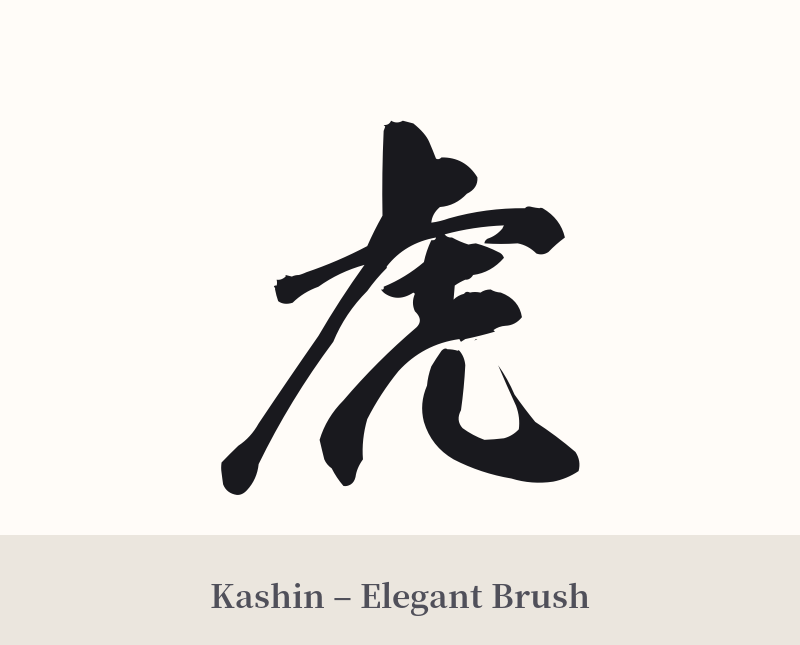
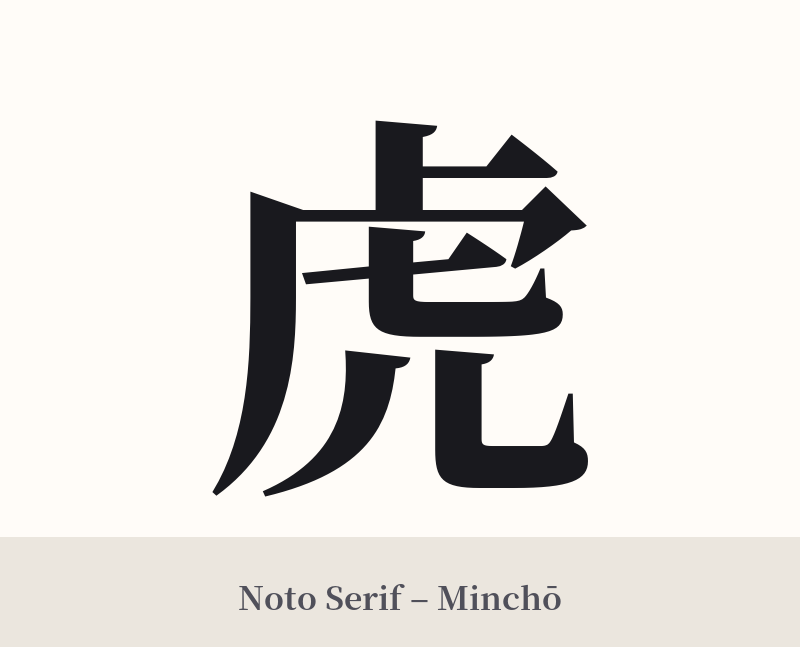
The same kanji can look dramatically different depending on the calligraphy style. Choose a font that matches the mood you want for your tattoo or design.
🎨 Tattoo Suitability
📐 Tattoo Design Guide
The kanji 虎 is a versatile and powerful element for a tattoo, lending itself to various styles and placements.
– Placement: Due to its strong presence, 虎 works well in prominent locations. For a large, impactful piece, consider the back, chest, or thigh. For a more focused design, the forearm, calf, or bicep provides a great canvas. It can stand alone or be the centerpiece of a larger composition.
– Style: A dynamic, semi-cursive calligraphy style (gyōsho) or a bold brushstroke (shodō) can emphasize the tiger's wild energy and movement. Conversely, a clean, architectural block script (kaisho) highlights its stability and raw strength.
– Visual Elements: Pairing 虎 with traditional motifs can deepen its meaning. Classic combinations include bamboo (resilience), fierce waves (unstoppable power), or a dragon to represent the iconic Ryūko rivalry. The kanji can also be subtly integrated into a larger illustrative tattoo of a tiger, perhaps on its forehead or as a background element.
Comments