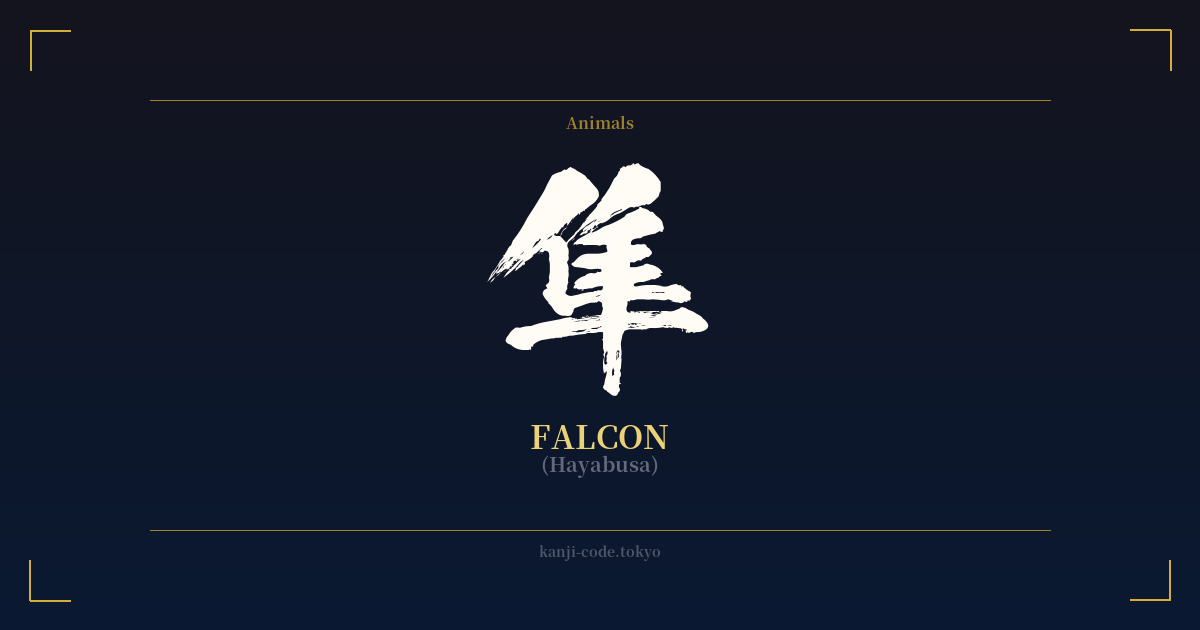
✍️ 隼 (Hayabusa) — Cultural Context
The kanji 隼, read as 'Hayabusa', specifically refers to the Peregrine Falcon, a bird revered in Japan and across the world for its breathtaking speed and hunting prowess. Its identity is deeply intertwined with concepts of swiftness, precision, and nobility, making it a potent symbol in Japanese culture.
Historically, the falcon was a creature of the elite. During the feudal era, falconry, known as 'takagari' (鷹狩り), was a prestigious sport and martial training exercise practiced by the samurai class and aristocracy. Owning and training a Hayabusa was a display of status, wealth, and control. The bird itself was seen as a reflection of the ideal warrior: focused, disciplined, and lethally efficient. Its ability to dive at incredible speeds to strike its prey with pinpoint accuracy mirrored the strategic ideals of Bushido, the way of the warrior.
This association with martial excellence meant the falcon became a common motif in samurai art, family crests ('kamon'), and literature. It represented not just physical speed but also quick thinking, sharp vision, and the ability to seize opportunities decisively. A falcon perched on a warrior's arm was a symbol of a powerful partnership, a unity of human intelligence and natural, untamed power.
In the modern era, the power of the Hayabusa symbol has not faded; it has evolved. The name was famously given to the Suzuki GSX1300R Hayabusa, a motorcycle that, upon its release in 1999, became the world's fastest production bike. The choice of name was deliberate, directly invoking the image of the falcon's incredible velocity to capture the spirit of the machine.
Even more recently, the Japan Aerospace Exploration Agency (JAXA) named its asteroid sample-return missions 'Hayabusa' and 'Hayabusa2'. These ambitious projects required incredible speed across the vastness of space, coupled with unmatched precision to land on a distant asteroid and return safely to Earth. The name perfectly encapsulated the mission's goals and celebrated its eventual success, cementing 隼 as a symbol of cutting-edge Japanese engineering and ambition.
From the gauntlet of a medieval samurai to the fairing of a hyperbike and the hull of a spacecraft, the kanji 隼 continues to represent the absolute pinnacle of speed, focus, and the successful execution of a difficult mission.
🖌️ Font Styles for 隼
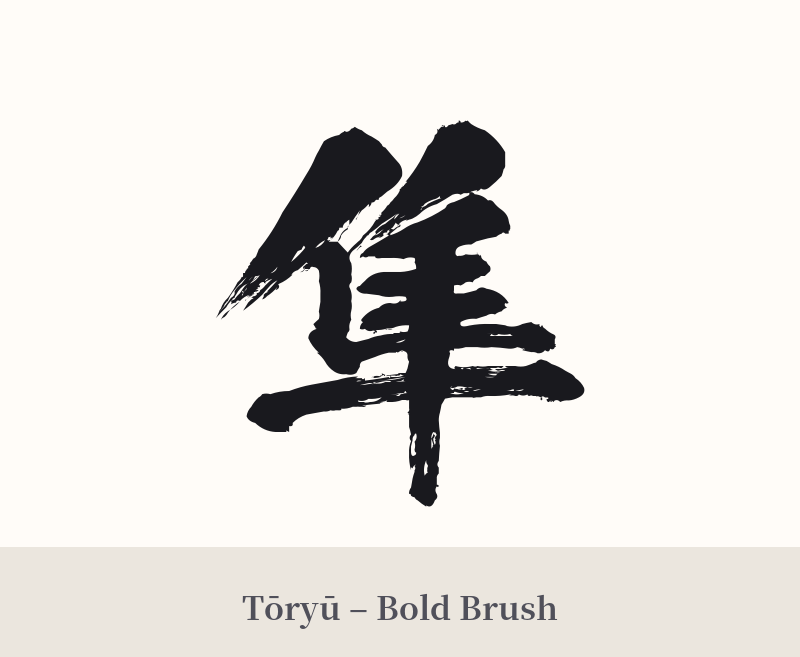
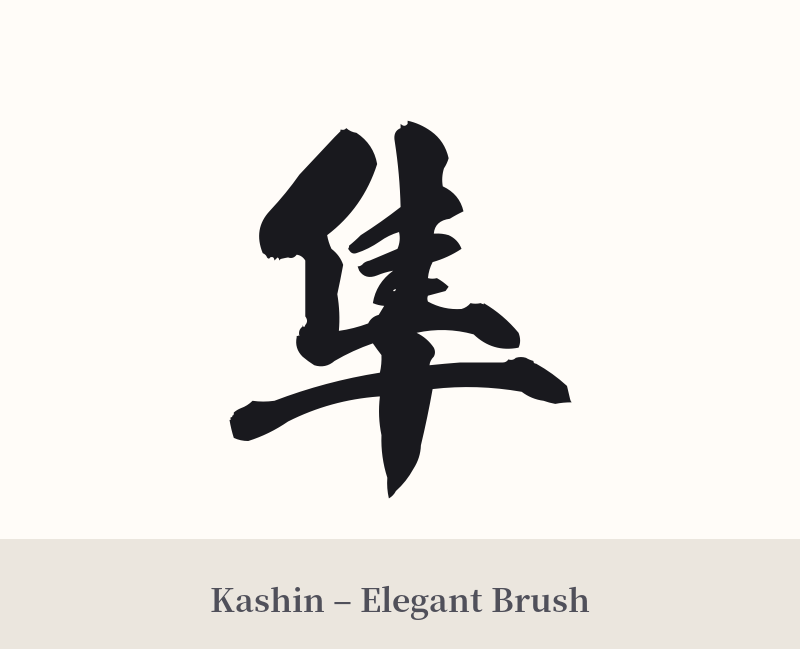
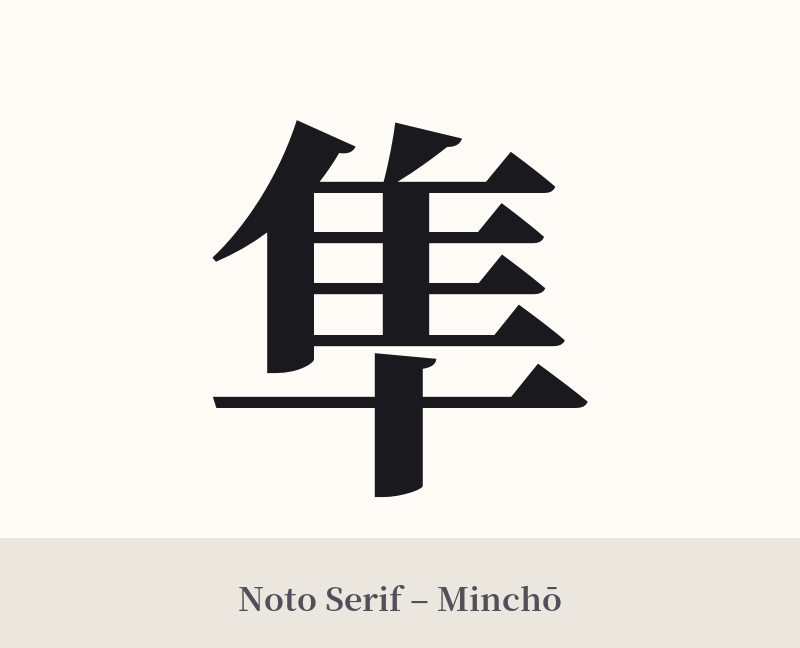
The same kanji can look dramatically different depending on the calligraphy style. Choose a font that matches the mood you want for your tattoo or design.
🎨 Tattoo Suitability
📐 Tattoo Design Guide
The kanji 隼 offers great flexibility for a tattoo design, embodying both elegance and power. Its balanced form works well in various styles and placements.
– Placement: For a vertical design, the forearm, calf, or along the spine are excellent choices that accentuate the character's form. The back of the shoulder or chest also provides a strong canvas.
– Font Style: A dynamic, semi-cursive script ('gyōsho') can emphasize the falcon's sense of motion and speed. For a more traditional and stately look, a crisp, printed style ('kaisho' or 'mincho') highlights its precision and noble bearing.
– Visual Pairings: Consider pairing 隼 with elements that enhance its meaning. Wind bars or abstract swooshes can represent its speed. Placing it alongside a pine tree branch can add a layer of longevity and resilience. For a more direct representation, it can be integrated with an ink-wash style illustration of a falcon.
Comments