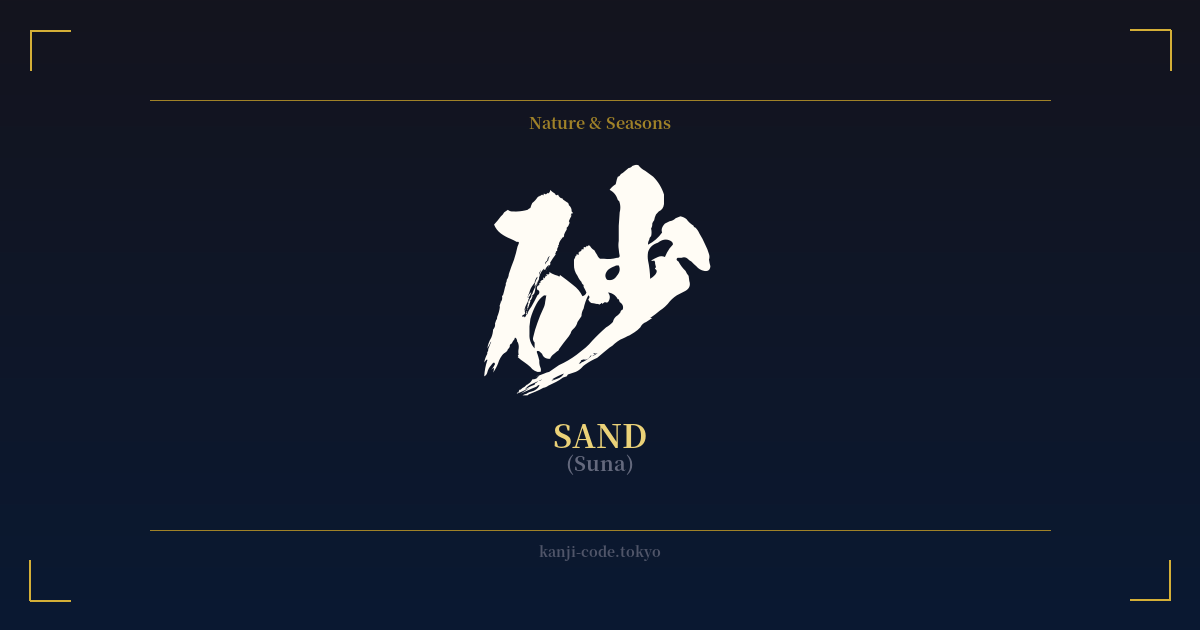
✍️ 砂 (Suna) — Cultural Context
The kanji 砂 (suna) is a beautiful example of Japanese ideography at its most intuitive. It is composed of two distinct elements: 石 (ishi), meaning 'stone,' and 少 (shō), meaning 'few' or 'small.' Together, they create a vivid picture: 'small stones,' or sand. This simple construction belies a wealth of cultural and philosophical depth that makes 砂 a potent symbol in Japanese culture.
Perhaps the most powerful association with 砂 is its central role in Japanese Zen gardens, known as karesansui (枯山水), or 'dry landscape gardens.' In these meticulously designed spaces, sand is not merely a decorative element; it is a canvas for contemplation. The raked white or grey sand often represents water—the vast ocean or flowing rivers—with carefully placed rocks symbolizing islands, mountains, or even mythical creatures. The act of raking the sand itself is a form of moving meditation, and the patterns created, from straight lines to swirling ripples, evoke a sense of calm, order, and fluidity.
This connection ties 砂 directly to the aesthetic and philosophical principles of wabi-sabi (侘寂), the appreciation of imperfection and transience. The patterns in the sand are temporary, easily disturbed by wind, rain, or a passing animal. This fragility serves as a constant reminder of mujō (無常), the Buddhist concept of impermanence. Just as every grain of sand is unique and part of a vast, ever-shifting whole, so too is life. The sand garden teaches that beauty exists in the fleeting moment and that peace can be found in accepting the natural flow of change.
Beyond Zen gardens, sand appears in Japanese folklore and expressions. The phrase 「砂を噛むよう」(suna o kamu yō), literally 'like chewing on sand,' is used to describe something utterly dry, boring, or devoid of flavor and interest. This speaks to the dual nature of sand: it can be a medium for profound beauty or a symbol of desolation and emptiness.
From the iconic Tottori Sand Dunes, a massive coastal desert landscape that has inspired artists for centuries, to the simple sandboxes in neighborhood parks, 砂 is a fundamental part of the Japanese physical and cultural landscape. It represents both the immense scale of geological time and the tiny, individual moments that make up existence.
🖌️ Font Styles for 砂
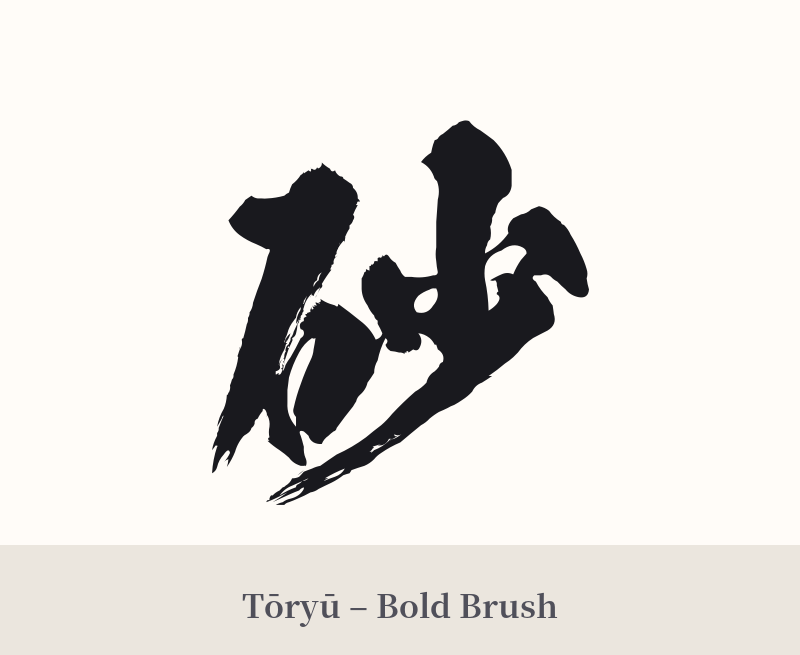
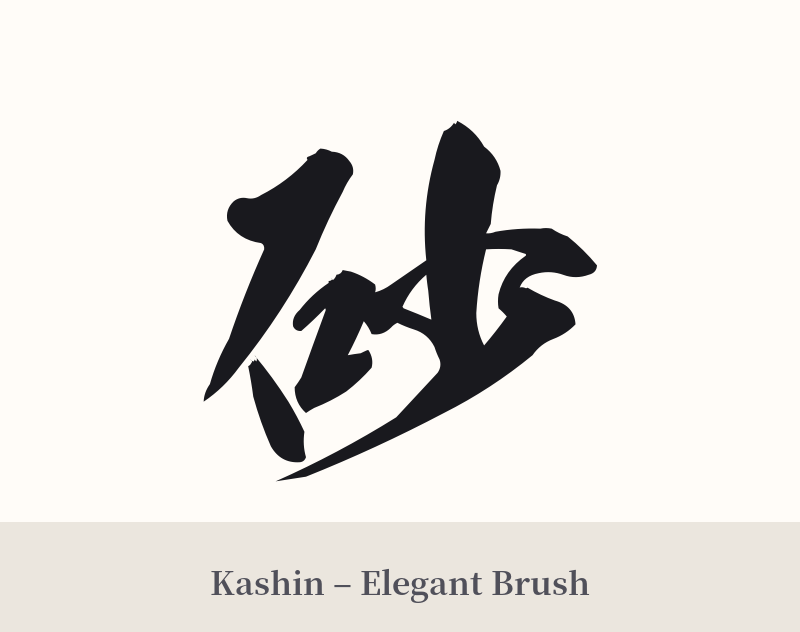
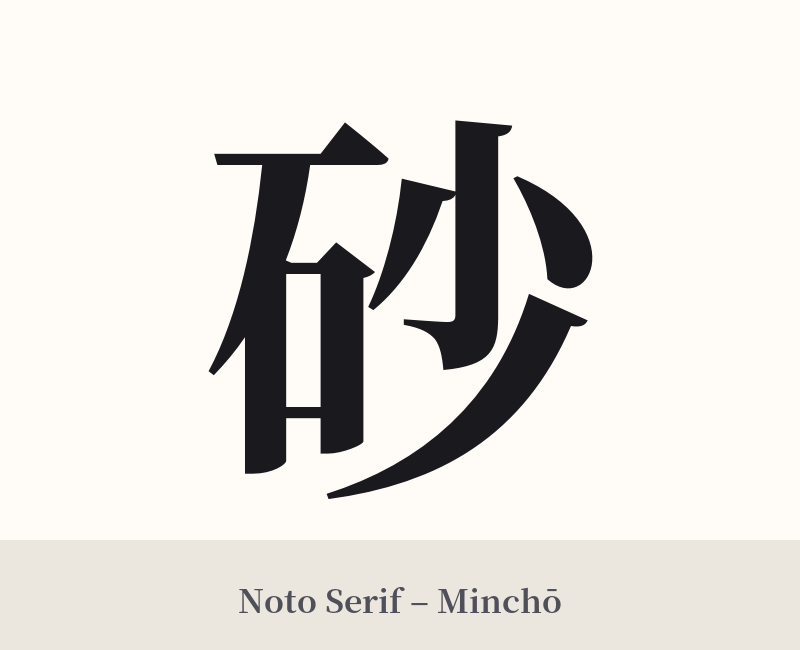
The same kanji can look dramatically different depending on the calligraphy style. Choose a font that matches the mood you want for your tattoo or design.
🎨 Tattoo Suitability
📐 Tattoo Design Guide
The kanji 砂 (suna) offers wonderful versatility for a tattoo design, lending itself to both minimalist and more elaborate concepts.
– Placement: For a subtle, personal piece, consider the inner wrist, behind the ear, or on the ankle. For a more prominent design, the forearm allows the character to be clearly legible, while the calf or shoulder blade provides a larger canvas to integrate it with other elements.
– Font Style: A standard, crisp Mincho or Gothic font emphasizes the character's clean lines and balanced structure. For a more organic and flowing feel, a semi-cursive (gyosho) or cursive (sosho) calligraphy style can beautifully evoke the image of raked sand or wind-swept dunes.
– Visual Tips: Consider having the strokes of the kanji themselves appear to be made of sand, or have the character slowly dissolving into individual grains at one edge. It can be the centerpiece of a larger design depicting a Zen garden (karesansui), with rake patterns flowing around it. Pairing it with a single, contrasting element like a smooth stone or a maple leaf can also create a powerful visual narrative.
Comments