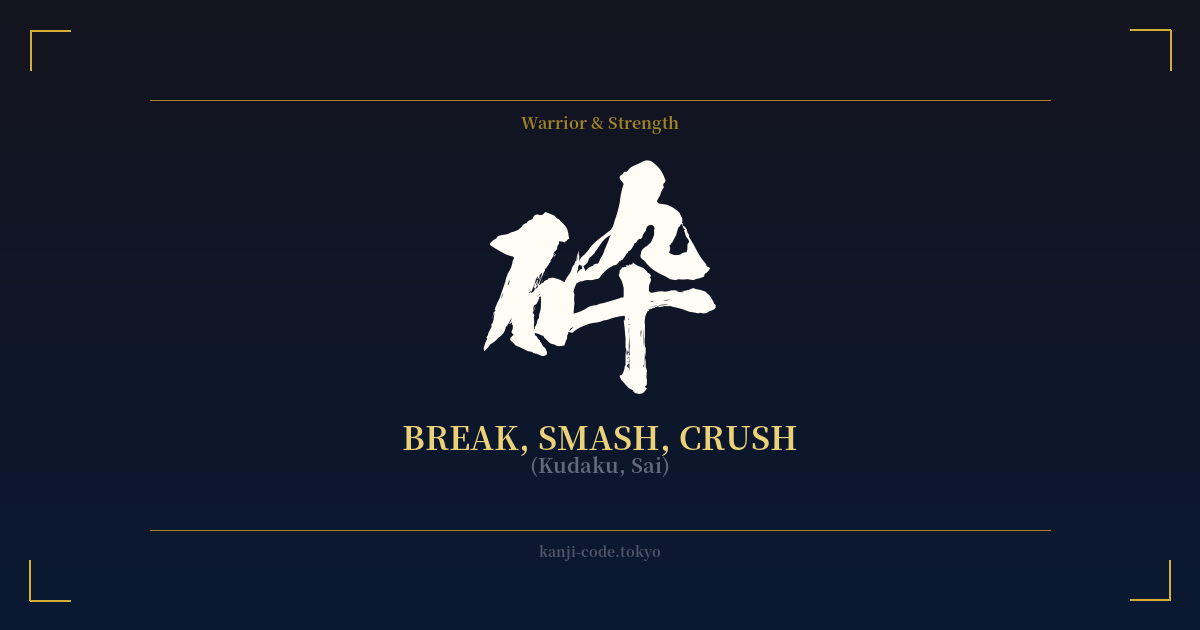
✍️ 砕 (Kudaku, Sai) — Cultural Context
The kanji 砕 (kudaku) is a character of immense force and visceral impact, embodying the very act of breaking, smashing, or crushing something into pieces. Its origin story is visually potent, combining the radical 石 (ishi), meaning 'stone,' with 卒 (sotsu), which can mean 'soldier' or 'to finish.' This paints a vivid picture: a soldier smashing a stone, or a stone being shattered completely. It’s a character not of gentle breaking, but of decisive, overwhelming force.
In its most literal sense, 砕 is used for physical destruction. You might use it to describe shattering ice (氷を砕く, kōri o kudaku) or crushing rocks. This raw power finds a prominent place in Japanese martial arts. The practice of tameshiwari (試し割り), breaking boards, tiles, or bricks with a single strike, is a physical manifestation of 砕. It's a test of focus, technique, and power, where the practitioner's energy is channeled to shatter a solid object.
However, the true depth of 砕 lies in its metaphorical applications. One of its most profound and somber uses is in the word 玉砕 (gyokusai), literally 'shattering like a jewel.' This term became a militaristic euphemism during World War II for honorable annihilation—choosing to fight to the last person and die rather than surrender. It evokes the image of a precious gem shattering into countless brilliant fragments, an honorable end rather than a tarnished capture. This usage carries significant historical weight and a sense of tragic finality.
On a less grim note, 砕 can represent the act of breaking down complex concepts into simpler parts. A teacher might 'kudaku' a difficult theory to make it understandable for students. The adjective 'kudaketa' (砕けた) describes a person's manner or speech as being casual, informal, and easygoing—literally 'broken down' from a formal, rigid state. It’s the difference between stiff, formal language and a relaxed chat among friends.
This duality makes 砕 a fascinating character. It is at once the destructive force that pulverizes an enemy—粉砕 (funsai)—and the intellectual process that simplifies a problem. It can represent the ultimate sacrifice in battle or the friendly ease of an informal conversation. This range, from brute force to intellectual clarity, gives 砕 a dynamic and compelling presence in the Japanese language.
🖌️ Font Styles for 砕
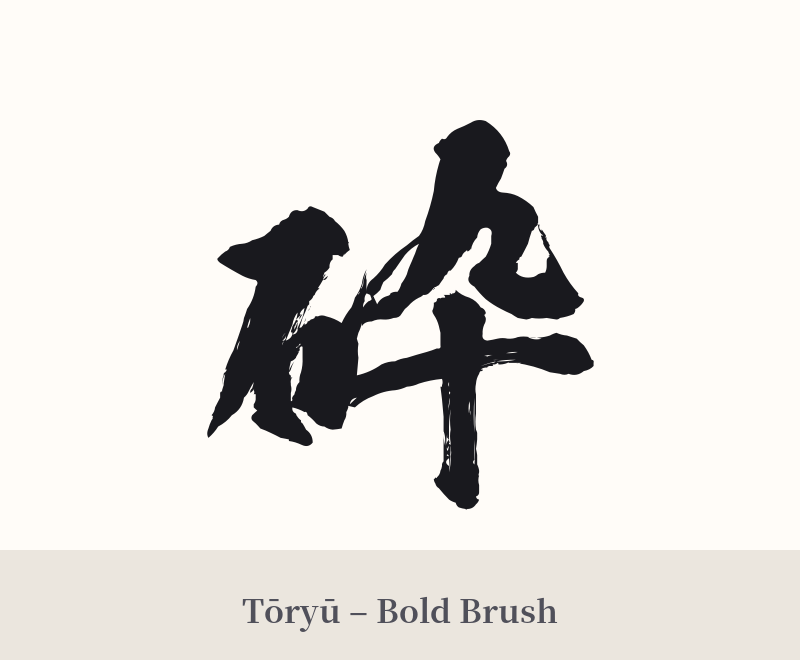
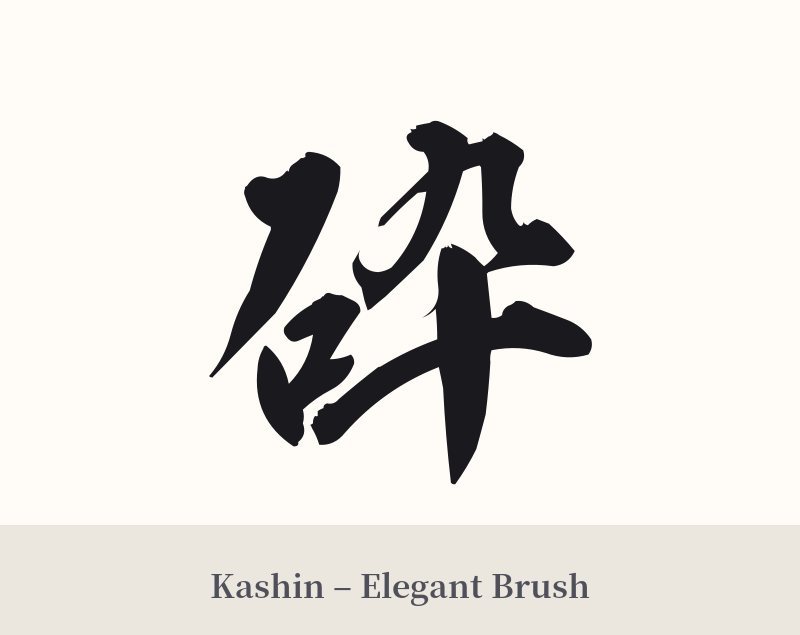
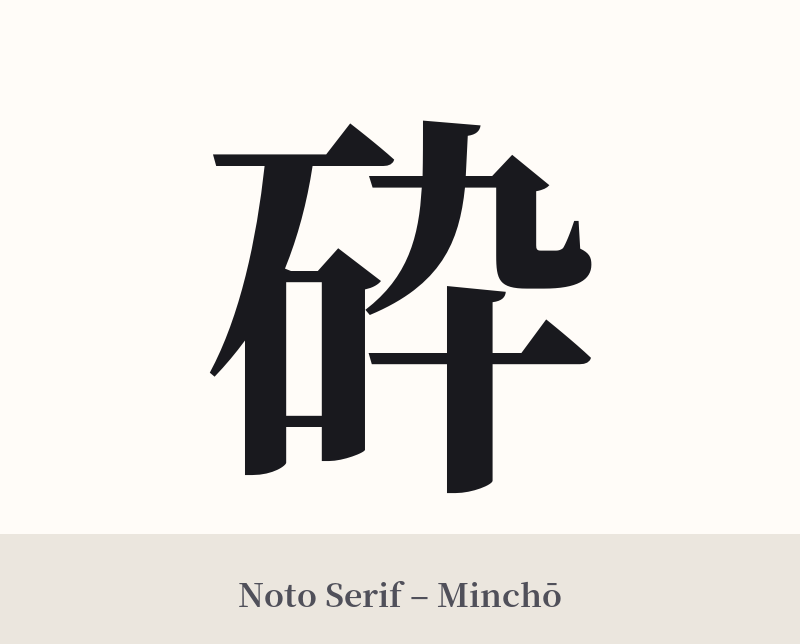
The same kanji can look dramatically different depending on the calligraphy style. Choose a font that matches the mood you want for your tattoo or design.
🎨 Tattoo Suitability
📐 Tattoo Design Guide
The kanji 砕 offers a lot of potential for a visually impactful tattoo due to its strong meaning and balanced structure.
– Placement: This character works well as a standalone piece on areas that can showcase its bold form. Consider the forearm, calf, back of the shoulder, or chest. These placements allow the character to be seen clearly and convey its sense of power.
– Style: For a raw, forceful look, a thick, blocky Kaisho (block script) or a heavy Gothic-style font emphasizes its destructive power. For a more dynamic and artistic interpretation, a Gyōsho (semi-cursive) or Sōsho (cursive) style can capture the motion of shattering, with ink splatters or fading strokes to represent fragments.
– Visual Elements: Consider incorporating visual elements that enhance its meaning. You could have the character itself appearing to crack or shatter. Another idea is to place it over an image of something being broken, like a chain or a rock, to symbolize breaking free or overcoming a specific obstacle.
Comments