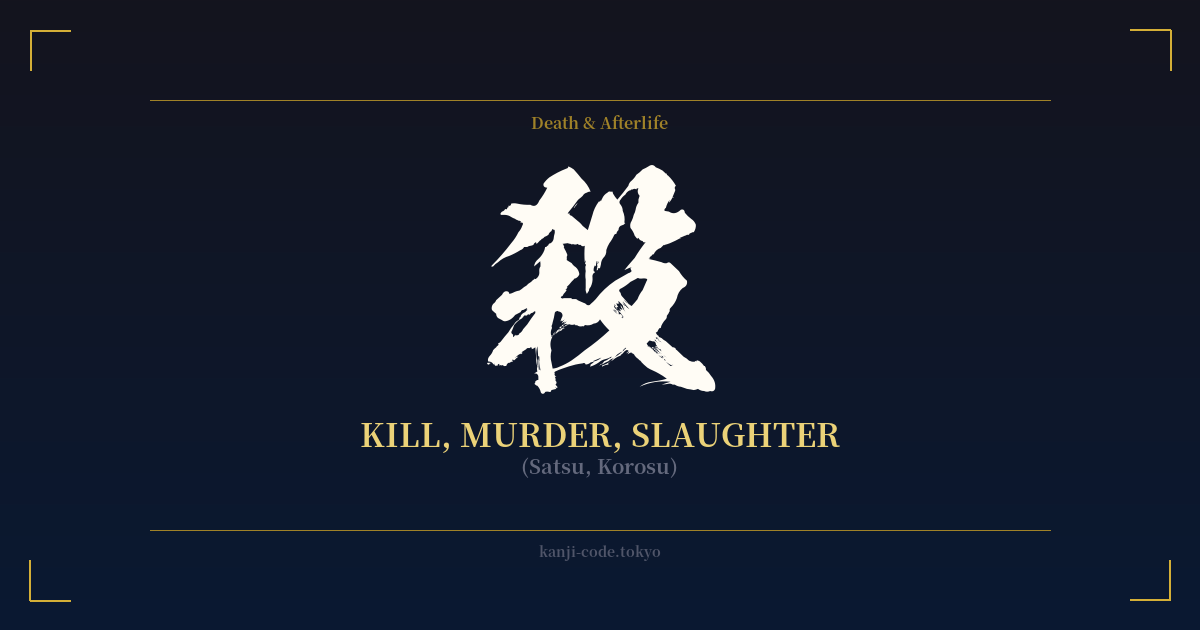
✍️ 殺 (Satsu, Korosu) — Cultural Context
The kanji 殺 (satsu) is one of the most direct and unsettling characters in the Japanese language, encapsulating the raw act of killing, murdering, or slaughtering. Its form tells a story of violence. The character is a compound of radicals that historically depicted a weapon (殳) striking a victim, creating a visceral and unambiguous visual representation of its meaning.
In modern Japan, 殺 is a word reserved for the gravest of contexts. You will see it in news reports about crimes in words like `satsujin` (殺人, murder) and `ansatsu` (暗殺, assassination). It's also a component of `jisatsu` (自殺, suicide), literally 'self-kill'. The presence of this kanji immediately signals a serious, tragic, and often brutal event. It carries a heavy weight that is completely devoid of any positive or romanticized connotations in daily life.
This stark reality contrasts sharply with its popular usage in global fiction, particularly in Japanese anime, manga, and video games. In these contexts, 殺 is often used to evoke a sense of danger, power, and 'cool' edginess. Think of a character's ultimate move, the name of a deadly technique, or the title of a dark fantasy series like 'Akame ga Kill!' (アカメが斬る!). This is where most non-Japanese speakers encounter the character, divorced from its real-world gravity.
Within the historical context of the samurai, a sliver of philosophical nuance can be found. The concept of the `satsujinken` (殺人剣), the 'killing sword,' was often contrasted with the `katsujinken` (活人剣), the 'life-giving sword.' The latter represents the martial artist's highest ideal: possessing the skill to take a life but having the wisdom and control to instead use that power to protect, preserve, and nurture life. However, this is a deep philosophical duality, and tattooing the 'killing' half alone completely misses this profound point, opting instead for the purely destructive aspect.
Ultimately, the cultural gap in perception is immense. While it may look cool and powerful on a fictional character's forehead or weapon, in the real world, it is a symbol of violence and tragedy. It is not a character that inspires awe, but one that evokes a sense of dread and sobriety.
🖌️ Font Styles for 殺
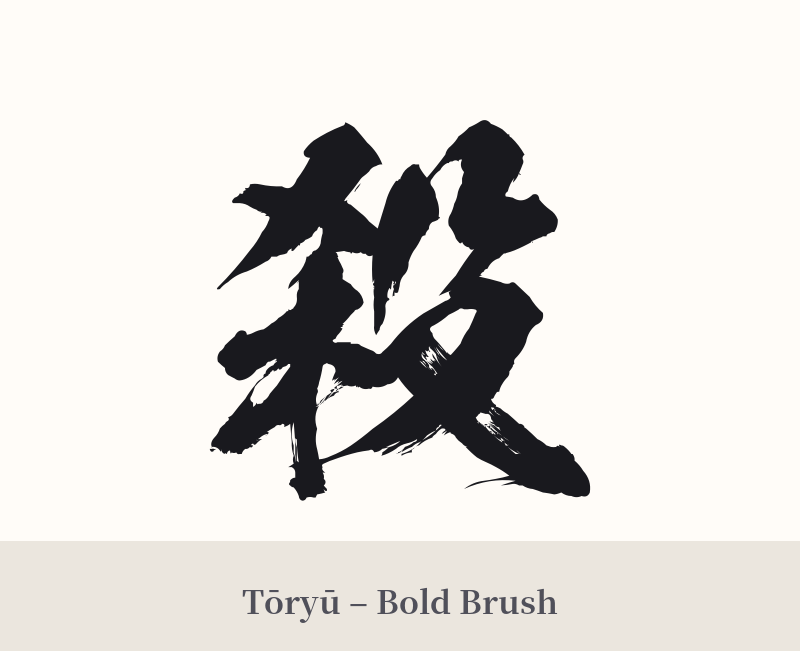
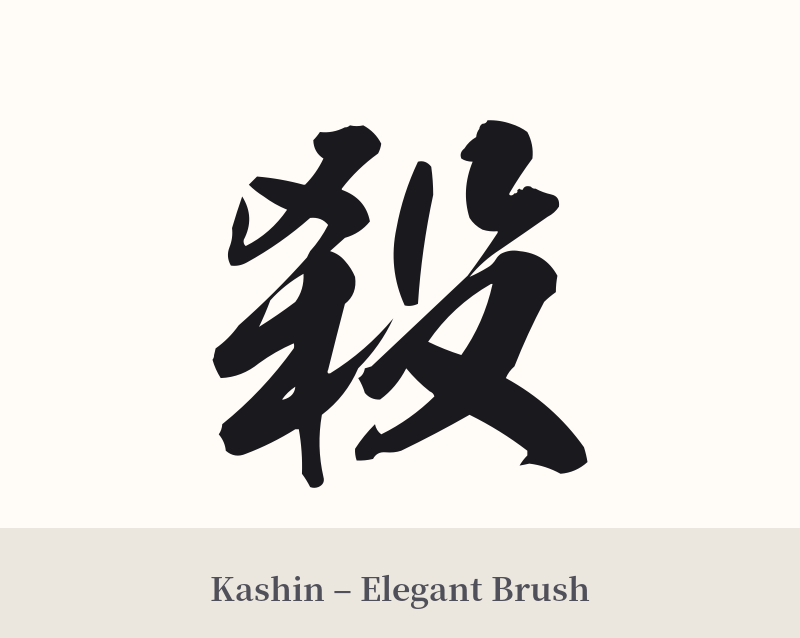
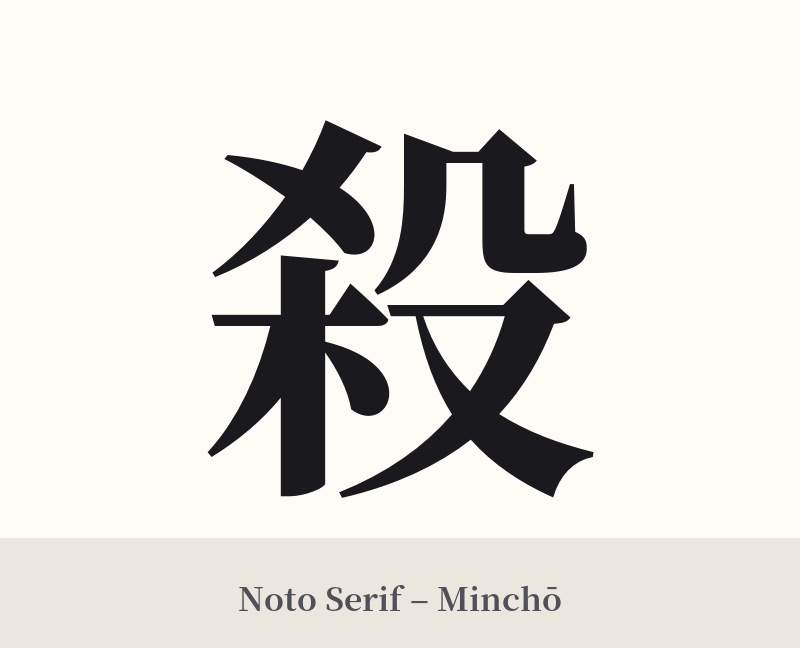
The same kanji can look dramatically different depending on the calligraphy style. Choose a font that matches the mood you want for your tattoo or design.
🎨 Tattoo Suitability
📐 Tattoo Design Guide
Given its aggressive and controversial nature, careful consideration of a 殺 tattoo is critical.
– Placement: Highly visible areas like the neck, face, or hands will send an extremely confrontational message. A more discreet location like the back, ribs, or inner arm allows for a personal connection without constantly alarming others.
– Font Style: The style can drastically alter the mood. A rough, scratchy, or dripping 'splatter' calligraphy style (gyōsho or sōsho) will amplify its violent energy. In contrast, a clean, blocky font like Mincho or Gothic can give it a cold, clinical, or even 'stamped' and impersonal feel.
– Visual Elements: 殺 has a strong standalone presence. Adding imagery can be risky but powerful. Combining it with a broken chain could symbolize 'killing' a bad habit, while pairing it with a lotus flower might create a contrast between violence and purity. However, adding elements like blood splatters or weapons will simply double down on the aggressive interpretation.
Comments