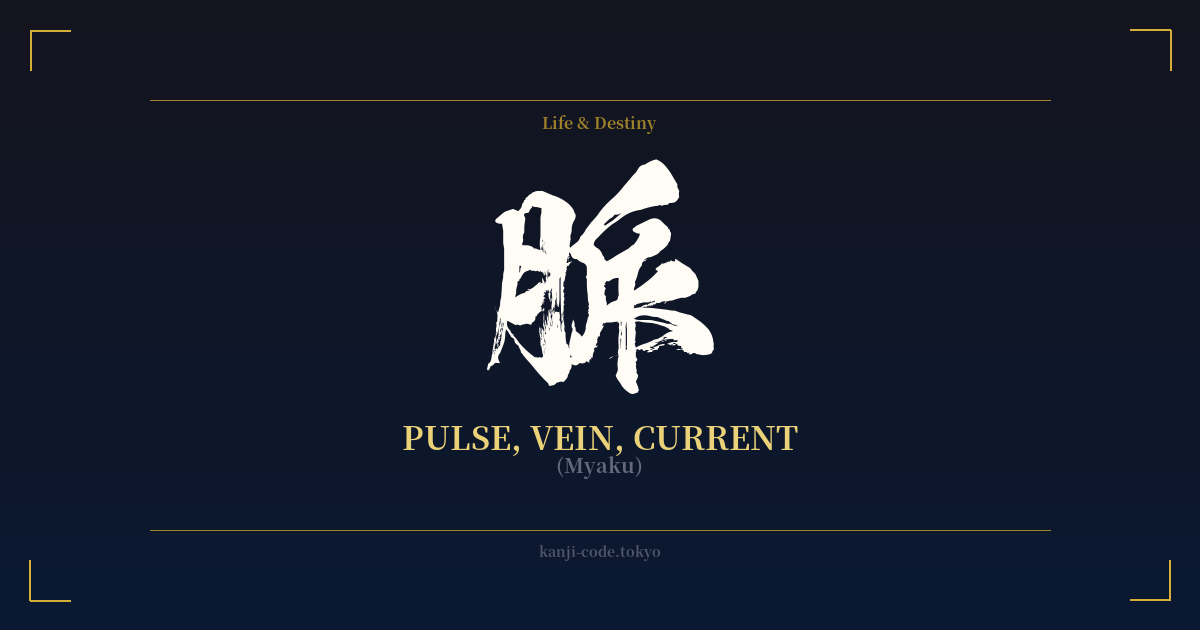
✍️ 脈 (Myaku) — Cultural Context
The kanji 脈 (myaku) is a character that flows through the very heart of Japanese language and thought, connecting the physical body to the vast, abstract currents of life and nature.
At its most literal level, 脈 refers to the pulse beating in your wrist or the veins that carry life-giving blood. In traditional Eastern medicine, the act of 'taking the pulse' (脈を診る – myaku o miru) is not just a measurement of heart rate but a sophisticated diagnostic art, revealing the state of one's internal energy, or 'Ki' (気). The doctor feels for the subtle qualities of the pulse to understand the body's entire ecosystem.
The character's origin beautifully illustrates this concept. It is composed of two parts: the left radical 月, which is a variant of 肉 (niku), meaning 'flesh' or 'body.' The right side is a simplified form of 永 (ei), which means 'eternal' or 'long' and pictographically represents a branching river. Together, 脈 is the 'eternal, branching river within the body'—a powerful and poetic image of life's continuous flow.
This idea of a continuous, branching connection extends far beyond anatomy. In Japanese, 脈 is the root of many important concepts. A mountain range, a continuous chain of peaks, is a 山脈 (sanmyaku). A vein of precious ore in the earth is a 鉱脈 (kōmyaku). The crucial flow of logic and meaning in a text is its 文脈 (bunmyaku), or 'context.'
Perhaps most significantly in Japanese culture, 脈 forms the word 人脈 (jinmyaku), which translates to one's 'personal network' or 'connections.' This is not just a casual list of contacts; it's a vital, living network of relationships built on trust and mutual obligation, considered essential for success in both business and personal life. Your jinmyaku is your lifeline.
Even in daily slang, the concept persists. The phrase 脈がある (myaku ga aru), literally 'there is a pulse,' is used colloquially to mean 'there's a chance' or 'there's hope,' often in the context of a potential romance or a business deal. If someone says 脈がない (myaku ga nai), it means the situation is hopeless—the life current has stopped. This single character, therefore, encapsulates everything from the beat of a heart to the web of human destiny, reminding us that all things are part of a larger, interconnected flow.
🖌️ Font Styles for 脈
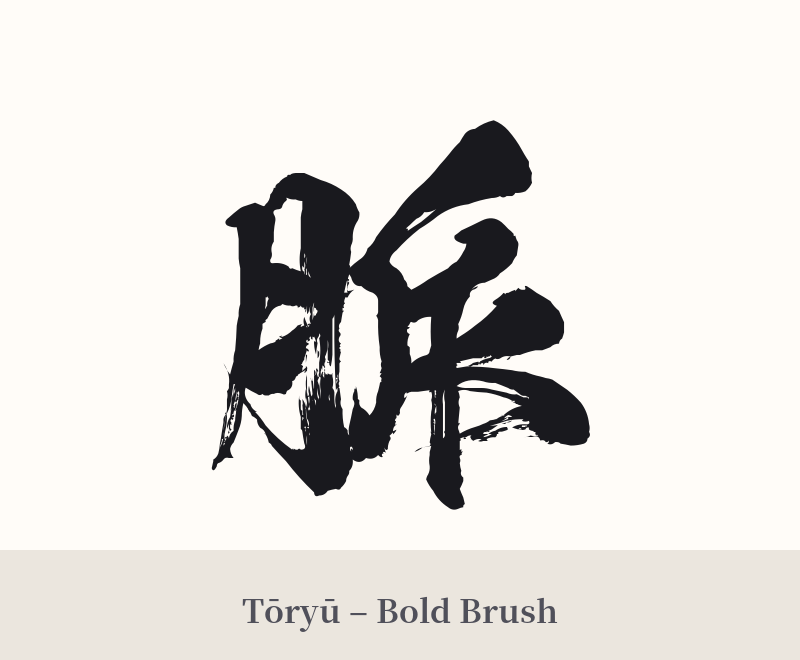
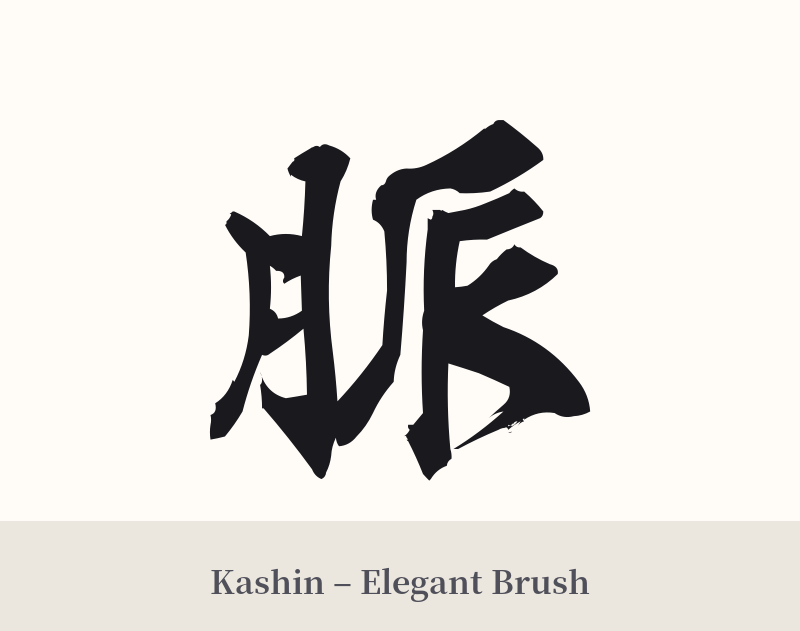
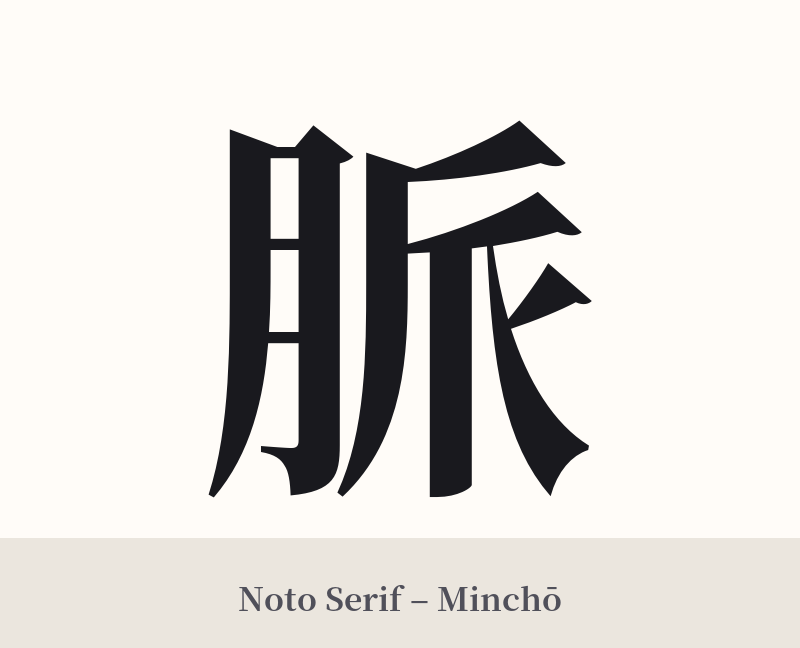
The same kanji can look dramatically different depending on the calligraphy style. Choose a font that matches the mood you want for your tattoo or design.
🎨 Tattoo Suitability
📐 Tattoo Design Guide
The kanji 脈 offers subtle yet profound design possibilities that emphasize flow and connection.
– Placement: The wrist is a very literal and powerful placement, directly over the pulse. Other strong choices include the forearm, along the spine to represent the central channel of energy, or on the back of the neck where it can be a more private symbol.
– Font Style: A flowing, semi-cursive or fully cursive calligraphy (gyōsho or sōsho) style is highly recommended. This captures the essence of 'myaku' as a current. A standard, blocky font (kaisho) can also work, giving it a sense of stability and foundation.
– Visual Tips: Consider using red ink to connect directly to the idea of blood, life, and vitality. Alternatively, a deep blue or black ink can evoke the feeling of a river or current. This kanji can also be integrated into a larger design, perhaps as the 'veins' of a leaf, the roots of a tree, or flowing from a heart symbol, to make its metaphorical meaning more explicit.
Comments