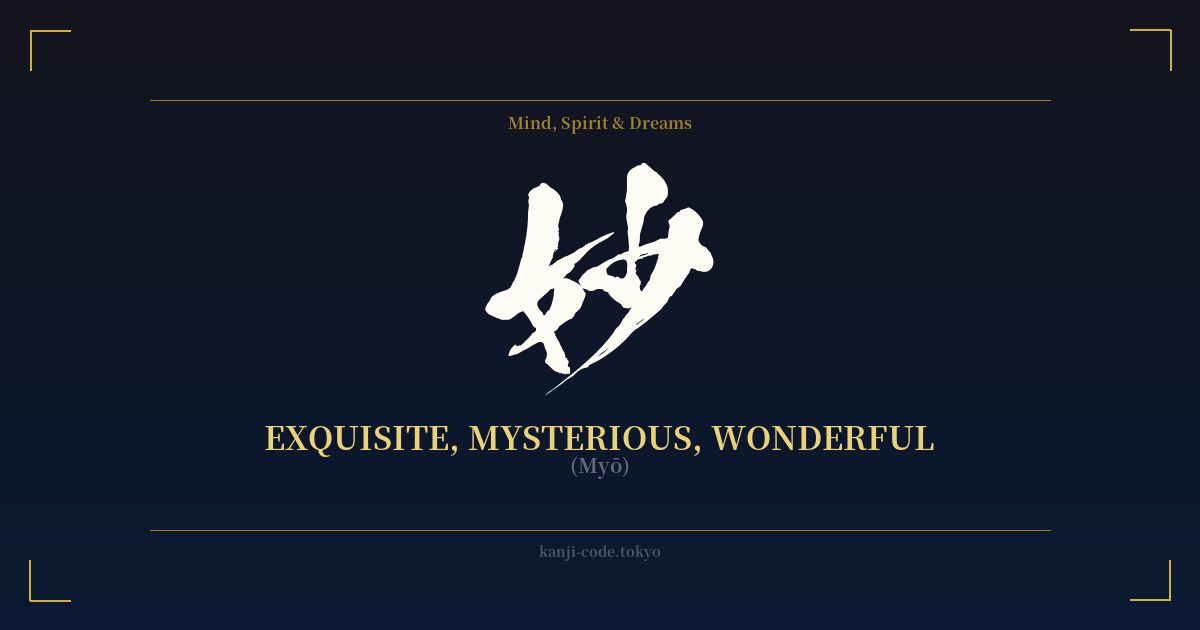
✍️ 妙 (Myō) — Cultural Context
The kanji 妙 (myō) is a gateway to the heart of Japanese aesthetics and philosophy. While its dictionary definitions include 'exquisite,' 'wonderful,' and 'mysterious,' its true essence lies in the space between these words. It describes a quality that is so subtly brilliant and uncannily perfect that it defies simple explanation. It’s not a loud, overt beauty, but a quiet, profound wonder that inspires awe.
The character's origin offers a clue to its meaning. It is composed of two radicals: 女 (onna), meaning 'woman,' and 少 (shō), meaning 'small' or 'few.' Together, they originally depicted a 'young woman,' a symbol of subtle, delicate, and mysterious beauty. Over centuries, this concrete image evolved into a purely abstract concept, capturing that same feeling of ineffable grace and charm in a much broader sense.
Nowhere is the significance of 妙 more profound than in Buddhism. It is the very first character in the title of the Lotus Sutra, one of the most important texts in East Asian Buddhism: 妙法蓮華経 (Myōhō Renge Kyō). Here, 妙 is translated as 'Mystic' or 'Wonderful,' as in the 'Mystic Law.' It represents the ultimate, inexpressible truth of the universe—a reality so deep and interconnected that it can only be experienced, not explained. This connection elevates 妙 from a simple aesthetic term to one of deep spiritual significance.
In the secular world, 妙 appears in words that describe exceptional skill or phenomena. For example, 絶妙 (zetsumyō) means 'exquisite' or 'perfectly timed,' used to describe a chef's masterful seasoning or a comedian's flawless timing. 奇妙 (kimyō) means 'strange' or 'curious,' pointing to something that is mysteriously odd. In all its uses, 妙 points to something that operates on a level beyond the ordinary, a wonderful strangeness that captures the imagination.
🖌️ Font Styles for 妙
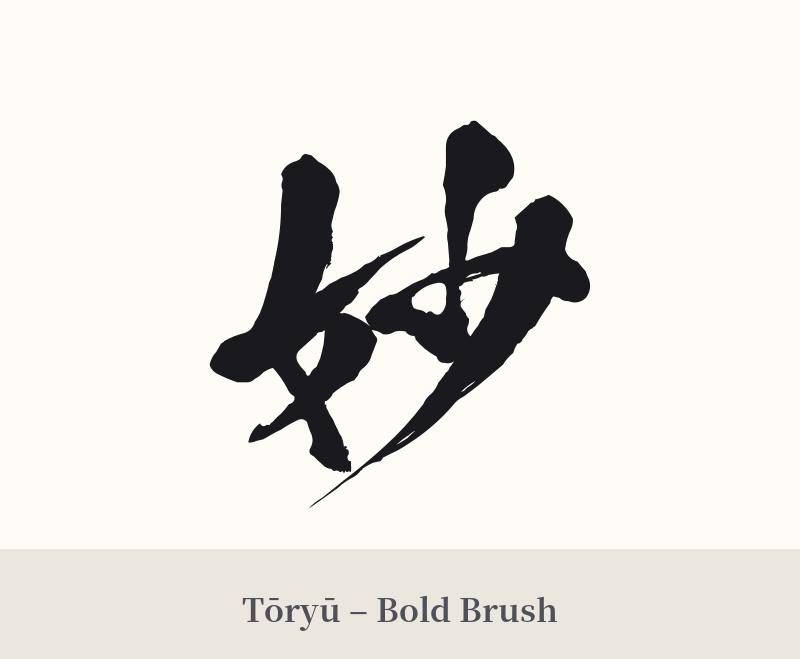
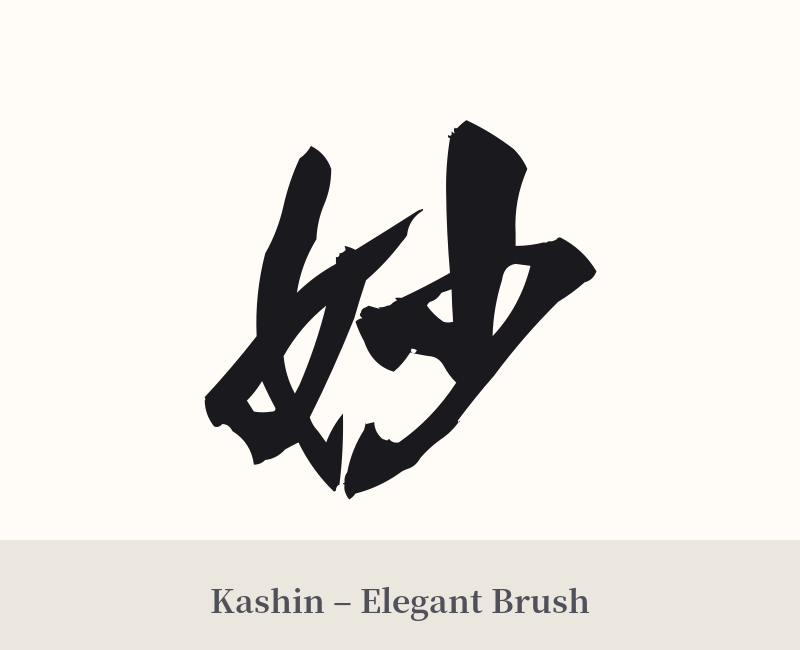
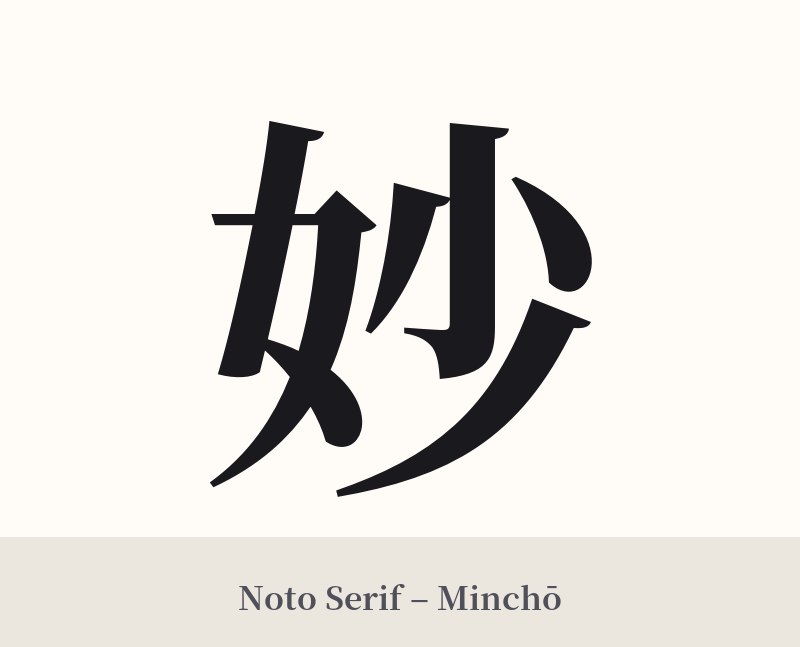
The same kanji can look dramatically different depending on the calligraphy style. Choose a font that matches the mood you want for your tattoo or design.
🎨 Tattoo Suitability
📐 Tattoo Design Guide
The kanji 妙 embodies subtlety and elegance, and its tattoo design should reflect that. Its simple structure allows for versatility in both style and placement.
– Placement: Due to its refined nature, 妙 works beautifully in delicate locations. Consider the inner wrist, the nape of the neck, behind the ear, or along the collarbone. For a larger piece, it can be placed on the forearm or shoulder blade, where its clean lines can be appreciated.
– Font Style: A standard, clean Kaisho (block) or Mincho (serif) style emphasizes its balance and clarity. For a more artistic and fluid feel that captures its 'mysterious' aspect, a semi-cursive Gyosho script or even a highly abstract Sosho script would be stunning. These styles can transform the character into a work of art in itself.
– Visual Tips: 妙 is powerful enough to stand alone. Avoid cluttering it with other elements that might distract from its profound meaning. If you wish to add a complementary image, a single, unfurling lotus petal or a faint wisp of smoke can tie into its Buddhist and mysterious connotations without overwhelming the kanji.
Comments