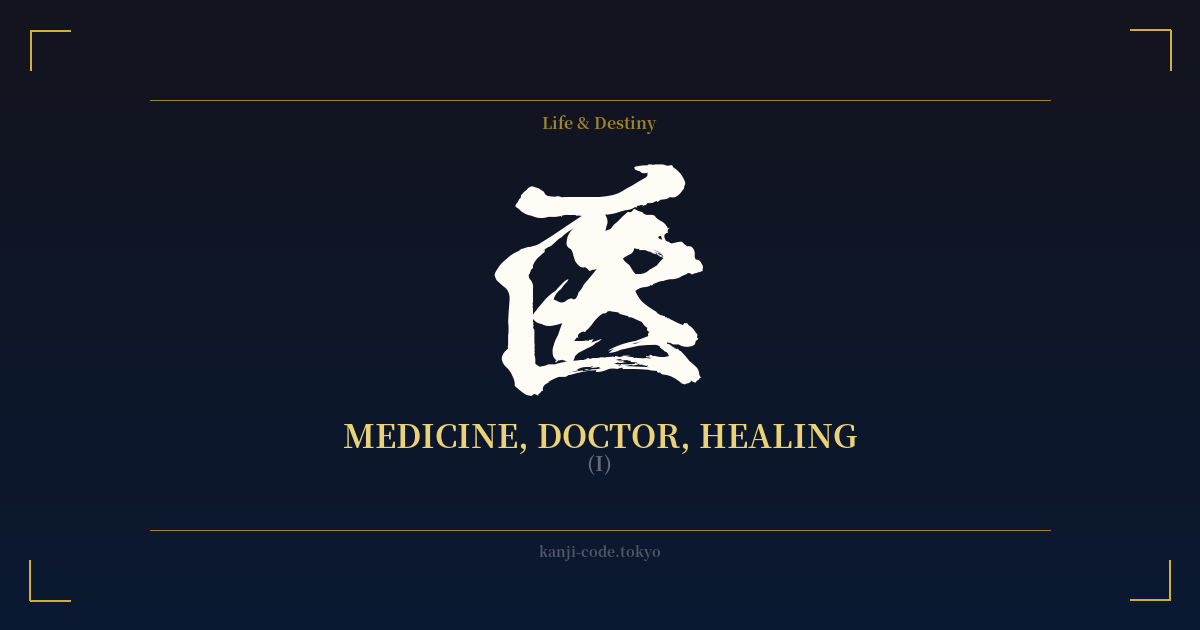
✍️ 医 (I) — Cultural Context
The kanji 医 (I) is the cornerstone character for the entire field of medicine in Japanese culture. It embodies not just the profession of a doctor but the very concepts of healing, treatment, and medical science. Its importance in society is immense, reflecting the deep respect afforded to those who practice the healing arts.
The character's origin provides a fascinating glimpse into ancient views on medicine. The most common etymological theory breaks 医 down into two parts. The outer radical, 匚 (hakogamae), represents a box or container. The inner component, 矢 (ya), means 'arrow'. This combination is thought to depict a box of tools, with the arrow symbolizing a sharp instrument used for treatment, possibly even an early form of acupuncture needle or lancet.
An older, more complex form of the character (醫) included 酉 (tori), the radical for 'sake' or alcohol, placed at the bottom. This version vividly illustrates the historical use of alcoholic concoctions as disinfectants, anesthetics, or medicinal bases. The top part of this older form also contained elements representing a weapon (殳) used to 'strike' or expel illness, which was often personified as an evil spirit. Thus, the kanji's history encapsulates a journey from shamanistic exorcism to the use of tools and medicinal substances.
In modern Japan, 医 is a symbol of scientific advancement, precision, and compassionate care. You see it everywhere in the context of health. A doctor is an `医者` (isha), medical science is `医学` (igaku), and medical care is `医療` (iryō). The path to becoming a doctor in Japan is notoriously rigorous, and the profession is held in extremely high regard. The character 医, therefore, carries the weight of that societal trust and respect.
Beyond its literal, clinical meaning, 医 can also be interpreted on a more personal level. It can represent a journey of healing, not just from physical ailments but from emotional or spiritual wounds. For someone who has overcome a great health challenge, or for someone who dedicates their life to helping others heal, this kanji can be a powerful and understated symbol of their path. It speaks to a quiet strength, a dedication to restoration, and the fundamental human desire to mend what is broken.
🖌️ Font Styles for 医
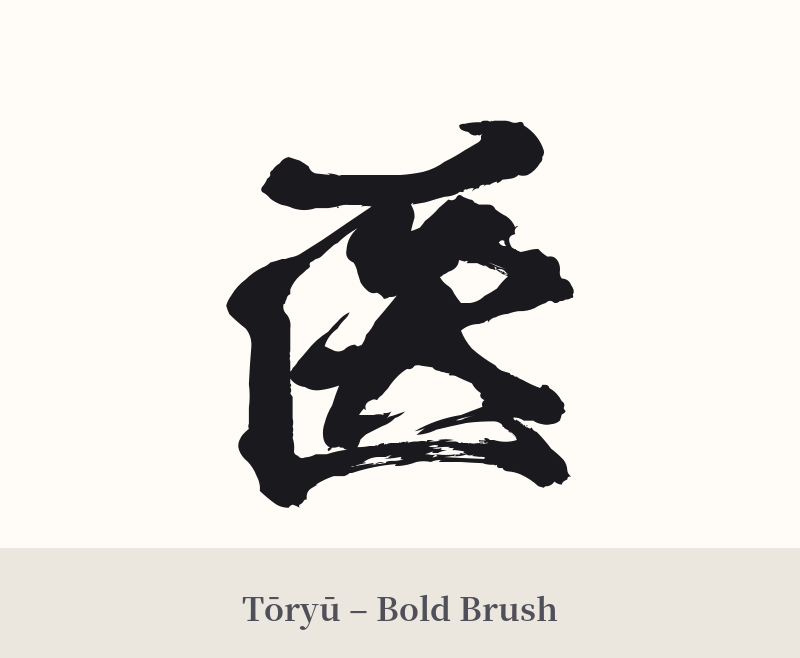
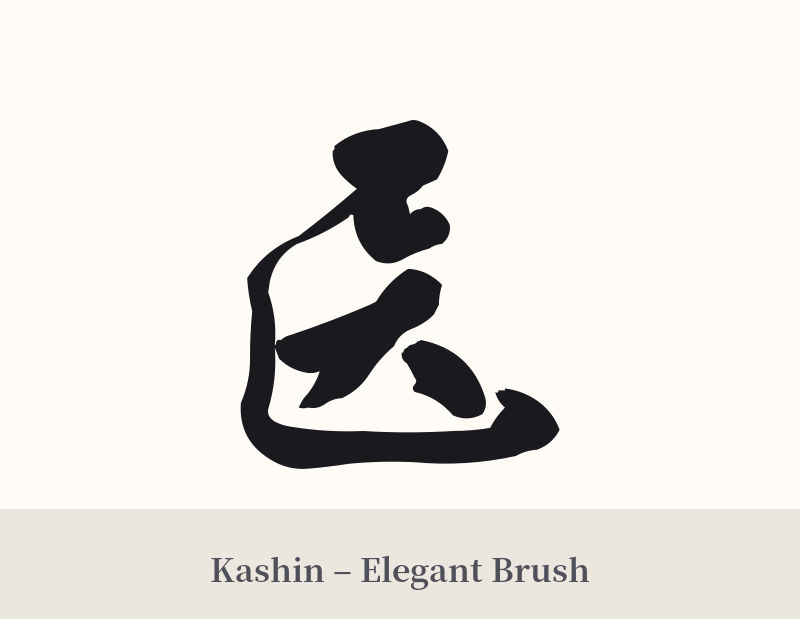
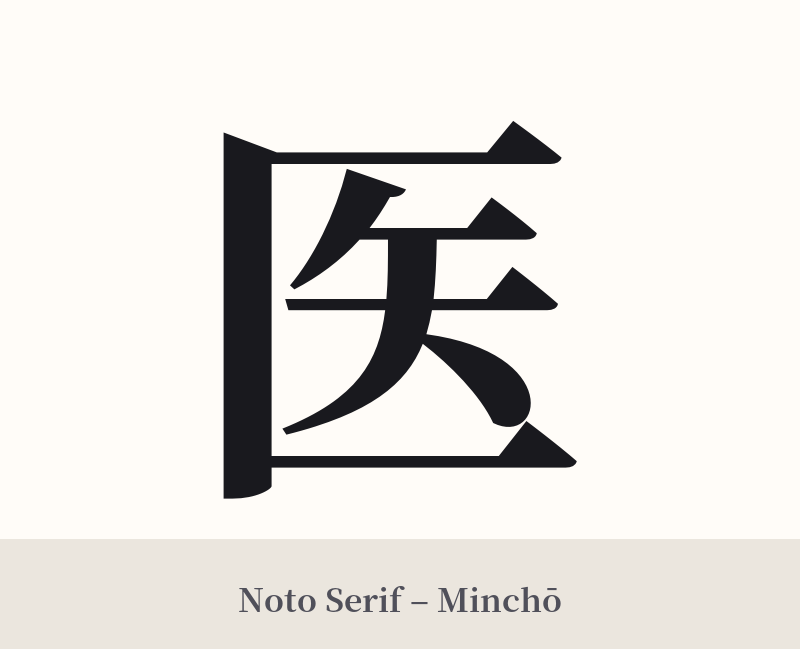
The same kanji can look dramatically different depending on the calligraphy style. Choose a font that matches the mood you want for your tattoo or design.
🎨 Tattoo Suitability
📐 Tattoo Design Guide
The kanji 医 is defined by its simplicity and clean lines, which should guide any tattoo design choices. Its straightforward nature makes it versatile, but it thrives with a minimalist approach.
– Placement: Due to its compact form, 医 works well in smaller, discreet locations. Consider the inner wrist, the forearm, behind the ear, or on the ankle. For a more prominent statement, it could be placed on the back of the neck or between the shoulder blades.
– Font Style: A standard, crisp block script (Kaisho) emphasizes the kanji's connection to science and precision. For a softer feel that highlights the 'healing' aspect, a semi-cursive (Gyosho) style can add a touch of organic flow without losing legibility. Avoid overly decorative or aggressive fonts, which would clash with the character's serious, caring nature.
– Visual Combinations: While it stands alone well, 医 can be paired with other elements to deepen its meaning. Combining it with a single red line could symbolize a heartbeat (ECG). Placing it within an Enso circle can represent the completion of a healing journey. It could also be subtly integrated with imagery like a lotus flower (rebirth, purity) or a snake, echoing the Rod of Asclepius, a Western symbol of medicine.
Comments