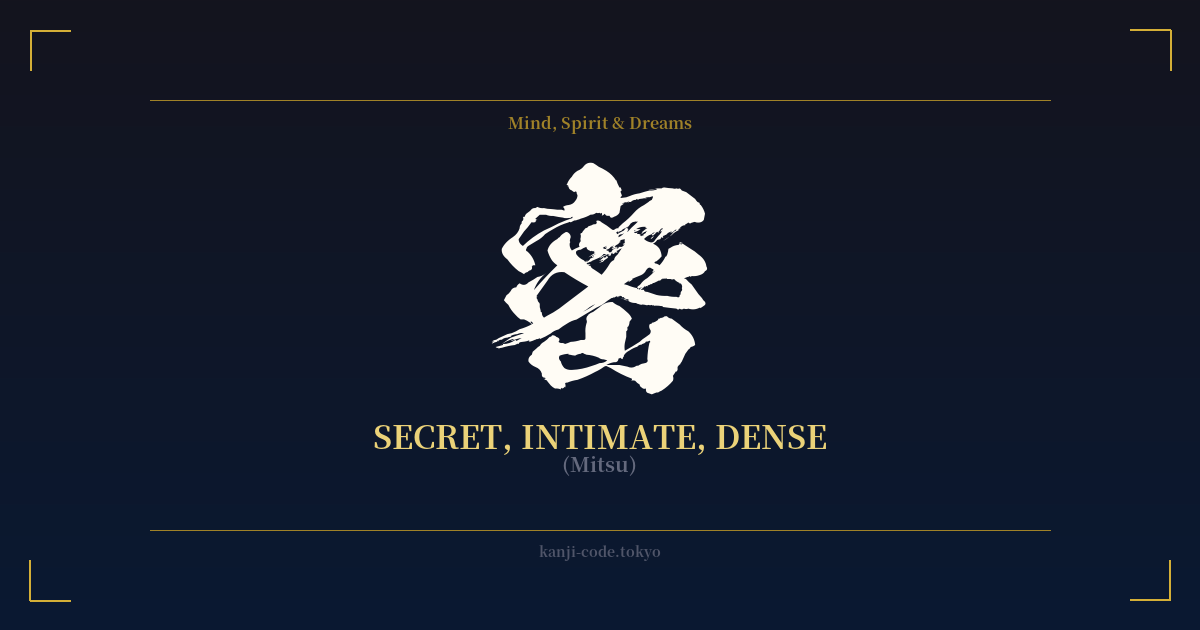
✍️ 密 (Mitsu) — Cultural Context
The kanji 密 (mitsu) is a character of fascinating depth and duality, weaving together concepts that seem distinct yet are deeply interconnected: secrecy, intimacy, and density. Its form offers the first clue to its meaning. It combines the radical 宀 (ukammuri), representing a roof or house, with 必 (kanarazu), meaning 'certainty' or 'necessity'. Together, they create a powerful image: something kept securely under a roof, hidden away from the outside world.
This leads to its most common understanding: that of a secret. The Japanese word for secret, 秘密 (himitsu), uses this kanji as its core. This isn't just about hidden information, but also the feeling of privacy, confidentiality, and things kept under wraps. It evokes a sense of mystery, of knowledge that is not for public consumption, a concept deeply ingrained in Japanese aesthetics and social interactions.
From this idea of being hidden and close, the meaning of 'intimacy' blossoms. A relationship that is intimate (親密, shinmitsu) is one that is close, private, and shared between a select few. It is a connection that exists in a space away from the public eye. 密 captures the essence of this closeness, the shared secrets and understanding that form the bedrock of a deep bond. It’s the quiet comfort of being near someone, physically or emotionally.
This physical closeness brings us to the third meaning: 'density'. 密 describes things that are packed tightly together, with little space between them. This can be seen in words like 密度 (mitsudo), or 'density'. While this can be a neutral, scientific term, it gained a powerful new social dimension during the COVID-19 pandemic. The Japanese government's public health campaign centered on avoiding the 'Three Mitsu' (三密, sanmitsu): closed spaces, crowded places, and close-contact settings. This campaign was so ubiquitous that 'Sanmitsu' was voted the word of the year for 2020. This has left a lasting, unavoidable imprint on the modern perception of the character.
Perhaps the most profound layer of 密 is its spiritual one. It is the first character in 密教 (Mikkyō), which translates to 'Esoteric Buddhism'. This refers to schools like Shingon and Tendai, where teachings were considered 'secret'—not because they were withheld, but because they could only be truly understood through direct transmission from master to disciple. This context elevates 密 from a simple secret to a symbol of deep, hidden wisdom and spiritual truth that requires dedication to uncover.
🖌️ Font Styles for 密
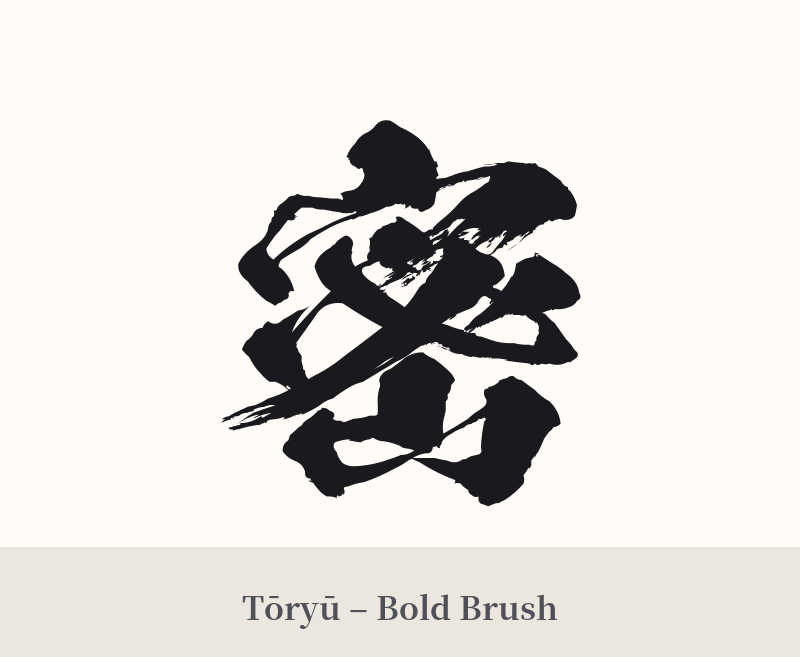
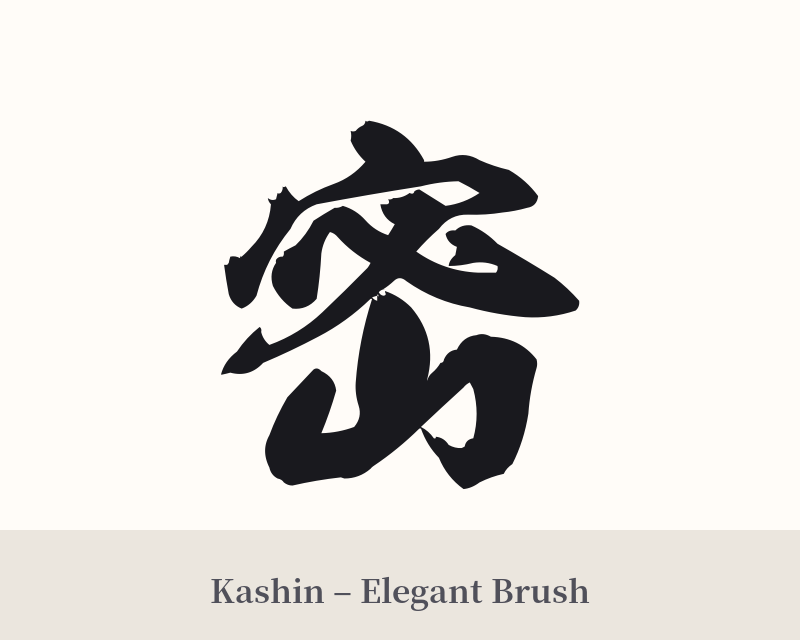
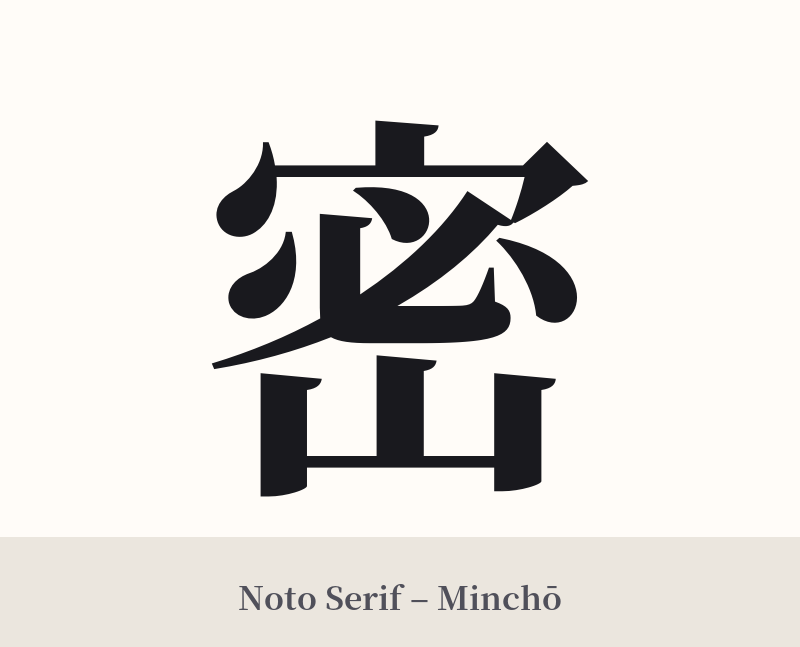
The same kanji can look dramatically different depending on the calligraphy style. Choose a font that matches the mood you want for your tattoo or design.
🎨 Tattoo Suitability
📐 Tattoo Design Guide
The multiple meanings of 密 (Mitsu) offer rich inspiration for a tattoo design. Its placement and style can be used to emphasize the specific nuance you wish to convey.
– Placement: To honor the 'secret' or 'intimate' nature of the kanji, consider discreet locations. The inner wrist, behind the ear, along the ribcage, or on the inner ankle are all excellent choices that keep the symbol personal and close to the body. For a more open declaration of a close bond, the forearm can work well.
– Font Style: The choice of script can dramatically alter the feel. A flowing, cursive style like Gyōsho or Sōsho can enhance the sense of mystery and elegance. For a feeling of clarity and strength, as in a strong bond, a clean and precise Kaisho (block) or Mincho (serif) style is ideal. To represent the 'esoteric' or 'dense' aspects, a bold, heavy-stroked font would be very effective.
– Visual Tips: Consider integrating 密 into a larger design. It could be partially obscured by a flower, smoke, or water to visually represent its 'hidden' nature. Using a single-needle style can give it a delicate, secret-like quality. Avoid cluttering the area around the kanji unless your goal is to explicitly represent the idea of 'density'.
Comments