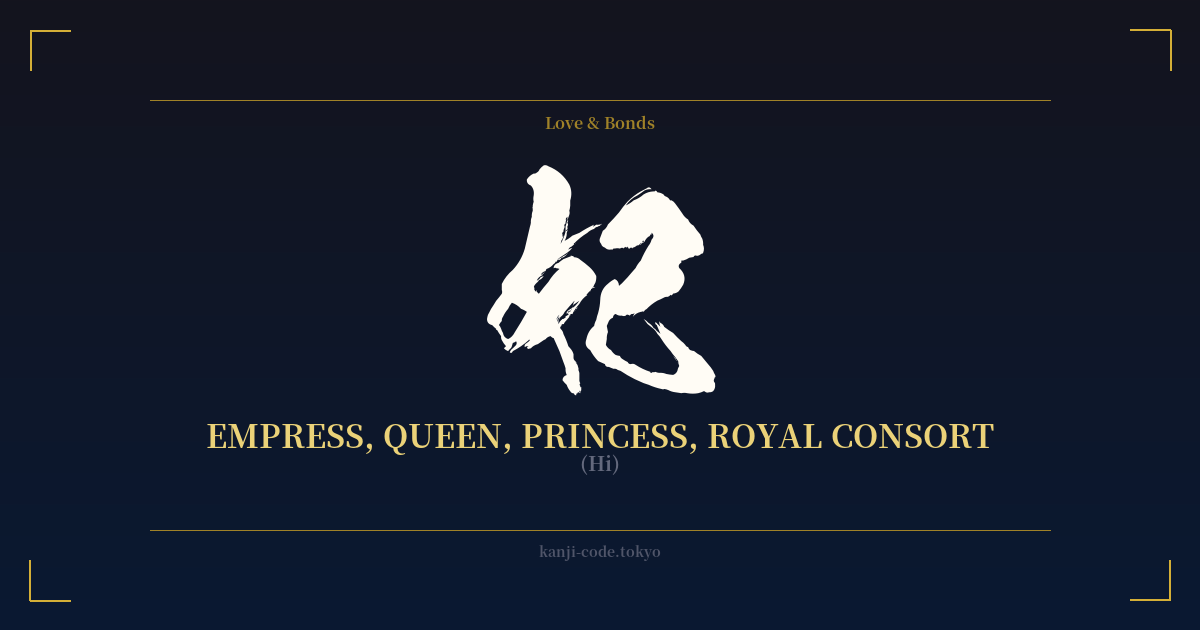
✍️ 妃 (Hi) — Cultural Context
The kanji 妃 (hi) is a character steeped in the history of East Asian imperial courts, carrying an aura of nobility, grace, and specific social standing. Its very structure tells a story: it is composed of the radicals 女 (onna), meaning 'woman,' and 己 (onore), meaning 'self' or 'one's own.' This combination has been interpreted as 'a woman who is a match for a man' or 'a woman paired with a high-ranking man,' immediately establishing its role as a relational term.
Historically, 妃 was a specific title conferred upon the consorts of emperors, kings, and high-ranking princes. In both Chinese and Japanese history, the imperial harem was a complex, hierarchical world with meticulously defined ranks. While 皇后 (Kōgō) was the title for the single, primary Empress consort, 妃 designated other official consorts of a very high rank, often second only to the Empress herself. This system allowed the emperor to have multiple recognized partners, solidifying political alliances and ensuring the continuation of the imperial line.
Understanding this context is crucial. The character 妃 does not represent a reigning monarch like Queen Elizabeth I. A female sovereign who rules in her own right is called a 女王 (Joō, 'female king/queen') or a 女帝 (Jotei, 'female emperor'). Instead, 妃 embodies a different kind of power—one of influence, beauty, and proximity to the center of authority. These women were often highly educated, skilled in arts like poetry and music, and wielded significant influence within the court, even if they did not hold direct political power.
In modern Japan, the character 妃 is most famously seen in the titles of members of the Imperial Family. For example, the Crown Princess is referred to as 皇太子妃 (Kōtaishihi). Beyond royal titles, the character appears in literature, historical dramas, and occasionally in female given names, where it imparts a sense of classical elegance and nobility. It evokes a world of refined courtly life, a vision of femininity that is both powerful and traditionally defined by its relationship to a male counterpart. This makes 妃 a character of beautiful, but specific, meaning.
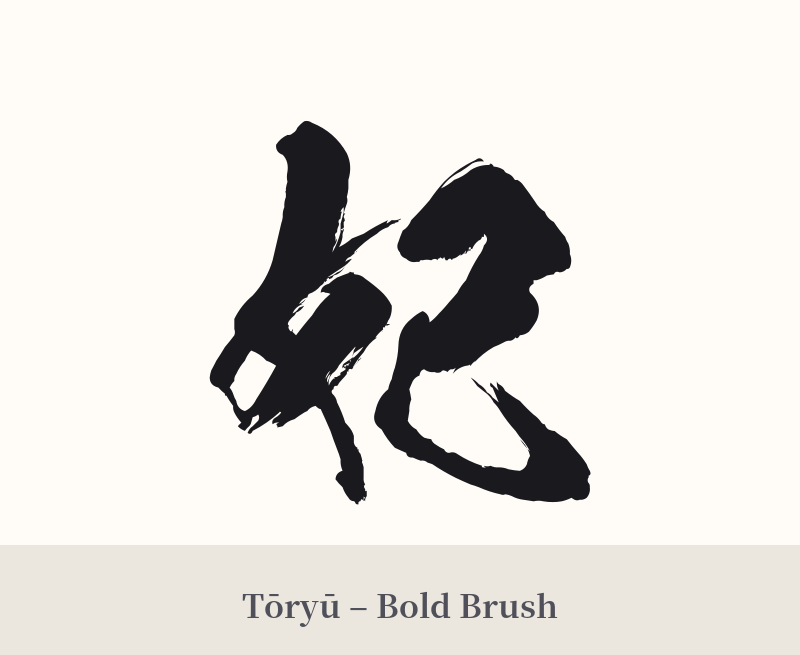
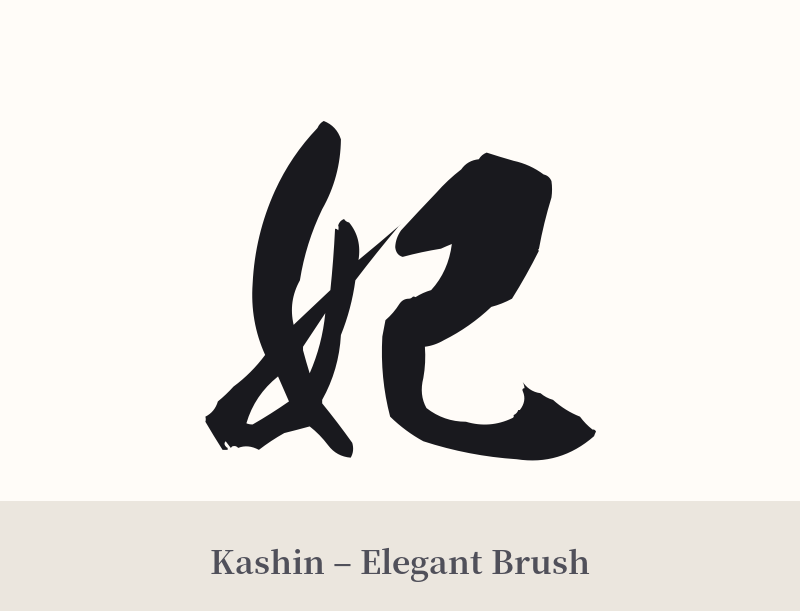
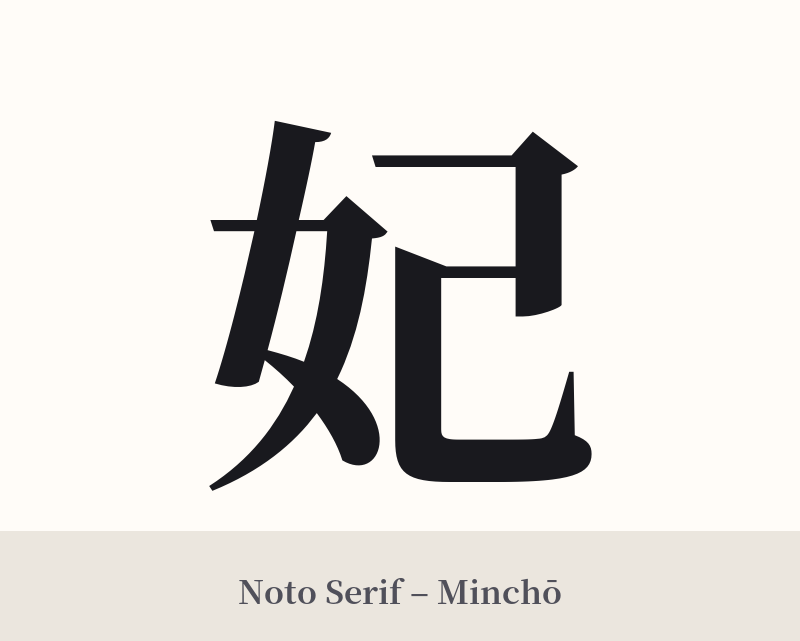
🖌️ Font Styles for 妃
The same kanji can look dramatically different depending on the calligraphy style. Choose a font that matches the mood you want for your tattoo or design.
🎨 Tattoo Suitability
📐 Tattoo Design Guide
The kanji 妃 has an elegant and balanced structure that lends itself well to graceful tattoo designs.
– Placement: Its vertical symmetry and refined nature make it ideal for delicate placements. Consider the inner wrist, behind the ear, on the collarbone, or the nape of the neck for a subtle and personal statement. For a larger piece, it could be placed on the ribs or shoulder blade, perhaps as part of a larger composition.
– Font Style: To honor its meaning, choose a font that reflects elegance. A classic Mincho (serif) style provides a timeless, print-like clarity. For a more artistic and feminine touch, a semi-cursive (Gyōsho) or full cursive (Sōsho) calligraphy script would be stunning, emphasizing flow and grace. Avoid heavy, blocky, or aggressive fonts, as they would clash with the character's refined essence.
– Visual Tips: Consider pairing 妃 with imagery that enhances its noble and feminine qualities. Delicate elements like cherry blossoms (sakura), a single peony, a crescent moon, or flowing water can complement the kanji beautifully without overpowering it. A simple, standalone execution, however, can be just as powerful, letting the character's inherent grace speak for itself.
Comments