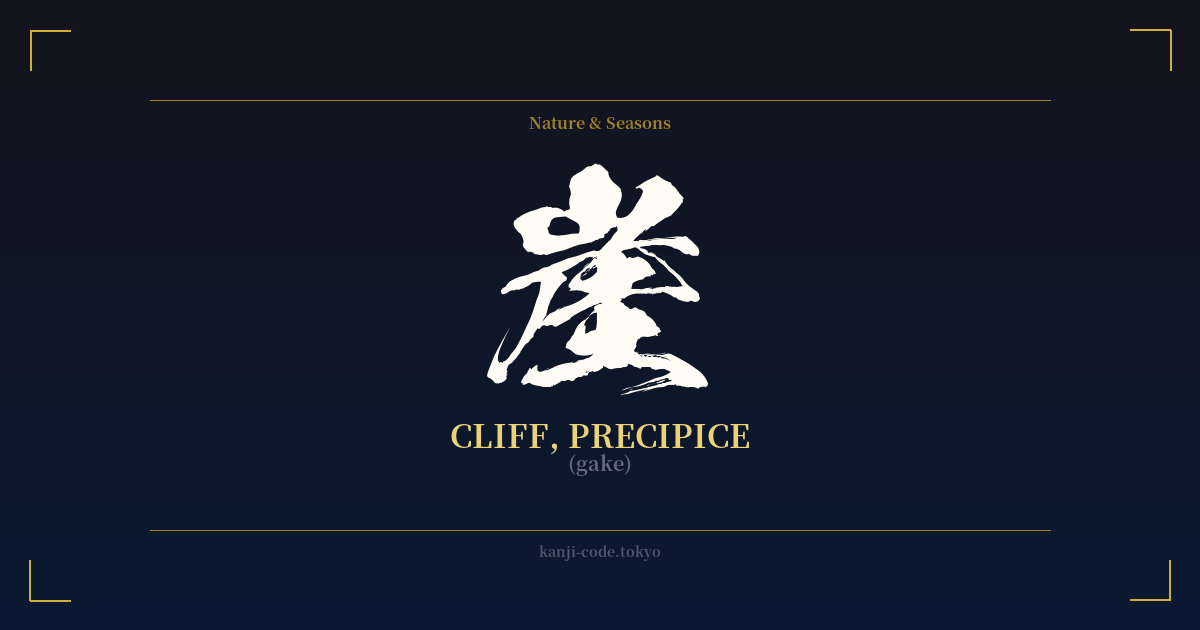
✍️ 崖 (gake) — Cultural Context
The kanji 崖 (gake) translates directly to 'cliff' or 'precipice,' a common sight in Japan's rugged, mountainous, and coastal geography. From the dramatic basalt columns of Tōjinbō in Fukui Prefecture to the scenic cliffs of the Izu Peninsula, these natural formations are deeply ingrained in the nation's physical and cultural landscape.
The character itself paints a clear picture. It is a compound kanji, combining the radical 山 (yama), meaning 'mountain,' on the left with the phonetic component 厓 (gai) on the right, which also carries the meaning of a cliff or riverbank. This construction firmly roots the character's identity in the earth and stone of a sheer drop.
Beyond its literal meaning, 崖 is a potent symbol in Japanese culture, most famously captured in the expression 「崖っぷち」 (gakeppuchi). Literally 'the edge of the cliff,' this phrase is the Japanese equivalent of being 'on the brink' or 'up against the wall.' It describes a desperate, last-ditch situation where failure seems imminent and the stakes are at their highest. You'll hear it in sports commentary when a team is about to be eliminated, in business discussions about a failing company, or in personal stories of overcoming immense adversity. This gives the kanji a powerful sense of tension and drama.
This dramatic quality makes 崖 a recurring motif in Japanese art and storytelling. In classic samurai films, the cliffside duel is a staple, providing a breathtaking and perilous backdrop that mirrors the life-or-death struggle of the combatants. In modern suspense dramas, a character standing at a cliff's edge is a universal symbol of despair, contemplation, or a pivotal choice. Even Studio Ghibli's 'Ponyo on the Cliff by the Sea' (崖の上のポニョ, Gake no Ue no Ponyo) uses the setting to establish a world that is both magical and perched on the boundary between two realms.
Ultimately, 崖 embodies duality. It is the raw, unyielding power of nature—a physical barrier and a place of immense danger. At the same time, it is a symbol of the ultimate test. To stand at the 'gake' is to face a critical moment, and to overcome it is a testament to strength, courage, and resilience.
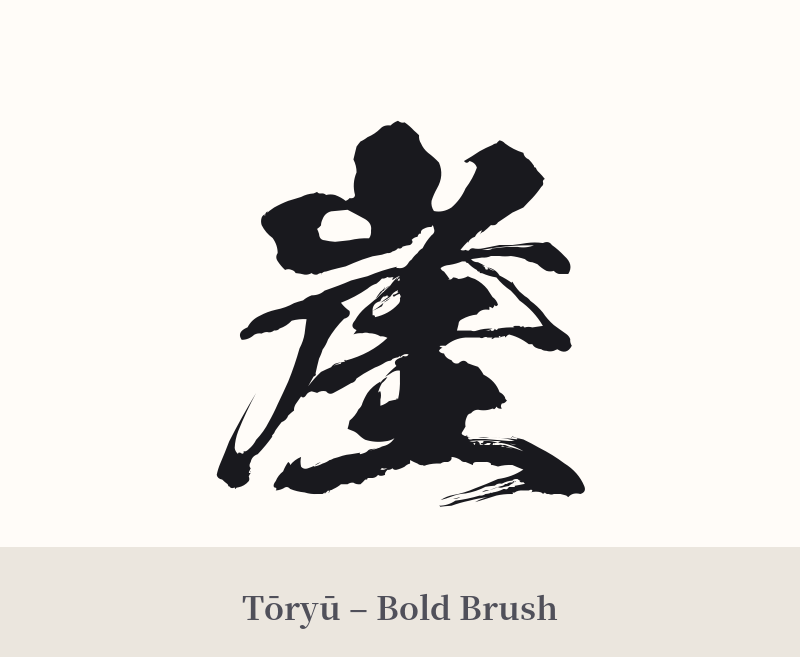
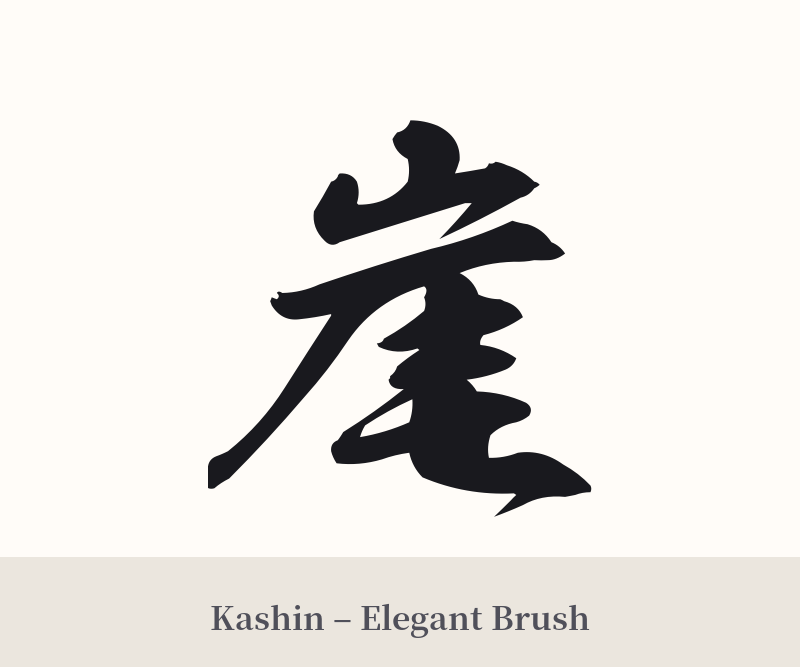
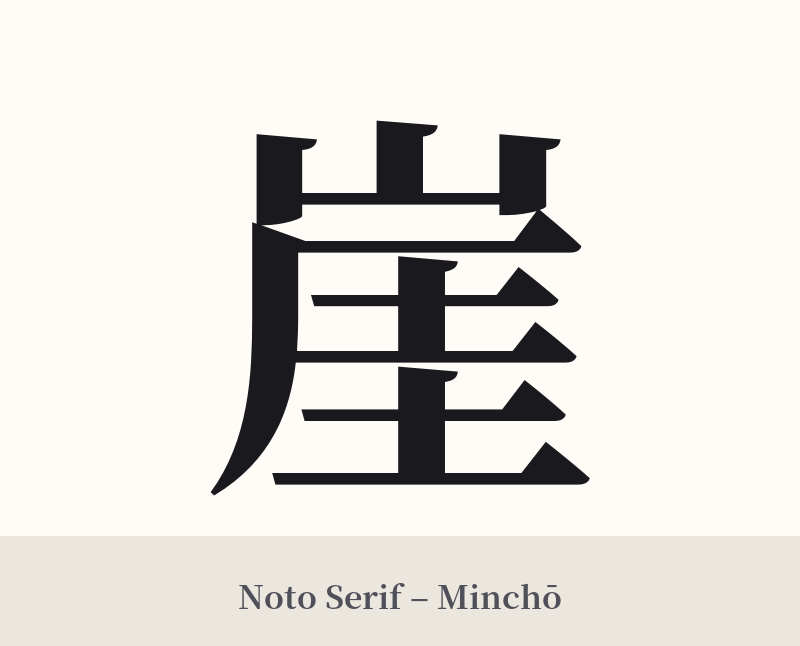
🖌️ Font Styles for 崖
The same kanji can look dramatically different depending on the calligraphy style. Choose a font that matches the mood you want for your tattoo or design.
🎨 Tattoo Suitability
📐 Tattoo Design Guide
The kanji 崖 (gake) has a strong, angular structure that offers great versatility in tattoo design.
– Placement: Vertical placements work exceptionally well to emphasize the feeling of height and a sheer drop. Consider the forearm, the calf, or along the spine. For a more contained design, the back of the shoulder or chest is also effective.
– Font Style: A bold, blocky Kaisho (regular script) font will give the kanji a solid, immovable, rock-like feel. For a more dynamic and rugged look, a Gyosho (semi-cursive) script with rougher brush strokes can evoke the texture of a natural cliff face.
– Visual Elements: Complementing 崖 with other imagery can deepen its narrative. Consider adding waves crashing at the base, a solitary pine tree clinging to the edge (a symbol of resilience), or a bird taking flight from the precipice to signify a leap of faith or newfound freedom.
Comments