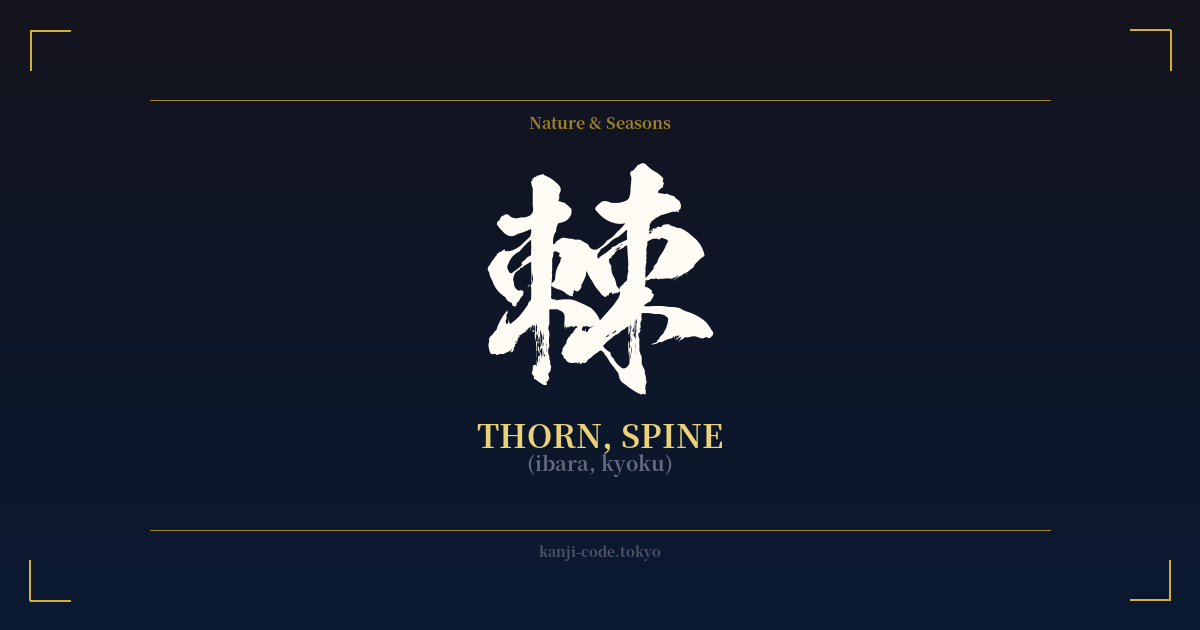
✍️ 棘 (ibara, kyoku) — Cultural Context
The kanji 棘, most commonly read as 'ibara', literally means 'thorn' or 'spine'. It refers to the sharp, pointed growths found on plants like roses, brambles, and thistles. This character has a fascinating structure, composed of two 朿 (tsuka) radicals stacked on top of each other. The 朿 radical itself depicts a tree with sharp points, so doubling it creates the image of a dense, thorny bush, perfectly capturing its essence.
Beyond its literal meaning, 棘 is deeply embedded in Japanese culture as a powerful metaphor for hardship and adversity. The most famous expression using this kanji is 'ibara no michi' (茨の道), which translates to 'a thorny path'. This phrase describes a life or journey filled with obstacles, challenges, and pain. Choosing to walk the 'ibara no michi' implies a conscious decision to face difficulties head-on for a greater purpose, embodying resilience and determination.
This duality is central to the kanji's appeal. A thorn causes pain, but it is also a plant's primary means of self-defense. It protects the delicate beauty of the flower it guards. In this way, 棘 symbolizes a kind of guarded or dangerous beauty, the idea that something precious is often protected by something sharp. It speaks to the inseparable nature of pleasure and pain, beauty and danger.
This concept is a recurring theme in Japanese aesthetics and philosophy, where imperfection and struggle are seen as integral parts of life's beauty. The thorn is not just a nuisance; it is a necessary component of the whole, a reminder of the plant's strength and will to survive.
In a more scientific context, the 'kyoku' reading of 棘 is used in terms like 'kyokuhidōbutsu' (棘皮動物), the word for echinoderms. This category of marine life includes sea urchins and starfish, creatures defined by their spiny skin. This usage reinforces the core meaning of 'spine' or 'prickle', grounding the poetic metaphor in the natural world. Therefore, 棘 is a rich symbol, weaving together themes of nature, pain, protection, resilience, and the difficult path toward a goal.
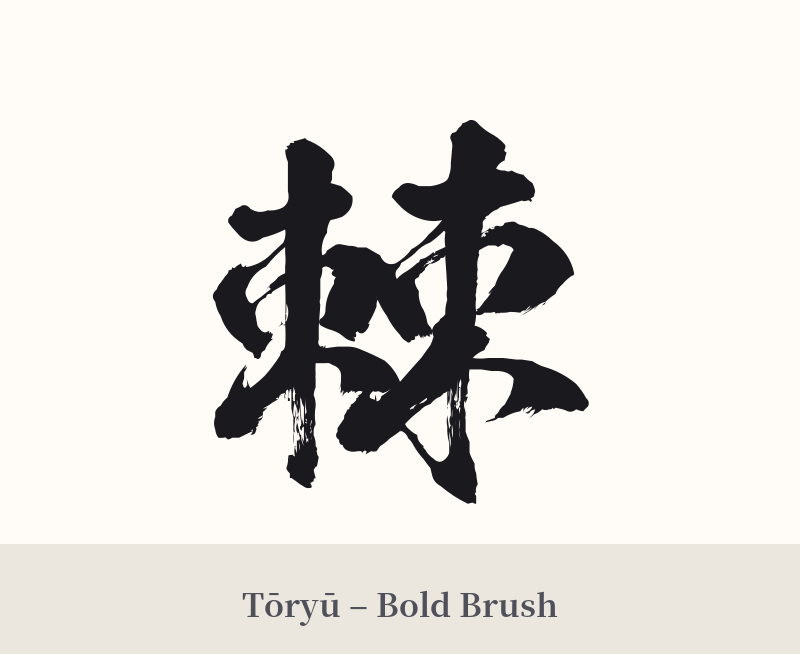
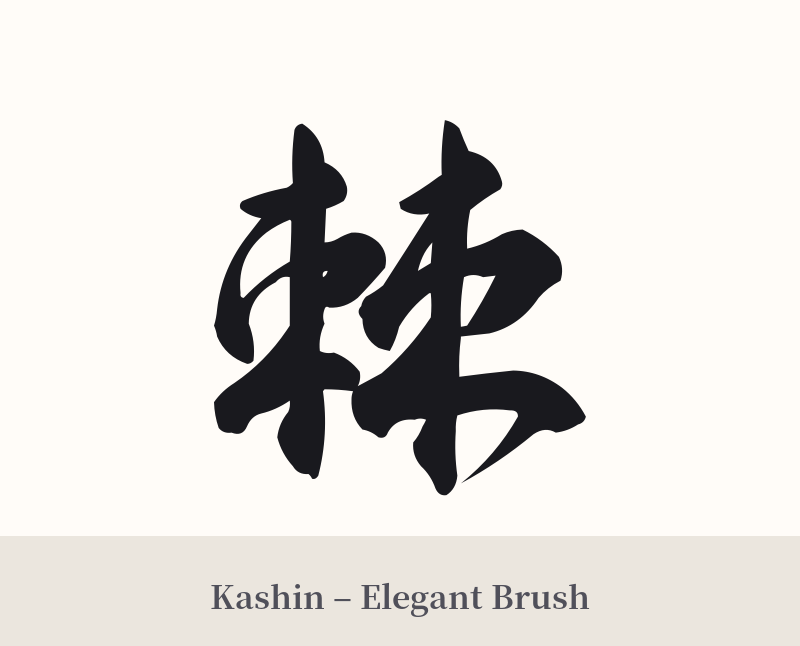
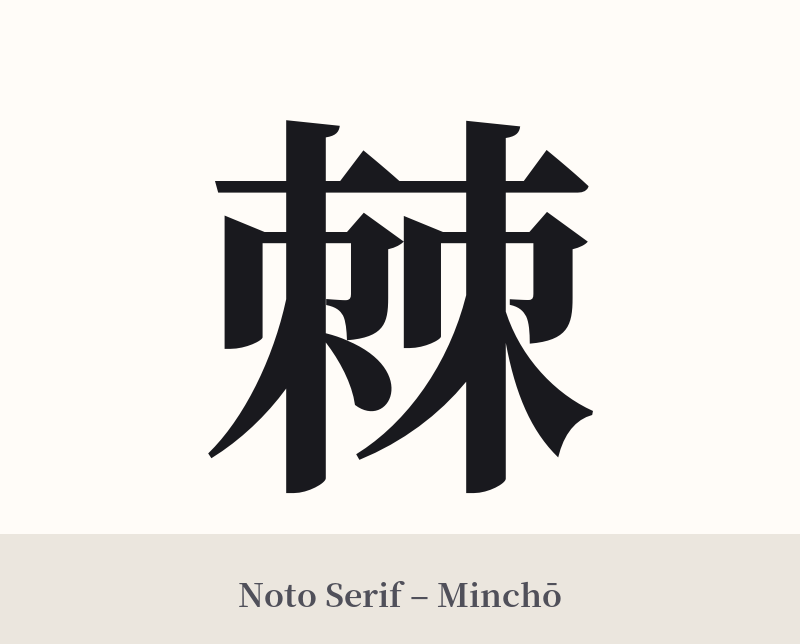
🖌️ Font Styles for 棘
The same kanji can look dramatically different depending on the calligraphy style. Choose a font that matches the mood you want for your tattoo or design.
🎨 Tattoo Suitability
📐 Tattoo Design Guide
The kanji 棘 has a complex and visually striking form that offers many design possibilities.
– Placement: For a design that emphasizes its protective or enduring nature, consider placements along the spine, ribs, or forearm. These areas provide a long canvas that can complement the character's vertical structure. The back of the neck or shoulder blade are also excellent spots for a standalone piece.
– Style: A bold, semi-cursive 'gyōsho' or an aggressive 'sōsho' calligraphy style can enhance the sharp, dynamic feeling of the thorns. The quick, powerful strokes will mirror the kanji's meaning. Alternatively, a crisp, clean 'kaisho' (block script) can highlight its intricate structure, focusing on the beautiful complexity of the character itself.
– Visuals: Consider integrating the kanji with related imagery. A thorny vine wrapping around the arm or leg with the character at its heart is a classic choice. It could also be paired with a rose to directly illustrate the 'beauty and pain' duality. For a more abstract take, the kanji could emerge from a splash of ink or be surrounded by sharp, geometric lines.
Comments