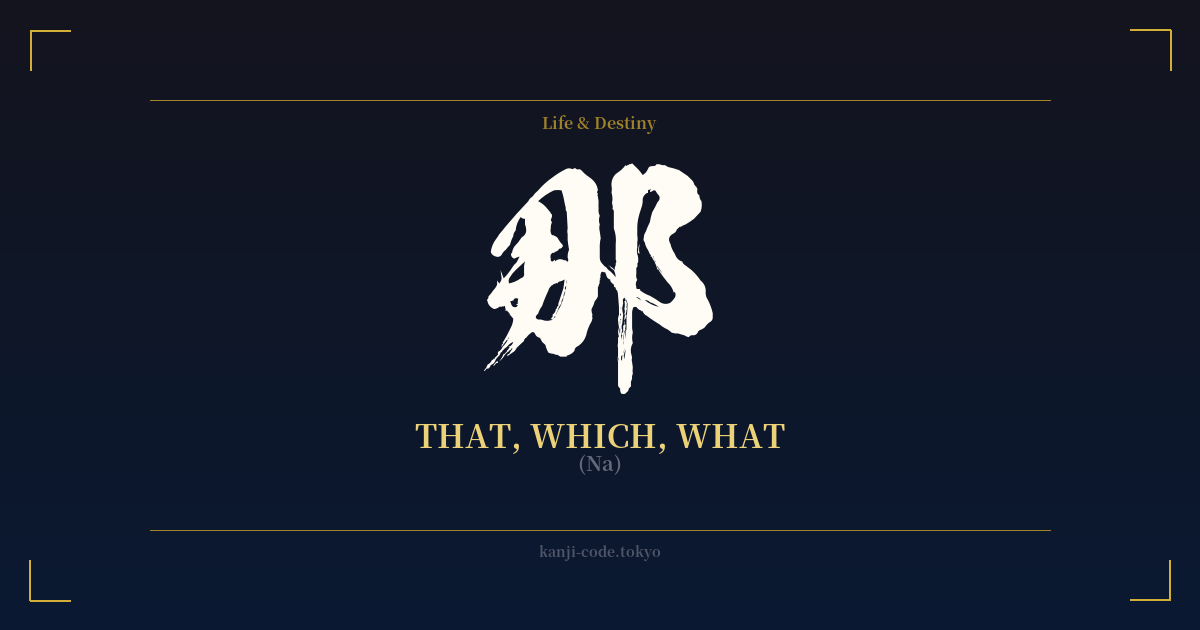
✍️ 那 (Na) — Cultural Context
The kanji 那 (Na) presents a fascinating case where simplicity of form hides a complex and nuanced function. With dictionary definitions like 'that,' 'which,' or 'what,' it seems straightforward. However, its true role in the Japanese language is far more subtle, making it a character that is both common and commonly misunderstood by learners.
Originally, the character depicted a place or settlement, combining the radical for 'city' or 'country' (邑, which becomes 阝 on the left) with a phonetic component. This hints at an ancient meaning related to 'that place.' While this demonstrative function exists in classical Chinese and Japanese literature, its use as a standalone pointer has largely been replaced in modern Japanese by hiragana-based words like その (sono) and あの (ano).
Today, the primary role of 那 is phonetic. It is a classic example of ateji, where a kanji is used for its sound rather than its meaning. This is most evident in Japanese names, particularly for girls. Names like Rina (里那), Haruna (春那), and Nana (奈那) use 那 for its pleasant 'na' sound, pairing it with other characters to create a beautiful and meaningful combination. Its simple, elegant strokes make it a visually appealing component in a name.
Beyond names, 那 holds a significant place in Buddhist philosophy through the word 刹那 (setsuna). This term, a transliteration of the Sanskrit 'kṣaṇa,' means 'an instant,' 'a moment,' or 'the smallest unit of time.' It captures the Buddhist concept of the ephemeral, fleeting nature of existence. In this context, 那 sheds its simple functional meaning and becomes part of a profound philosophical idea. The idea of setsuna permeates Japanese art and literature, valuing the beauty found in a single, transient moment.
This character also appears phonetically in place names, most famously in Naha (那覇), the capital of Okinawa Prefecture. Here again, the characters were chosen to represent the sound of the original Okinawan name for the area.
Therefore, while 那 on its own appears to be a simple grammatical tool, its cultural story is one of adaptation—from a pointer in ancient texts to a phonetic building block for names and a carrier of deep Buddhist thought. Understanding 那 is to understand that in Japanese, a character's value often lies not in its isolated meaning, but in the words and ideas it helps to build.
🖌️ Font Styles for 那
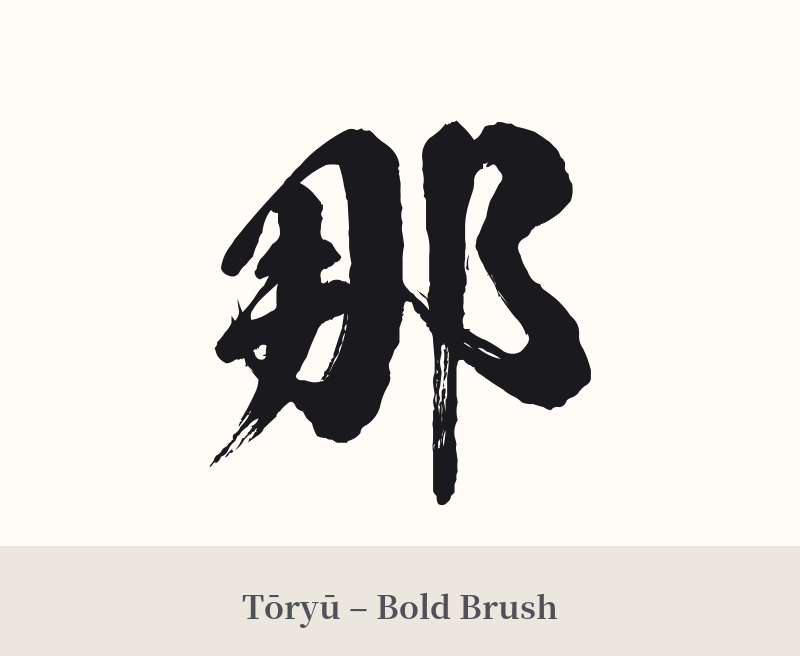
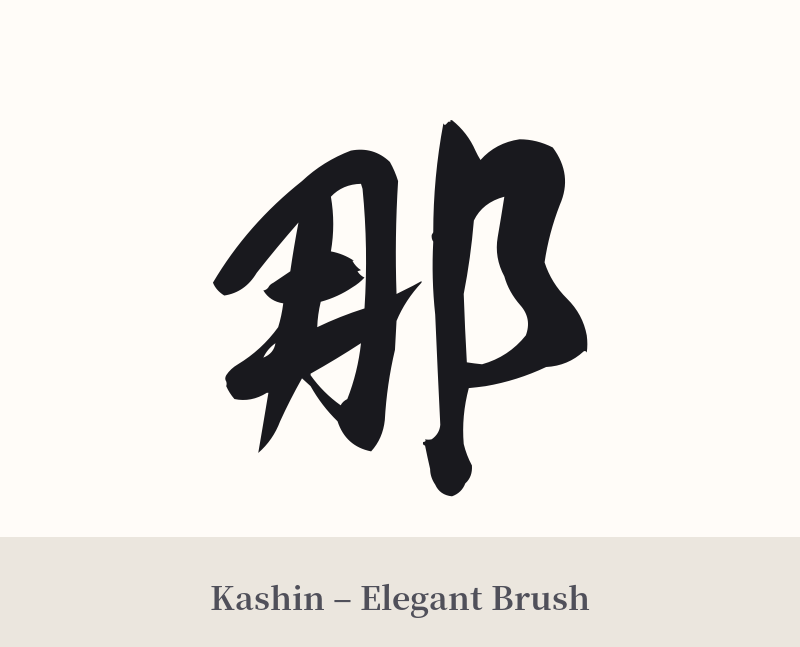
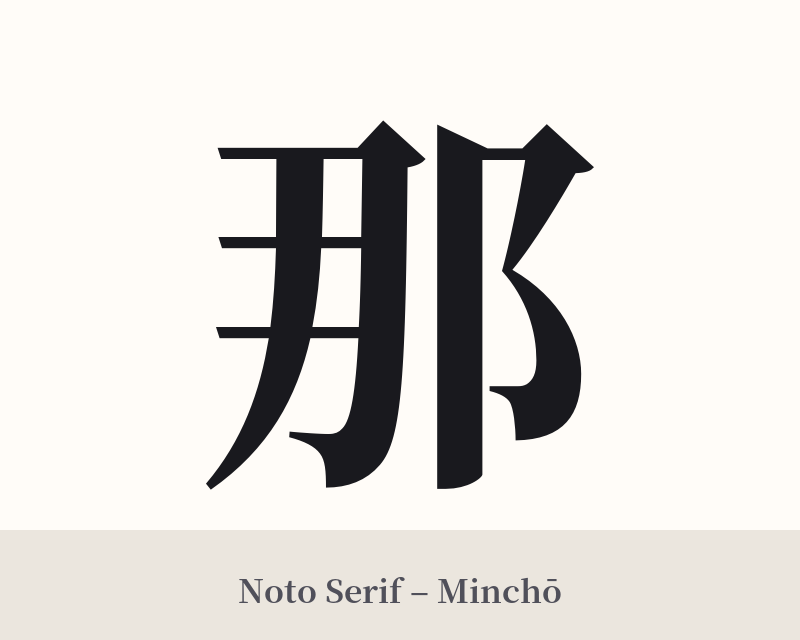
The same kanji can look dramatically different depending on the calligraphy style. Choose a font that matches the mood you want for your tattoo or design.
🎨 Tattoo Suitability
📐 Tattoo Design Guide
Given its lack of standalone meaning, a tattoo of just 那 is strongly discouraged. However, if you are drawn to its form or its use in a specific context, here are some design considerations:
– Combine with other Kanji: The best way to use 那 is to make it part of a meaningful word. The most powerful choice is 刹那 (Setsuna), representing 'a fleeting moment.' This transforms a simple character into a profound philosophical statement.
– Subtle Placement: If you must use it alone (perhaps it represents a syllable in a meaningful name), opt for a very subtle placement. Locations like the inner wrist, behind the ear, or on the ankle would treat it as the small, subtle element it is.
– Simple Font Styles: This is not a character that benefits from elaborate fonts. A clean, crisp Mincho or a standard Kaisho (block) script will honor its simple elegance. Overly cursive or aggressive styles would feel mismatched with its functional nature.
– Integrate, Don't Isolate: Consider incorporating a lone 那 into a larger design. It could be a small element within a bigger piece that represents a name or a moment, rather than being the central focus of the tattoo.
Comments