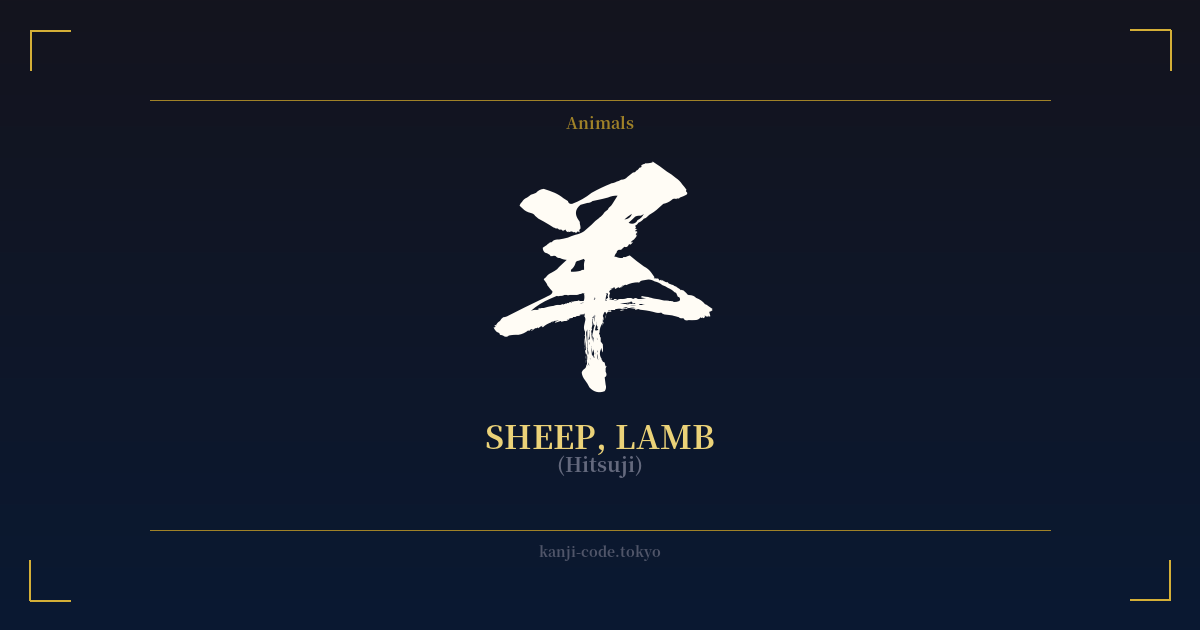
✍️ 羊 (Hitsuji) — Cultural Context
The kanji 羊 (Hitsuji) is a beautiful and elegant character that carries meanings far beyond its simple translation of 'sheep' or 'lamb'. Its origins are pictographic, evolving from an ancient drawing of a ram's head, complete with prominent, curving horns. This visual legacy is still apparent in the character's balanced, symmetrical form, making it one of the more aesthetically pleasing animal kanji.
In Japanese culture, the sheep is a powerful symbol of peace, gentleness, and tranquility. Unlike some Western cultures where 'sheep' can imply blind conformity, the Japanese perspective focuses on the animal's calm demeanor and strong herd instinct, which is interpreted as a metaphor for family harmony and community-mindedness. The sheep represents a quiet, unassuming strength and the value of living in peace with others.
Perhaps the most significant cultural role of the sheep is its place as the eighth animal in the Japanese zodiac, or 'Eto' (干支). Those born in the Year of the Sheep (未年, hitsuji-doshi) are often described as being calm, creative, empathetic, and kind-hearted. They are thought to be artistic souls who value beauty and harmony in their surroundings. For someone born in a sheep year (such as 1955, 1967, 1979, 1991, 2003, or 2015), a tattoo of 羊 can be a deeply personal emblem of their identity and character traits.
The importance of the sheep in ancient Japanese and Chinese thought is further revealed by its use as a radical (a component part) in other significant kanji. The character for 'beauty', 美 (bi), is a combination of 羊 (sheep) and 大 (big). The ancient understanding was that a large, healthy sheep was a beautiful and prosperous sight, a symbol of wealth and good fortune. Similarly, the kanji for 'goodness' or 'virtue', 善 (zen), and 'righteousness', 義 (gi), both incorporate the sheep radical, cementing its association with positive, moral concepts. This shows that the sheep was not just an animal, but a foundational symbol for what is good and beautiful in the world.
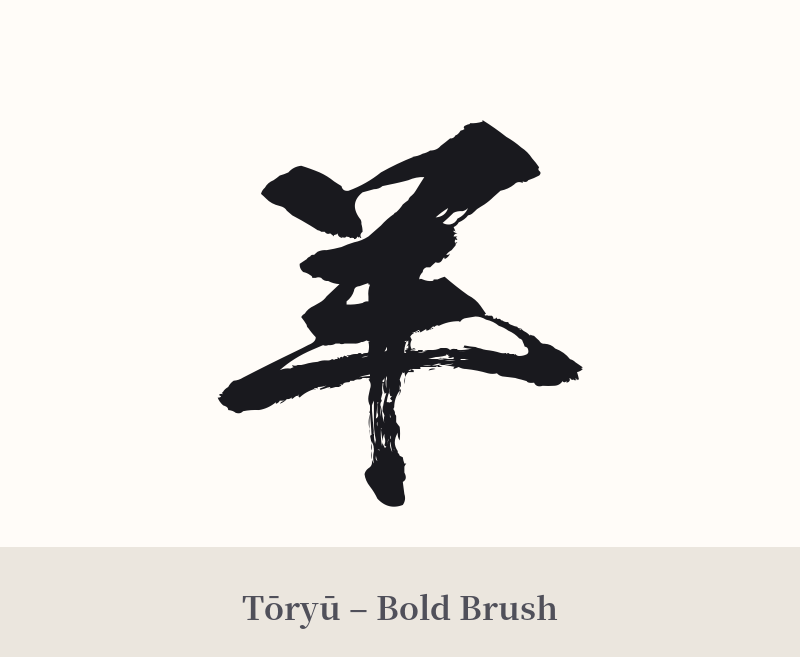
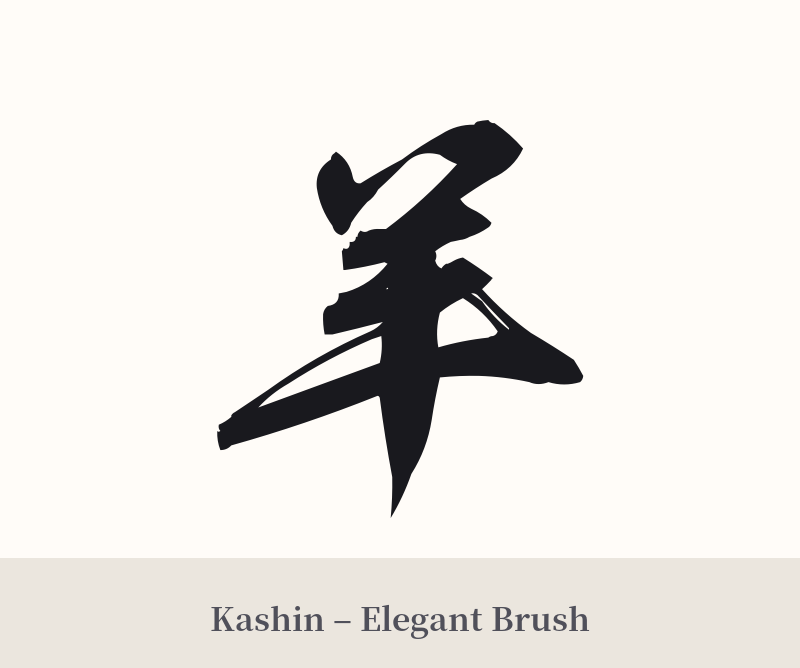
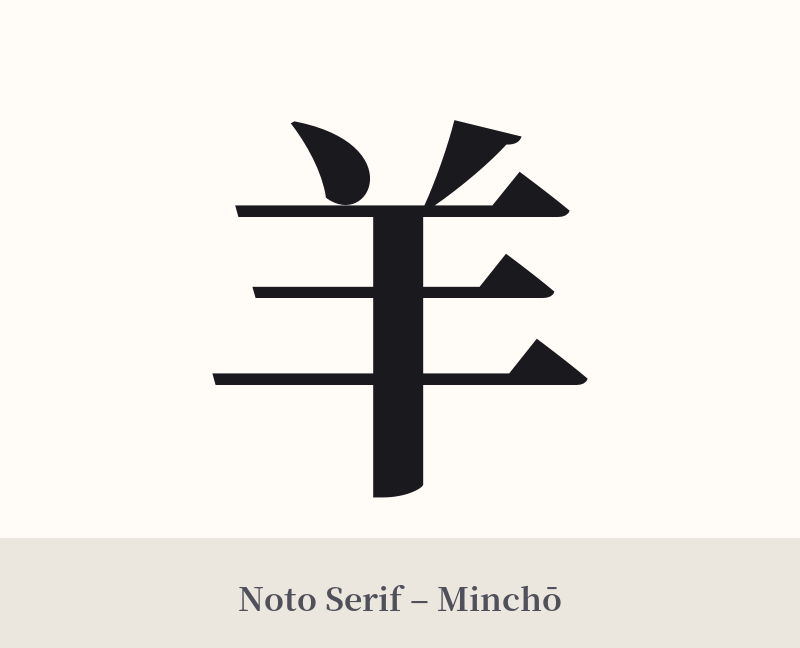
🖌️ Font Styles for 羊
The same kanji can look dramatically different depending on the calligraphy style. Choose a font that matches the mood you want for your tattoo or design.
🎨 Tattoo Suitability
📐 Tattoo Design Guide
The simple elegance of 羊 (Hitsuji) makes it versatile for tattoo design. Its clean lines and balanced form work well in a variety of styles.
– Placement: Due to its simplicity and small size, it is perfect for subtle placements like the wrist, ankle, behind the ear, or on the collarbone. It can also stand alone beautifully in a more central location, such as the forearm or the nape of the neck.
– Style: A minimalist, single-needle approach can highlight the character's clean form. For a more traditional look, a classic calligraphy style like Kaisho (block script) or Gyosho (semi-cursive) adds a touch of artistic flair and movement. Avoid overly complex or ornate styles that might obscure its simple beauty.
– Visual Pairings: Consider pairing 羊 with other elements to enhance its meaning. Combining it with cherry blossoms can symbolize the gentle beauty of life. Placing it within a mountain landscape evokes a sense of pastoral peace. For those born in the Year of the Sheep, it could be paired with the kanji for their birth year's element (wood, fire, earth, metal, water).
Comments