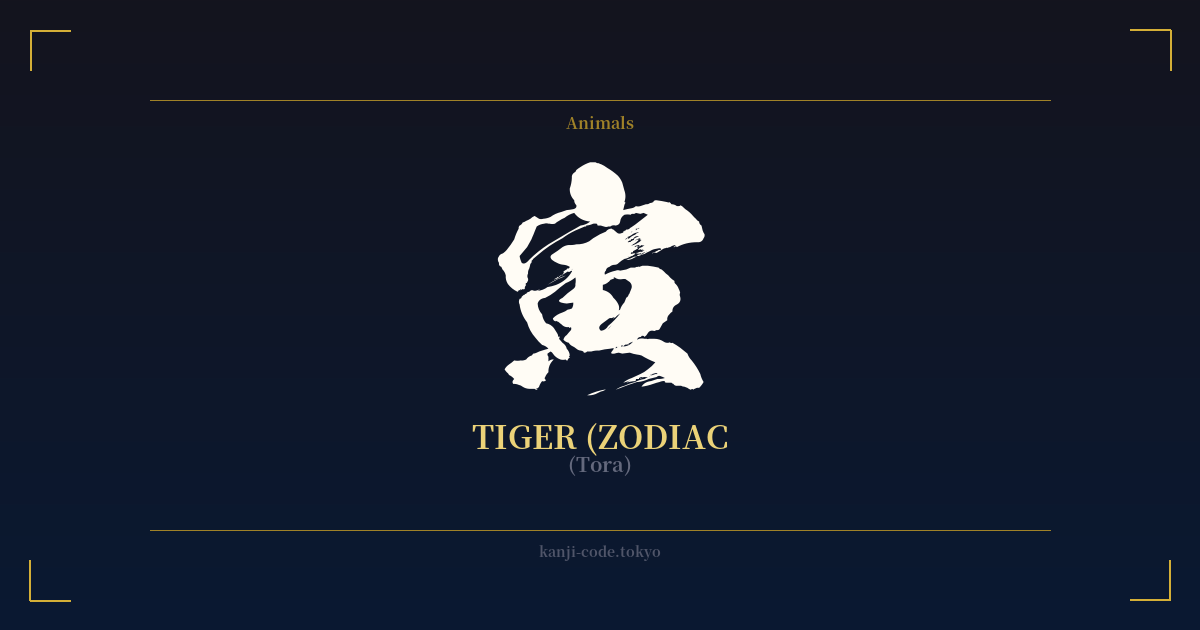
✍️ 寅 (Tora) — Cultural Context
The kanji 寅 (Tora) is a character steeped in millennia of East Asian cosmology. While it translates to 'Tiger,' its meaning is far more specific and profound than the simple name of an animal. This character represents the third of the twelve Earthly Branches (十二支, Jūnishi), the system that forms the foundation of the Chinese zodiac.
In Japanese, both 寅 and the more common kanji 虎 are read as 'tora.' However, their usage is distinct. 虎 refers to the physical, living tiger—the majestic striped predator. In contrast, 寅 is an abstract, symbolic concept. It represents the zodiacal Tiger, a marker of time, a specific direction (east-northeast), and a set of personality traits associated with those born under its sign.
People born in the Year of the Tiger (寅年, Tora-doshi) are traditionally seen as embodying the tiger's spirit. They are considered courageous, powerful, confident, and natural leaders. They possess a fierce independence and a passion for justice. However, this same energy can also manifest as impulsiveness, recklessness, and a rebellious streak. The Tiger is a force of nature, and so too are the people born under its sign.
Historically, the Earthly Branches were integral to daily life, used for everything from timekeeping to divination. The 'Hour of the Tiger' (寅の刻, Tora no koku) corresponded to the period between 3:00 AM and 5:00 AM. This was a time of deep mystery, believed to be a liminal space when the veil between the human and spirit worlds was thin, and demons were most active. The Tiger's association with this powerful hour cemented its role as a protective, spiritual guardian.
In folklore and proverbs, the tiger's power is legendary. One famous saying, 'A tiger travels a thousand leagues and returns' (虎は千里を行って千里を帰る), speaks to the animal's immense vitality and resilience, a quality also attributed to the zodiacal Tiger. This symbol of untamable energy and protective strength makes 寅 a powerful emblem of one's birthright and inner character.
🖌️ Font Styles for 寅
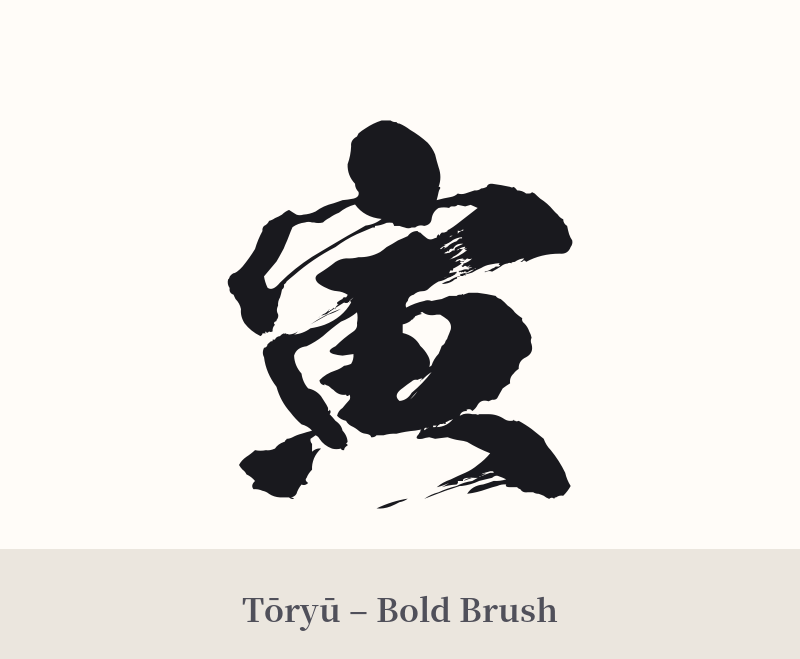
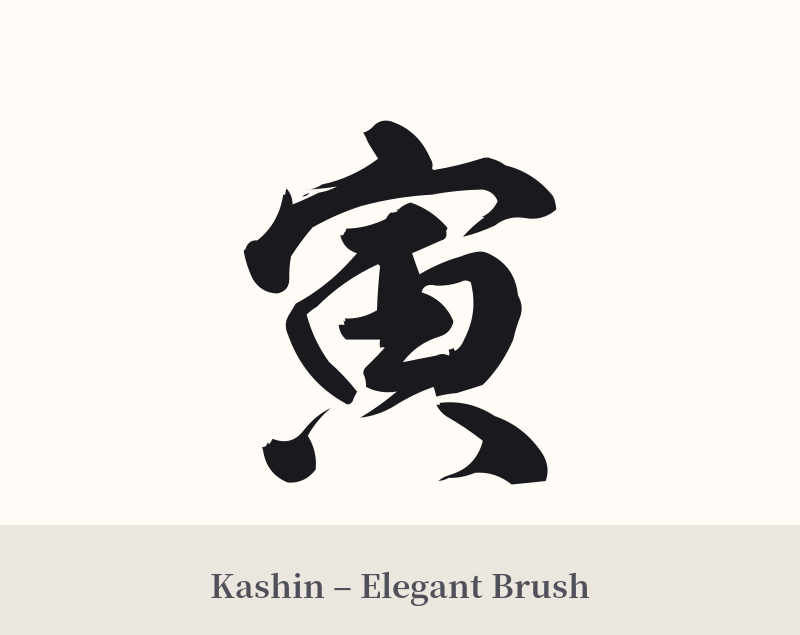
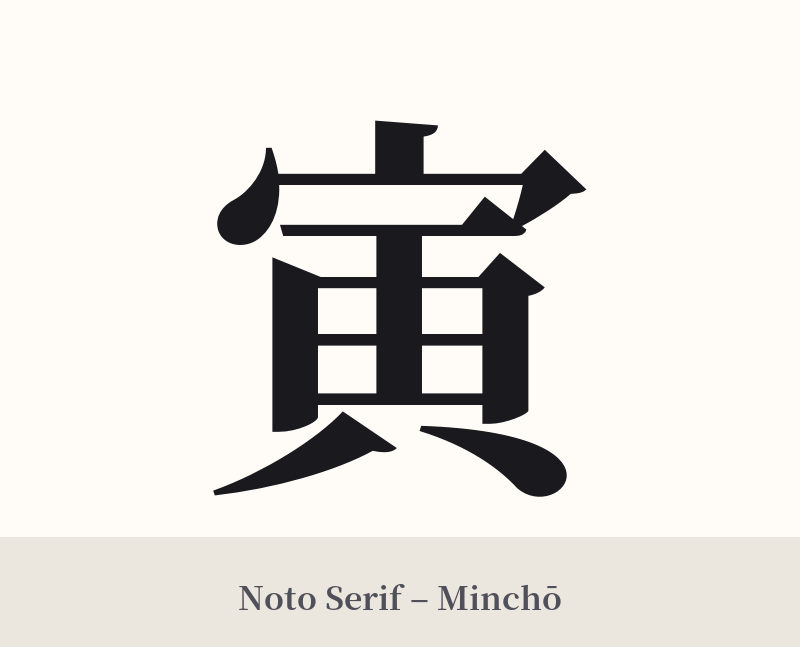
The same kanji can look dramatically different depending on the calligraphy style. Choose a font that matches the mood you want for your tattoo or design.
🎨 Tattoo Suitability
📐 Tattoo Design Guide
The kanji 寅 offers a powerful and symbolic choice for a tattoo, especially for those born in the Year of the Tiger.
– Placement: For a bold statement, consider larger areas like the back, chest, or the side of the thigh. This allows the character's 11 strokes to be rendered with clarity and impact. For a more discreet but equally meaningful piece, the forearm, bicep, or calf are excellent choices.
– Style: The style can dramatically alter the feel. A strong, angular Kaisho (block script) emphasizes the Tiger's authority and power. For a more fluid and dynamic look, a Gyosho (semi-cursive) or Sosho (cursive) script can evoke the animal's movement and primal energy.
– Visual Elements: Pairing 寅 with other elements can deepen its meaning. Combining it with an illustration of a tiger creates a direct link between the symbol and the animal. Bamboo is a classic pairing, representing resilience and flexibility alongside the tiger's strength. You could also incorporate it into a design with your full birth year in Japanese numerals (e.g., 昭和六十一年 for 1986). A design resembling a red ink hanko (personal stamp) can give the kanji a very traditional and personal feel.
Comments