武
Martial, Warrior
The character that ancient kings claimed meant “stopping the spear”—but warriors who actually swung swords knew it meant something far more practical.
Walk into any martial arts dojo from Tokyo to Toronto, and you’ll find this character somewhere—on certificates, on uniforms, carved into wooden plaques above doorways. 武 (bu or take) appears in 武道 (budō, martial way), 武士 (bushi, warrior/samurai), 武術 (bujutsu, martial techniques), and 武器 (buki, weapons). It’s the single kanji binding together Japan’s entire martial tradition, from ancient battlefield combat to modern discipline-building sports.
The character combines two elements that create its meaning—though scholars have argued for centuries about which meaning the combination actually produces. The top component 戈 (ka or hoko) depicts a dagger-axe or halberd, the primary polearm weapon of ancient Chinese warfare. The bottom component 止 (shi) shows a footprint or foot, and here’s where things get interesting. Does it mean “to stop,” suggesting warriors who prevent conflict? Or does it mean “to walk/advance,” depicting armies marching into battle?
Tradition credits King Zhuang of Chu (circa 597 BCE) with the poetic interpretation: 武 means “stopping the spear”—true martial strength exists to prevent violence, not cause it. Modern martial arts instructors love this version. It sounds noble, philosophical, aligned with values of restraint and discipline. But linguistic evidence suggests the ancient meaning was simpler and bloodier: soldiers advancing with weapons toward the enemy. The character described war, not its prevention. The pretty interpretation came later, when warriors needed philosophy to justify their violence.
✨ Kanji Styles Gallery
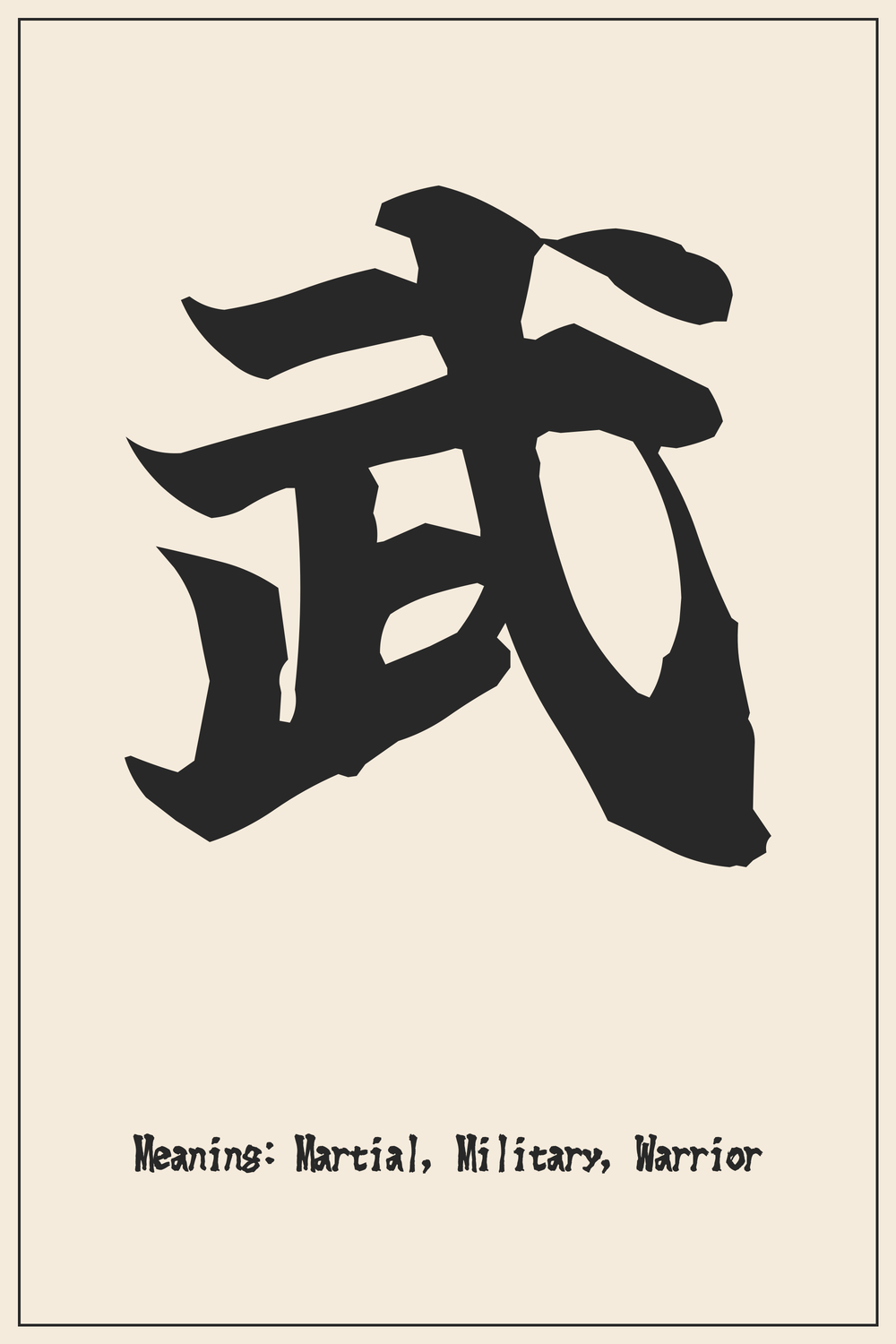
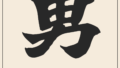
🖌️ Calligraphy Style
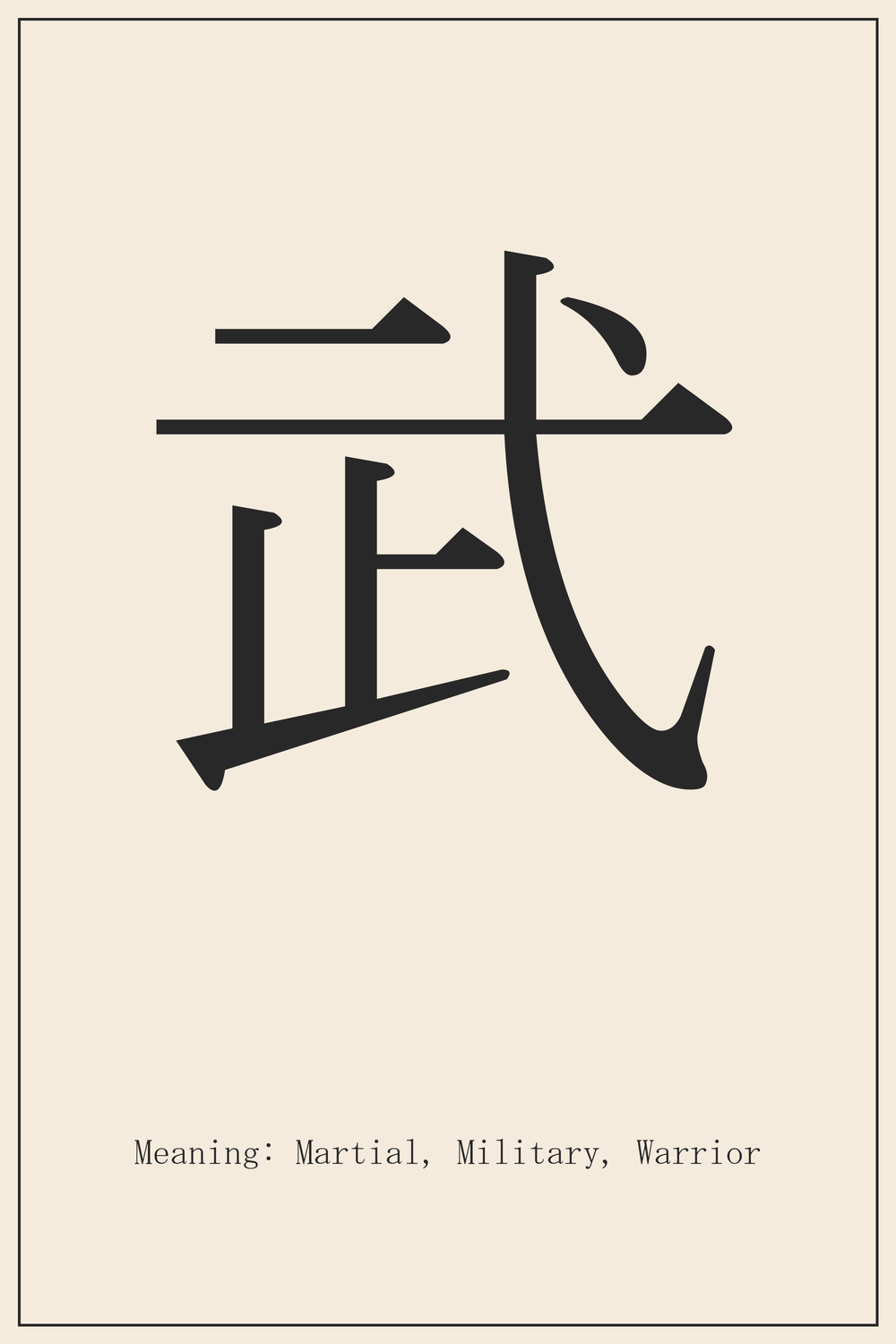
📝 Mincho Style
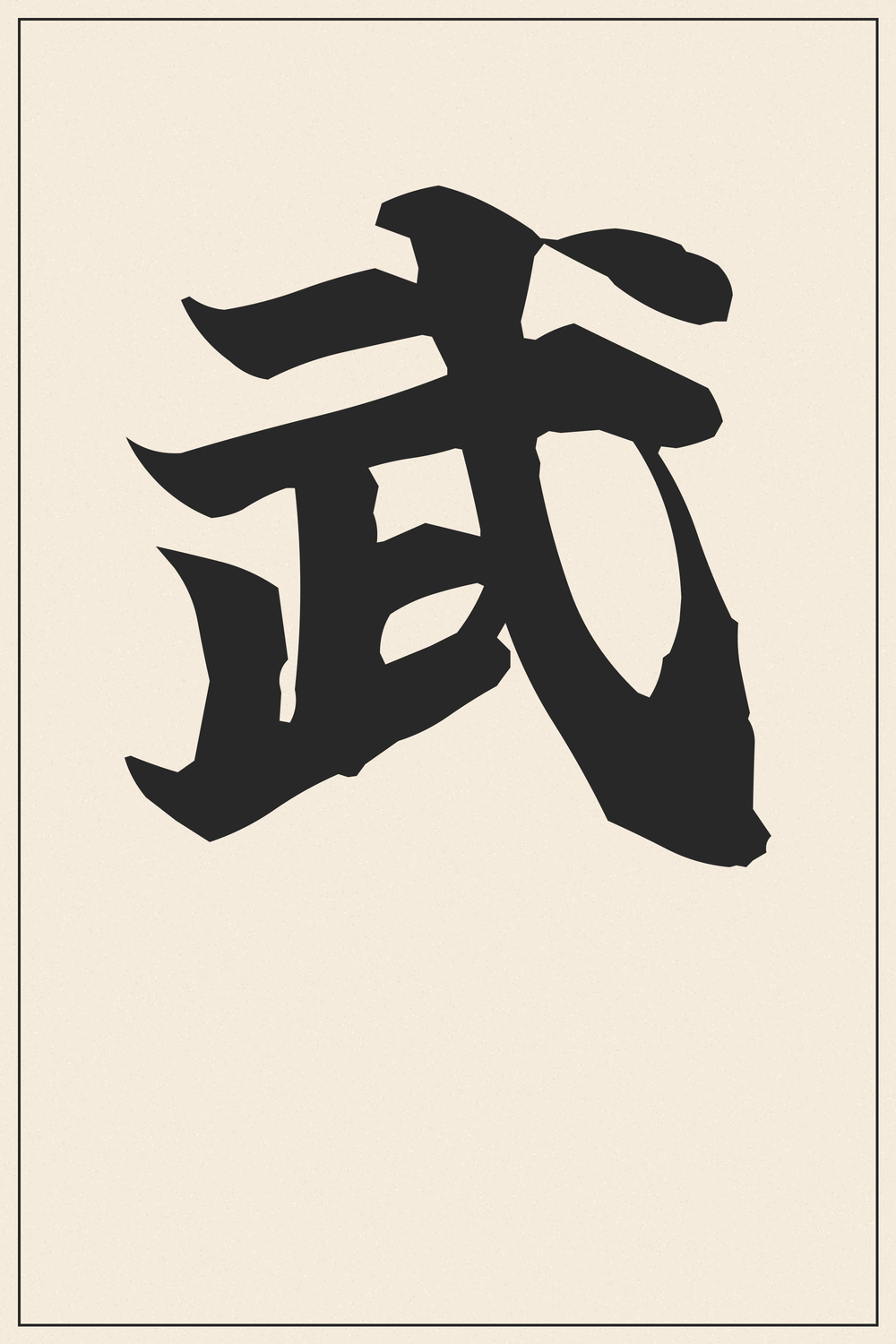
📜 Vertical Writing
⚡ Quick Facts
Breaking Down 戈 (Ka/Hoko)
The component 戈 depicts a dagger-axe or ji—the primary polearm weapon used in ancient Chinese and early Japanese warfare. Picture a long wooden shaft with a perpendicular blade attached near the top, plus a forward-pointing spearhead. Warriors could thrust forward with the spear point or swing sideways using the perpendicular blade to hook enemies off horses or slash through formations.
This wasn’t ceremonial decoration. The dagger-axe dominated battlefields for over a millennium before iron swords became common. The character 戈 appears in numerous war-related kanji: 戦 (sen, war/battle), 戒 (kai, commandment/warning), 截 (setsu, to cut off). Any character containing 戈 carries military or aggressive connotations because the weapon itself symbolized organized violence and military power.
When you see 戈 in 武, you’re looking at the fundamental reality of martial arts: they originated as killing techniques. Modern practitioners train for sport, fitness, character development, cultural connection—but the root remains unchanged. These movements were designed to destroy human bodies efficiently. The philosophical overlay came later, after warriors needed to justify their profession as something beyond sanctioned murder.
Most modern people have never seen a dagger-axe because swords replaced them centuries ago. But in the Bronze Age and early Iron Age, the 戈 dominated East Asian battlefields the way rifles dominate modern combat. The character preserves visual memory of a weapon technology that defined an era then disappeared from practical use.
Breaking Down 止 (Shi)
The component 止 originally depicted a foot or footprint—you can still see the toes and heel in the character’s structure. This radical appears in characters related to walking, standing, or movement: 歩 (ho, walk), 歴 (reki, history—originally meaning “traveling through places”), 正 (sei, correct—originally showing feet stopping at the proper place).
The component carries dual meanings that create the entire etymological debate. As a verb, 止 means “to stop, to cease, to end”—giving the poetic “stopping the spear” interpretation. But when used as a radical in other characters, 止 consistently relates to feet, walking, and movement—suggesting 武 originally meant “advancing with weapons,” depicting marching armies rather than peacekeeping forces.
Linguistic analysis of ancient texts supports the “advancing” interpretation. Early Chinese military vocabulary used 武 to describe active warfare, military expeditions, and aggressive conquest—contexts where “stopping violence” makes no sense. The character described what warriors DID (march to battle with weapons), not the philosophical justification they’d construct centuries later to feel better about doing it.

The character that defines an entire martial tradition
The Two Interpretations
The “stopping the spear” interpretation traces to King Zhuang of Chu in 597 BCE. According to historical records, when asked about the meaning of 武, he replied: “The character means stopping the dagger-axe. True military strength exists to prevent conflict, not perpetuate it. The greatest warrior is one who achieves victory without fighting.” This became canonical interpretation, quoted endlessly through Chinese and Japanese history.
Modern linguists point out the obvious problem: when 止 functions as a radical in other characters, it NEVER means “stop” in that abstract sense—it always relates to feet and walking. Characters like 步 (walk), 歧 (diverge—literally “feet going different directions”), and 歴 (travel through places) all use 止 to indicate physical movement. Applying the “stop” meaning only to 武 while ignoring its consistent “foot/walk” meaning everywhere else looks suspiciously like retconning philosophy onto etymology.
Martial arts instructor Ellis Amdur offered the perfect synthesis: “Let’s say it means ‘stopping the spear’—in the opponent’s belly.” Maybe both interpretations work. Armies advance with weapons (literal meaning) to stop enemy aggression (philosophical interpretation). The character can describe the practical reality of war while pointing toward the ethical framework warriors developed to make that reality bearable.
King Zhuang’s “stopping the spear” interpretation served political purposes—he was justifying military campaigns as defensive actions maintaining peace. Later Confucian scholars embraced it because it subordinated military power to moral authority. The interpretation that survived history wasn’t necessarily the accurate one; it was the useful one for rulers wanting philosophical cover for violence.
武 in Japanese Context
Japan imported 武 along with Chinese writing systems around the 5th-6th centuries CE. The character became foundational to warrior-class identity. 武士 (bushi) literally means “martial gentleman”—combining military prowess (武) with educated social status (士). The compound distinguished professional warriors from mere soldiers or thugs, implying cultivation and discipline alongside combat skill.
During the Edo period (1603-1868), Japan experienced unprecedented peace under Tokugawa shogunate rule. Suddenly, an entire warrior class found itself with no wars to fight. 武 underwent philosophical transformation. If warriors couldn’t prove their worth through combat, they needed alternative justification for their elevated social status and samurai privileges. Enter 武道 (budō)—”the martial way.”
The suffix change from 武術 (bujutsu, martial techniques) to 武道 (budō, martial way) marked ideological shift. Techniques focused on effectiveness—how to kill efficiently. “Way” suggested spiritual cultivation, character development, moral improvement through training. Peacetime warriors transformed violence into philosophy, combat into meditation, battlefield skills into character-building exercises. 武 stopped meaning “what we do” and started meaning “who we are.”
Modern Martial Arts Philosophy
Contemporary martial arts instructors overwhelmingly embrace the “stopping the spear” interpretation. Students learning karate, judo, kendo, or aikido hear repeatedly: we train to prevent violence, not cause it. The strongest person is one who never needs to fight. True mastery means controlling yourself, not defeating others. These philosophies align perfectly with the poetic etymology King Zhuang proposed 2,600 years ago.
This interpretation serves modern needs beautifully. Parents enroll children in martial arts wanting them to learn discipline, respect, confidence—not how to hurt people. Adults train for fitness, stress relief, personal growth. The “stopping violence” framework lets people practice combat techniques without confronting the uncomfortable reality that they’re training in formalized violence, however controlled and sporting modern application becomes.
But honest practitioners acknowledge the dual nature. Yes, martial arts teach restraint, discipline, when NOT to use force. They also teach extremely efficient methods for destroying human bodies when necessary. The character 武 holds both truths simultaneously: the weapon and the restraint, the capacity for violence and the wisdom to avoid it, the warrior’s skill and the warrior’s ethics.
The Japanese Budō Association established a formal charter in 1987 defining budō principles: cultivate character, respect etiquette, exhibit self-control, win with modesty, accept defeat gracefully. These values represent centuries of philosophical evolution transforming battlefield brutality into personal development methodology—武 reimagined for peaceful society.
🎨 Tattoo Design Ideas
- ✨ Bold Standalone Character – Single 武 character in powerful brushwork makes maximum impact through simplicity. The eight strokes create balanced, aesthetically pleasing composition that reads clearly at any size. Perfect for 3-5 inch placements on shoulder, chest, or forearm where the character commands attention.
- ✨ Traditional Calligraphy Style – Flowing brush strokes with visible texture capture martial arts’ connection to traditional Japanese culture. The calligraphic style should feel confident and decisive—no hesitation in the strokes, mirroring the warrior mindset the character represents.
- ✨ Minimalist Modern Line – Clean, precise strokes without decorative flourish work perfectly for contemporary aesthetic. The character’s structure remains powerful even in simplified form. Ideal for smaller placements (2-4 inches) where clarity matters more than ornate detail.
- ✨ Integrated Weapon Imagery – Since 武 contains the weapon radical, consider incorporating subtle sword, spear, or dagger-axe silhouette behind or beside the character. Keep imagery minimal and stylized—the kanji remains focal point, weapon provides historical context.
- ✨ Combined with Discipline Character – Pair 武 with related concepts: 道 (way/path), 心 (heart/spirit), or 力 (strength/power). Two-character combinations create deeper meaning while maintaining readability. Arrange vertically for traditional feel or horizontally for modern presentation.
- ✨ Circular Ensō Frame – Place 武 inside Zen ensō circle connecting martial practice to meditation and spiritual cultivation. The circle shouldn’t compete with the character—thin, simple brushstroke that frames rather than distracts. This design emphasizes budō (martial way) over bujutsu (martial techniques).
Who Chooses This Tattoo
Martial arts practitioners obviously gravitate toward 武 as representation of their practice. Whether you study karate, judo, kendo, aikido, jujutsu, or any Japanese martial art, this single character encompasses your training’s essence. It works because it’s not style-specific—it represents the fundamental martial spirit underlying all combat disciplines.
Military personnel and veterans sometimes choose 武 connecting their service to warrior traditions spanning millennia. The character acknowledges military profession’s ancient lineage while suggesting something beyond mere soldiering—a commitment to protecting others, strategic thinking, discipline under pressure, the warrior ethos transcending specific wars or causes.
But people also select 武 for personal battles having nothing to do with physical combat. Cancer survivors fighting for their lives. Addicts battling demons. People overcoming abuse, rebuilding after devastating loss, fighting depression. They choose warrior symbolism because they recognize their struggle demands martial qualities: courage, discipline, willingness to suffer, refusal to surrender. 武 honors the warrior in everyone who fights, whatever their battlefield.
武 carries profound weight in Japanese culture—it’s not decorative or casual. If you get this tattoo without martial arts training or military service, be prepared to explain your connection respectfully. The character deserves authenticity, not appropriation. Choose it because you genuinely embody or aspire to warrior principles, not just because it looks cool.
Why This Character Endures
The character survives because it holds contradictions without resolving them. It depicts weapons and violence while suggesting restraint and peace. It describes physical combat while pointing toward spiritual development. It names external conflict while demanding internal discipline. These paradoxes don’t weaken the character—they make it deeper, more applicable across contexts.
Modern life rarely requires physical combat, but martial challenges remain constant. You need courage confronting difficult truths. You need discipline maintaining commitments when motivation fades. You need strategic thinking navigating career obstacles. You need the capacity for controlled aggression defending boundaries. You need warrior qualities even if you never throw a punch.
武 endures because being human requires being a warrior—not necessarily in literal combat, but in the broader sense of facing life’s battles with courage, discipline, and skill. Whether the character originally meant “advancing with weapons” or “stopping the spear” matters less than what it’s come to represent: the warrior spirit that refuses to surrender, that trains relentlessly, that develops strength not for its own sake but to protect what matters. That’s a philosophy worth preserving in ink on skin.
Comments