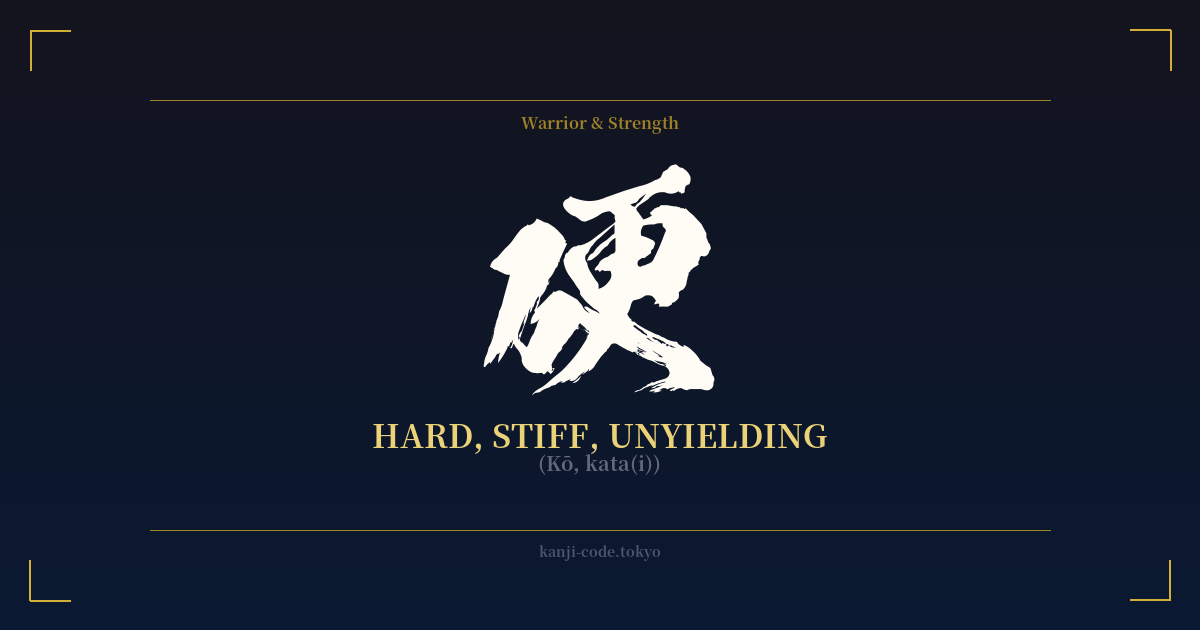
✍️ 硬 (Kō, kata(i)) — Cultural Context
The kanji 硬 (kō) is a powerful symbol, rooted in the most tangible and enduring elements of the natural world. Its very structure tells a story: it is composed of the radical 石 (ishi), meaning 'stone,' on the left, and the character 庚 (kō) on the right, which serves primarily as a phonetic component. The immediate visual association is one of rock-solid, unyielding substance, a quality that forms the bedrock of its meaning.
In its most literal sense, 硬 describes physical hardness. It is the kanji used to describe diamonds (金剛石 – kongōseki), steel (鋼鉄 – kōtetsu), and coins (硬貨 – kōka). This physical quality provides a direct and powerful metaphor for human characteristics. When applied to a person or their spirit, 硬 speaks of immense resilience, fortitude, and an unbreakable will. It is the quality of a warrior who endures the harshest training or a person who stands firm in their convictions against overwhelming opposition.
This concept of 'hardness' is deeply valued in Japanese martial arts (budō). Practitioners strive to condition their bodies to become 'hard' to withstand blows, a process that simultaneously forges a 'hard' or unyielding spirit (不動心 – fudōshin, the immovable mind). The term 硬骨 (kōkotsu), literally 'hard bones,' is a high compliment, describing someone with an unbending will and integrity, who refuses to be swayed by corruption or pressure.
However, the cultural nuance of 硬 is not purely positive. Like a rock that can be a foundation, it can also be an obstruction. Hardness can tip over into negative traits like stubbornness, inflexibility, and a lack of compassion. The Japanese word for stubborn, 頑固 (ganko), uses a character that itself contains 硬. Similarly, the word 硬直 (kōchoku) can mean stiffness or rigidity, but also describes the state of a market that has seized up or, more grimly, rigor mortis. This duality is crucial to understanding the character's depth.
Therefore, to choose 硬 is to embrace this complexity. It is not a symbol of simple, brutish strength, but of a profound and sometimes difficult quality. It represents the strength to endure, but also carries the warning of becoming too rigid, too unbending. It is the character of both the steadfast mountain and the stubborn mule, asking its user to reflect on the fine line between principled resilience and blind obstinance.
🖌️ Font Styles for 硬
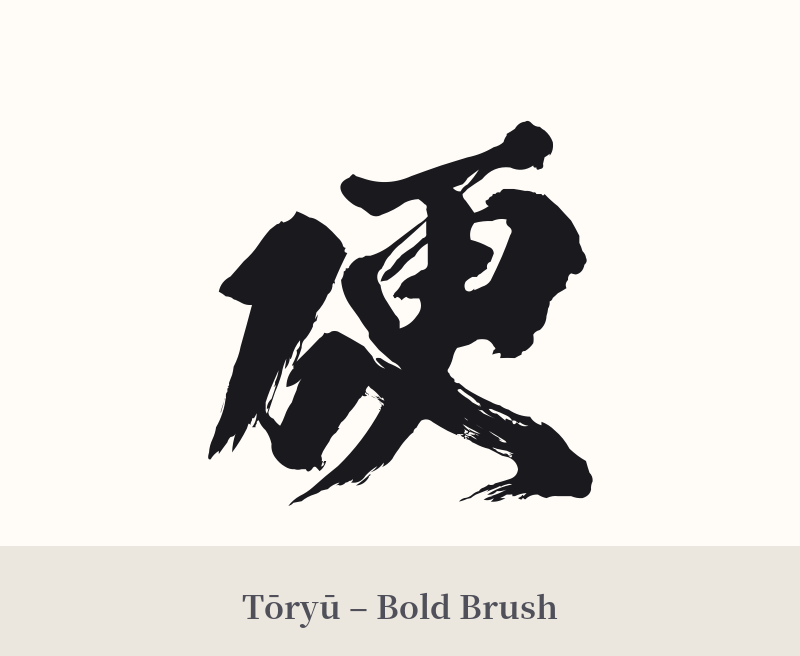
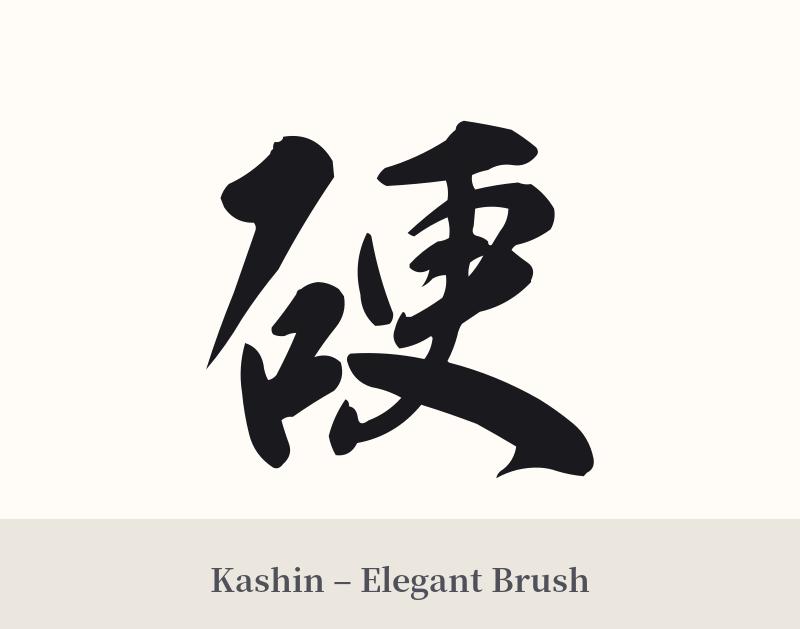
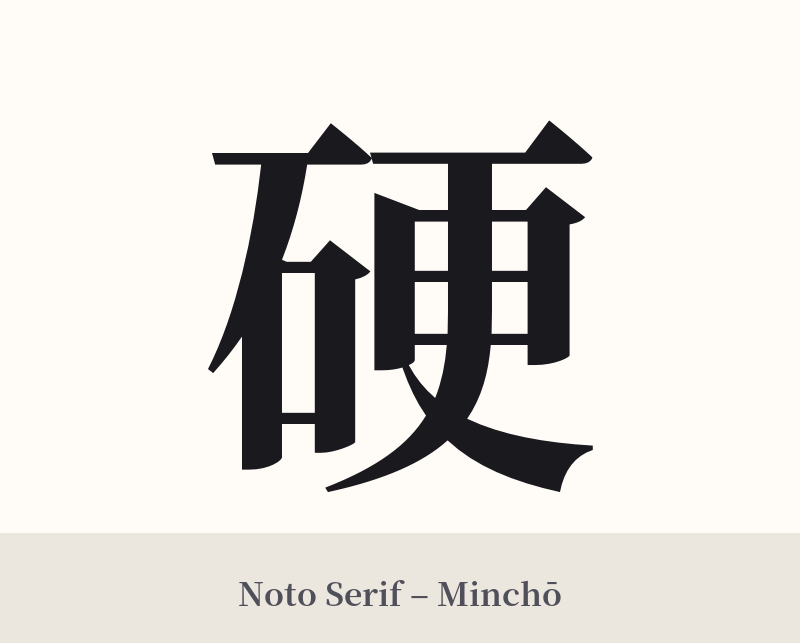
The same kanji can look dramatically different depending on the calligraphy style. Choose a font that matches the mood you want for your tattoo or design.
🎨 Tattoo Suitability
📐 Tattoo Design Guide
The kanji 硬 offers excellent design flexibility due to its solid and balanced structure.
– Placement: Consider areas of the body that convey strength and stability. The forearm, calf, chest, or the back of the shoulder are all powerful canvases for this character. A central placement on the upper back can create a strong focal point symbolizing a 'hard' backbone.
– Font Style: For a traditional and authoritative look, a thick, blocky Kaisho (楷書) script is ideal. It emphasizes the 'stone' radical and the character's inherent solidity. For a more dynamic and aggressive feel, a semi-cursive Gyōsho (行書) or a wild, expressive Sōsho (草書) can look like a mark carved into rock, suggesting battle-hardened resilience.
– Visual Tips: While 硬 is powerful enough to stand alone, it can be integrated with other imagery. Placing it within a cracked or broken circle can symbolize breaking through hardship. It could also be designed to look as if it were chiseled out of stone or forged from metal, enhancing its core meaning visually.
Comments