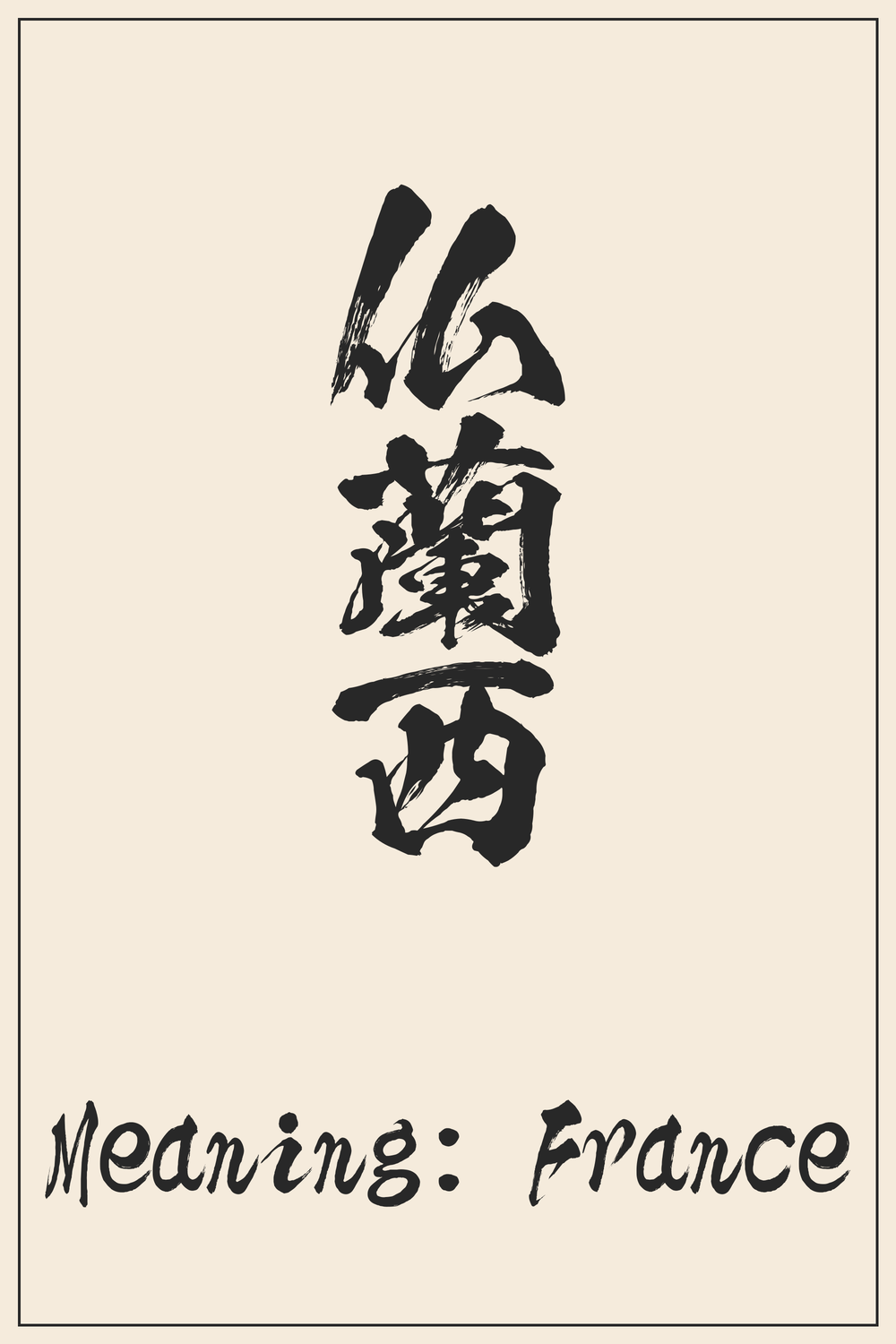
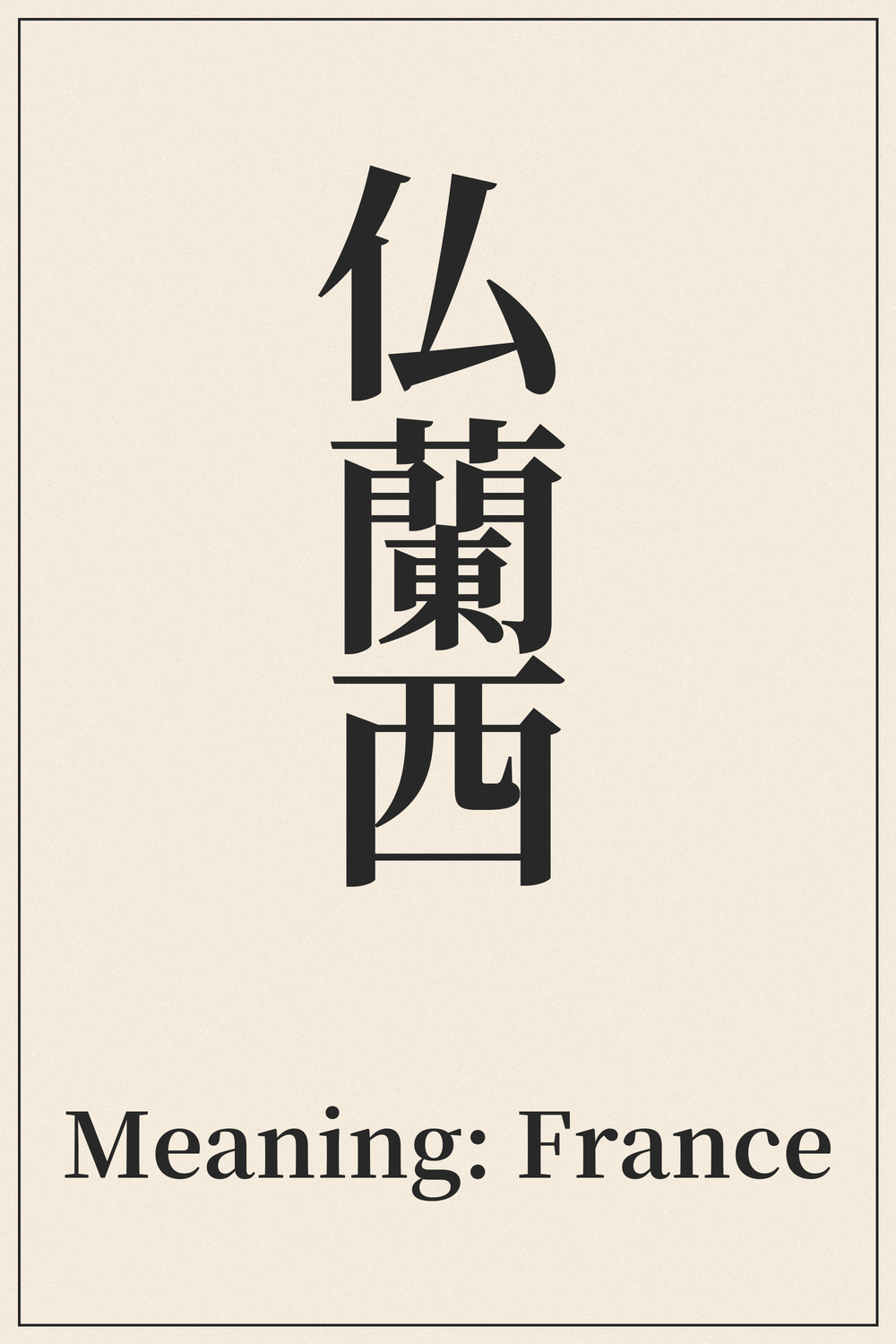
Exploring the Kanji for ‘France’ reveals a fascinating linguistic journey, an elegant example of how Japanese adapts foreign sounds. This unique combination of characters phonetically approximates the country’s name, showcasing the rich depth of Ateji.
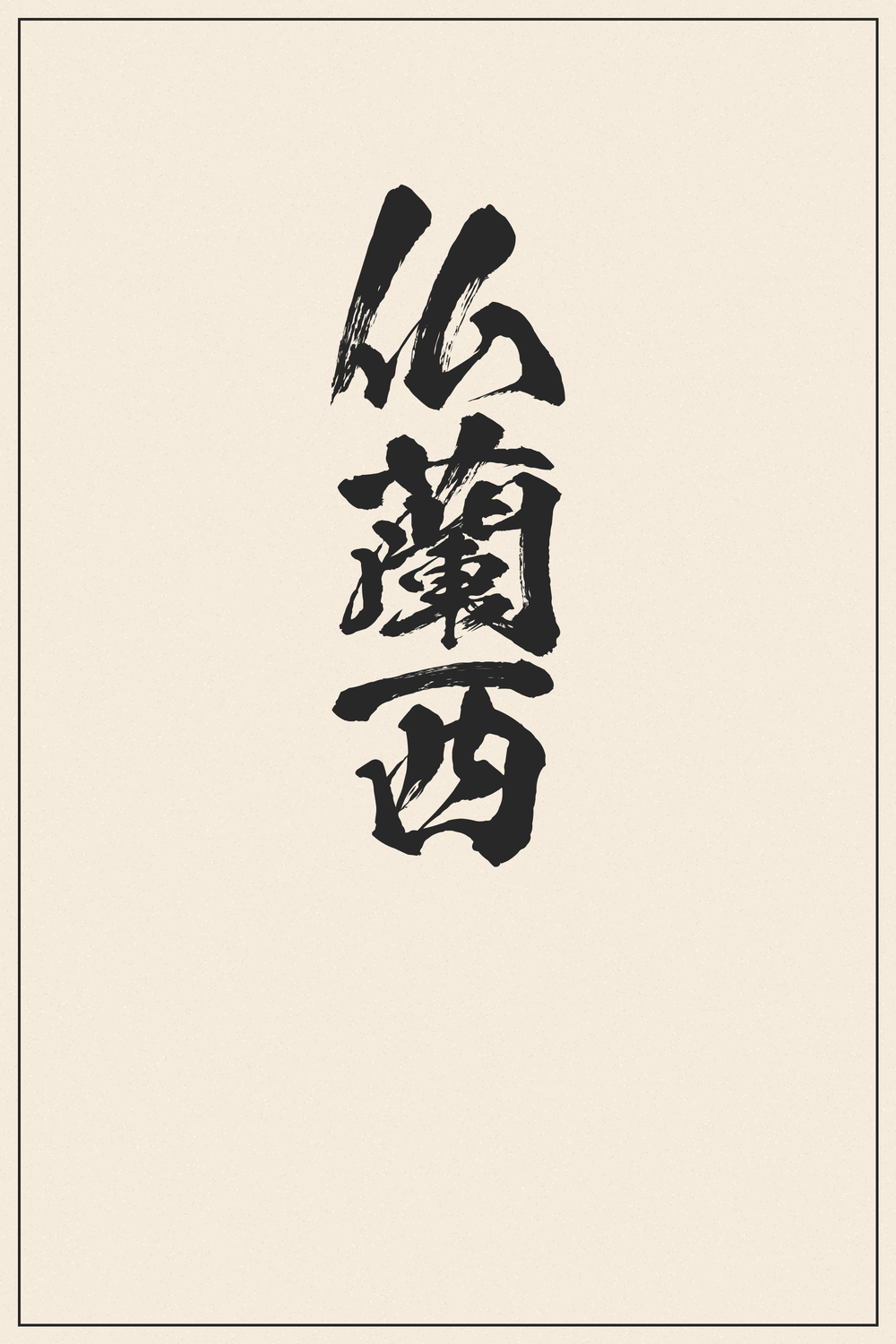
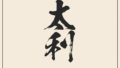
The atmosphere of a Kanji character changes dramatically depending on the font style. A character that looks elegant in a brush style might look bold and modern in a different font.
Recommendation: Since a tattoo is permanent, we strongly recommend comparing various font styles beyond what is shown here. Use our designs as a trusted reference for the correct structure, but feel free to explore different artistic variations to find the perfect match for your vision.
The Deep Meaning Behind 仏蘭西
The Kanji for France, 仏蘭西 (Furansu), is a prime example of ‘Ateji’ (当て字), where characters are chosen primarily for their phonetic values rather than their literal meanings to represent foreign words or names. This historical practice allowed Japan to integrate concepts from other cultures into its writing system.
In this context, 仏蘭西 does not carry a deep symbolic meaning related to the individual characters’ definitions. Its objective literal meaning would be ‘Buddha Orchid West’, which is a phonetic choice. Instead, its significance lies purely in its function as a phonetic representation of ‘France’, reflecting Japan’s engagement with global nomenclature.
Kanji Breakdown
The characters in 仏蘭西 are selected for their sounds to represent ‘France’, rather than their individual semantic values, characteristic of Ateji.
Buddha, France: Originally meaning ‘Buddha’, this character is commonly used as a phonetic component for the ‘bu’ or ‘fu’ sound in Ateji, particularly for ‘France’ (仏蘭西).
Orchid, Holland: This character primarily means ‘orchid’ and is also used as a phonetic component for the ‘ran’ sound in many foreign names, including Holland (和蘭) and France.
West: Meaning ‘west’, this character provides the ‘shi’ or ‘sei’ sound, completing the phonetic approximation of ‘Furansu’. Its literal meaning is less relevant in this Ateji context.
Conclusion
仏蘭西 (Furansu) stands as a testament to the flexibility of the Japanese writing system, demonstrating how Kanji can be employed for phonetic transcription. It is a historical and linguistic artifact, representing ‘France’ through its sounds rather than a composite of its individual characters’ meanings.
While its individual characters carry meanings like ‘Buddha,’ ‘orchid,’ and ‘west,’ the combination for ‘France’ is purely phonetic and does not inherently convey a symbolic message suitable for a personal tattoo in the way other Kanji might. Its appeal lies in its cultural significance as an Ateji for a country name.
Comments