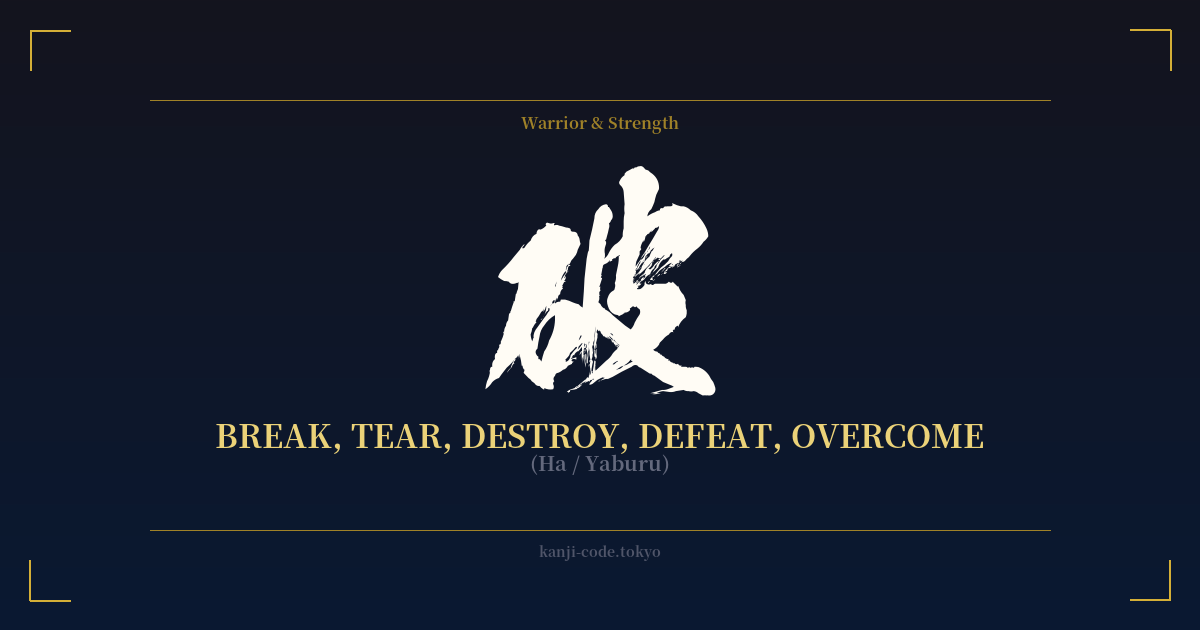
✍️ 破 (Ha / Yaburu) — Cultural Context
The kanji 破 (ha/yaburu) is a character of immense force and dynamism, embodying the act of breaking, tearing, and destroying. Its etymology offers a clue to its raw power: it combines the radical for ‘stone’ (石) with the character for ‘skin’ or ‘pelt’ (皮). This vivid imagery suggests the force required to shatter something as tough and resistant as stone or hardened leather.
However, to see 破 as purely destructive is to miss its deeper, more profound significance in Japanese culture. It represents not just an end, but a necessary transition—a breakthrough. This concept is central to the traditional aesthetic principle of Jo-Ha-Kyū (序破急), which describes the tempo of a performance in arts like Noh theater, music, and even martial arts. The 'Jo' is the slow beginning, the 'Ha' is the break where the pace accelerates and complexity develops, and the 'Kyū' is the rapid, climatic finish. Here, 破 is the crucial, transformative middle act where old patterns are broken to create something new and more intense.
In the world of Bushido and martial arts, 破 is a core concept. It appears in terms like 突破 (toppa), meaning 'breakthrough,' referring to smashing through an enemy's defenses. A martial artist might aim to 'break' an opponent's posture or spirit. The practice of tameshiwari, or breaking boards and bricks, is a physical manifestation of 破, demonstrating not just physical strength but the mental focus to overcome a solid barrier.
This idea of breakthrough extends to personal development. To 'break' one's old self (古い自分を破る) is to achieve personal growth and transcend limitations. It is the spirit behind the term 破天荒 (hatenkō), which literally means 'to break the uncultivated wilderness' but is used to describe something unprecedented, groundbreaking, or audacious. It signifies shattering expectations and achieving what was once thought impossible.
Therefore, 破 is a symbol of violent change that can be either destructive or creative. It is the force that demolishes a building but also the power that allows a chick to break out of its shell. It represents the difficult, often chaotic, process of dismantling the old to make way for the new, making it a powerful symbol for anyone who has overcome adversity or is committed to radical self-transformation.
🖌️ Font Styles for 破
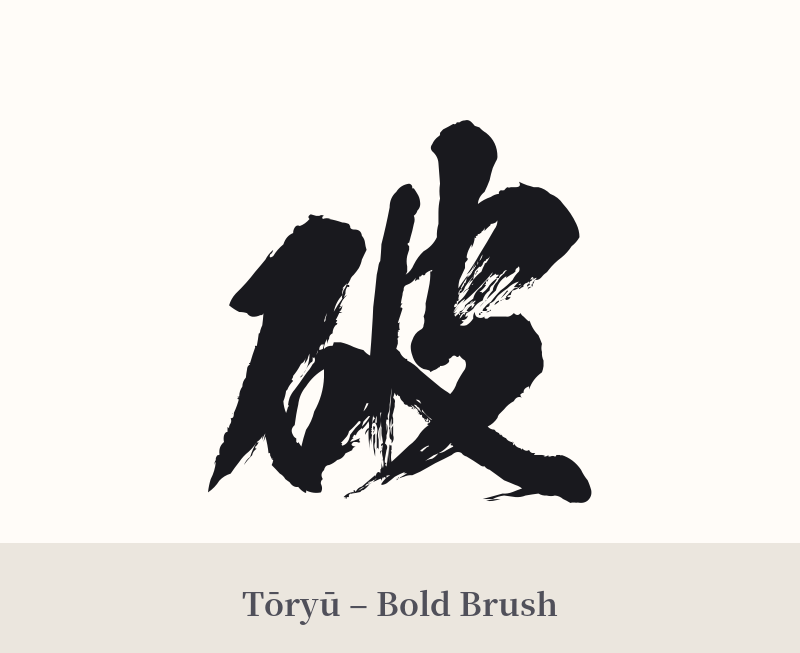
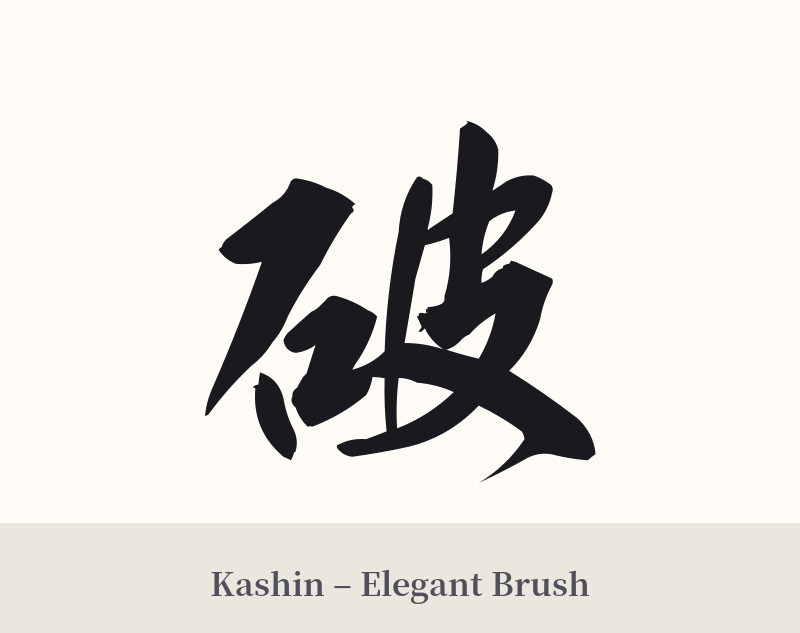
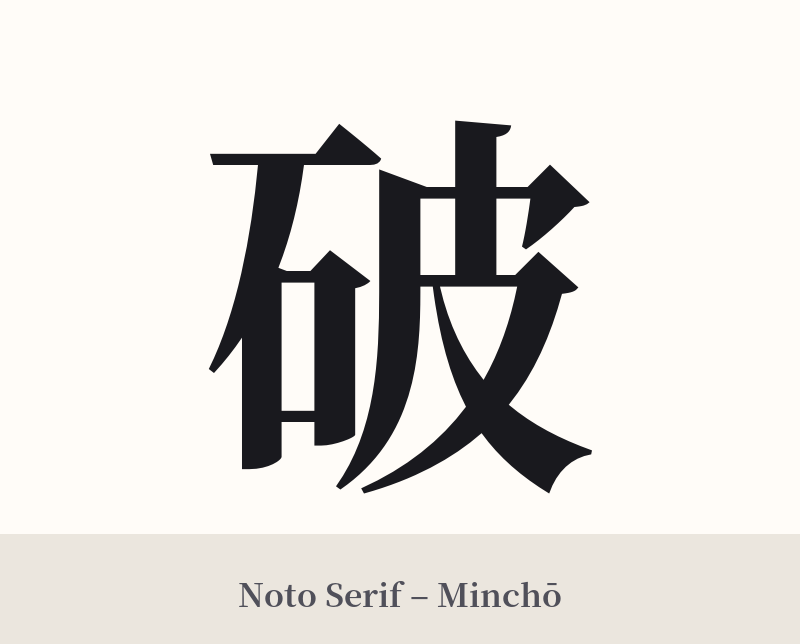
The same kanji can look dramatically different depending on the calligraphy style. Choose a font that matches the mood you want for your tattoo or design.
🎨 Tattoo Suitability
📐 Tattoo Design Guide
The kanji 破 demands a design that reflects its inherent force and action. Its meaning is ill-suited to delicate or overly ornate styles.
– Placement: This character works best on areas of the body associated with strength and action. The forearm, calf, back of the shoulder, or chest are excellent choices, as they provide a solid canvas and complement the kanji's powerful vibe.
– Style: Opt for bold, dynamic calligraphy. A strong gyōsho (semi-cursive) or sōsho (cursive) style can capture the energy of the act of breaking. Thick, forceful brushstrokes with visible 'splatter' (飛白, hihaku) can enhance the sense of impact.
– Visual Elements: Consider incorporating elements that reinforce the theme. A design where the kanji itself appears to be shattering, or one that is breaking through a chain or a solid line, can visually narrate the story of 'breakthrough.' Avoid placing it within a perfect circle or square, as this can feel contradictory to its meaning.
Comments