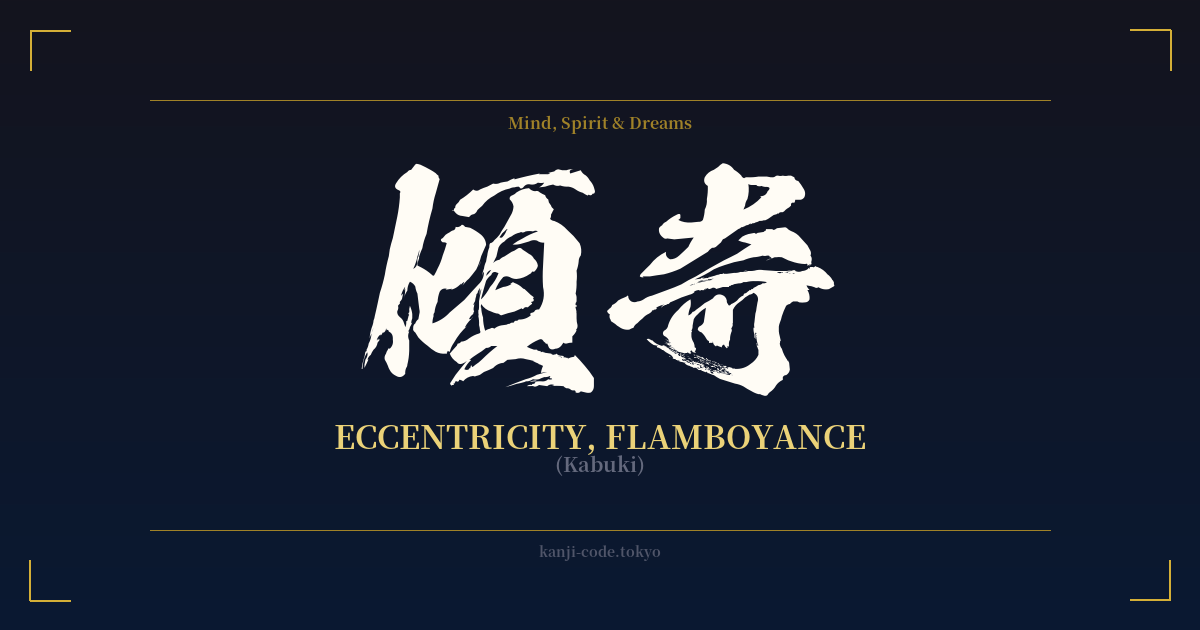
✍️ 傾奇 (Kabuki) — Cultural Context
The term 傾奇 (kabuki) embodies a spirit of flamboyant rebellion and stylish eccentricity, a concept deeply rooted in a fascinating period of Japanese history. It is most famously associated with the 'kabukimono' (傾奇者), or 'the strange ones,' who emerged during the transition from the chaotic Sengoku (Warring States) period to the rigid peace of the Edo period.
These kabukimono were often masterless samurai (rōnin) or young men from warrior families who found themselves without a war to fight. They rejected the strict social codes and stoic aesthetic of the traditional samurai class. Instead, they expressed their identity through outrageous fashion, bizarre hairstyles, and disruptive public behavior.
Their style was a deliberate provocation. They wore brightly colored, often feminine-style kimonos, used unusual materials like velvet imported from Europe, and carried oversized or elaborately decorated swords. Their actions were just as loud as their clothing; they were known for picking fights, speaking in slang, and swaggering through the streets in groups, intentionally clashing with the authorities and the general populace.
The word itself is a perfect descriptor. The verb 'kabuku' (傾く) means 'to lean,' 'to incline,' or 'to deviate.' Combined with 'ki' (奇), meaning 'strange' or 'odd,' the term literally translates to 'leaning towards the strange.' It captures the essence of consciously deviating from the established norm and embracing the unconventional.
This rebellious subculture had a profound impact on Japanese arts. The world-renowned Kabuki theater (歌舞伎) owes its origins to this very spirit. The founder, Izumo no Okuni, began performing sensational dances in Kyoto, often dressing in an exaggerated, masculine style inspired by the kabukimono. Her performances were so popular that the name 'kabuki' stuck, though the kanji was later changed to the more refined 歌 (song), 舞 (dance), and 伎 (skill) to distance the art form from its delinquent roots.
Today, the spirit of 傾奇 lives on. It is used to describe anyone who defies convention with a strong, self-assured sense of style. In manga and video games, characters who embody the kabukimono archetype, such as Maeda Keiji from 'Hana no Keiji,' are celebrated as charismatic heroes who live by their own code. To embrace 傾奇 is to embrace a philosophy of bold, unapologetic individualism.
🖌️ Font Styles for 傾奇
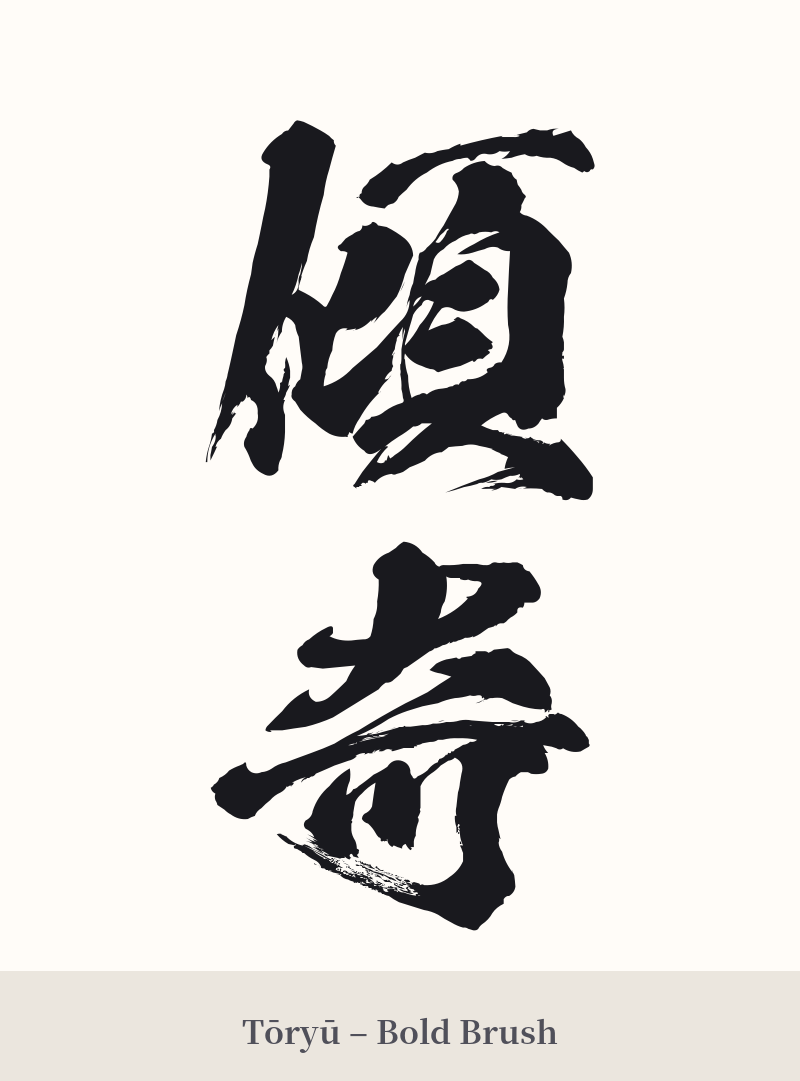
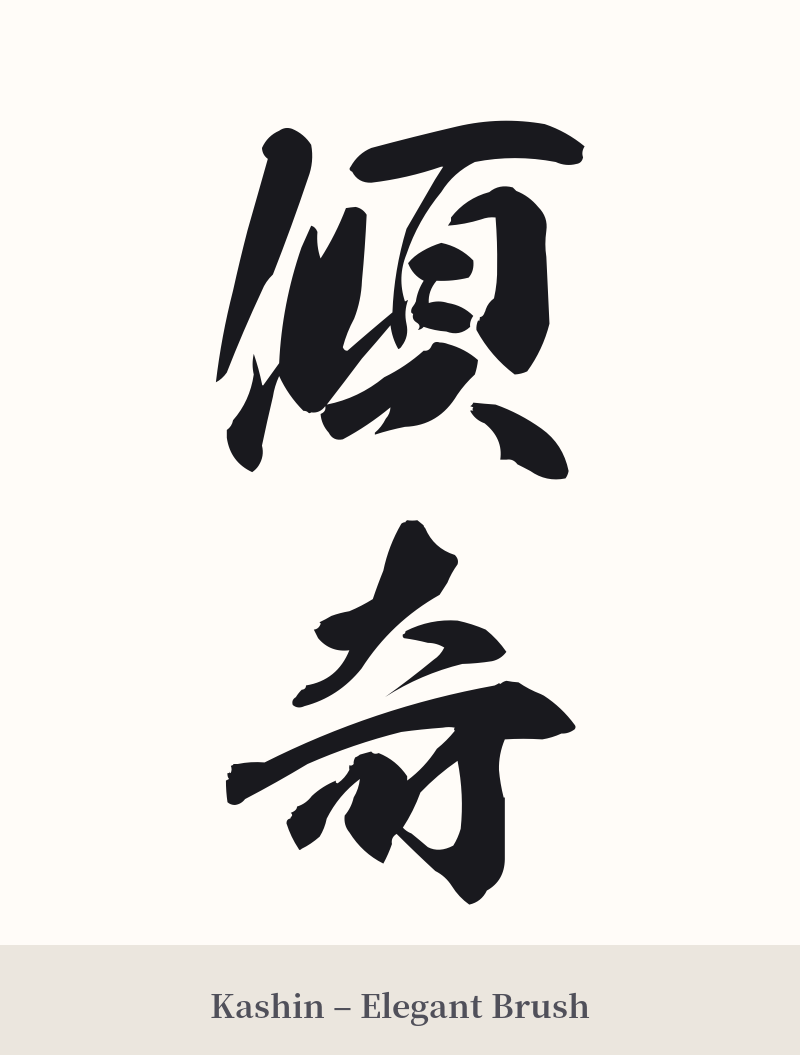
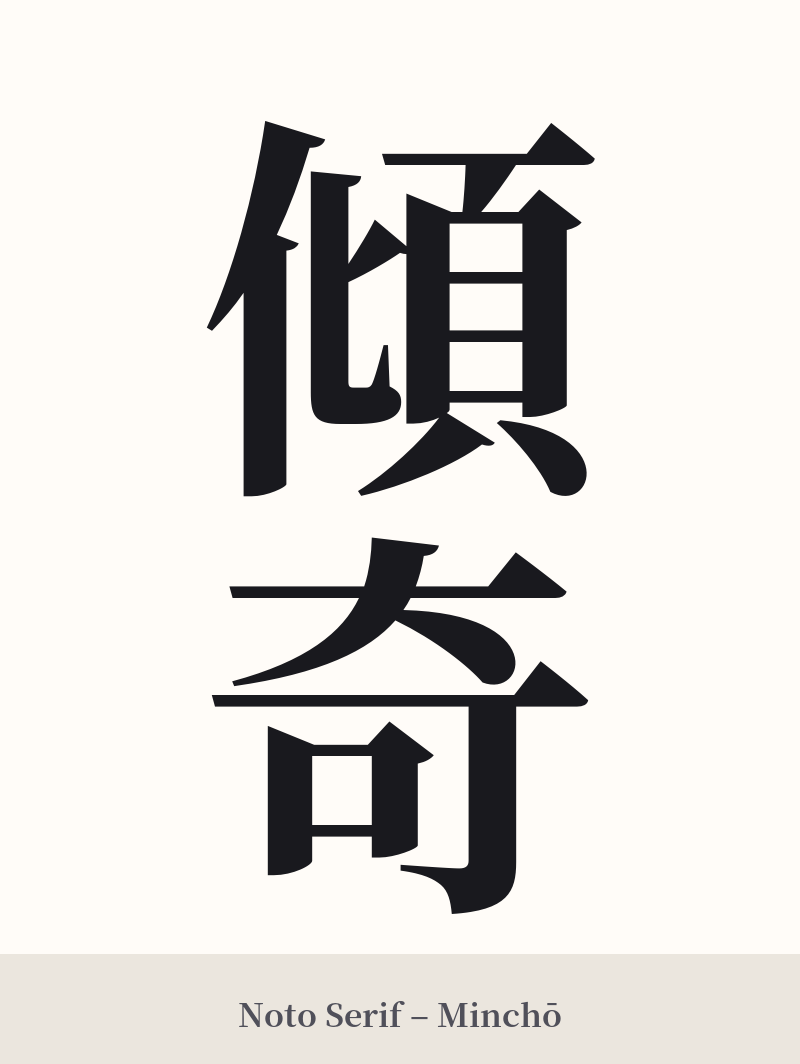
The same kanji can look dramatically different depending on the calligraphy style. Choose a font that matches the mood you want for your tattoo or design.
🎨 Tattoo Suitability
📐 Tattoo Design Guide
A 傾奇 tattoo makes a bold statement about non-conformity and personal style. For the design, consider these recommendations:
– Placement: A vertical alignment works exceptionally well for this two-character compound. Prime locations include the forearm, the spine, or the calf, where the characters can flow downwards.
– Font Style: Expressive, dynamic calligraphy is key. A semi-cursive (gyōsho) or full cursive (sōsho) script can capture the fluid, rebellious energy of the kabukimono. Avoid overly rigid or blocky fonts, as they contradict the meaning of 'deviating' from the norm.
– Visual Tips: Consider having the characters themselves rendered with a slight 'lean' to visually represent the meaning. You could also incorporate a splash of a bold color like red or gold to symbolize flamboyance. This kanji pairs well with larger Japanese-style motifs, such as a samurai helmet (kabuto), a koi fish swimming upstream, or crashing waves.
Comments