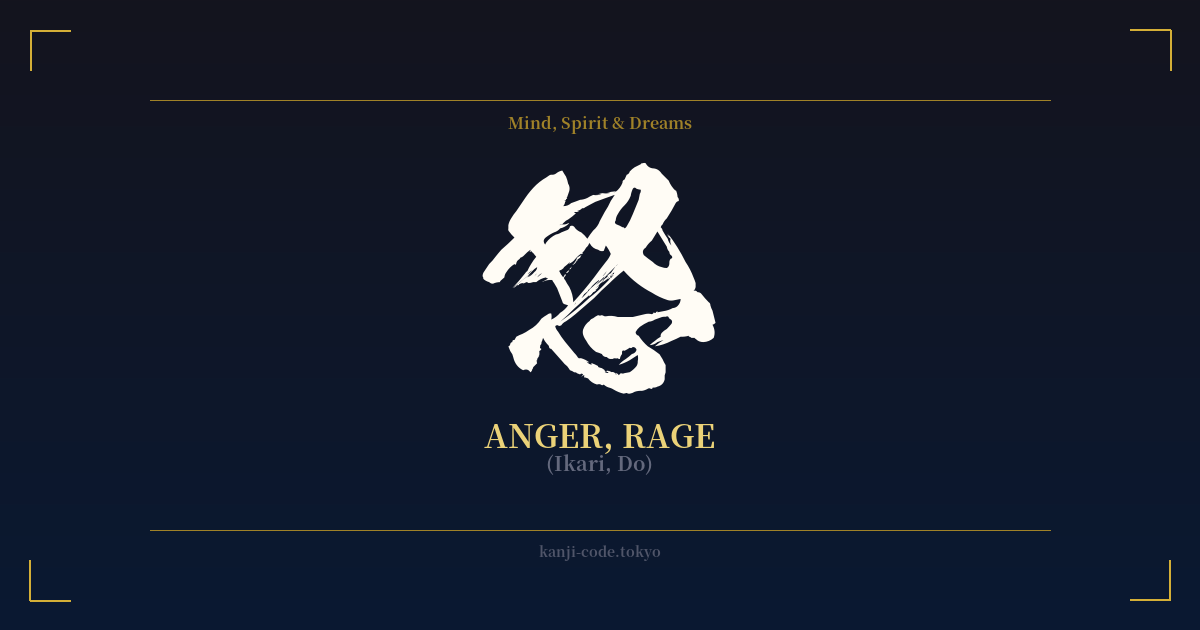
✍️ 怒 (Ikari, Do) — Cultural Context
The kanji 怒 (ikari) is a visceral and potent symbol, capturing one of the most fundamental human emotions: anger. Its construction offers a fascinating glimpse into its meaning. The character is composed of two parts: 奴 (nu/do) on top, which can mean 'slave' or 'guy,' and 心 (shin/kokoro) on the bottom, meaning 'heart' or 'mind.' Together, they form a powerful image: the heart of a slave. This suggests feelings of oppression, resentment, and a building pressure that finally erupts into rage. It’s not just a fleeting annoyance; it’s a deep, powerful force that has been constrained.
In Japanese culture, the expression of anger is often complex and highly contextual. While Western cultures may sometimes encourage 'letting it all out,' traditional Japanese society places a high value on social harmony (和, wa). Openly displaying anger is frequently seen as a sign of immaturity or a loss of self-control. For the samurai and in the philosophy of Bushido, maintaining a calm, imperturbable mind (不動心, Fudōshin) was paramount. An angry warrior was a predictable one, and losing one's cool in battle could be a fatal mistake.
However, this doesn't mean anger has no place. There is a concept of 'righteous anger' or indignation (憤怒, funnu), which can be a powerful motivator for justice. This is most vividly seen in Japanese Buddhism, particularly with the Wrathful Deities (明王, Myōō). Figures like Fudō Myōō (不動明王) are depicted with terrifying, angry faces, surrounded by flames. This anger is not evil; it is a manifestation of fierce compassion. Their wrath is directed at ignorance, illusion, and the obstacles that prevent enlightenment. Their role is to frighten away evil and forcefully guide beings toward salvation. In this context, 怒 becomes a symbol of protective strength and unwavering resolve.
In everyday language, the character is common. The noun 'anger' is 怒り (ikari), and the verb 'to get angry' is 怒る (okoru). There are countless expressions that describe its various shades, from mild irritation like 腹が立つ (hara ga tatsu, literally 'the stomach stands up') to explosive fury, 激怒 (gekidō). This single character, therefore, sits at a cultural crossroads: it represents a feeling that is often suppressed for social harmony, yet it is also recognized as a source of immense power, capable of both destruction and fierce protection.
🖌️ Font Styles for 怒
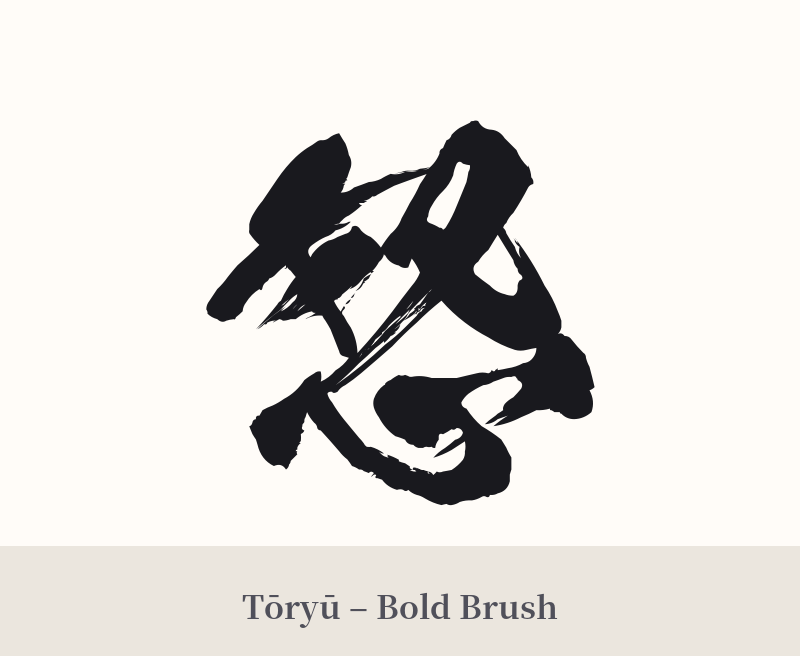
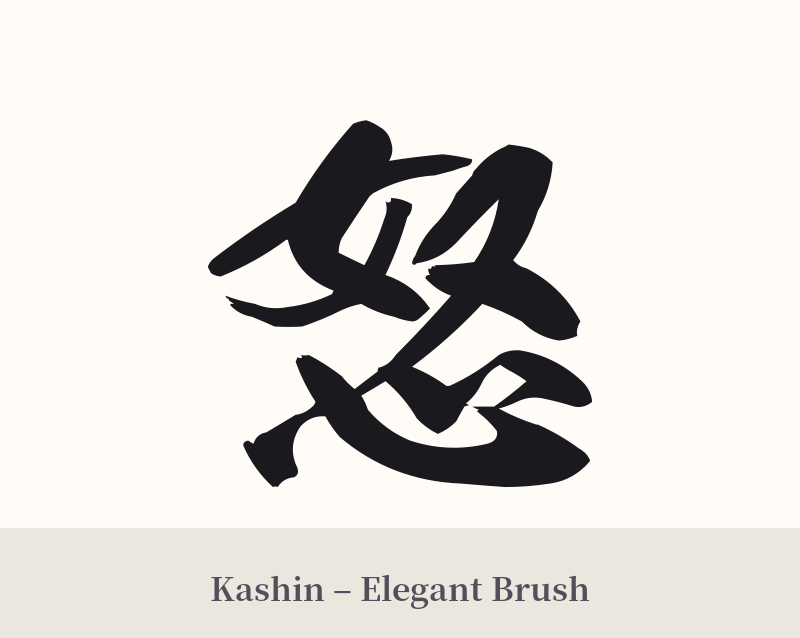
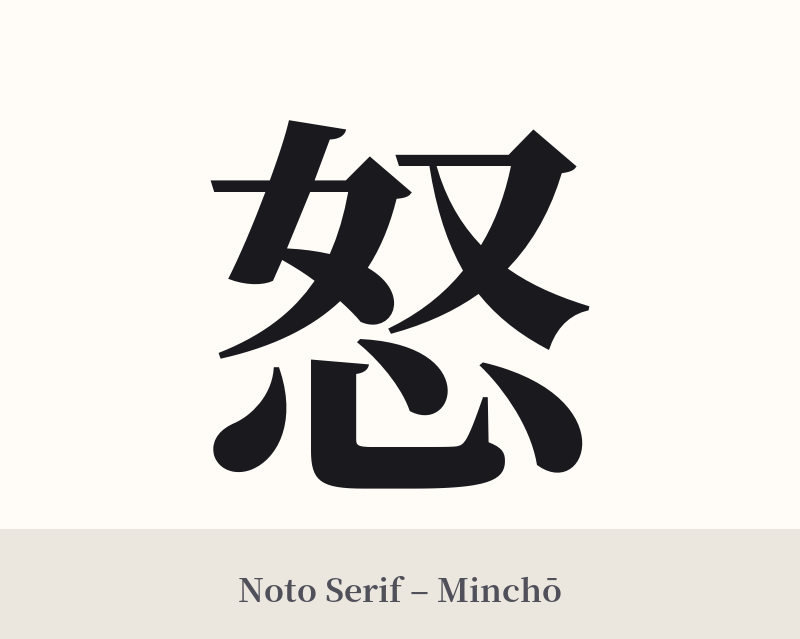
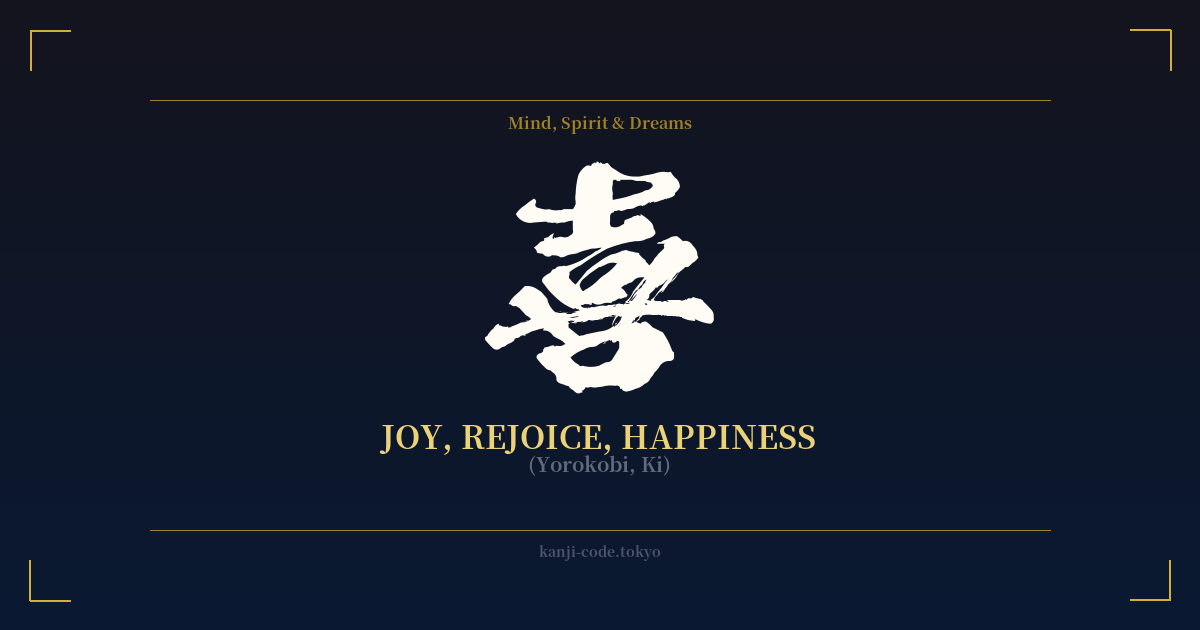
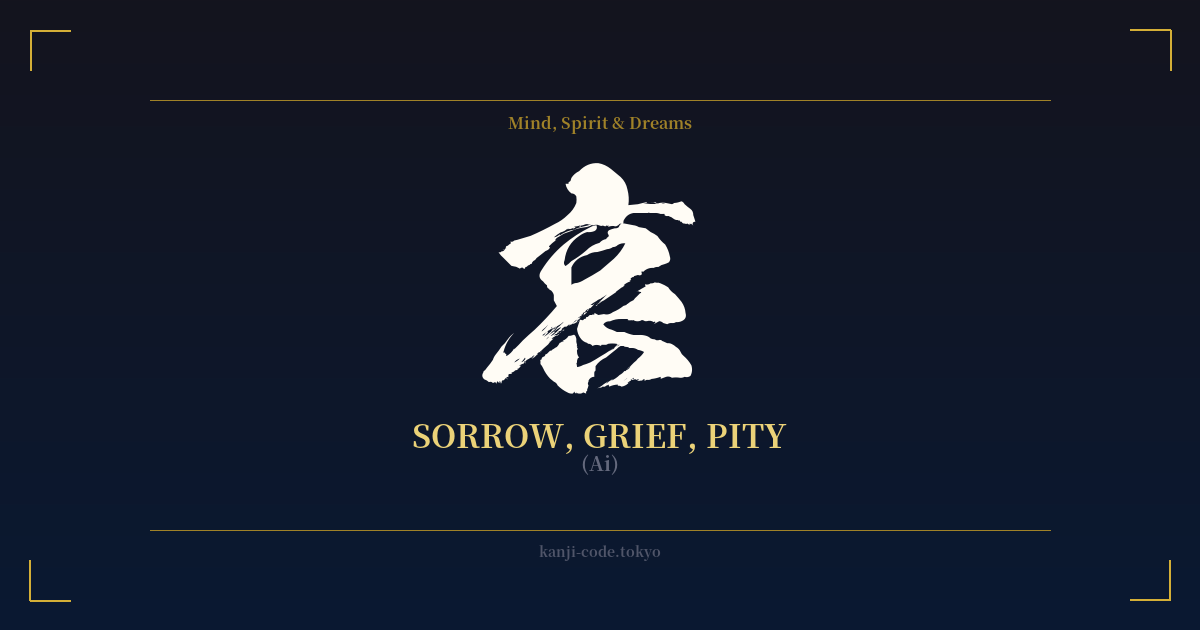
The same kanji can look dramatically different depending on the calligraphy style. Choose a font that matches the mood you want for your tattoo or design.
🎨 Tattoo Suitability
📐 Tattoo Design Guide
The kanji 怒 carries a strong, aggressive energy, and its design should reflect that. It works well as a standalone piece that makes a bold statement.
– Placement Suggestions: Consider areas of the body that convey strength and action, such as the forearm, bicep, calf, or across the shoulder blades. For a more personal and contained representation, the chest over the heart could be symbolic, linking back to the kanji's components.
– Font Style Recommendations: A thick, heavy Kaisho (block) style can emphasize a sense of immense, contained pressure. For a more dynamic and explosive feel, a semi-cursive (Gyosho) or full cursive (Sosho) style with sharp, quick strokes can capture the feeling of rage being unleashed.
– Visual Tips: To add context and nuance, consider pairing 怒 with other imagery. Surrounding it with flames can amplify the sense of rage. Conversely, incorporating elements like calm water or a lotus flower can create a powerful design about controlling or overcoming anger. It could also be part of a larger piece featuring a wrathful deity like Fudō Myōō or an Oni mask.
Comments