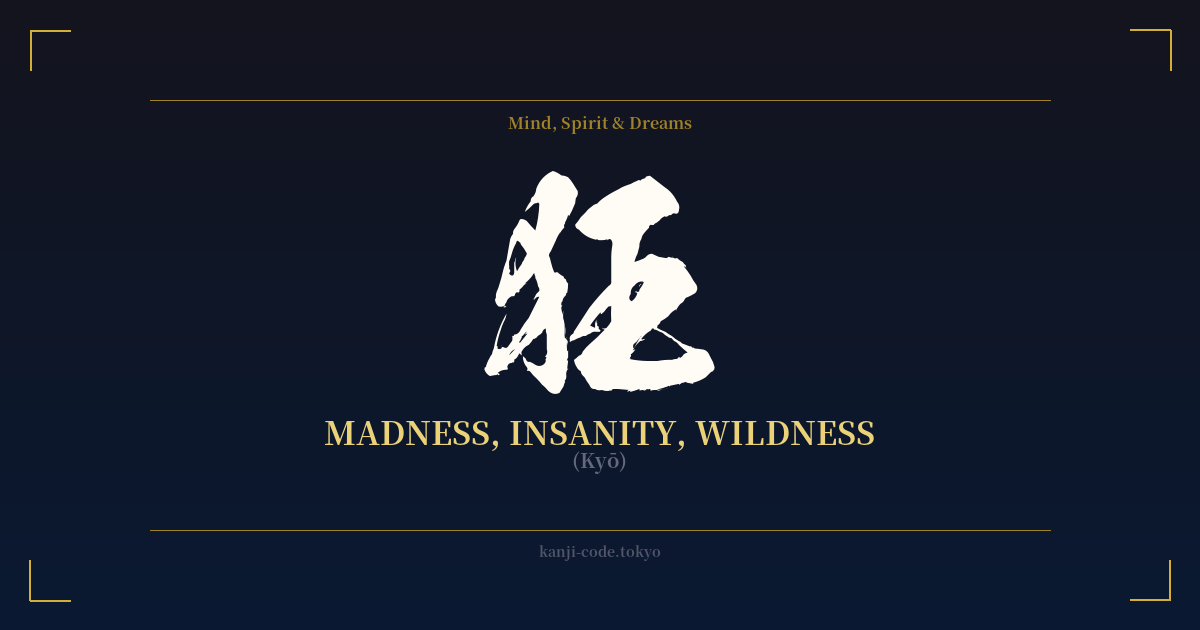
✍️ 狂 (Kyō) — Cultural Context
The kanji 狂 (kyō) is a potent and unsettling character that delves into the concepts of madness, insanity, and untamed wildness. Its very structure tells a story of chaos. The character is composed of two radicals: the left side, 犭 (kemonohen), is a variant of 犬 (inu), meaning 'dog' or 'beast.' This radical immediately grounds the character in animalistic, untamed, and instinctual behavior. The right side is 王 (ō), meaning 'king.' Together, they can be interpreted as a 'wild king' or a 'king of beasts'—an entity with immense power but no rational control, acting purely on impulse. This etymology paints a picture not just of chaos, but of powerful, unchecked chaos that deviates from the expected order.
In modern Japanese, 狂 carries a wide spectrum of meanings, ranging from the clinical to the colloquial. Its most direct translation refers to insanity or madness (精神錯乱, seishin sakuran). It's a heavy word, often used in medical or psychological contexts to describe a state of being mentally unwell. Because of this, using it lightly can be seen as insensitive or offensive, trivializing serious mental health conditions.
However, the character also occupies a space in colloquial language to mean 'crazy' or 'fanatical' in a less severe, more metaphorical sense. This is where nuance becomes critical. When attached to a noun, it can signify an extreme, all-consuming passion. For example, a 野球狂 (yakyū-kyō) is a 'baseball fanatic,' someone so obsessed with the sport that their devotion seems almost mad. Similarly, 熱狂 (nekkyō) means 'wild enthusiasm' or 'frenzy,' the kind you might see at a packed concert. In these contexts, the 'madness' is channeled into a specific interest, implying a level of focus so intense it borders on the irrational.
In Japanese literature, folklore, and pop culture, characters described with 狂 are often dangerous, unpredictable, and operate outside of societal norms. They might be the tragic figure in a Noh play driven mad by grief, or the 'berserker' archetype in an anime who unleashes a wild, uncontrollable power. This character doesn't just represent anger (like 怒) or simple chaos (like 乱); it embodies a fundamental break from reason, a state where instinct and emotion completely overwhelm the rational mind. The verb form, 狂う (kuruu), means 'to go mad' or 'to be out of order,' used for both people and machines, highlighting its core meaning of deviating from normal function.
🖌️ Font Styles for 狂
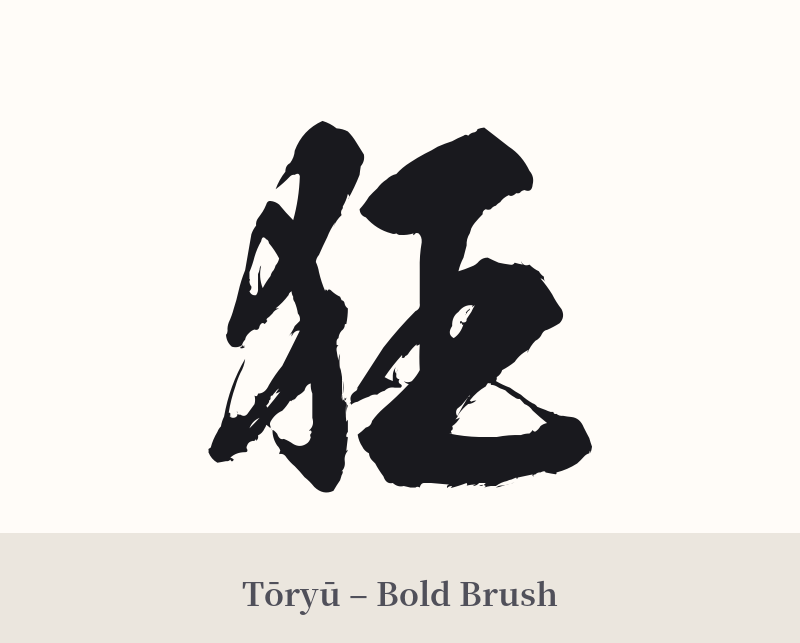
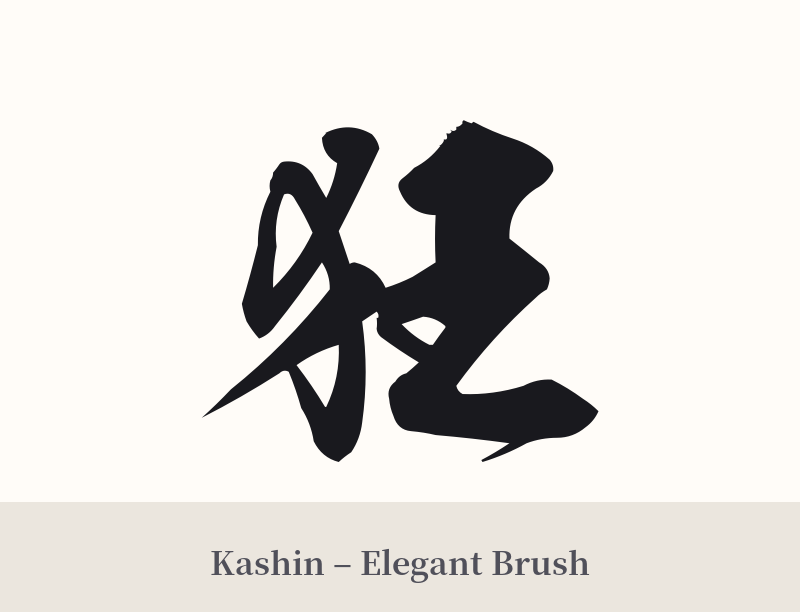
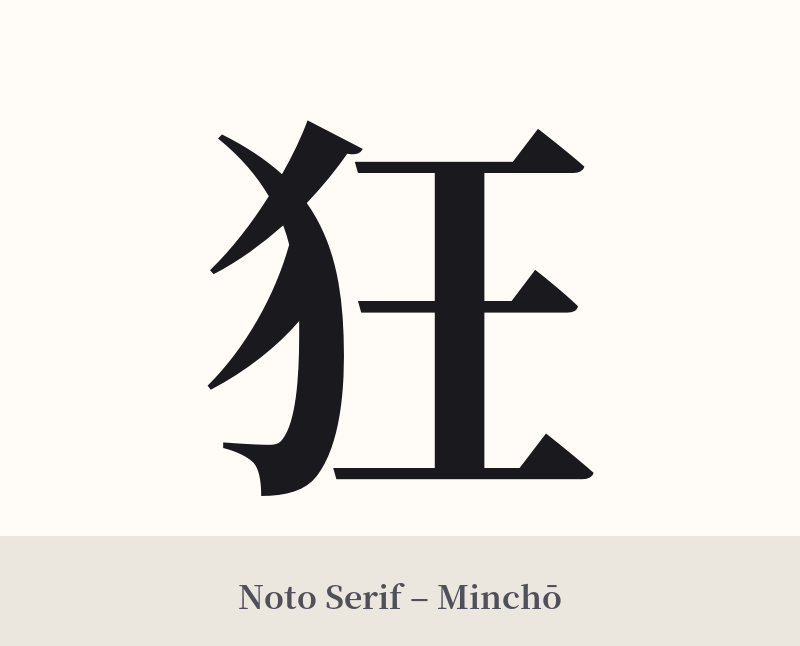
The same kanji can look dramatically different depending on the calligraphy style. Choose a font that matches the mood you want for your tattoo or design.
🎨 Tattoo Suitability
📐 Tattoo Design Guide
Given the potent and often negative meaning of 狂, a tattoo of this character requires careful consideration of its presentation and placement.
– Placement: This kanji is best placed in an area that can be concealed, such as the ribs, upper thigh, or back shoulder. This allows you to control who sees it and avoids constant misinterpretation. Highly visible placements like the neck, hands, or forearm are strongly discouraged as they can project an aggressive or unstable image.
– Font Style: The style can dramatically alter the feeling. A rough, frantic brushstroke (sōsho or gyōsho style) can emphasize the 'wildness' and 'chaos' inherent in the character. Conversely, a clean, sharp, and blocky kaisho or mincho font can give it a more deliberate, almost clinical feel, like a warning label, which can be its own powerful statement.
– Visual Tips: Because it's a risky standalone character, consider incorporating 狂 into a larger design that provides context. Pairing it with imagery of a storm, a wild animal like a wolf or tiger, or cracking/shattering effects can help frame the 'madness' as a force of nature rather than a personal declaration. Avoid pairing it with imagery that is traditionally peaceful or serene unless the goal is to create a jarring and unsettling contrast.
Comments