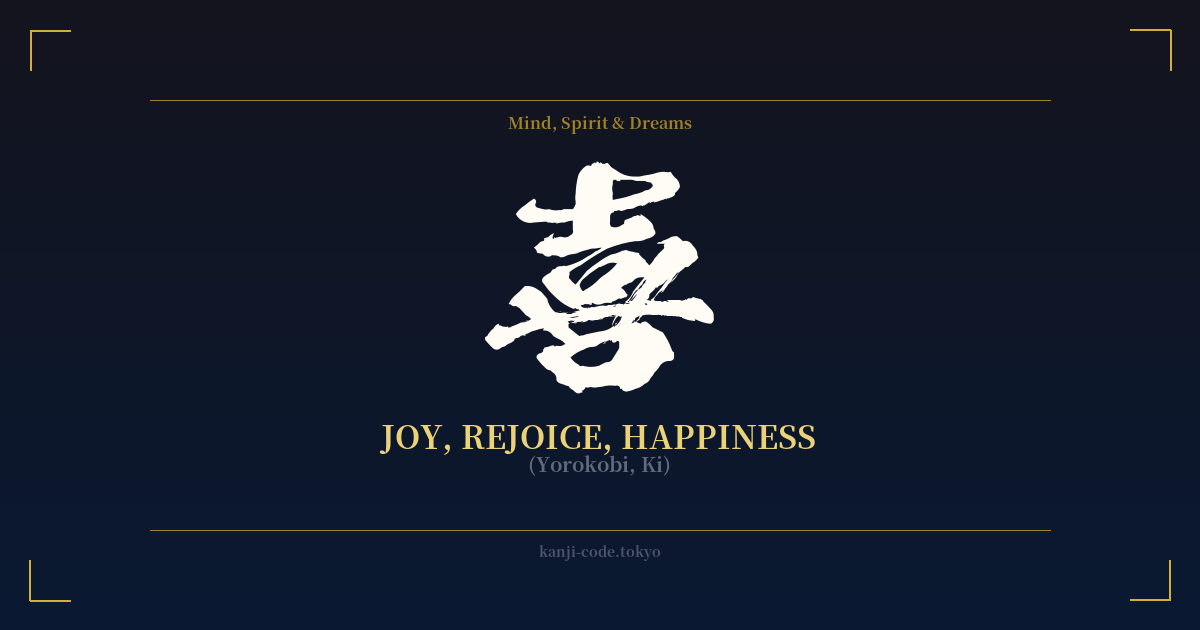
✍️ 喜 (Yorokobi, Ki) — Cultural Context
The kanji 喜 (yorokobi) is a beautiful and evocative character that captures the essence of joy, delight, and celebration. Its origins are as expressive as its meaning. The character is a pictograph, a visual story frozen in time. The top portion, 壴 (originally), depicts a drum on a stand, while the bottom, 口, represents a mouth. Together, they form the image of someone beating a drum and singing or shouting in celebration. This etymology grounds the character not in a passive state of being happy, but in an active, outward expression of joy.
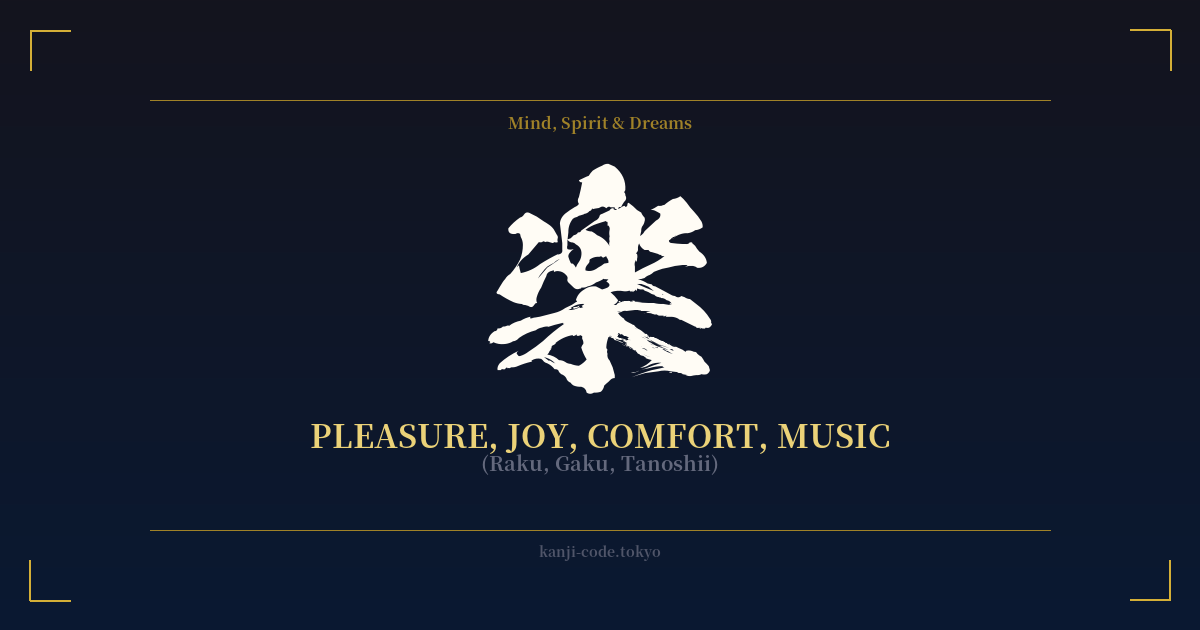
In the Japanese language, nuance is everything, and the concept of happiness is no exception. 喜 (yorokobi) is distinct from other similar words. While 幸 (shiawase) refers to a deeper, more sustained state of happiness or good fortune, and 楽 (tanoshii) describes a feeling of fun or enjoyment in a specific activity, 喜 captures a more immediate, spontaneous burst of delight. It's the joy you feel upon receiving good news, the delight of a surprise reunion with a friend, or the celebratory feeling of a major accomplishment. It is a peak emotional experience, often shared with others.
This character is deeply woven into the fabric of Japanese culture and traditions. It appears in words like 歓喜 (kanki), meaning 'great joy' or 'ecstasy,' and 喜劇 (kigeki), which means 'comedy'—literally, a 'joyful play.' One of the most charming cultural references is the 喜寿 (kiju), the celebration of one's 77th birthday. The name for this milestone comes from the fact that a cursive, stylized form of the character 喜 looks like the characters for seventy-seven (七十七) stacked together. This clever wordplay elevates the character beyond a simple word into a symbol of a long and joyful life.
To choose 喜 is to embrace a philosophy of celebrating life's positive moments. It represents an appreciation for the events and people that bring us delight. It’s a reminder that joy is not just a feeling to be passively experienced, but an emotion to be expressed, shared, and celebrated, much like the ancient image of beating a drum and singing with an open heart.
🖌️ Font Styles for 喜
The same kanji can look dramatically different depending on the calligraphy style. Choose a font that matches the mood you want for your tattoo or design.
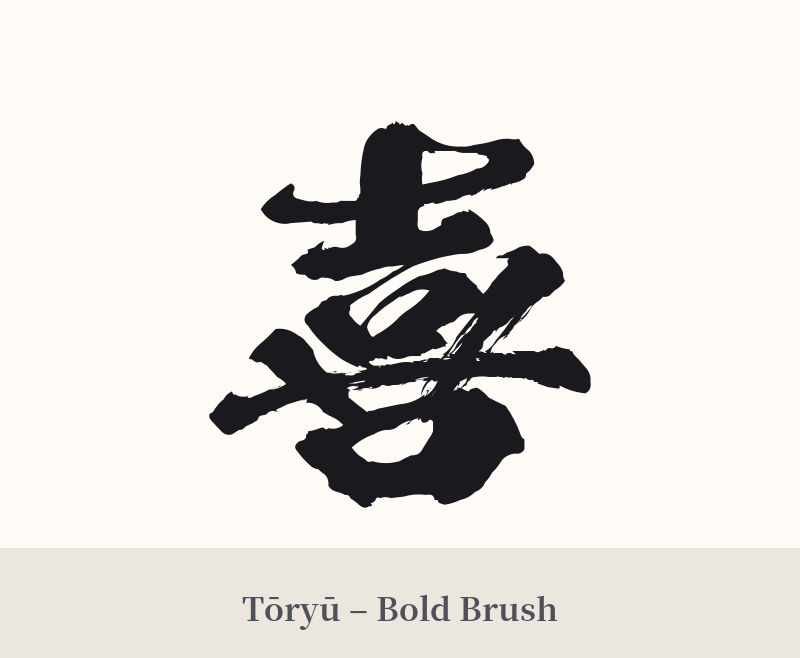
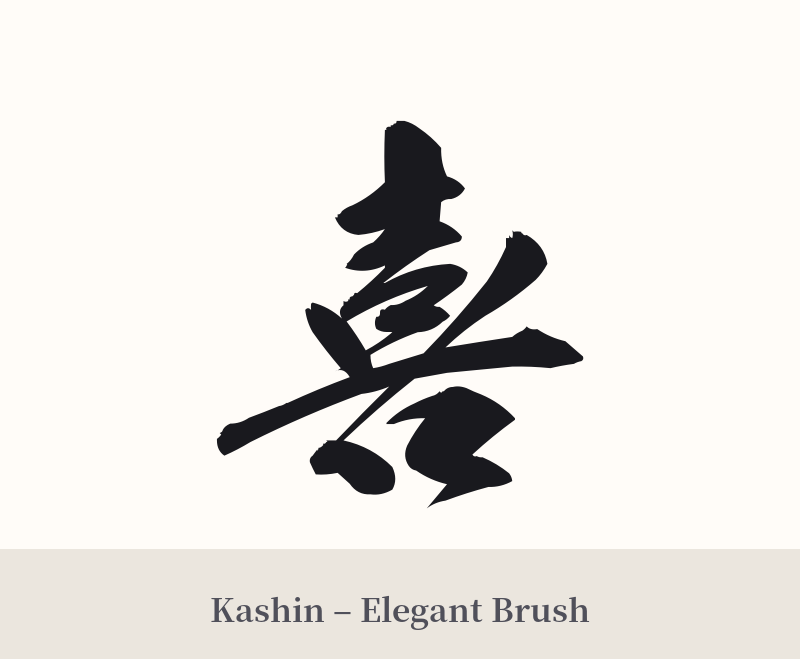
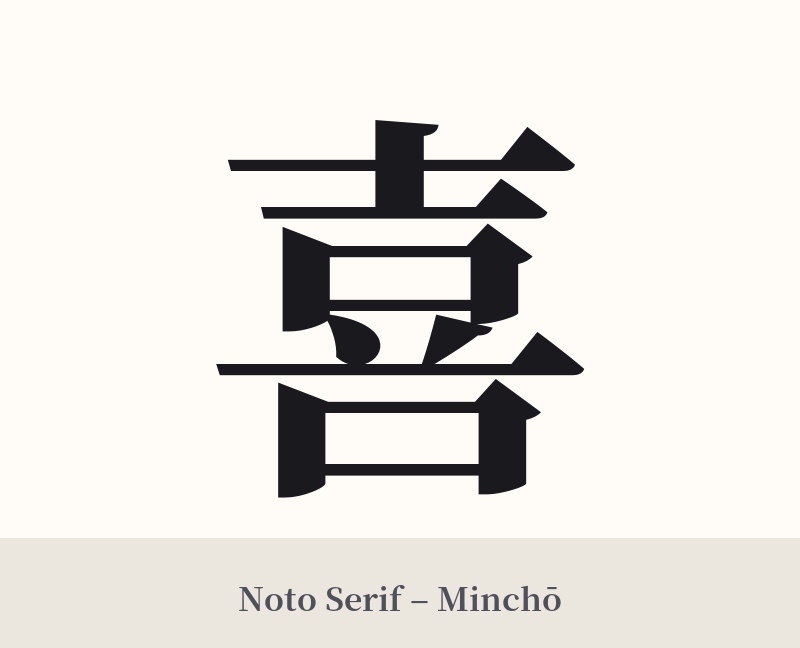
🎨 Tattoo Suitability
📐 Tattoo Design Guide
The kanji 喜 offers wonderful flexibility for a tattoo design, conveying a sense of vibrant, positive energy.
– Placement: For a small, personal reminder of joy, consider the inner wrist, behind the ear, or on the ankle. Its balanced shape also works well on the back of the neck or along the collarbone. For a larger, more prominent piece, it can be a beautiful centerpiece on the forearm, calf, or shoulder blade.
– Style: The style you choose can dramatically alter the feel. A bold, clean Kaisho (block script) font gives it a sense of solid, grounded happiness. For a more fluid and expressive look, consider Gyosho (semi-cursive) or Sosho (cursive) styles, whose flowing lines can mimic the feeling of spontaneous joy.
– Visual Elements: Consider pairing 喜 with other symbols of happiness and celebration. It could be rendered within a circle (ensō), symbolizing enlightenment and the universe. It also pairs beautifully with natural imagery like cherry blossoms (sakura) to represent the beautiful, fleeting nature of joyful moments, or a crane, which symbolizes good fortune and longevity.
Comments