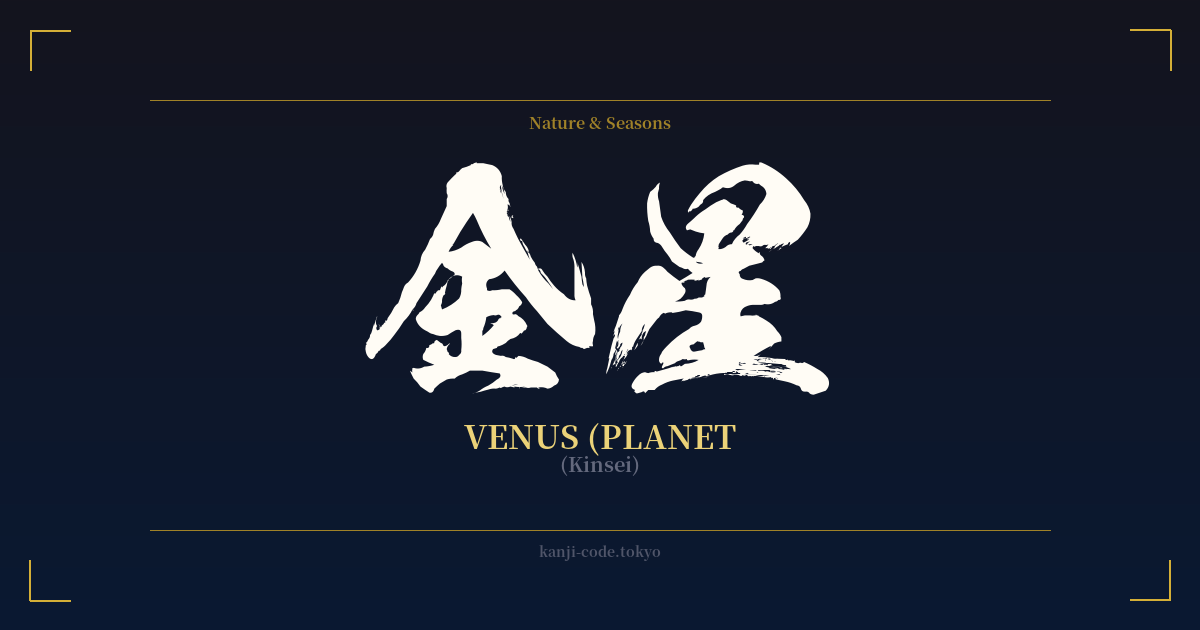
✍️ 金星 (Kinsei) — Cultural Context
The Japanese word for Venus, 金星 (Kinsei), offers a fascinating window into how ancient Eastern cultures viewed the cosmos. The literal translation is 'Metal Star' or 'Gold Star,' a name that is not arbitrary but deeply connected to ancient Chinese philosophy that heavily influenced Japan.
The name originates from the Taoist concept of Wu Xing, the Five Elements or Phases: 木 (Wood), 火 (Fire), 土 (Earth), 金 (Metal), and 水 (Water). In this system, each element corresponds to various aspects of the natural world, including directions, seasons, colors, and, importantly, the five planets visible to the naked eye.
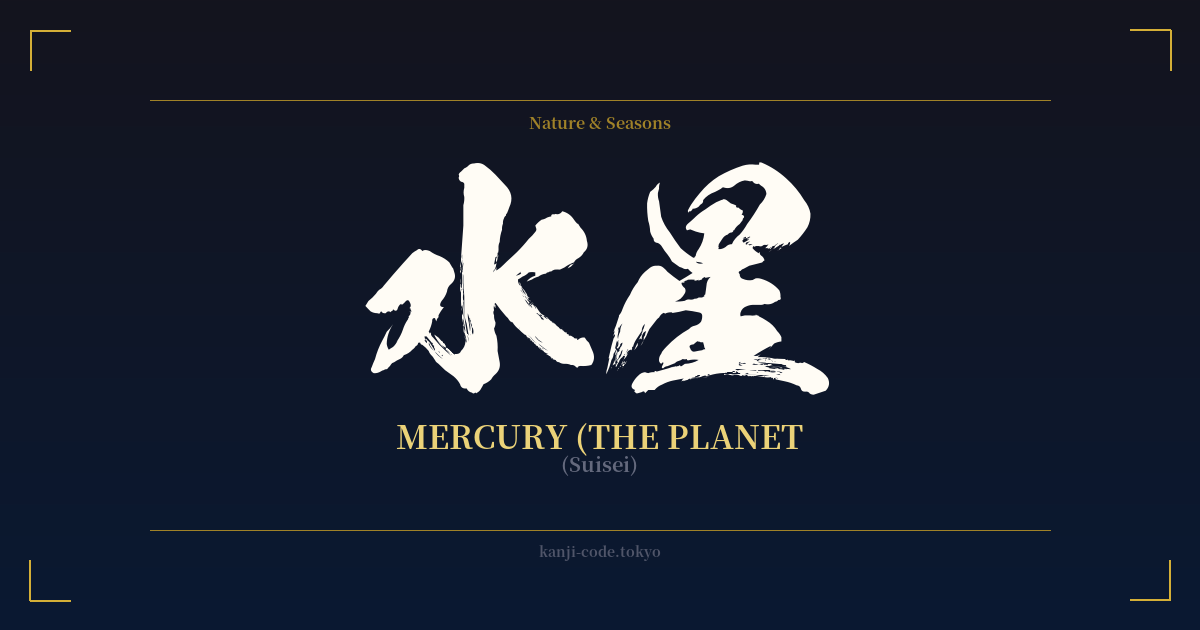
Venus was assigned the element of Metal (金). The other planets were similarly named: Mars became 火星 (Kasei, the Fire Star), Jupiter became 木星 (Mokusei, the Wood Star), Mercury became 水星 (Suisei, the Water Star), and Saturn became 土星 (Dosei, the Earth Star). This system created a cohesive, elemental map of the solar system.
The association of Venus with 'Metal' is particularly poetic. The element Metal is linked to the direction West, the season of Autumn, and the color white. Venus, as the brightest object in the sky after the sun and moon, is most famously visible as the 'Evening Star' in the western sky just after sunset. Its brilliant, white light perfectly matched the characteristics of the Metal element.
Beyond its astronomical name, Japan also has more native, descriptive names for Venus that capture its dual role in the sky. As the first light to appear before sunrise, it is called 明けの明星 (Ake no Myōjō), the 'Bright Star of Dawn.' When it lingers in the twilight sky after sunset, it is known as 宵の明星 (Yoi no Myōjō), the 'Bright Star of the Evening.'
In a fascinating modern evolution, 金星 has taken on a powerful metaphorical meaning in the world of sumo wrestling. A 'kinboshi' (an alternate reading) signifies a major victory, specifically when a lower-ranked maegashira wrestler defeats a grand champion, or yokozuna. This feat is a huge upset and earns the wrestler a cash bonus and lasting prestige. By extension, the term is now used in broader society to describe any stunning upset or a star-making performance against a dominant opponent.
🖌️ Font Styles for 金星
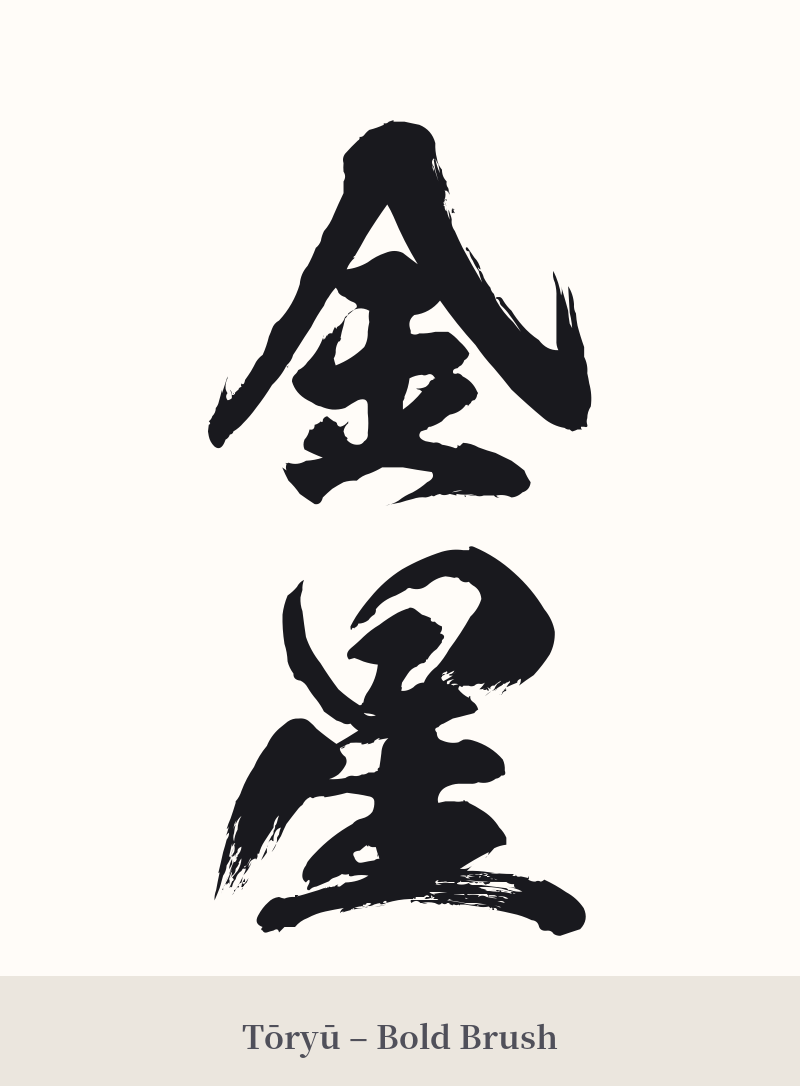
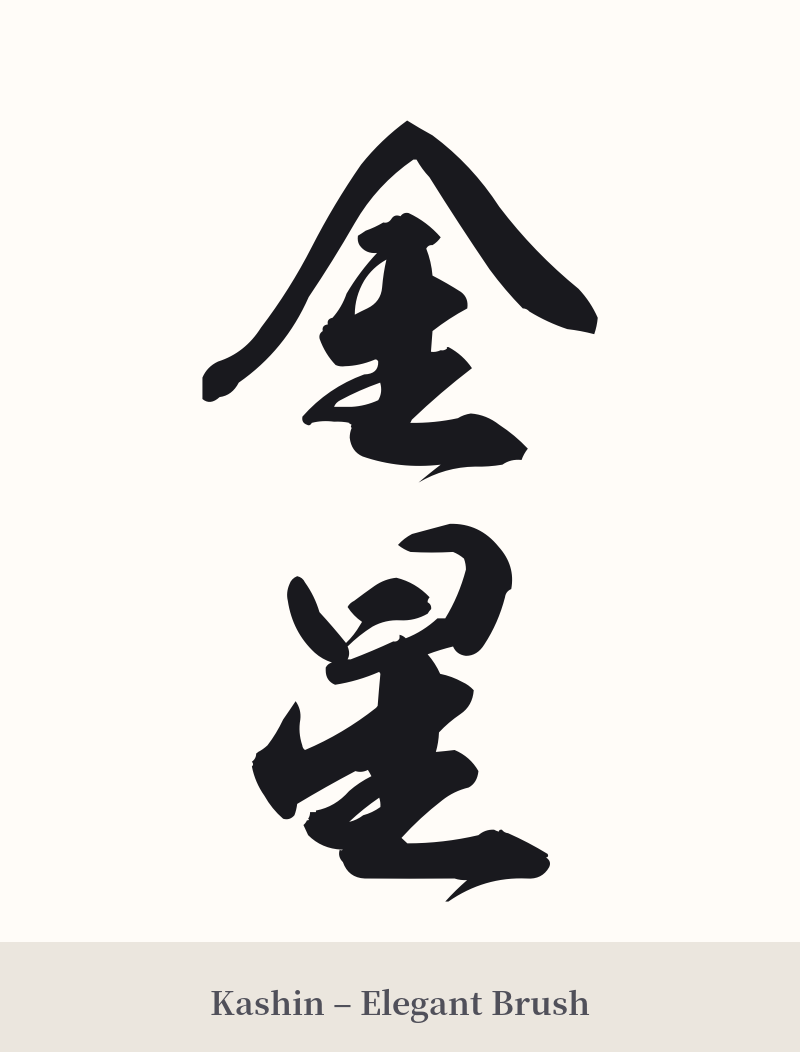
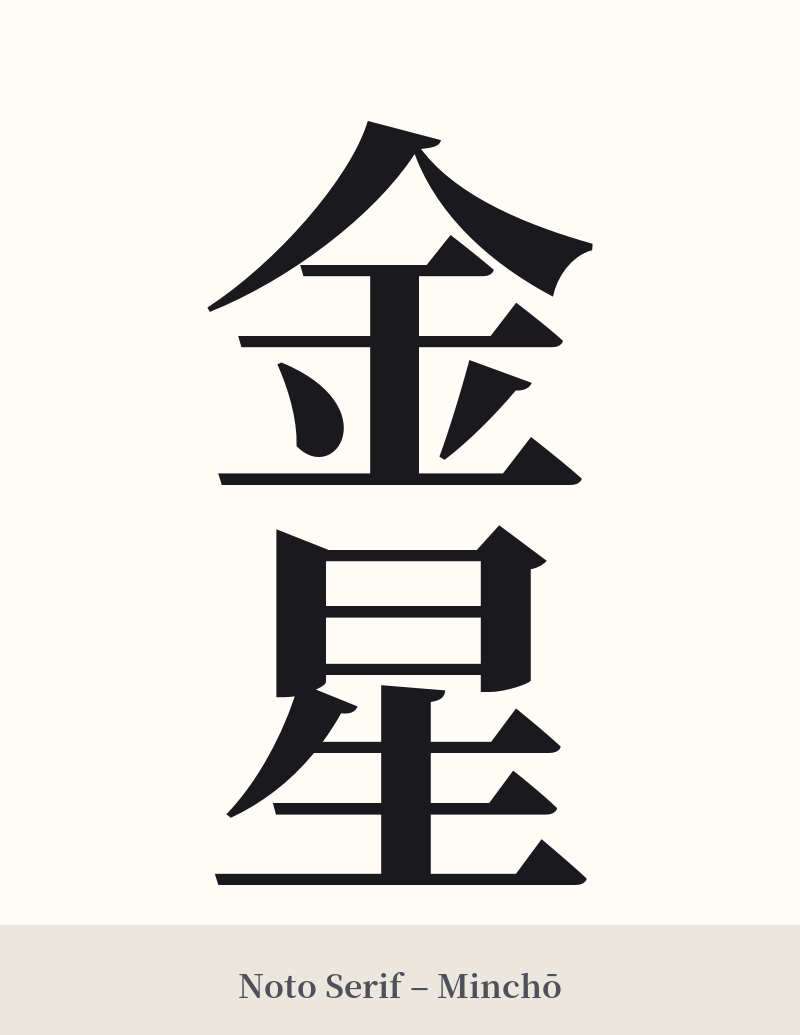
The same kanji can look dramatically different depending on the calligraphy style. Choose a font that matches the mood you want for your tattoo or design.
🎨 Tattoo Suitability
📐 Tattoo Design Guide
For a 金星 tattoo, the two characters offer great flexibility in design. Their balanced forms work well both vertically and horizontally.
– Placement: A vertical arrangement is classic and looks powerful along the forearm, calf, or spine. A horizontal design fits well on the chest, upper back, or across the back of the neck.
– Font Style: To emphasize the 'Metal' aspect, consider a strong, angular script like Kaisho (block script). For a more celestial or poetic feel, a flowing semi-cursive (Gyosho) or cursive (Sosho) style can evoke the image of a star moving across the sky.
– Visual Elements: Consider incorporating subtle visual cues. A single, bright dot or starburst near the kanji can reinforce the meaning. You could also ask your artist to use shading techniques that give the ink a slight metallic sheen. Placing the kanji within a larger piece featuring a nebula, twilight sky, or other celestial bodies can create a stunning and context-rich design.
Comments