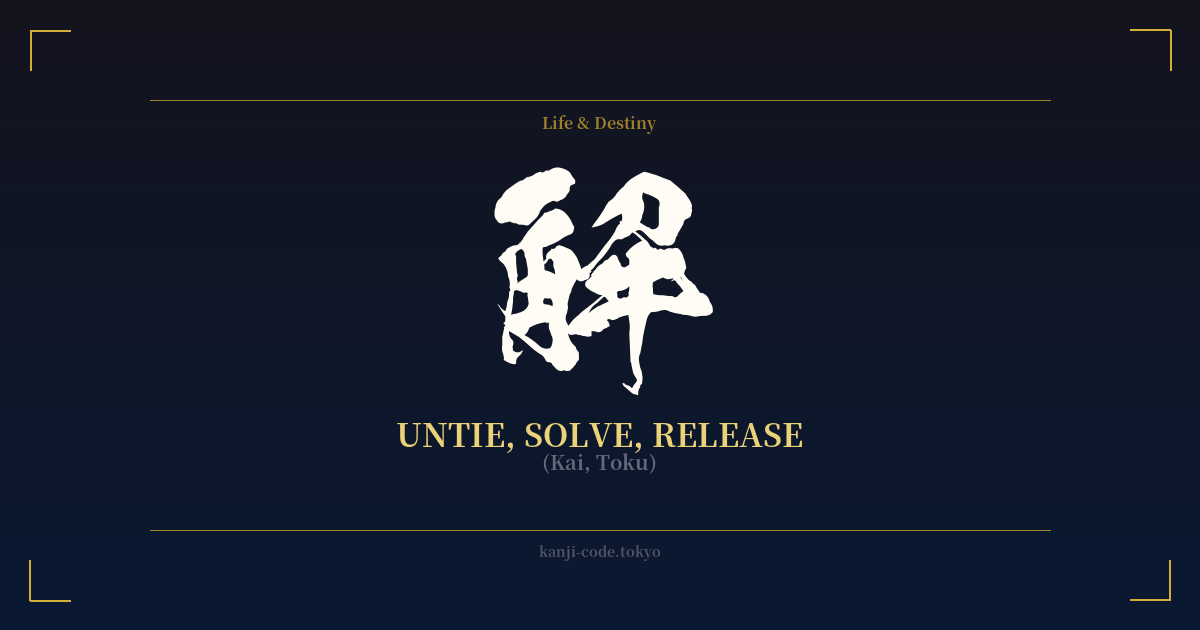
✍️ 解 (Kai, Toku) — Cultural Context
The Japanese kanji 解 (kai) is a character rich with layers of meaning, all revolving around a central theme of separation and clarification. Its story begins with its ancient form, a vivid pictograph combining a horn (角), a knife (刀), and an ox (牛). The image depicts the act of using a blade to skillfully separate the horn from an ox, an act of careful dissection and analysis. This powerful origin story informs all of its modern meanings.
At its most literal, 解 means 'to untie,' 'to unfasten,' or 'to loosen.' This can be as simple as untying a knot (紐を解く – himo o toku) or as profound as resolving a misunderstanding. This physical act of untangling extends beautifully into the metaphorical realm, representing the release from emotional burdens or difficult situations. It’s the feeling of a weight being lifted from your shoulders.
From this idea of taking something apart to see how it works, we get the meaning of 'to solve' or 'to answer.' When you solve a puzzle or a mathematical problem (問題を解く – mondai o toku), you are essentially dissecting it, breaking it down into understandable components to find the solution (解答 – kaitō). This gives the kanji a strong intellectual and analytical quality. It represents the 'aha!' moment of a breakthrough, the clarity that comes after a period of confusion.
This leads to another crucial meaning: 'to understand' (理解 – rikai). True understanding, in this context, isn't just passive acceptance; it's an active process of analyzing and comprehending. By breaking down a complex idea, you come to grasp its essence. This intellectual pursuit is a core part of the character's identity.
Perhaps its most profound application is in a spiritual context, particularly within Buddhism. The word 解脱 (gedatsu) means liberation or emancipation—specifically, the release from the cycle of suffering and rebirth (samsara). Here, 解 signifies the ultimate untying of worldly attachments and delusions, leading to enlightenment. It represents a deep, transformative freedom of the spirit, making it a symbol of profound personal growth and spiritual awakening.
🖌️ Font Styles for 解
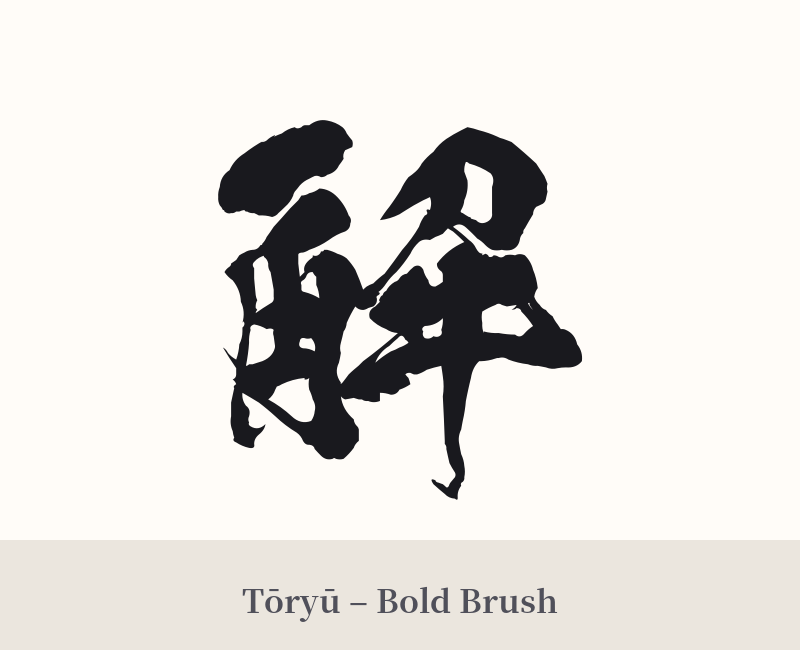
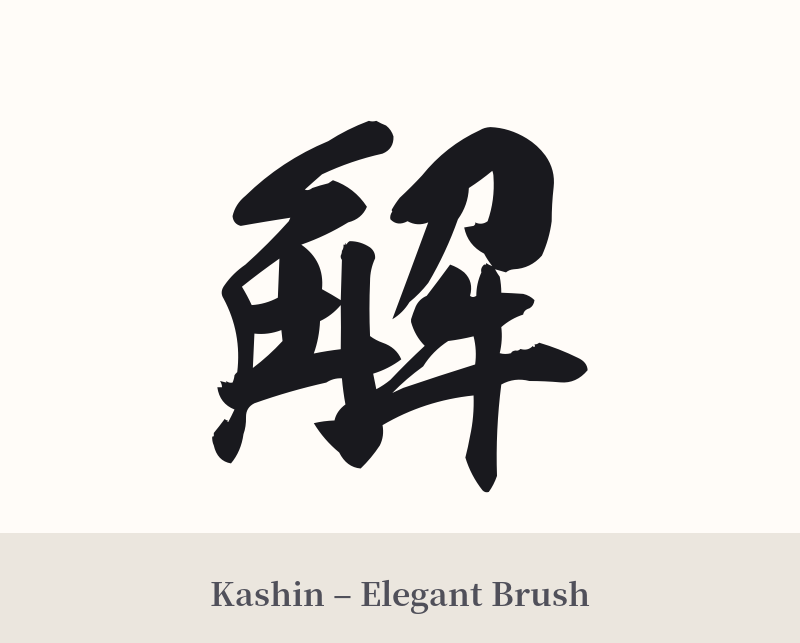
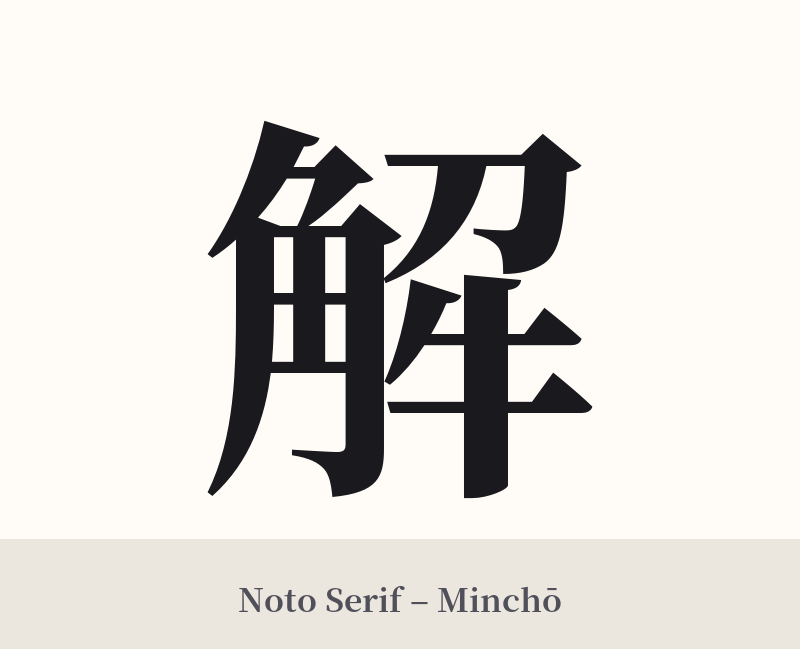
The same kanji can look dramatically different depending on the calligraphy style. Choose a font that matches the mood you want for your tattoo or design.
🎨 Tattoo Suitability
📐 Tattoo Design Guide
The kanji 解 offers great flexibility for a tattoo design, suiting both bold and subtle approaches.
– Placement: For a personal and introspective meaning like 'release' or 'understanding,' consider placements like the inner wrist, forearm, or over the chest. For a bolder statement about 'solving' or 'breaking free,' the back of the neck or along the spine can be very effective.
– Font Style: The choice of script can dramatically alter the feeling. A strong, clear Kaisho (block script) emphasizes the analytical, 'solving' aspect of the character. For a more fluid and personal feel, a Gyōsho (semi-cursive) or Sōsho (cursive) style can visually represent the idea of 'release' and 'untying.'
– Visual Complements: To add context and avoid ambiguity, consider pairing 解 with other imagery. A design featuring an unraveling rope, a key, a broken chain, or a bird taking flight can powerfully reinforce the theme of liberation. For the 'understanding' aspect, you might incorporate elements like a circle (ensō) or a simple brush stroke.
Comments