万里一空
One Sky Over Ten Thousand Miles
Four characters that Japan’s deadliest swordsman used to describe the unwavering focus that kept him alive through 60 duels and zero defeats.
Miyamoto Musashi killed his first man at age thirteen. By the time he died at seventy, he’d fought over sixty duels without losing once, developed a revolutionary two-sword fighting style, authored Japan’s most influential martial arts text, and distilled his life philosophy into four characters: 万里一空 (banri ikkū). Literally “ten thousand miles, one sky”—no matter how far you travel, the same sky stretches overhead. Your fundamental truth, your singular purpose, remains constant regardless of changing circumstances.
Musashi wrote this phrase in his later work *Hyōhō Sanjūgo-kajō* (The Thirty-Five Articles on the Art of Swordsmanship), composed when he’d retired from dueling and devoted himself to teaching. He used it to explain the mindset required for mastery: whether facing one opponent or a hundred, whether wielding a sword or a brush, the underlying principle—the “sky” overhead—never changes. Distractions, obstacles, fears might vary infinitely, but your core purpose stays singular.
The phrase transcended Musashi’s swordsmanship to become broader Japanese philosophy. Athletes invoke it training for Olympic gold. Students repeat it grinding through university entrance exams. Entrepreneurs keep it on office walls during startup struggles. The imagery works universally: no matter how long the journey (万里, ten thousand miles), maintain focus on the single objective (一空, one sky). Don’t let the vastness of the distance distract from the constancy of the destination.
✨ Kanji Styles Gallery
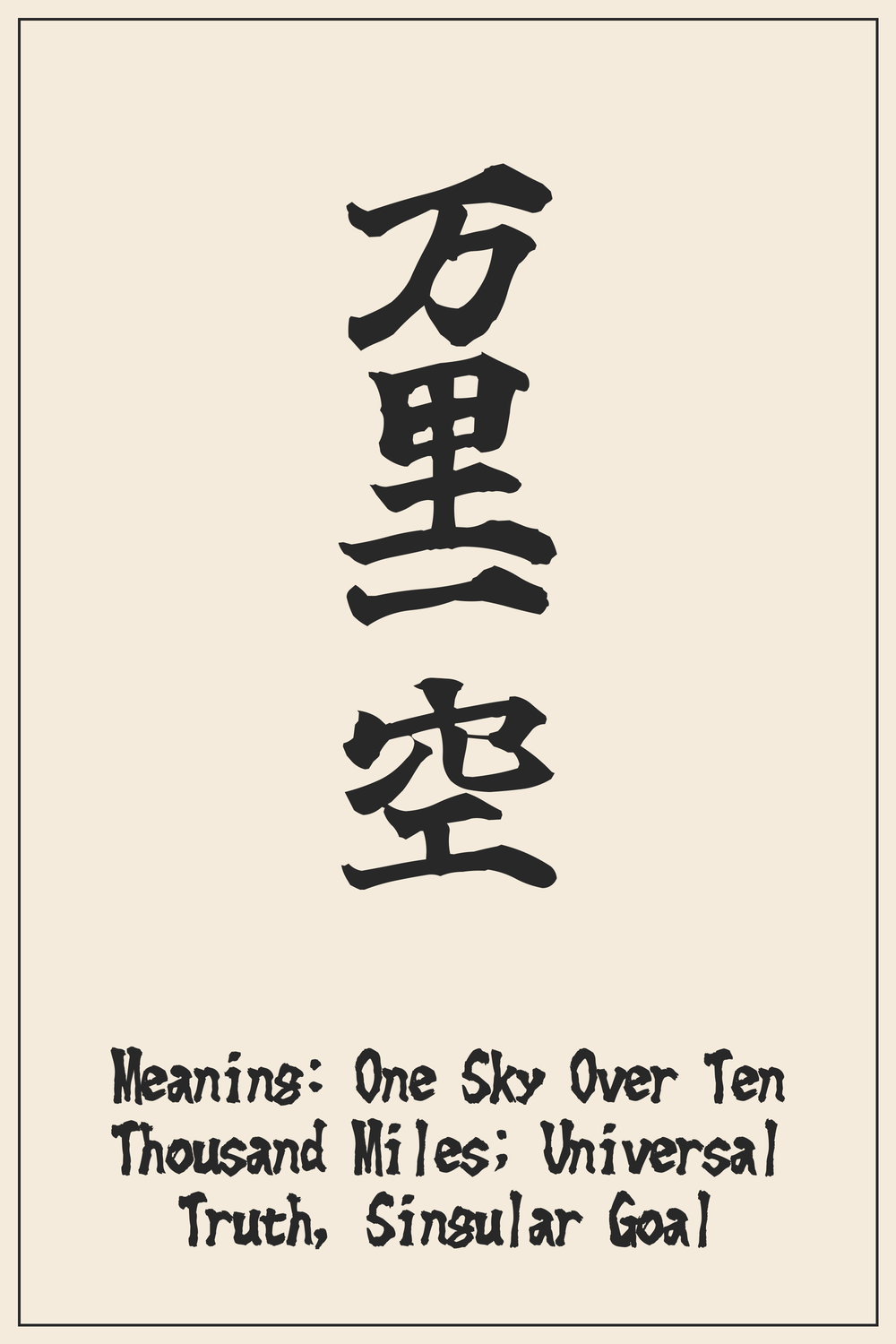
🖌️ Calligraphy Style
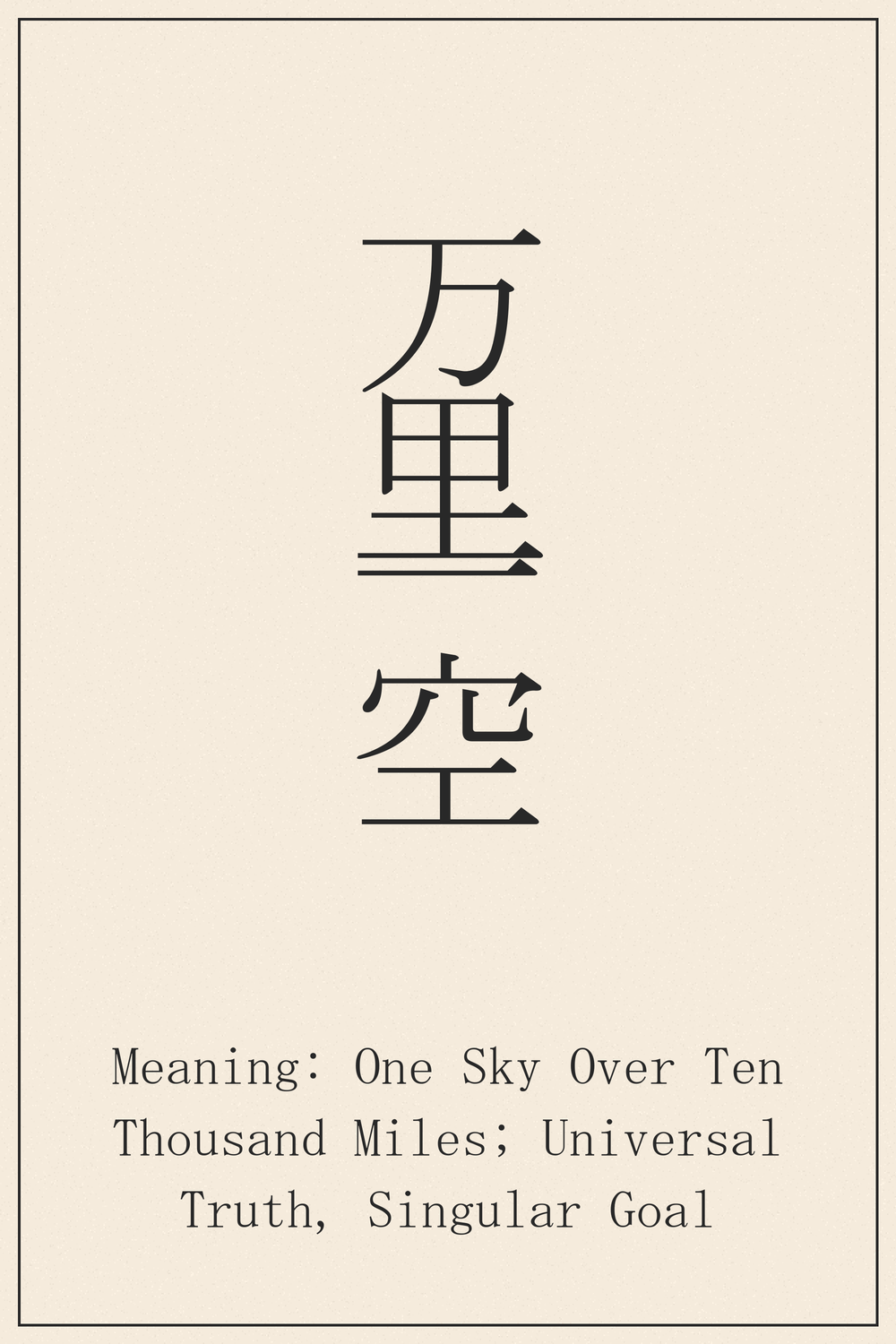
📝 Mincho Style
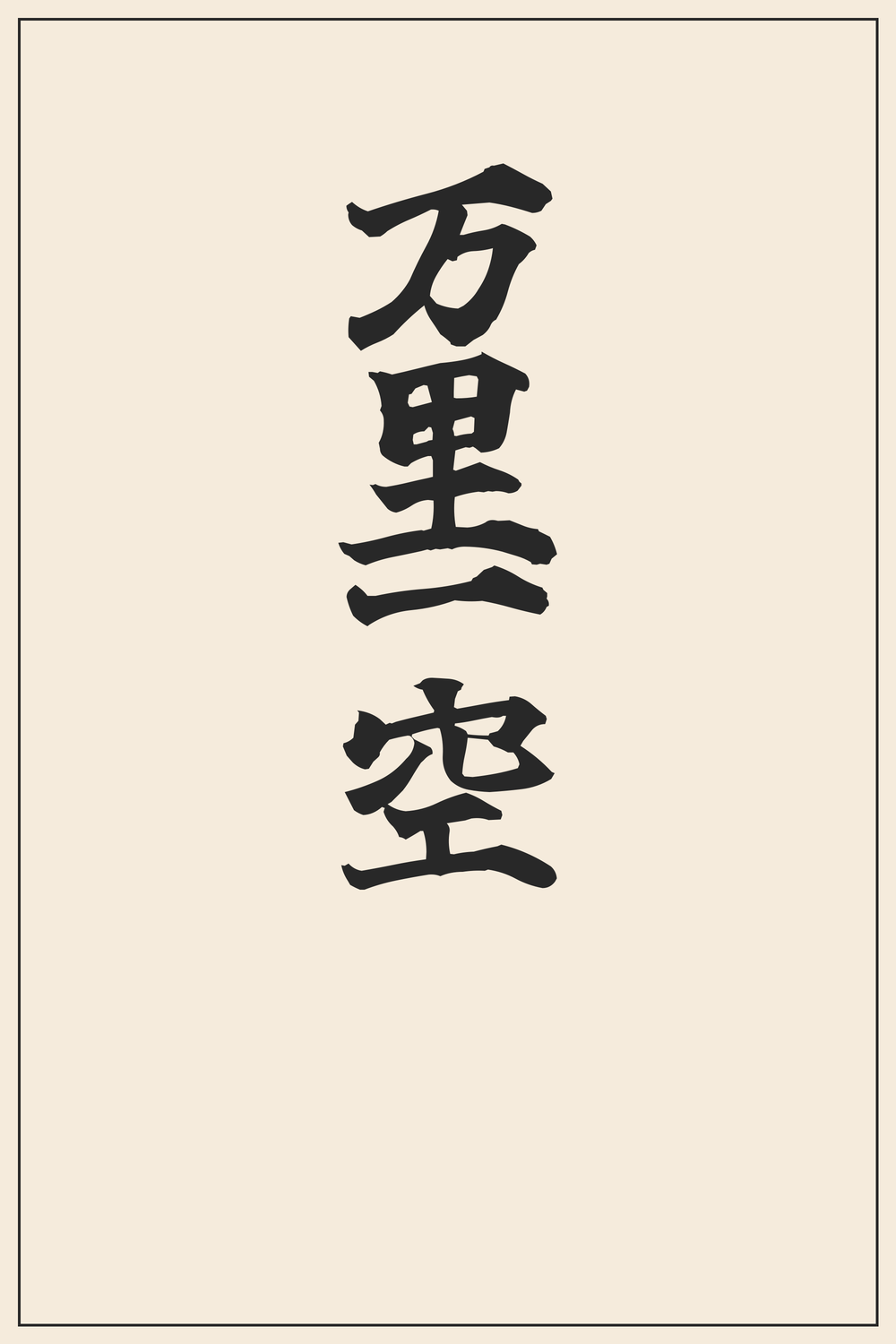
📜 Vertical Writing
⚡ Quick Facts
Breaking Down 万 (Ban/Man)
The character 万 represents “ten thousand”—not literally that exact number but the concept of “myriad,” “countless,” “all possible.” In ancient Chinese and Japanese number systems, ten thousand marked the highest standard unit before transitioning to abstract concepts of infinity. It meant “as many as you can practically imagine.”
Ancient oracle bone versions showed a scorpion or possibly a dancer—the etymology remains debated. What matters is the character’s evolved meaning: representing vast quantities beyond easy counting. 万歳 (banzai, “ten thousand years”) wishes for eternal life. 万能 (bannō) means “all-powerful, omnipotent.” 万人 (bannin) means “all people, everyone.” The character always suggests totality, completeness, the full extent of possibility.
In banri ikkū, 万 sets the scale. It establishes that we’re not talking about a short trip or minor challenge. We’re talking about the longest conceivable journey, every possible obstacle, all the difficulties and distractions imaginable. The phrase works because it acknowledges reality’s vastness before insisting on singular focus anyway.
Before modern mathematics introduced concepts like millions and billions, 万 (10,000) represented the practical limit of countable quantity in East Asian systems. Beyond that, you needed compound expressions. So 万 carried weight—it meant “everything you could possibly count,” making it perfect for expressing totality.
Breaking Down 里 (Ri)
The character 里 represents a unit of distance—approximately 3.9 kilometers in modern measurement, though historical definitions varied. The character originally showed fields (田) and earth (土), suggesting the distance between villages or the area surrounding a settlement. It meant “the distance a person travels,” making it inherently human-scaled measurement.
万里 together creates “ten thousand ri”—roughly 39,000 kilometers if taken literally, enough to circle the Earth. But nobody calculated exact mileage. The phrase meant “unimaginably far,” “the longest journey conceivable,” “farther than you’d ever actually travel.” It’s the distance equivalent of saying “a million miles” in English—technically quantifiable but functionally representing “impossibly distant.”
The character also means “village” or “hometown” in some contexts, adding layered meaning. 万里 could suggest being so far from home you can’t see it anymore, yet the sky connecting you remains the same. No matter how distant you travel from your origin, the fundamental truth overhead persists.
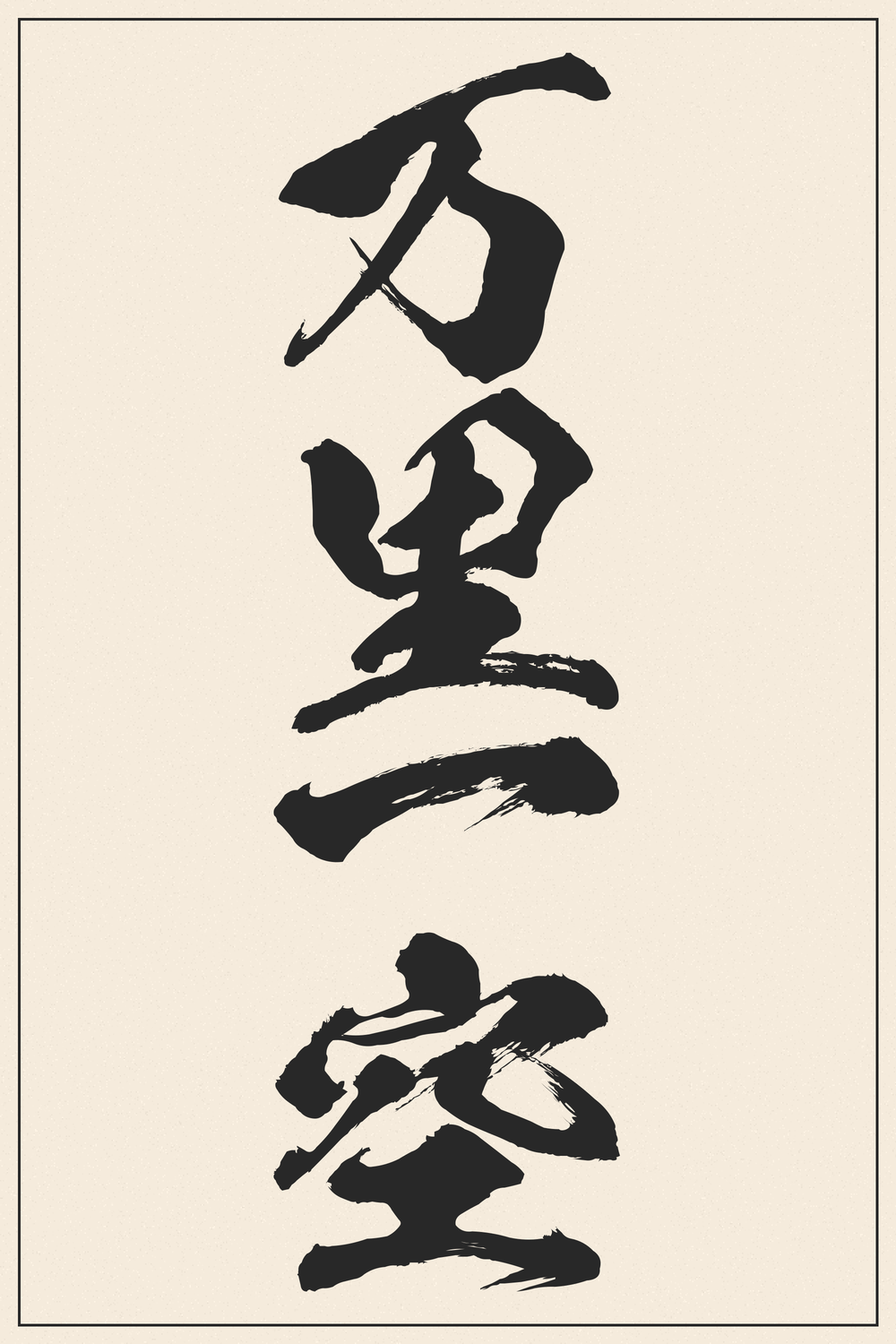
Musashi’s philosophy preserved in powerful brushstrokes
Breaking Down 一 (Ichi/Itsu)
The character 一 is beautifully simple—a single horizontal stroke representing “one.” It’s the first character children learn, the foundational number, the irreducible unit. But in philosophical contexts, it represents more than numerical unity. It suggests singularity, uniqueness, the essential core that cannot be divided further.
In compound words, 一 emphasizes wholeness and focus: 一心 (isshin, single-minded devotion), 一途 (ichizu, earnest dedication), 一生 (isshō, entire lifetime). The character transforms whatever it modifies into something unified, concentrated, undivided. It’s the opposite of scattered attention or divided loyalty—it’s commitment distilled to pure essence.
Positioned between the vast distance (万里) and the universal sky (空), this tiny stroke becomes the pivot point. It declares: despite the countless miles, the sky remains ONE. Despite infinite distractions and obstacles, your purpose stays SINGULAR. The simplest character carries the phrase’s most crucial philosophical weight.
Breaking Down 空 (Kū)
The character 空 combines hole/cavity (穴) and construction/craft (工), originally suggesting an empty space within a structure. It evolved to mean “sky,” “emptiness,” “void”—the ultimate open space above everything. In Buddhist philosophy, 空 (kū) represents śūnyatā, the emptiness or voidness at the heart of reality, the concept that all phenomena lack inherent, independent existence.
But in banri ikkū, 空 works more literally as “sky” or “heaven”—the vast, unchanging dome overhead visible from anywhere on Earth. Whether you’re in your hometown or ten thousand miles away, whether you’re winning or losing, healthy or sick, the same sky arches above. It represents the constant backdrop to all changing circumstances, the universal truth underlying specific situations.
Musashi’s choice of 空 adds subtle layers. The sky is simultaneously everywhere and nowhere, infinite yet singular, completely empty yet containing everything beneath it. It’s the perfect metaphor for the warrior’s ultimate truth or goal—something vast enough to encompass all experience yet unified enough to provide unwavering direction.
Musashi studied Zen Buddhism alongside swordsmanship, and his use of 空 reflects that influence. The character connects banri ikkū to Buddhist concepts of emptiness and universal truth, suggesting that the “one sky” isn’t just literal atmosphere but the fundamental nature of reality that practitioners seek to realize.
Musashi’s Life Philosophy
Miyamoto Musashi lived the principle he coined. At thirteen, he killed a trained samurai in his first duel using a wooden stick against the opponent’s steel blade. For the next two decades, he wandered Japan as a ronin (masterless samurai), challenging the best swordsmen he could find, developing his unique two-sword style, refining technique through survival pressure. Sixty-some duels, zero losses. Every opponent dead or crippled.
His most famous duel happened on Ganryū Island in 1612 against Sasaki Kojirō, considered Japan’s greatest swordsman. Musashi arrived hours late (psychological warfare), carved a wooden sword from a boat oar during the trip over, and killed Kojirō with a single strike to the head. The victory cemented his reputation, but also marked a turning point. He largely stopped dueling afterward, having proven what he needed to prove.
Musashi spent his final decades painting, sculpting, writing, and teaching. His masterwork *Go Rin no Sho* (The Book of Five Rings) remains essential martial arts reading worldwide. He approached art with the same intensity he’d brought to combat—singular focus on mastery, constant refinement, no wasted motion. Whether wielding a sword or a brush, the underlying principle stayed constant: 万里一空. The sky overhead—truth, mastery, purpose—remained singular.
Beyond Musashi: Modern Applications
Japanese martial arts dojos hang 万里一空 calligraphy on walls as constant reminder to students. The long journey from white belt to black belt demands unwavering focus. Students will fail tests, suffer injuries, doubt their abilities, feel tempted to quit. The phrase says: keep your eyes on the singular goal. The distance is vast, but the destination stays constant.
Japanese corporations adopted the phrase for business motivation. Startup founders grinding through years of near-bankruptcy before breakthrough success invoke it. Sales teams chasing impossible quotas repeat it. The metaphor translates perfectly: building a company requires traveling unimaginable distances through hostile territory, but your vision—the “sky” you’re aiming for—must stay singular and clear.
Athletes training for Olympic gold tattoo 万里一空 as permanent commitment. Four years of brutal training, thousands of hours in the gym, countless sacrifices—all for one moment on one podium. The journey spans “ten thousand miles,” but the goal remains “one sky.” The phrase validates the struggle by acknowledging the distance while insisting on singular focus.
The original *Karate Kid* film featured banri ikkū philosophy without naming it. Mr. Miyagi’s “wax on, wax off” training—seemingly pointless repetition building muscle memory for precise blocks—exemplifies the concept. The student travels a long journey through confusion and doubt, but the singular principle underlying everything eventually reveals itself.
🎨 Tattoo Design Ideas
- ✨ Traditional Horizontal Scroll – Four characters arranged horizontally in bold calligraphic brushwork creates classic yojijukugo presentation. Best for upper back, chest, or ribcage placements (8-12 inches wide) where all four characters command equal visual weight and remain easily readable.
- ✨ Vertical Column Format – Traditional top-to-bottom arrangement along spine or outer thigh honors authentic Japanese writing direction. The vertical descent mirrors the long journey concept while maintaining visual impact. Perfect for tall placements where the phrase flows naturally downward.
- ✨ Minimalist Modern Line – Clean, precise strokes without decorative embellishment work for smaller placements (6-8 inches). Four-character idioms maintain readability even at reduced size. The simplicity lets philosophical weight carry aesthetic impact rather than relying on flourishes.
- ✨ Integrated Sky Imagery – Pair the four characters with subtle sky elements—single bird silhouette, minimalist cloud line, gentle horizon gradient. Keep additions atmospheric, not literal. The kanji dominate; imagery provides context suggesting the metaphor’s meaning.
- ✨ Combined with Path Symbol – Add a simple winding path, road, or journey line beneath or alongside the characters, visually representing the “ten thousand miles” traveled under the “one sky.” The path should be minimal line work, not detailed illustration.
- ✨ Circular Composition – Arrange the four characters in a ring or arc suggesting the dome of the sky overhead. This breaks from linear tradition but creates powerful symbolic geometry—the characters become the sky they describe, wrapping around to show completeness and unity.
Who Chooses This Tattoo
Martial artists—particularly those studying Japanese disciplines—gravitate toward banri ikkū as embodiment of their training philosophy. It validates the long grind from beginner to master, the years of repetition, the countless hours spent perfecting techniques that take seconds to execute. The phrase says your journey matters because your destination remains worthy and singular.
People pursuing long-term goals in any field choose it as permanent reminder during difficult periods. Medical students enduring decade-long training. Artists honing craft through years of obscurity. Athletes recovering from career-threatening injuries. Anyone facing a journey so long they sometimes forget why they started—万里一空 refocuses attention on the unchanging “sky” they’re aiming for.
But the phrase also appeals to people who simply value philosophical depth and historical resonance. Getting Musashi’s personal motto tattooed connects you to one of history’s most fascinating figures—a man who killed dozens yet became a revered artist, who mastered violence then transcended it through discipline and wisdom. The characters carry that complexity.
万里一空 carries serious martial and philosophical weight in Japanese culture. It’s not casual vocabulary—it references one of Japan’s most legendary warriors and sophisticated training philosophy. Choose it because you genuinely connect with the concept of unwavering focus through long struggle, not just because it sounds cool or looks impressive.
Why These Characters Endure
Modern life fragments attention like never before. Notifications, social media, endless options, constant FOMO—we’re encouraged to keep all possibilities open, never fully commit, maintain flexibility to pivot at any moment. This creates achievement without mastery, experience without depth, movement without meaningful direction.
万里一空 offers radical counternarrative from a man who committed so completely to one path he became legendary. Musashi didn’t dabble in swordsmanship. He didn’t maintain work-life balance or keep his options open. He focused with terrifying intensity on singular mastery, and that focus transformed him from a violent teenager into a figure still studied worldwide four centuries after his death.
The phrase endures because the fundamental challenge hasn’t changed. Whether you’re a 17th-century ronin or a 21st-century entrepreneur, the obstacle remains identical: maintaining singular focus across vast distances filled with infinite distractions. The sky overhead—your truth, your purpose, your ultimate goal—stays constant only if you refuse to let the journey’s length or difficulty make you forget why you started walking.

Comments