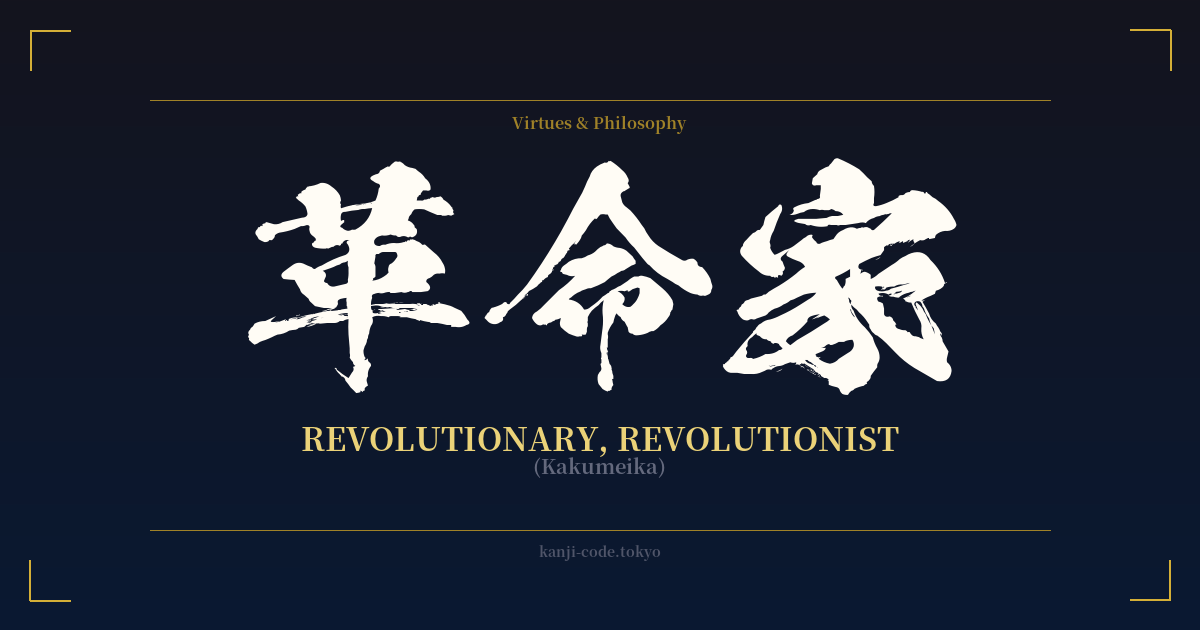
✍️ 革命家 (Kakumeika) — Cultural Context
革命家 (Kakumeika) is the Japanese word for a revolutionary—a person who either leads or is a key figure in a revolution. The term is far more than a simple job title; it's a profound statement about a person's role in history, packed with philosophical and political significance.
To understand 革命家, one must first break down its component word, 革命 (kakumei), meaning "revolution." This term itself is a fascinating window into East Asian political philosophy. It is composed of 革 (kaku), meaning "reform" or "to change," and 命 (mei), meaning "mandate" or "life." Together, they signify a "change of the mandate."
This concept originates from the ancient Chinese idea of the "Mandate of Heaven" (天命, Tenmei in Japanese). This was the divine right bestowed upon a ruler to govern. If a ruler or dynasty became corrupt, unjust, or incompetent, it was believed they had lost this mandate. A successful rebellion was therefore seen as proof that heaven had transferred its mandate to a new leader, legitimizing the overthrow. A revolution was not just a coup; it was a cosmic, morally justified event.
In Japan, this concept was imported and adapted. While the Emperor was seen as divinely descended and his mandate theoretically unbreakable, the actual political power was often held by shoguns and regents who could be overthrown. The term 革命家, therefore, evokes figures who dare to challenge the established order, not just for personal gain, but to enact a fundamental shift in the very structure of society. A famous historical figure often associated with this spirit is Sakamoto Ryōma, who played a crucial role in negotiating the alliance that led to the Meiji Restoration—Japan's own version of a revolution that ended the samurai era.
The final character, 家 (ka), is a suffix that denotes an expert, specialist, or person defined by their pursuit. It transforms the abstract concept of "revolution" (革命) into a human agent, "the revolutionary" (革命家). It's the same suffix used in words like 芸術家 (geijutsuka, artist) and 作家 (sakka, author), elevating the role to one of dedicated expertise.
Today, 革命家 can be used more broadly to describe innovators who revolutionize fields beyond politics, such as technology, art, or science. Someone like Steve Jobs might be called a 革命家 in the world of computing for fundamentally changing the industry. However, the word always retains its core sense of dramatic, disruptive, and systemic change.
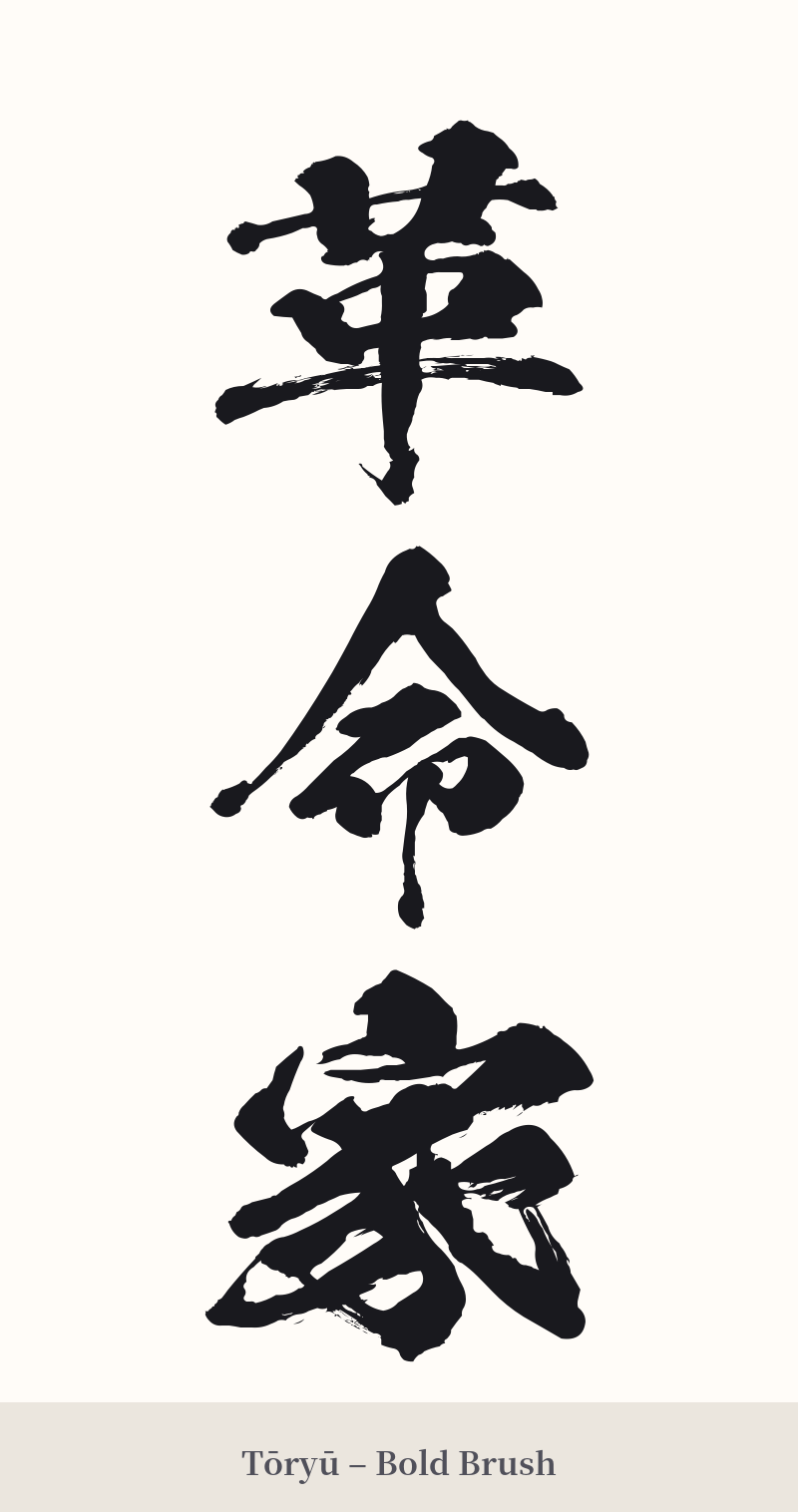
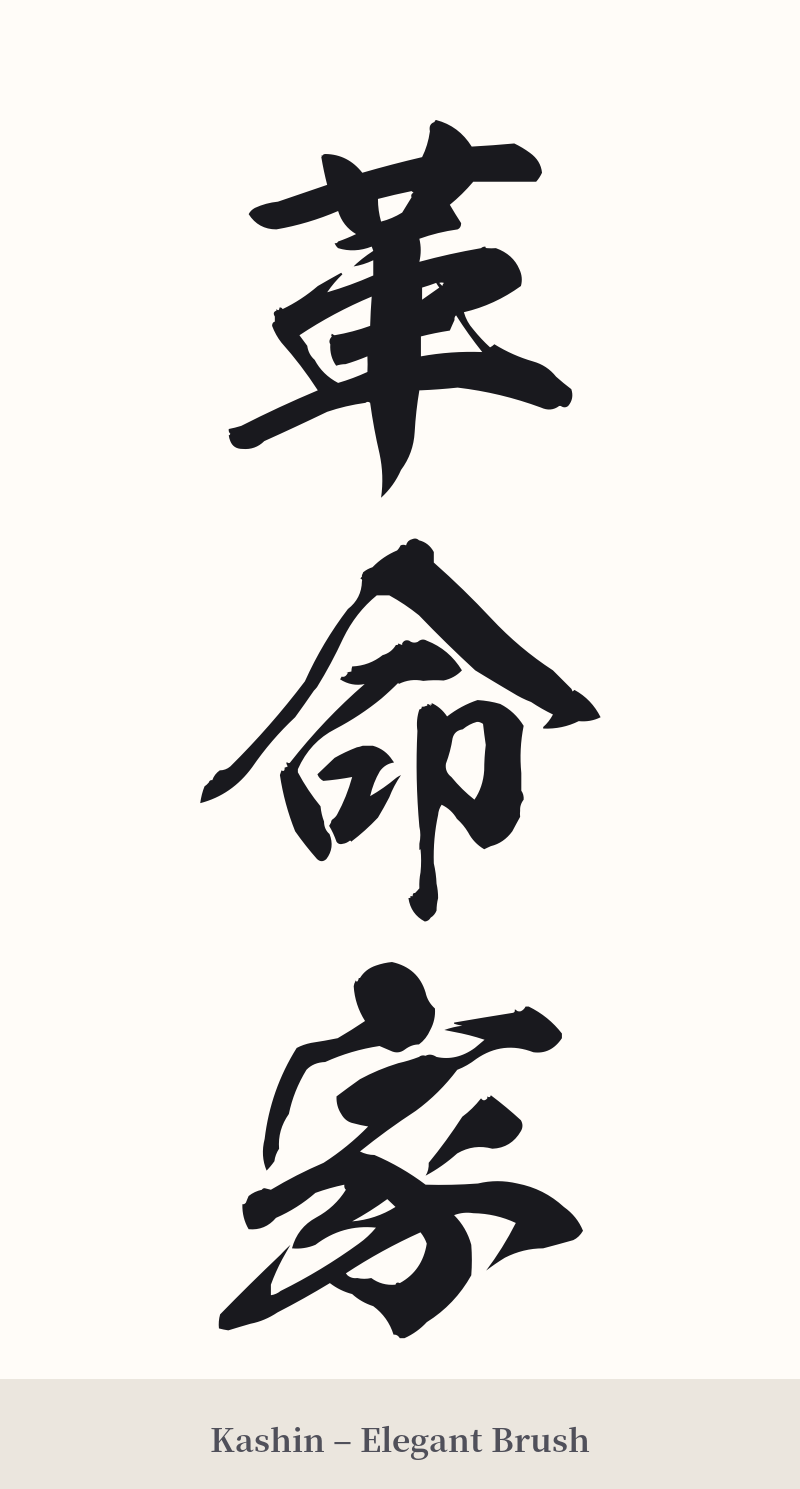
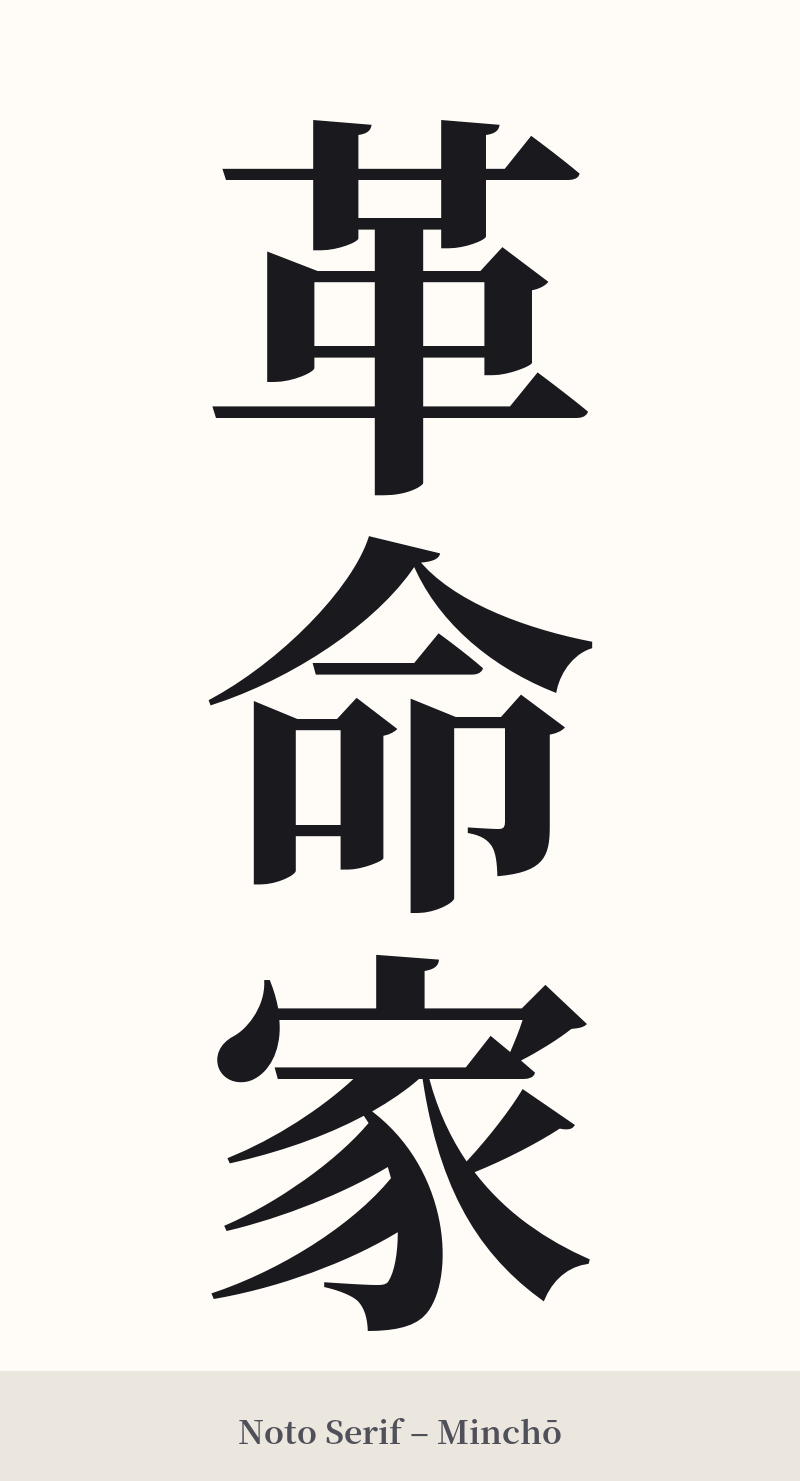
🖌️ Font Styles for 革命家
The same kanji can look dramatically different depending on the calligraphy style. Choose a font that matches the mood you want for your tattoo or design.
🎨 Tattoo Suitability
📐 Tattoo Design Guide
The three characters of 革命家 create a strong, balanced design that works exceptionally well in a vertical orientation. This makes it ideal for placements like the spine, forearm, or along the calf.
– Font Style: To match the word's power, consider a bold and dynamic script. A strong Kaisho (block script) emphasizes stability and resolve, while a flowing Gyosho (semi-cursive) can capture the dynamic, forceful nature of a revolution. Avoid overly delicate or thin fonts, as they would clash with the inherent strength of the meaning.
– Placement: Vertical alignment is highly recommended to honor the traditional writing style and create an elegant pillar of text. The inner forearm allows for a personal yet visible statement. The spine is a classic, powerful placement that emphasizes the centrality of this ideal to your character.
– Visual Elements: While the kanji alone is a powerful statement, you could consider minimalist accompanying elements. A broken circle or chain could symbolize the shattering of the old order. A single, bold brushstroke in red (enso circle) behind the kanji could represent both the void and the potential for a new beginning.
Comments