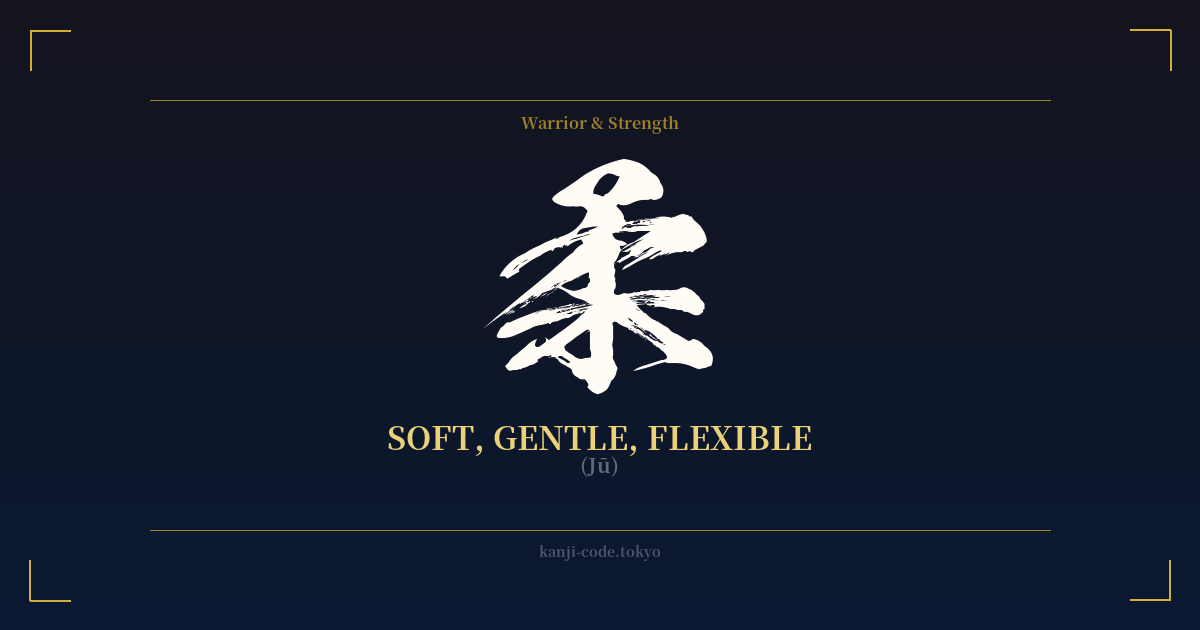
✍️ 柔 (Jū) — Cultural Context
The kanji 柔 (Jū) carries a meaning far more profound than its simple translation of 'soft' or 'gentle' might suggest. It represents a sophisticated and strategic form of strength rooted in flexibility, resilience, and the ability to yield without breaking. This character is not about weakness; it is about the power found in adaptability.
At its core, 柔 embodies the famous principle, "Jū yoku gō o seisu" (柔よく剛を制す), which translates to "The soft overcomes the hard." This concept, with roots in Taoist philosophy, observes that rigid, unyielding things are often the first to snap under pressure, while flexible things endure. Think of a mighty oak tree cracking in a storm while the slender willow branch bends and survives. This is the essence of 柔.
This philosophy is most famously crystallized in Japanese martial arts. The very names Judo (柔道, "the Gentle Way") and Jujutsu (柔術, "the Art of Softness") are built upon this character. These disciplines teach practitioners not to meet force with opposing force, but to redirect an opponent's energy, using their momentum against them. It is a physical manifestation of yielding to gain control, a dance of leverage and timing rather than a clash of brute strength.
Beyond the dojo, 柔 speaks to a desirable quality of character. A person described with this kanji might be gentle in spirit (柔和, nyūwa) or possess a flexible mind (柔軟な考え, jūnan na kangae). It signifies an approach to life that is calm, adaptable, and composed. It is the quiet confidence to absorb impact, adapt to changing circumstances, and ultimately persevere through resilience rather than aggression.
The character's origin itself tells a story. It is composed of the radicals for 'spear' (矛) and 'tree' (木). This combination beautifully illustrates the concept: a spear shaft made from a flexible wood that can bend and absorb shock without shattering. It is a weapon that derives its strength from pliability. Therefore, 柔 is a powerful symbol of a higher form of strength—one that is intelligent, enduring, and ultimately victorious.
🖌️ Font Styles for 柔
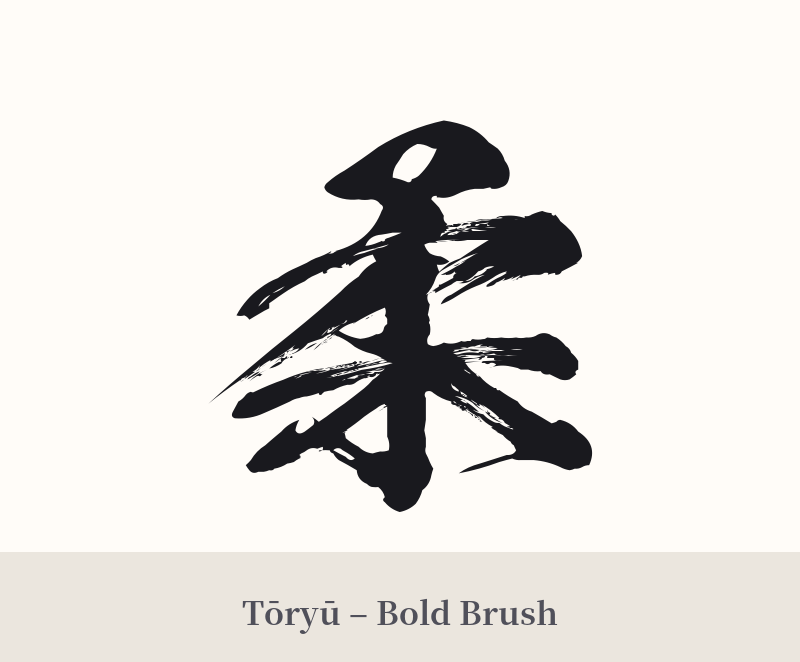
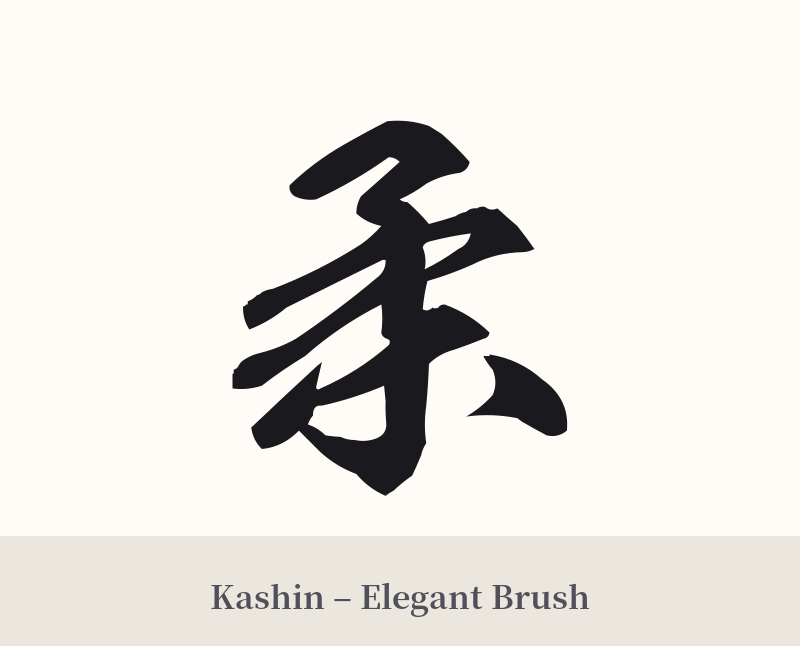
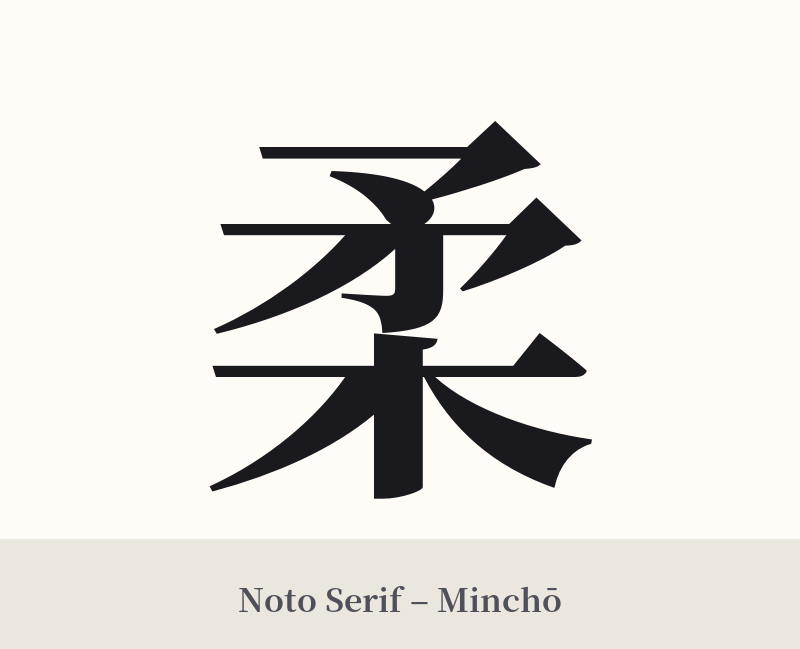
The same kanji can look dramatically different depending on the calligraphy style. Choose a font that matches the mood you want for your tattoo or design.
🎨 Tattoo Suitability
📐 Tattoo Design Guide
The kanji 柔 offers wonderful versatility in tattoo design, reflecting its core meaning of flexibility.
– Placement: Consider places on the body that suggest flow and movement. The forearm, calf, or along the ribs can complement the character's dynamic nature. For a more introspective statement, the back of the neck or over the heart are also powerful choices.
– Font Style: A flowing, semi-cursive (gyōsho) or fully cursive (sōsho) script is a natural fit, as the brush strokes can mimic the kanji's meaning of yielding and adapting. Conversely, a strong, angular block script (kaisho) can create a compelling visual paradox: the form is 'hard,' but the meaning is 'soft,' echoing the principle of hidden strength.
– Visual Embellishments: To enhance the meaning, consider integrating imagery like a flowing stream of water, a bending willow branch, or an enso circle (a Zen symbol of enlightenment and the universe). These elements can visually reinforce the concepts of flow, resilience, and harmony associated with 柔.
Comments