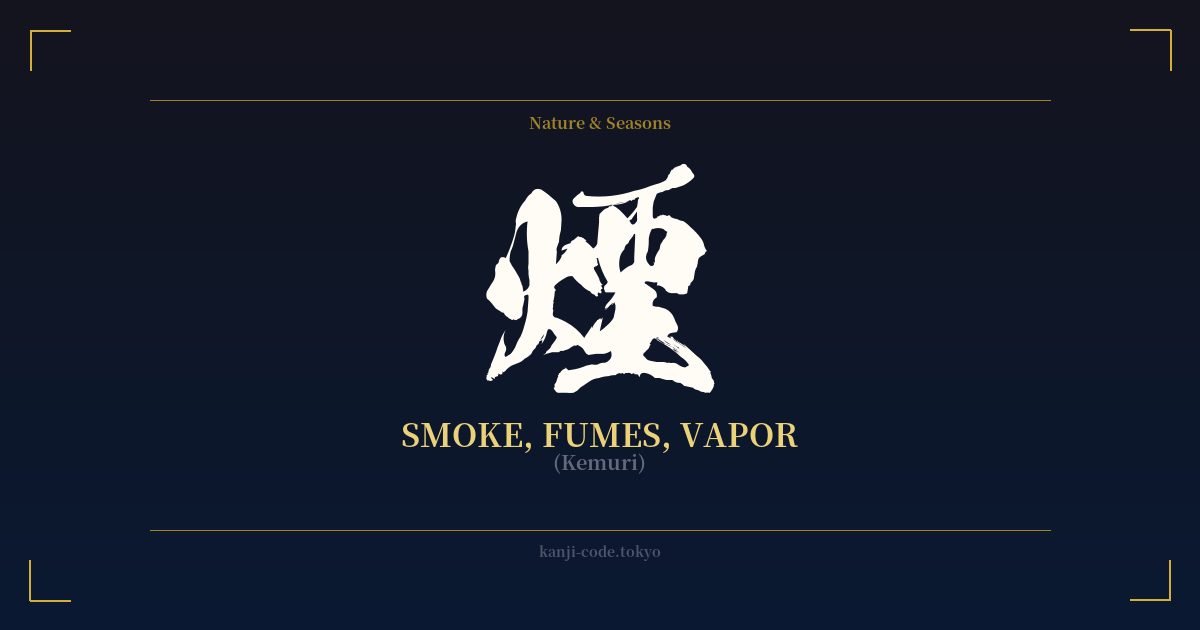
✍️ 煙 (Kemuri) — Cultural Context
The kanji 煙 (kemuri) is a fascinating character that encapsulates both the tangible and the intangible, the beautiful and the mundane. Its very structure tells a story. On the left, the radical 火 (hi) means 'fire,' the undeniable source. The right side, 因, originally depicted a person on a mat and now means 'cause' or 'reason,' lending a phonetic component and a sense of origin. Together, they form a clear picture: the visible result caused by fire.
In Japanese art and literature, smoke is a powerful and recurring motif, often used to evoke a sense of mono no aware—a gentle sadness or pathos for the transience of things. A wisp of smoke rising from a distant mountain in a ukiyo-e print or a line in a haiku about chimney smoke in autumn can symbolize impermanence, fleeting moments, and nostalgia. It is the physical manifestation of something that was just there but is now gone, leaving only a trace that will soon disappear.
This connection to the ephemeral is deeply woven into spiritual practices. The smoke from incense (香, kō) is a central element in Buddhist temples and at household altars (仏壇, butsudan). This is not just any smoke; it is a sacred medium. The fragrant plumes of senkō (incense sticks) are seen as purifying a space, carrying prayers and respects to the heavens, and connecting the living with the spirits of their ancestors. In this context, 煙 is a bridge between the physical and spiritual realms, a symbol of memory and reverence.
However, 煙 is not always so poetic. In modern, everyday Japan, it carries very practical and often negative connotations. The word is plastered across the country on 禁煙 (kin'en) or 'No Smoking' signs. It can refer to the harmful fumes of pollution (排煙, haien), the unpleasant smoke from a fire, or the simple annoyance of a smoky room. This duality is crucial to understanding the character's full scope. It is not purely beautiful or purely negative; it exists in the space between.
This is perfectly captured in the Japanese proverb, 火のない所に煙は立たぬ (Hi no nai tokoro ni kemuri wa tatanu), which is the equivalent of the English "There's no smoke without fire." It speaks to the kanji's role as evidence, a sign of a hidden truth or an underlying cause, reinforcing its complex identity as both a physical phenomenon and a powerful symbol.
🖌️ Font Styles for 煙
The same kanji can look dramatically different depending on the calligraphy style. Choose a font that matches the mood you want for your tattoo or design.
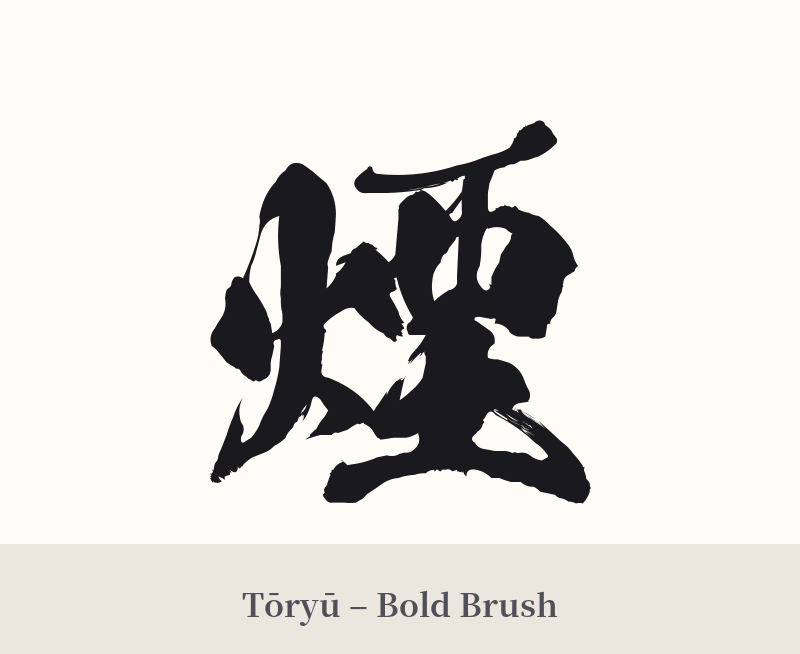
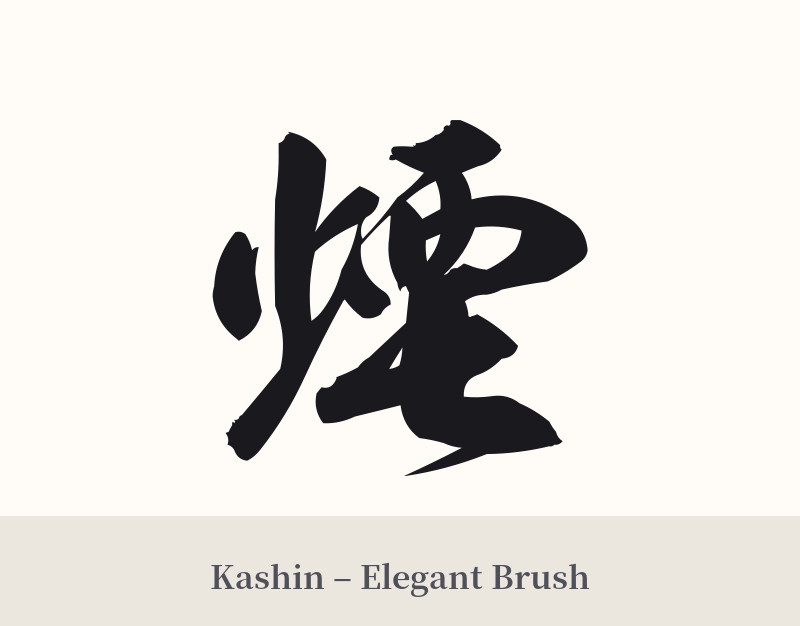
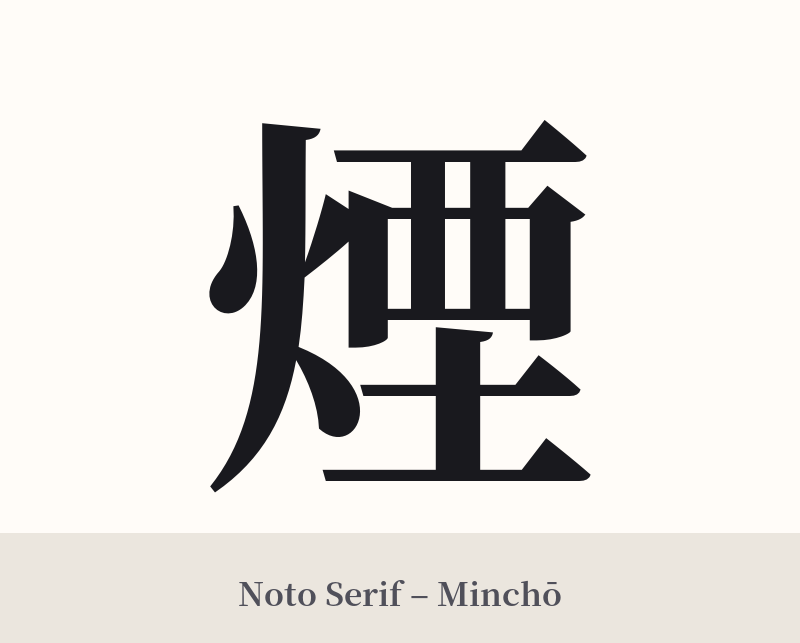
🎨 Tattoo Suitability
📐 Tattoo Design Guide
For a tattoo of 煙, the style and placement can greatly enhance its meaning. Calligraphic scripts are highly recommended to capture the fluid, ephemeral nature of smoke.
– Font Style: Consider a semi-cursive (gyōsho) or fully cursive (sōsho) style. These flowing scripts mimic the movement of smoke, giving the character a sense of life and motion. A standard block script (kaisho) can also work, creating a stark, impactful contrast to the kanji's fluid meaning.
– Placement: Areas of the body that allow for vertical flow are ideal. The forearm, the calf, along the ribs, or down the spine can complement the rising nature of smoke. For a more subtle design, the back of the neck or inner wrist are good choices.
– Visual Tips: Think about incorporating the design with other elements. The kanji could be rendered in a grey-wash ink, appearing to be made of smoke itself. You could also have wisps of smoke trailing off the character's strokes, blending it into a larger piece. Combining it with kanji like 夢 (dream) or 魂 (soul) can create a more specific and personal meaning.

Comments