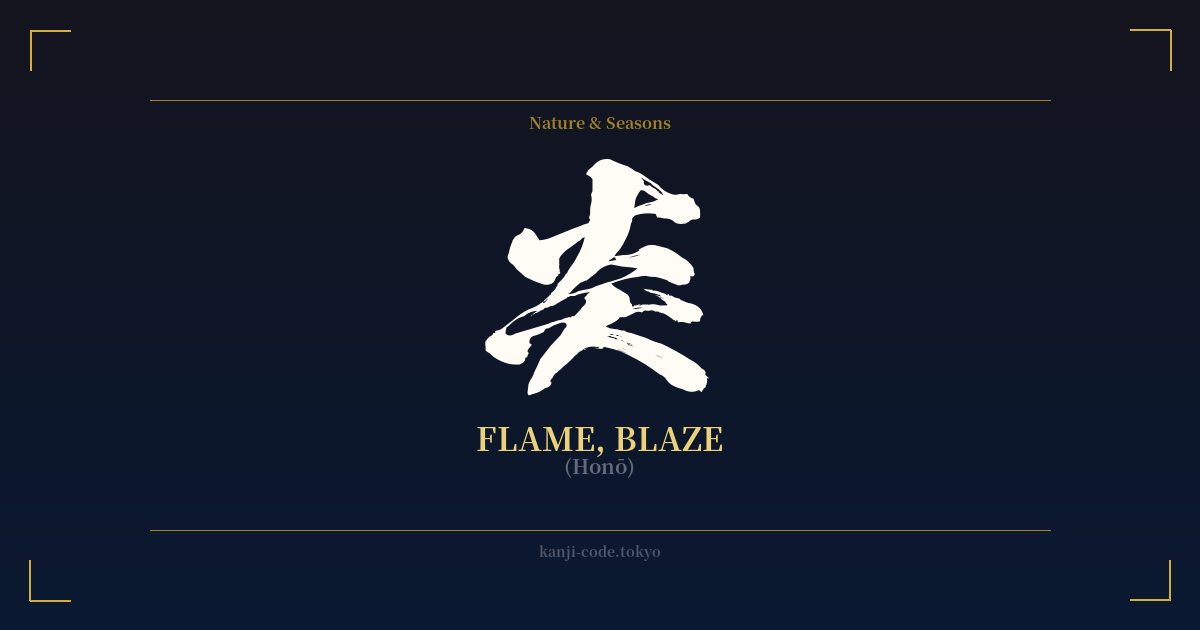
✍️ 炎 (Honō) — Cultural Context
The kanji 炎 (honō) is a vivid and powerful symbol, visually capturing the essence of a roaring blaze. Its very structure tells a story: it is composed of two 火 (hi) characters stacked on top of each other. Where a single 火 represents 'fire' in its basic form—a spark, a small flame, the element itself—炎 depicts a much larger, more intense conflagration. This is not just fire; this is a blaze, a passionate inferno, an overwhelming force.
In Japanese culture, fire holds a profound dual significance. It is a force of creation and life. Fire provides warmth, cooks food, and forges steel, playing a central role in the nation's history of craftsmanship, particularly in the legendary art of sword-making. It is a symbol of purification in both Shinto and Buddhist traditions. Shinto rituals often use fire to cleanse impurities and ward off evil spirits, while massive bonfires at festivals like Kyoto's Gozan no Okuribi are meant to guide ancestral spirits.
Conversely, 炎 represents immense destruction. In a country where cities were historically built from wood and paper, devastating fires (火事, kaji) were a constant threat. The Great Fire of Meireki in 1657, which destroyed much of Edo (modern-day Tokyo), is etched into the collective memory. This destructive aspect gives the kanji a dangerous edge, a reminder of nature's untamable power.
This duality is perfectly embodied by the Buddhist deity Fudō Myōō (不動明王), the Immovable Wisdom King. He is always depicted surrounded by a halo of flames (炎). This fire is not for destruction but for purification, burning away worldly desires, ignorance, and obstacles on the path to enlightenment. His fiery sword metaphorically cuts through delusion, representing the power of wisdom to overcome negativity.
The character has also found its place in modern language. The term 炎上 (enjō), literally 'to go up in flames,' is the common word for a social media firestorm or a major public controversy. This modern usage perfectly captures the feeling of a small issue rapidly escalating into an uncontrollable blaze of public opinion. At the same time, it can describe intense positive feelings, as in 情熱の炎 (jōnetsu no honō), 'the flame of passion.' From ancient deities to online slang, 炎 remains a potent symbol of intensity in all its forms.
🖌️ Font Styles for 炎
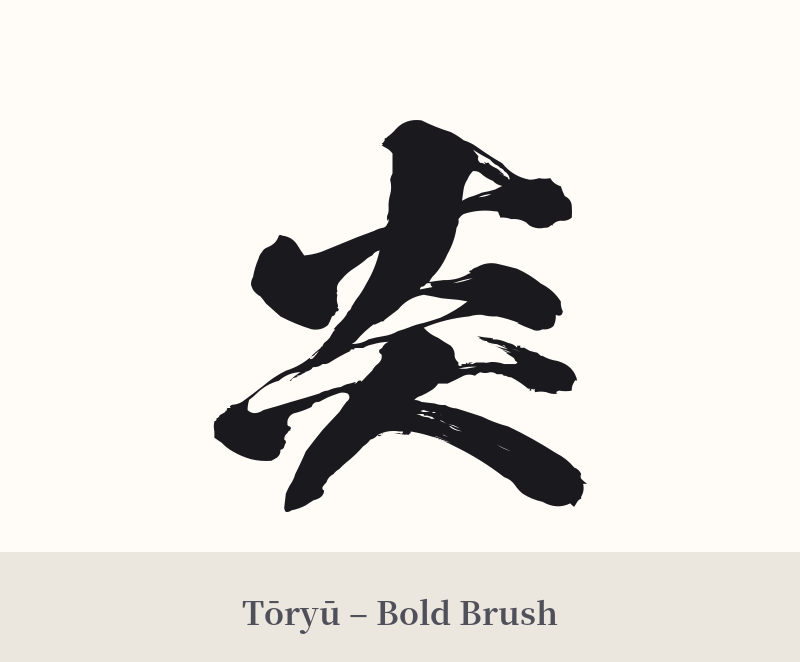
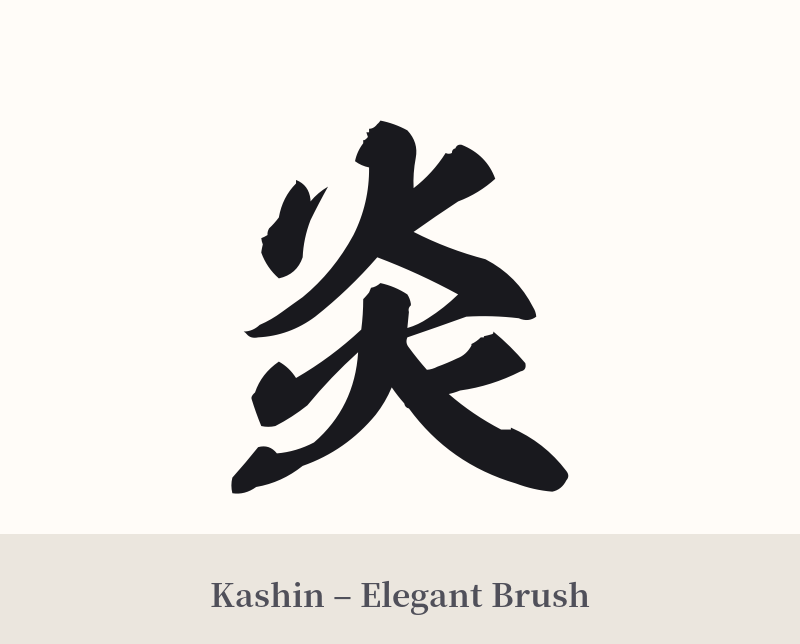
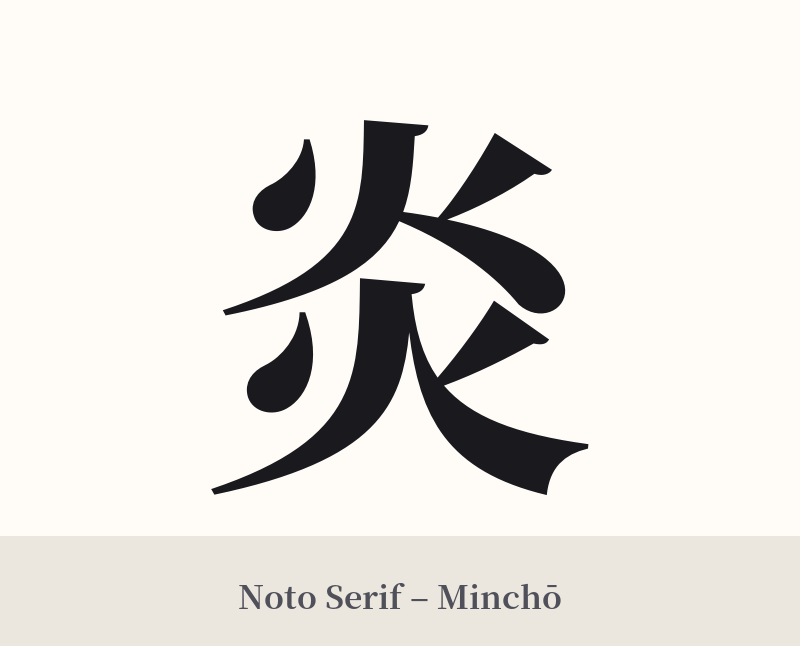
The same kanji can look dramatically different depending on the calligraphy style. Choose a font that matches the mood you want for your tattoo or design.
🎨 Tattoo Suitability
📐 Tattoo Design Guide
The kanji 炎 is a visually dynamic character that offers great flexibility for a tattoo design. Its inherent energy makes it a powerful statement piece.
– Placement: Consider areas that complement its vertical, rising energy. The forearm, calf, or along the ribs are excellent choices. For a larger, more prominent piece, the back or chest provides a great canvas to capture its blazing form.
– Style: A bold, aggressive calligraphy style (shodō) with scratchy, energetic brushstrokes can emphasize its raw power and passion. Conversely, a clean, thick mincho-style font can give it a more solid, controlled, and modern feel.
– Visuals: While stunning on its own in black ink, 炎 can be enhanced with color. Incorporating red, orange, and yellow gradients can bring the flame to life. You can also add visual elements like wisps of smoke curling from the top, or embers falling from the bottom to create a more complete scene. It pairs exceptionally well with other powerful Japanese motifs like a dragon (龍) or a phoenix (火の鳥).
Comments