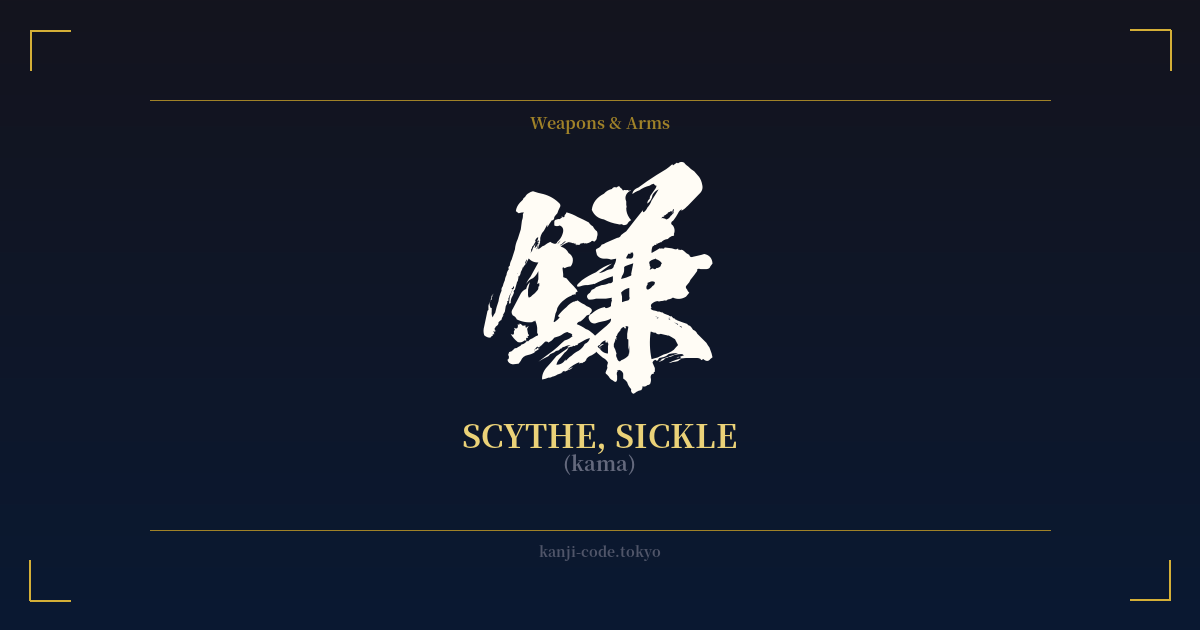
✍️ 鎌 (kama) — Cultural Context
The kanji 鎌 (kama) is a character of profound duality, embodying two seemingly opposite concepts: the life-giving harvest and the life-taking weapon. At its core, it represents a simple, curved blade, a tool that has been fundamental to human civilization for millennia.
In Japan, the kama is first and foremost an agricultural tool, a sickle used for reaping crops like rice and wheat. For centuries, rice cultivation has been the backbone of Japanese society and economy, making the kama a symbol of hard work, sustenance, and the cyclical nature of life. It represents a connection to the earth, the bounty of the harvest, and the quiet dignity of labor. This agrarian root gives the character a grounded, historical weight.
However, this humble farming implement was ingeniously adapted into a formidable weapon. The most famous example is the kusarigama, or 'chain-sickle,' a weapon consisting of a kama with a long metal chain and a heavy iron weight attached to the end. It was a versatile and deadly tool in the hands of a skilled practitioner, often associated with samurai and, more famously, ninja. The kusarigama allowed for a wide range of techniques, from striking and slashing at close range to ensnaring an opponent or their weapon from a distance. This martial history transforms the kama from a simple tool into a symbol of self-defense, ingenuity, and deadly potential.
In the modern era, the kama has taken on a new, powerful identity through its depiction in popular culture, particularly anime, manga, and video games. It has become the archetypal weapon of the shinigami, or 'death god,' the Japanese equivalent of the Grim Reaper. Wielding a large scythe, these figures are arbiters of life and death, guiding souls to the afterlife. This association imbues the kanji with a dark, mythological, and supernatural aura, linking it to themes of mortality, fate, and the spirit world.
Thus, the single character 鎌 contains a rich narrative. It is a symbol that speaks to the cycle of life and death—from the rice it harvests to the souls it reaps. This blend of the earthy and the ethereal, the practical and the fantastical, makes it a deeply compelling and multi-layered kanji.
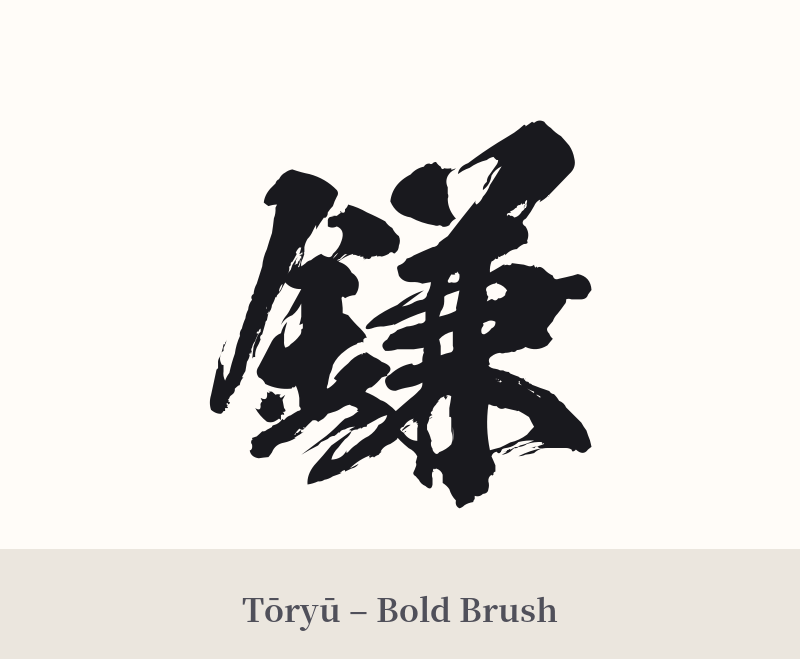
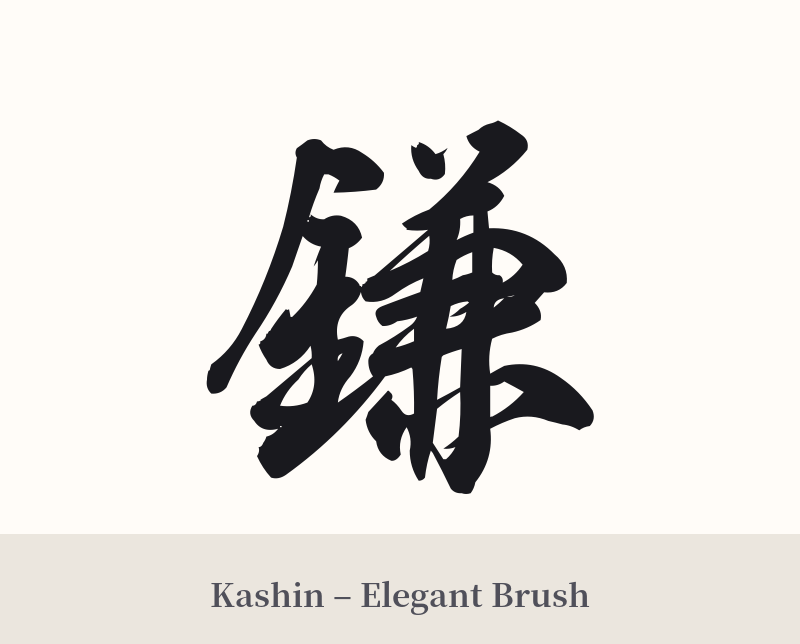
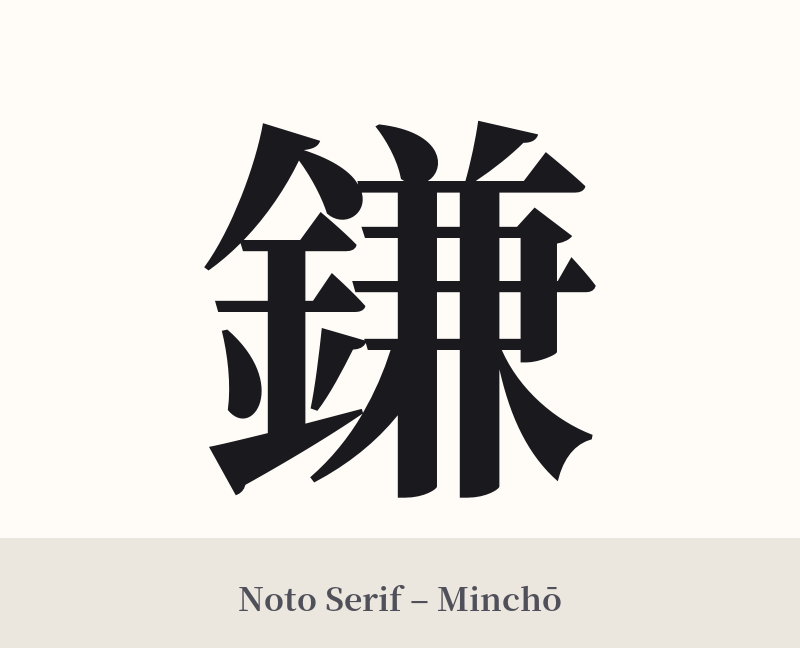
🖌️ Font Styles for 鎌
The same kanji can look dramatically different depending on the calligraphy style. Choose a font that matches the mood you want for your tattoo or design.
🎨 Tattoo Suitability
📐 Tattoo Design Guide
The 鎌 kanji offers strong visual potential for a tattoo, but its complexity requires careful consideration.
– Placement: This character needs space. The forearm, calf, back, or shoulder blade are excellent choices. These areas allow for a larger size, ensuring the intricate strokes remain clear and don't merge into a blob over time.
– Font Style: A bold, dynamic calligraphy style (shodō) can emphasize the character's martial and historical energy. For a more modern or pop-culture-focused design, a crisp, graphic font with sharp edges can highlight its connection to anime and the 'shinigami' aesthetic.
– Visual Tips: Consider integrating the kanji into a larger piece. It could be held by a stylized shinigami figure, emerge from wisps of smoke or spirit energy, or be contrasted with elements of life like rice stalks or a full moon. This can help direct the narrative of the tattoo towards either its agricultural or mythological meaning.
Comments