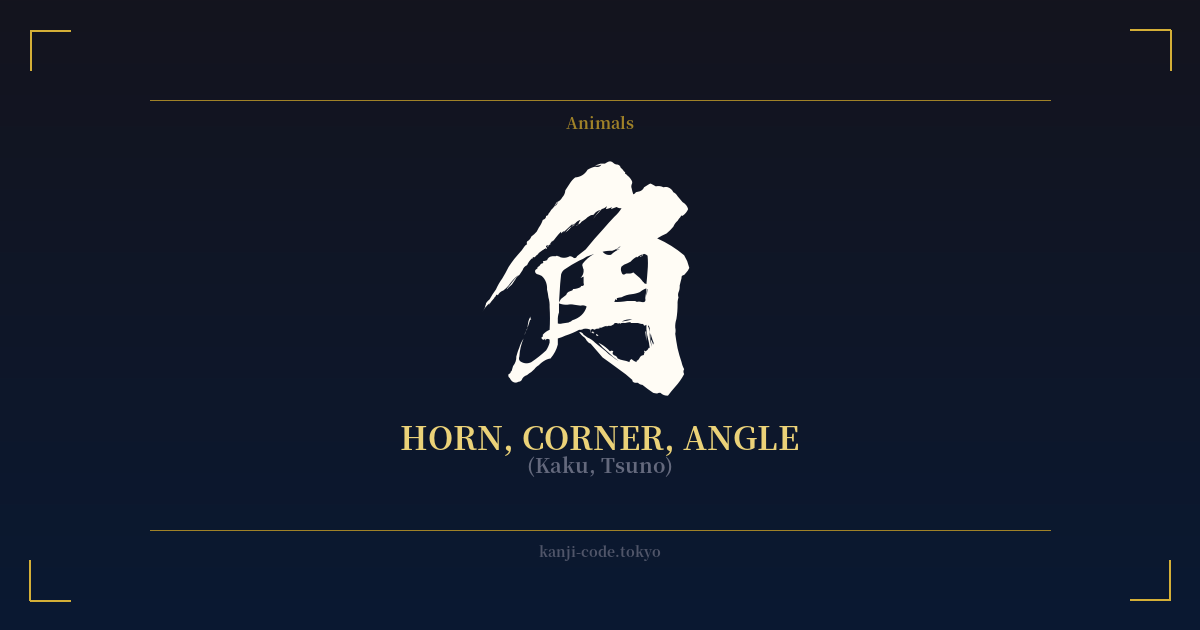
✍️ 角 (Kaku, Tsuno) — Cultural Context
The kanji 角 (kaku, tsuno) is a fascinating character, born from a simple pictograph of an animal's horn. Its story is one of duality, bridging the gap between the raw, primal world of nature and the ordered, abstract world of human intellect. This single symbol manages to contain both the wildness of a beast and the precision of mathematics.
Its most ancient meaning, read as 'tsuno', refers to the physical horn of an animal. In Japanese culture, horns are potent symbols. They represent the untamed power and ferocity of creatures like deer, bulls, and rhinos. More profoundly, they are the defining feature of the 'oni' (鬼), the iconic demons or ogres of Japanese folklore. An oni's horns are the source of its supernatural strength and fearsome nature. This connection gives the kanji a powerful, slightly dangerous, and rebellious undertone. A common Japanese phrase, 'tsuno o dasu' (角を出す), literally 'to show one's horns,' is used to describe a person (traditionally a woman) becoming enraged or fiercely jealous.
In stark contrast, the reading 'kaku' pulls the character into the realm of geometry and abstraction. Here, 角 means 'corner' or 'angle.' This usage is everywhere in modern Japanese. A triangle is a 'sankaku' (三角, three corners), a square is a 'shikaku' (四角, four corners), and a street corner is a 'kado' (角). This meaning speaks to structure, precision, and defined space.
This duality extends into cultural activities. In the world of sumo wrestling, a wrestler facing a losing record and potential demotion is said to be 'kadoban' (角番), literally 'at the corner,' backed into a precarious position. In the strategic board game of shogi (Japanese chess), the 'kaku' piece is the bishop, moving diagonally across the board and controlling its angles. Even the helmets of samurai, the 'kabuto,' often featured stylized horn-like decorations called 'kuwagata,' blending the symbol of power with a practical, defensive object.
Therefore, to understand 角 is to appreciate this tension. It is a character of edges and points, both literal and figurative. It represents the sharp point of a horn that can defend or attack, as well as the sharp corner of a shape that defines form and order. It is at once wild and civilized, a single stroke of ink that captures two fundamentally different ways of seeing the world.
🖌️ Font Styles for 角
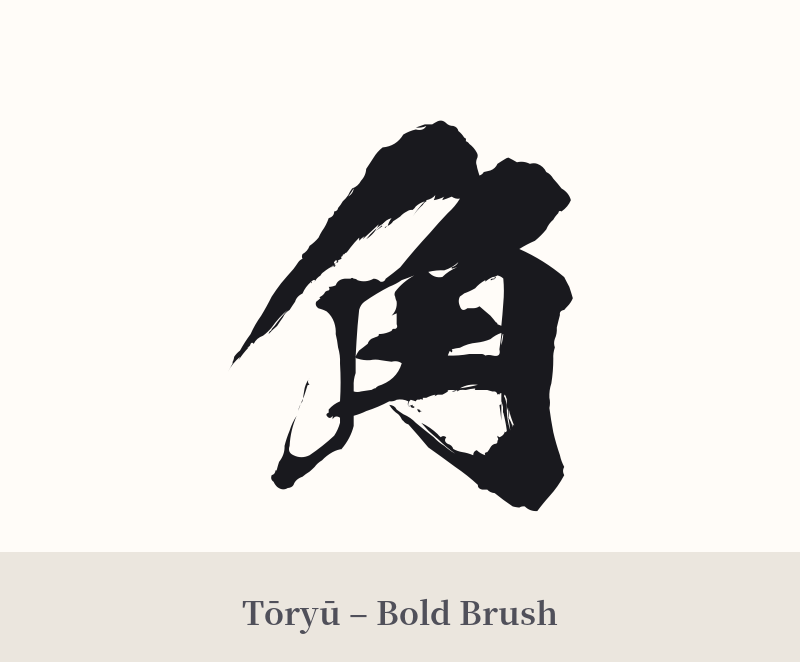
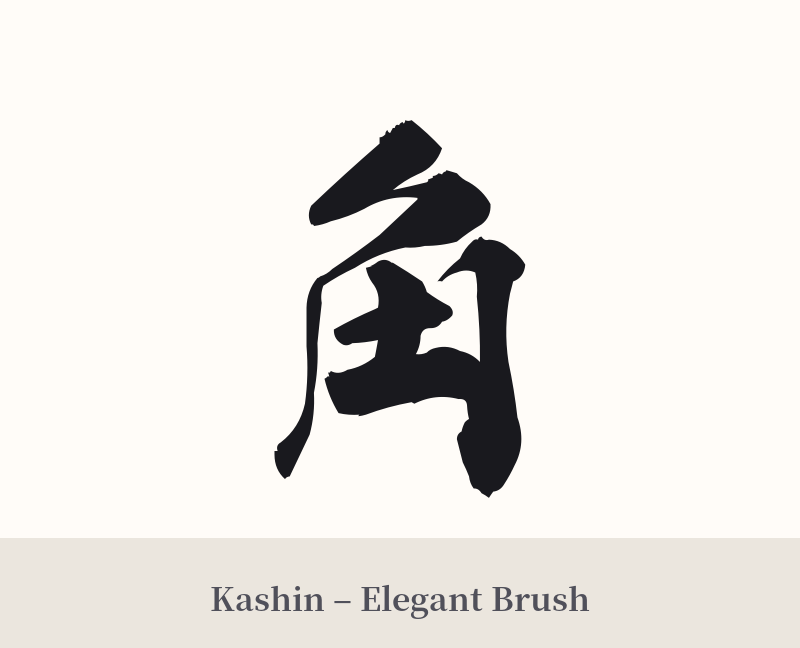
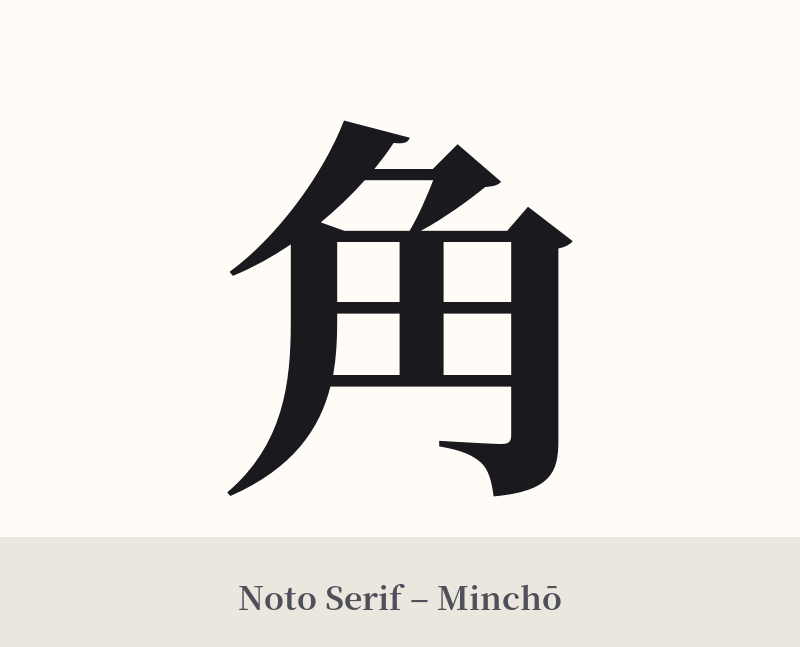
The same kanji can look dramatically different depending on the calligraphy style. Choose a font that matches the mood you want for your tattoo or design.
🎨 Tattoo Suitability
📐 Tattoo Design Guide
The dual nature of 角 offers interesting design possibilities, but requires careful thought to convey the intended meaning.
– Placement: To emphasize its angularity, consider placing it on parts of the body with natural lines or points, such as the shoulder blade, the side of the calf, or along the forearm. The sharpness of the character can complement the body's own geometry.
– Font Style: For the 'horn' meaning, an aggressive, fluid brush script (sōsho) can capture a sense of wildness and power. For the 'corner' or 'angle' meaning, a crisp, blocky kaisho or gothic font emphasizes its geometric precision and stability.
– Visual Context is Key: Because of its ambiguity, 角 is a character that benefits immensely from supporting imagery. To ensure the 'horn' meaning is clear, consider pairing it with an oni mask, a deer silhouette, or having it emerge from another design like a dragon's head. For the 'corner' meaning, it could be part of a larger geometric pattern, integrated into a compass rose, or placed alongside architectural elements.
Comments