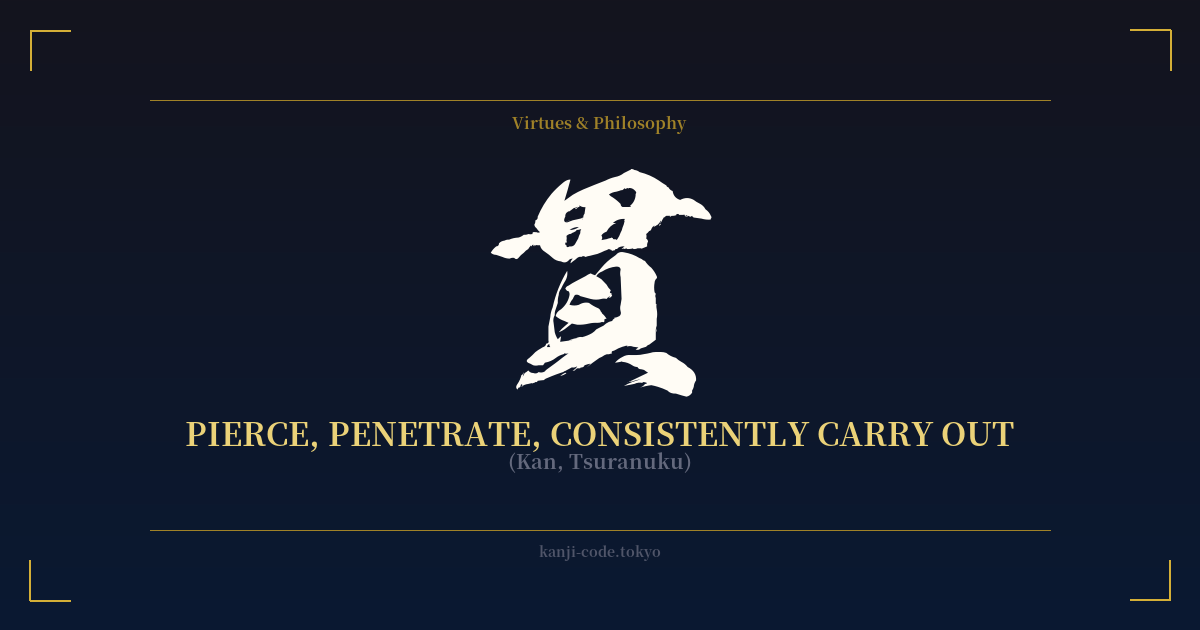
✍️ 貫 (Kan, Tsuranuku) — Cultural Context
The kanji 貫, read as 'kan' or more evocatively as the verb 'tsuranuku', holds a meaning far deeper than its literal translation of 'to pierce' or 'penetrate'. It embodies the quintessentially Japanese virtue of carrying something out from beginning to end with unwavering resolve. It’s the spirit of consistency, follow-through, and the force of will required to see a path to its conclusion, no matter the obstacles.
The character’s origin story paints a vivid picture of this concept. It is a composite of 毌, a pictograph of a skewer or string, and 貝, the symbol for a cowrie shell, which was used as currency in ancient times. Together, they depict the act of stringing coins together. This simple, tangible image gives rise to a powerful metaphor: the act of uniting disparate parts into a coherent whole, of maintaining a single, connecting thread through a series of events or objects. It is the visual representation of a timeline held together by a single, consistent principle.
This idea of a connecting thread is central to its philosophical weight. To 'tsuranuku' a belief is to uphold it throughout your life. In the context of Bushido, the samurai code, this kanji was paramount. A warrior’s path was one of 貫—not just piercing enemy lines in battle, but more importantly, consistently adhering to the strict code of honor, loyalty, and duty. The popular phrase 初志貫徹 (shoshi kantetsu) means 'to carry out one's original intention to the very end,' a powerful expression of this ideal that is still revered in Japanese culture today.
This isn't about blind stubbornness; it's about principled integrity. It is the spirit of the master craftsman (shokunin) who dedicates a lifetime to perfecting a single skill, consistently showing up day after day. It’s the force that drives an artist to complete a masterpiece or a leader to guide their people through hardship without wavering from their vision.
The verb form, 'tsuranuku', is often used in dynamic and poetic ways. It can mean to pierce the darkness with a ray of light, to penetrate a complex mystery with sharp intellect, or to stick to one's guns ('kangae wo tsuranuku'). It is a verb of action, of overcoming, and of relentless forward motion guided by an inner compass.
As a symbol, 貫 represents the strength found not in a single burst of effort, but in the relentless, sustained application of will. It speaks to a life of purpose, where actions are aligned with beliefs, and promises are seen through to completion. It is a testament to the power of a single, unifying principle that can pierce through any challenge.
🖌️ Font Styles for 貫
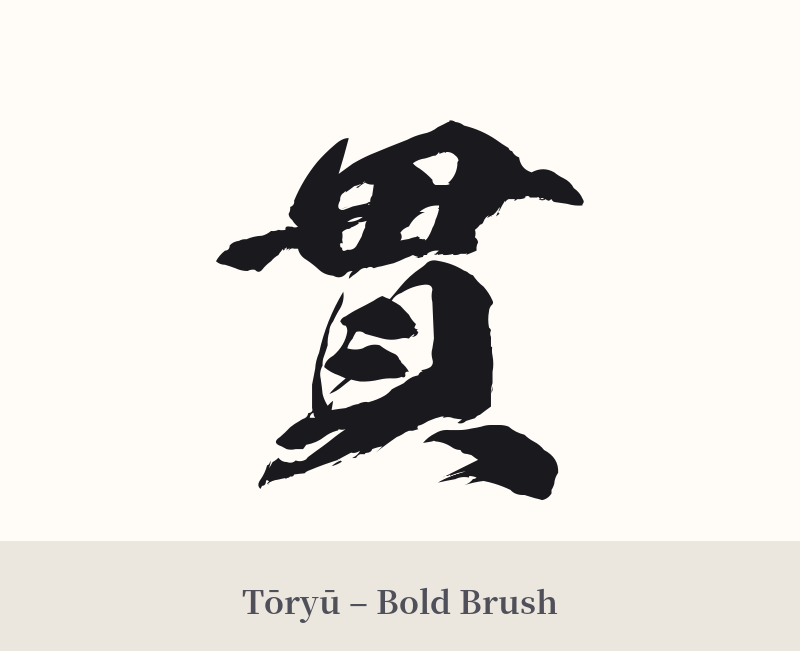
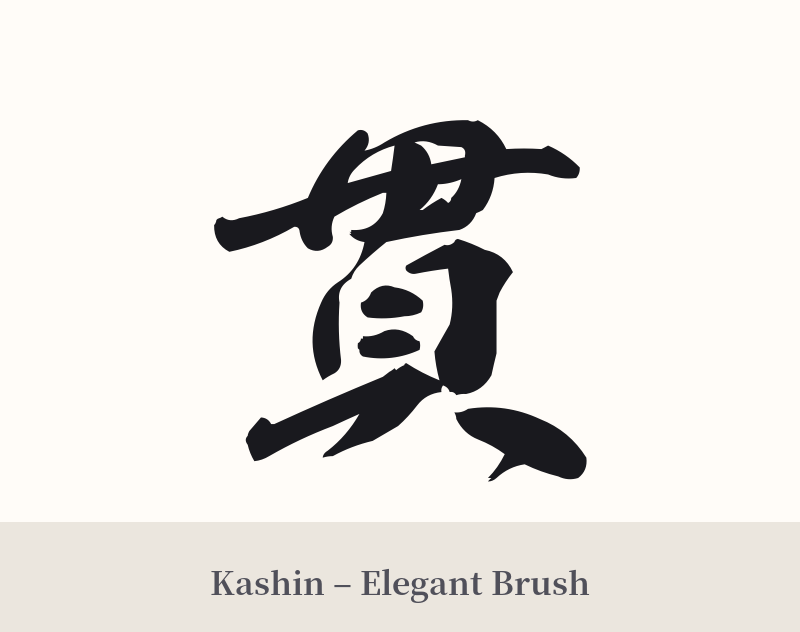
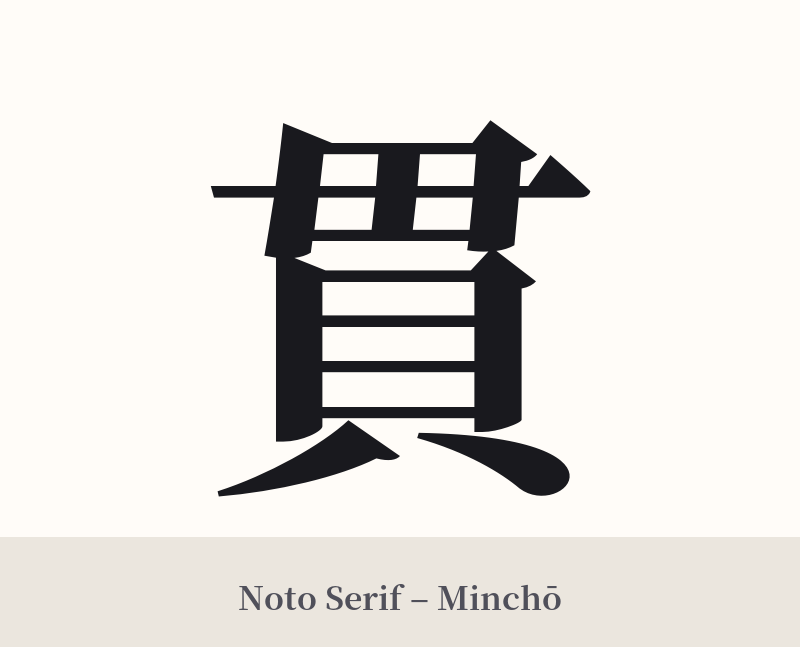
The same kanji can look dramatically different depending on the calligraphy style. Choose a font that matches the mood you want for your tattoo or design.
🎨 Tattoo Suitability
📐 Tattoo Design Guide
The kanji 貫 is a strong statement piece that benefits from thoughtful design and placement.
– Placement Suggestions: The forearm is an excellent choice, symbolizing the will to carry out actions. Placed vertically along the spine, it can represent a core principle guiding your life. The calf or shin can also work well, suggesting a forward-moving path.
– Font Style Recommendations: A bold, angular calligraphy style like Kaisho (block script) will emphasize the kanji's power and stability. For a more fluid and dynamic feel that captures the 'follow-through' aspect, a Gyosho (semi-cursive) or Sosho (cursive) script can be very effective. Avoid overly delicate fonts that might clash with the character's strong meaning.
– Visual Tips: Consider integrating the kanji with a visual metaphor. A simple arrow or spear motif can play on the 'piercing' meaning, representing focus and direction. You could also place the kanji within an Enso (Zen circle) to symbolize the complete journey or universe through which one's will penetrates. A design that bleeds from dark to light could represent piercing through adversity.
Comments