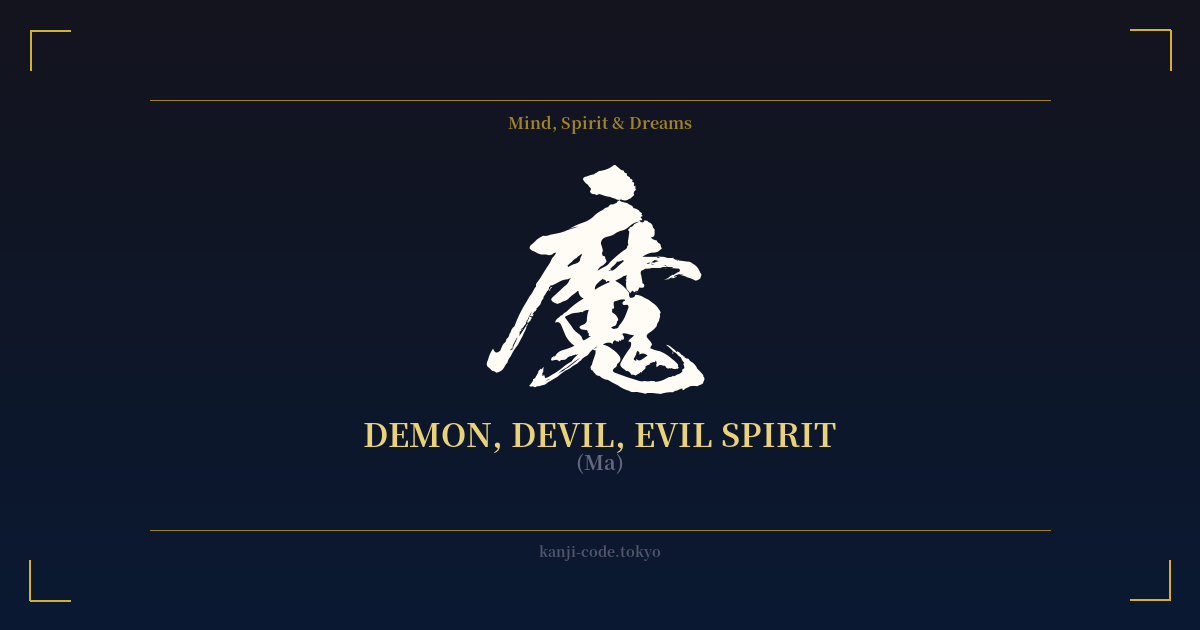
✍️ 魔 (Ma) — Cultural Context
The kanji 魔 (Ma) carries a weight of darkness, temptation, and supernatural power that is both ancient and strikingly modern. Its story begins not in Japan, but with the Sanskrit word 'Māra,' the name of a demonic celestial king in Buddhist mythology.
Māra was the ultimate tempter, the being who tried to distract Siddhartha Gautama with visions of beautiful women and armies of monsters to prevent him from achieving enlightenment. When Buddhist scriptures were translated into Chinese, the character 麻 (ma), meaning 'hemp,' was initially used as a phonetic placeholder for Māra.
This, of course, was confusing. To clarify that the term referred to a demonic entity and not a plant, the character was later modified. The 'demon' radical, 鬼 (oni/ki), was added to the right side, creating the definitive character 魔. This etymology anchors the kanji in the concept of spiritual obstacles, illusion, and the forces that corrupt the mind and prevent enlightenment.
In Japan, 魔 was integrated into a landscape already populated by native spirits and demons, like the 鬼 (Oni). While Oni are often depicted as physical, ogre-like brutes, 魔 tends to represent a more insidious, abstract, or magical form of evil. It’s the corrupting influence, the source of dark power. This is why it forms the basis for words like 魔王 (Maō), the 'Demon King'—a classic antagonist in fantasy—and 魔法 (Mahō), or 'magic,' literally 'demonic arts,' implying power drawn from supernatural, often forbidden, sources.
Today, 魔 has a vibrant dual identity. In a religious or traditional context, it retains its serious, negative meaning of malevolence and spiritual peril. Yet, in modern pop culture—manga, anime, and video games—it has been embraced as a symbol of immense power, dark aesthetics, and anti-heroic rebellion. Characters who wield 'ma' are often the most powerful and visually spectacular. This has made the kanji incredibly popular among a global audience who associate it with strength, mystery, and a rejection of the conventional.
🖌️ Font Styles for 魔
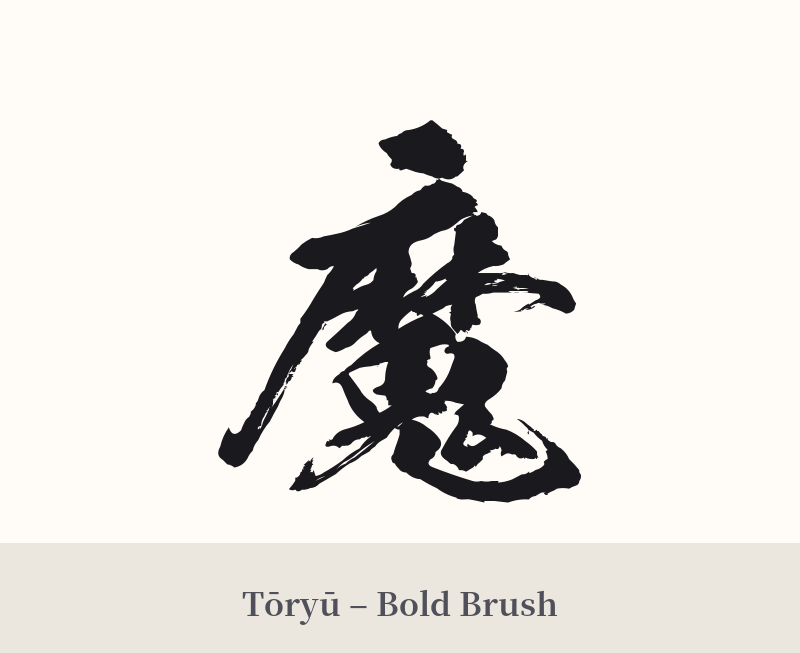
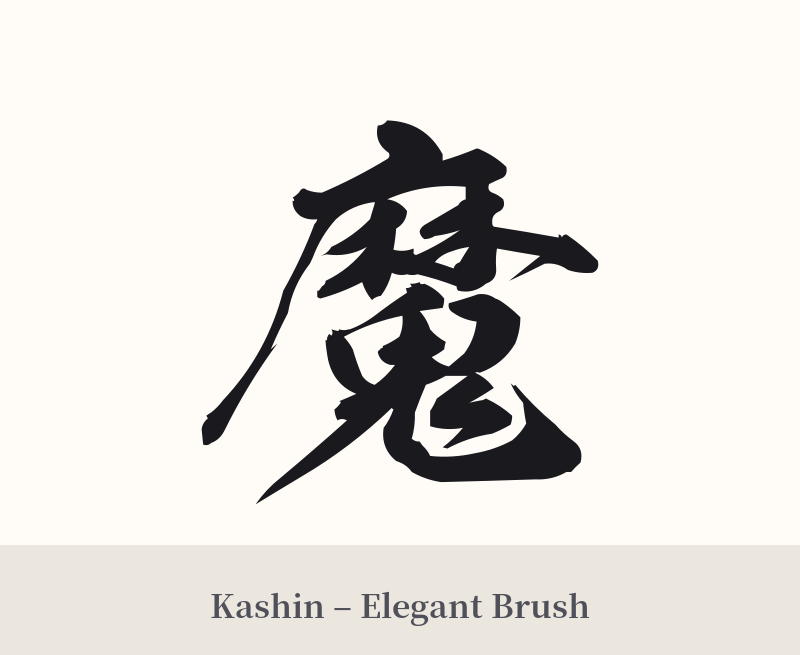
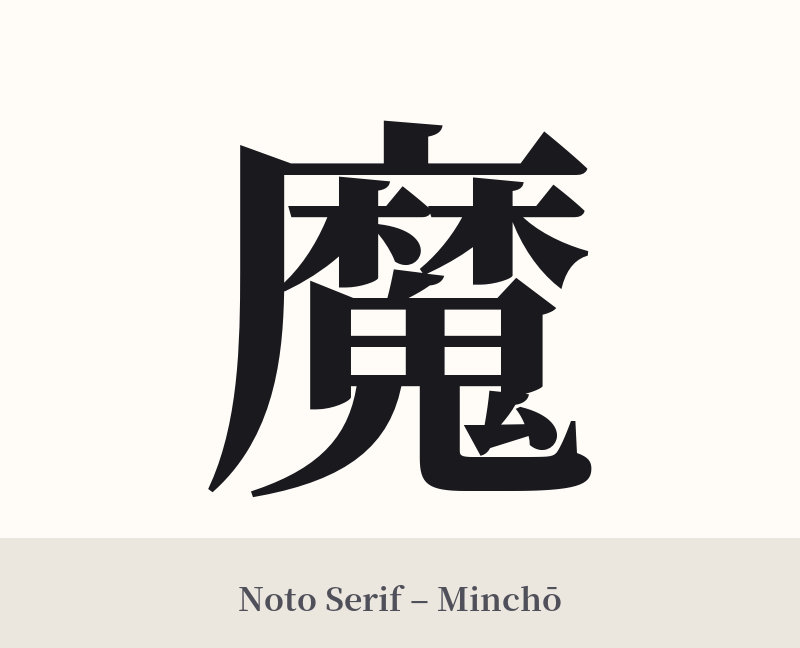
The same kanji can look dramatically different depending on the calligraphy style. Choose a font that matches the mood you want for your tattoo or design.
🎨 Tattoo Suitability
📐 Tattoo Design Guide
The kanji 魔 is complex and visually dense, making it a powerful choice for a tattoo. To do it justice, consider these design recommendations:
– Placement: This character needs space. Its 21 strokes can become a blur if tattooed too small. Opt for larger, flatter areas like the back, chest, forearm, or calf. This allows the artist to render each stroke with clarity.
– Style: A bold, aggressive calligraphy style like gyosho (semi-cursive) or a more primal, energetic sosho (cursive) can emphasize its chaotic nature. For a more imposing and solid feel, a thick, blocky kaisho (standard script) font works exceptionally well.
– Visual Elements: Consider pairing 魔 with complementary imagery to enhance its meaning. Surrounding it with dark flames, swirling smoke, or ominous clouds can amplify its demonic theme. For a design rich in contrast and meaning, you could place it near a lotus flower, symbolizing the struggle to overcome temptation and achieve purity amidst darkness.
Comments