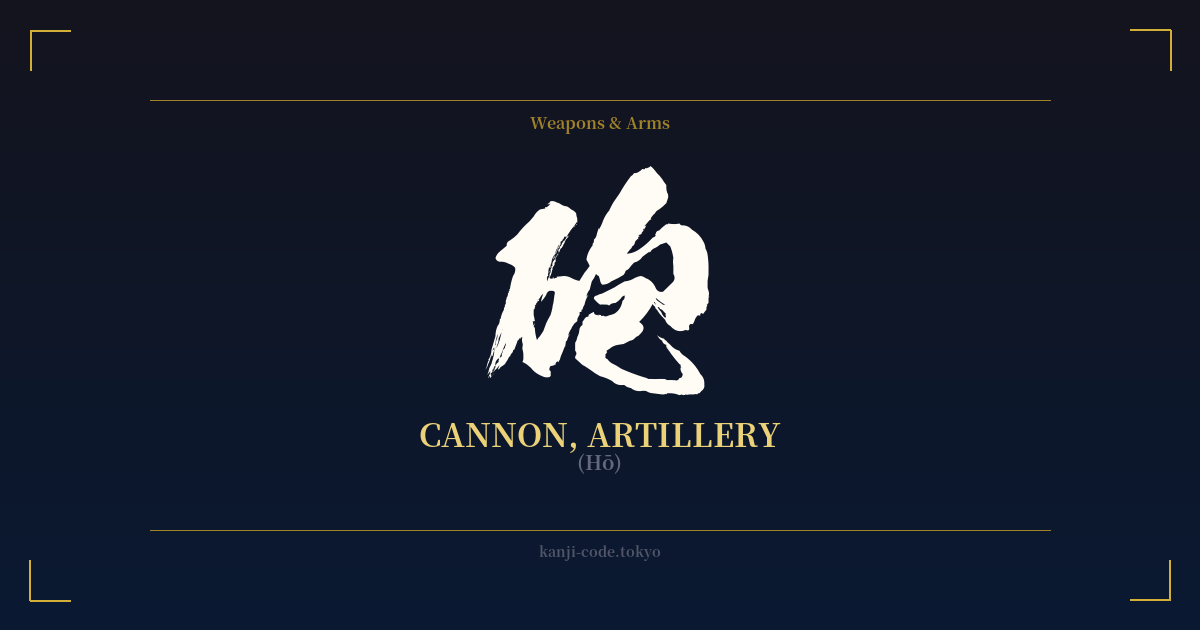
✍️ 砲 (Hō) — Cultural Context
The kanji 砲 (Hō) is a powerful and direct character, embodying the concept of the cannon or artillery. Its story is one of technological evolution in warfare, tracing a path from ancient siege engines to modern, devastating weaponry.
The character's origins lie in its components. It is a combination of 石 (ishi), meaning 'stone,' and 包 (hō), meaning 'to wrap' or 'envelop.' This composition originally painted a picture of a catapult or trebuchet—a machine that launched large, often wrapped, stones to break down castle walls. It represents the very idea of a projectile weapon, a force launched from a distance.
This meaning was dramatically supercharged in the 16th century with the arrival of the Portuguese in Japan. They introduced firearms, most notably the arquebus (火縄銃, hinawajū), which the Japanese quickly adopted and improved upon, calling them 'tanegashima' after the island where they first landed. This event forever changed the face of Japanese warfare. The character 砲, once associated with stone-throwers, became the symbol for the new, terrifying power of gunpowder.
During the Sengoku Jidai, the 'Warring States' period, powerful daimyō like Oda Nobunaga embraced this new technology. Cannons and firearms were instrumental in castle sieges and large-scale battles, helping to end a century of civil war and unify Japan. In this context, 砲 represents not just a weapon, but a paradigm shift—the triumph of technology and organized firepower over the traditional warrior's individual skill.
In modern Japanese, 砲 is used exclusively in a military or weapon-related context. You see it in words like 大砲 (taihō, 'large cannon' or 'artillery'), 鉄砲 (teppō, 'gun'—a term now more historical but foundational), and 砲弾 (hōdan, 'cannonball' or 'shell'). There is no ambiguity, no hidden layer of peaceful meaning. It is a character of force and destruction.
Figuratively, elements of the word can appear in phrases describing a forceful, sudden action. For example, 鉄砲玉 (teppōdama, 'bullet') can refer to a person sent out on a risky, often one-way mission. However, the single character 砲 itself remains starkly literal. In pop culture, it appears frequently in anime, manga, and games centered on war or historical conflict, always representing heavy firepower and overwhelming force.
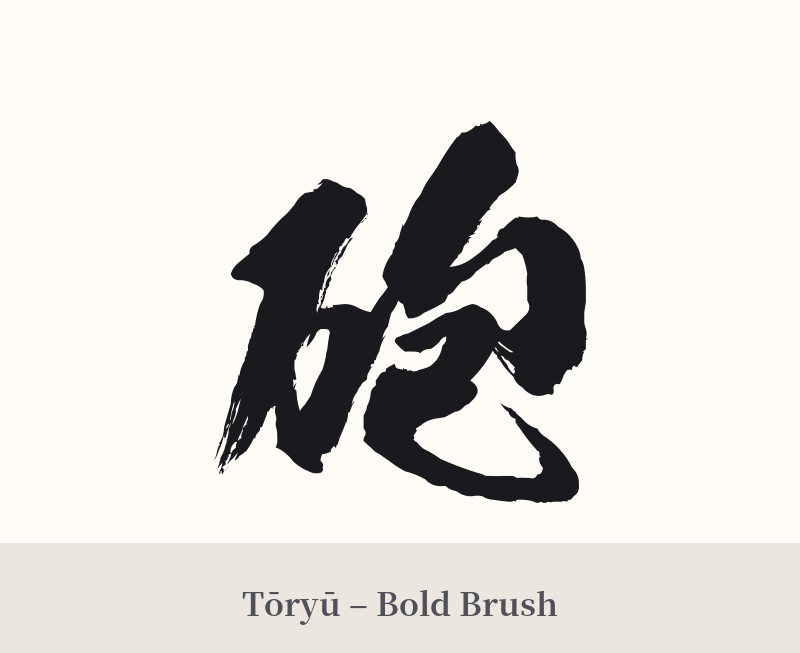
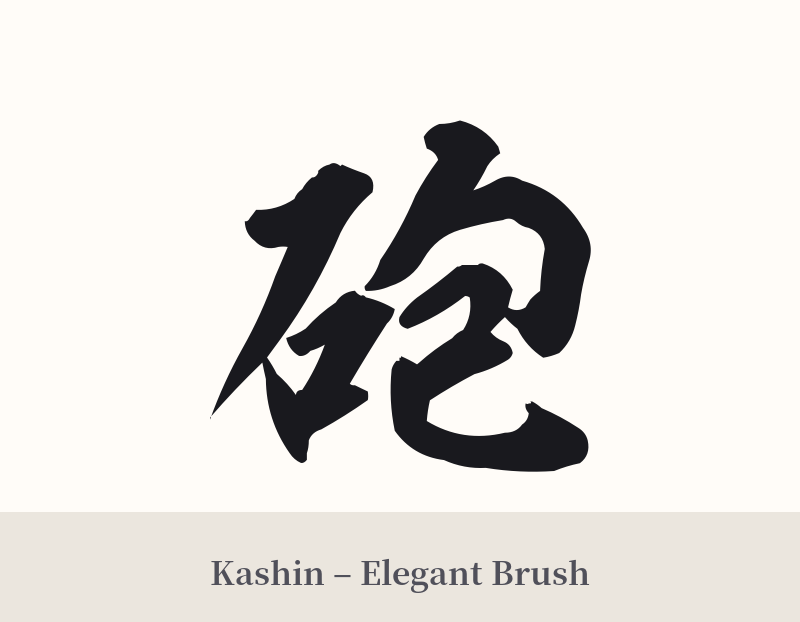
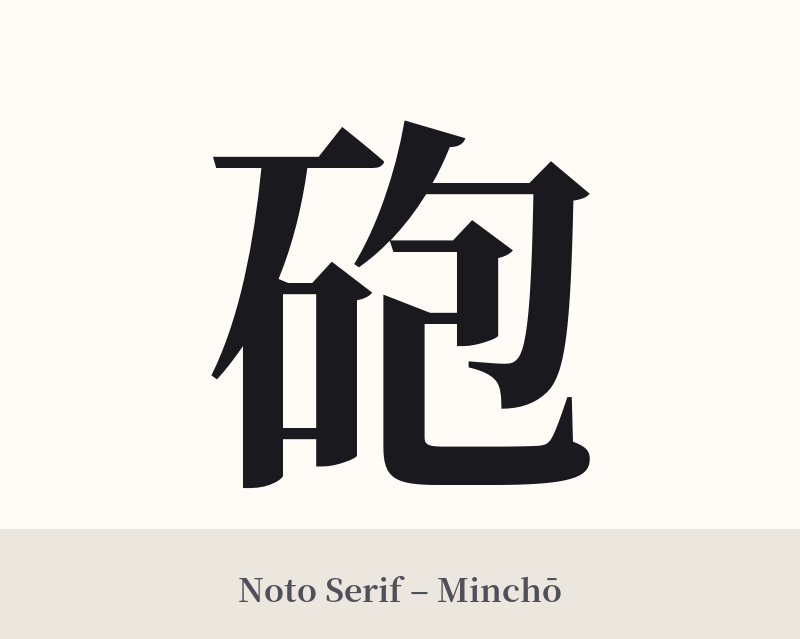
🖌️ Font Styles for 砲
The same kanji can look dramatically different depending on the calligraphy style. Choose a font that matches the mood you want for your tattoo or design.
🎨 Tattoo Suitability
📐 Tattoo Design Guide
A tattoo of 砲 is a statement of raw, mechanical power. The design choices should reflect this direct and aggressive nature.
– Placement: This character works well in places that suggest strength and action. The calf, forearm, or shoulder blade are excellent choices. Placing it on the chest could symbolize a 'human cannon,' a very bold statement.
– Font Style: A strong, angular script is most fitting. A standard Kaisho (block) style emphasizes its mechanical precision. A slightly rougher, more aggressive brushstroke style can also work, suggesting explosive force. Avoid delicate or overly ornate scripts, as they would clash with the kanji's inherent meaning.
– Visual Accompaniments: While 砲 can stand alone due to its clear meaning, it can be enhanced with related imagery. Wisps of smoke, bursts of fire, or cracked ground beneath the character can amplify the sense of impact and destruction. For a historical theme, you could pair it with the 'mon' (crest) of a famous samurai clan known for their use of firearms, like the Oda clan.
Comments