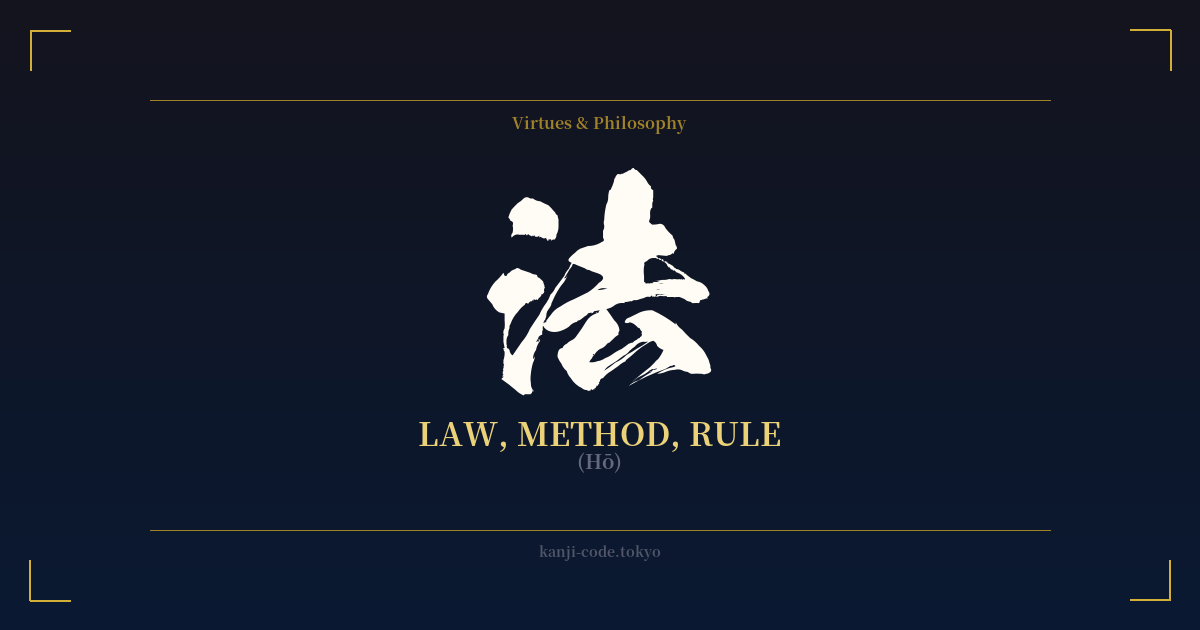
✍️ 法 (Hō) — Cultural Context
The kanji 法 (Hō) is a character of immense depth, representing concepts that form the very bedrock of civilization and philosophy. Its meanings span from the mundane to the cosmic, encompassing 'law,' 'method,' and 'rule,' but also reaching into the profound spiritual territory of the Buddhist 'Dharma.'
To understand its essence, we can look at its ancient form, 灋. This complex character was a vivid pictograph. It featured the 'water' radical (氵) on the left, symbolizing levelness, fairness, and impartiality—like the still surface of water. On the right, it contained a mythical creature said to be able to distinguish right from wrong, and the character 去, meaning 'to go away' or 'to remove.' The combined image was of a divine beast removing the guilty, with the entire process being as fair and level as water. This beautifully illustrates the ancient ideal of justice as a natural, impartial force.
Over centuries, this character was simplified to its modern form, 法. While the mythical beast is gone, the core components of 'water' (氵) and 'to go' (去) remain. This simplification shifts the emphasis slightly, suggesting a 'flow' or a 'way to proceed'—a natural course of action. This is where the meaning of 'method' or 'technique' comes from. Words like 方法 (hōhō, method) and 文法 (bunpō, grammar) use 法 to denote a structured system or a correct way of doing things.
Perhaps its most significant meaning is its use in Buddhism, where 法 is the Japanese translation of the Sanskrit word 'Dharma.' In this context, it transcends man-made laws and refers to the universal, cosmic law. It is the fundamental truth of existence, the teachings of the Buddha, and the path to enlightenment. When a Buddhist speaks of the 法, they are referring to the very nature of reality itself. It is one of the Three Jewels of Buddhism: the Buddha (the enlightened one), the Dharma (the teaching/truth), and the Sangha (the community).
This single character, therefore, operates on multiple planes. It is the law that governs a nation (法律, hōritsu), the method used in an art form (作法, sahō, etiquette), and the cosmic principle that governs the universe (仏法, buppō, Buddhist law/Dharma). To embrace the kanji 法 is to acknowledge the importance of order, principle, and underlying truth, whether it is found in a courtroom, a dojo, or in the quiet contemplation of the cosmos.
🖌️ Font Styles for 法
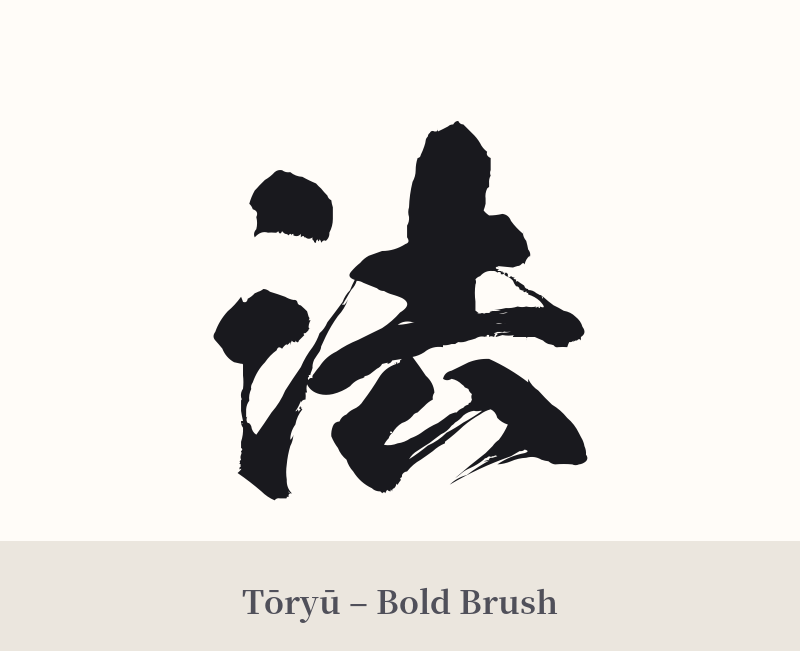
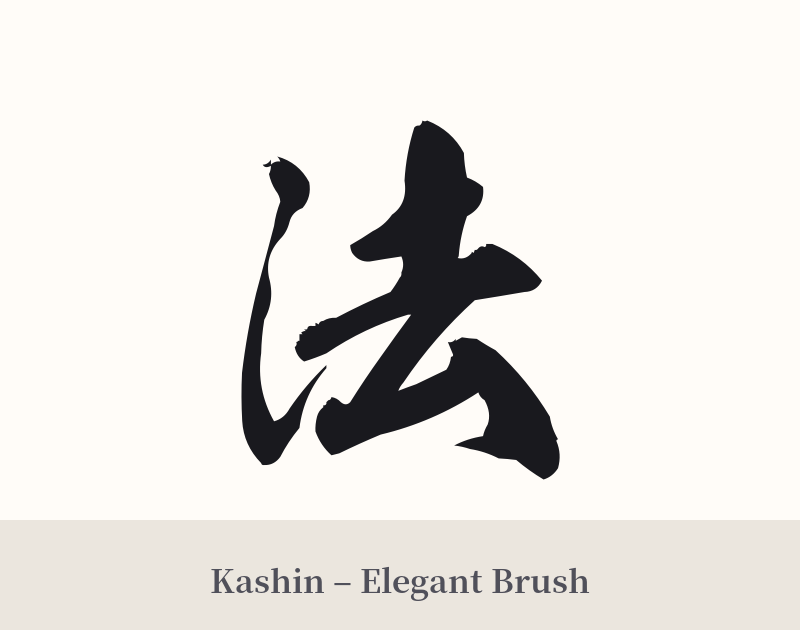
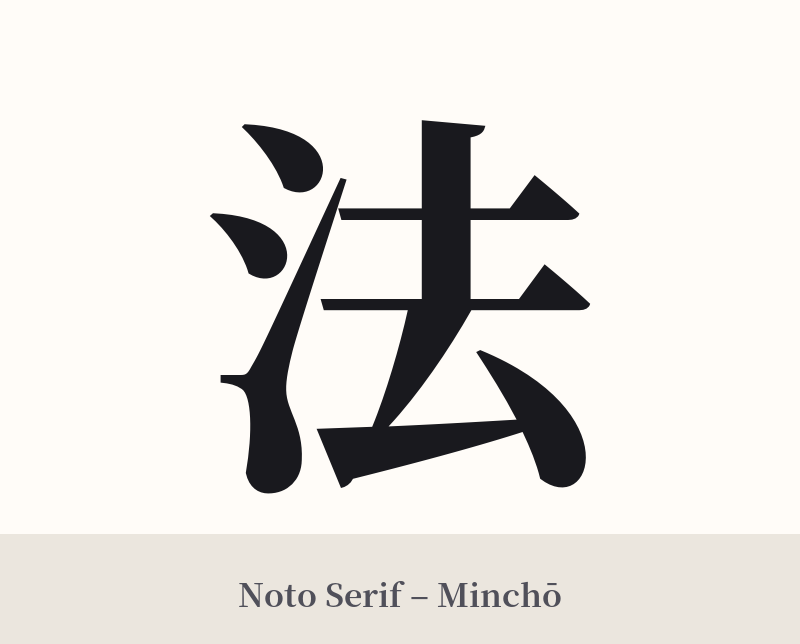
The same kanji can look dramatically different depending on the calligraphy style. Choose a font that matches the mood you want for your tattoo or design.
🎨 Tattoo Suitability
📐 Tattoo Design Guide
The kanji 法 offers a clean, balanced aesthetic that works well for various tattoo designs.
– Placement: A vertical placement on the forearm or along the spine can emphasize its sense of principle and structure. For a more personal statement, the chest or inner bicep are excellent choices.
– Font Style: A standard Kaisho (block) script will give it a formal, authoritative look, perfect for representing 'law' and 'order.' For a design that leans into the 'Dharma' or 'method' meaning, a more fluid Gyosho (semi-cursive) script can evoke the 'water' radical's sense of flow and naturalness.
– Visual Tips: To enhance its meaning, consider incorporating related imagery. Placing 法 within an Enso (Zen circle) strongly connects it to Buddhist philosophy. A design that integrates subtle water ripples or wave patterns can be a beautiful nod to the character's etymological roots and the concept of fairness.
Comments