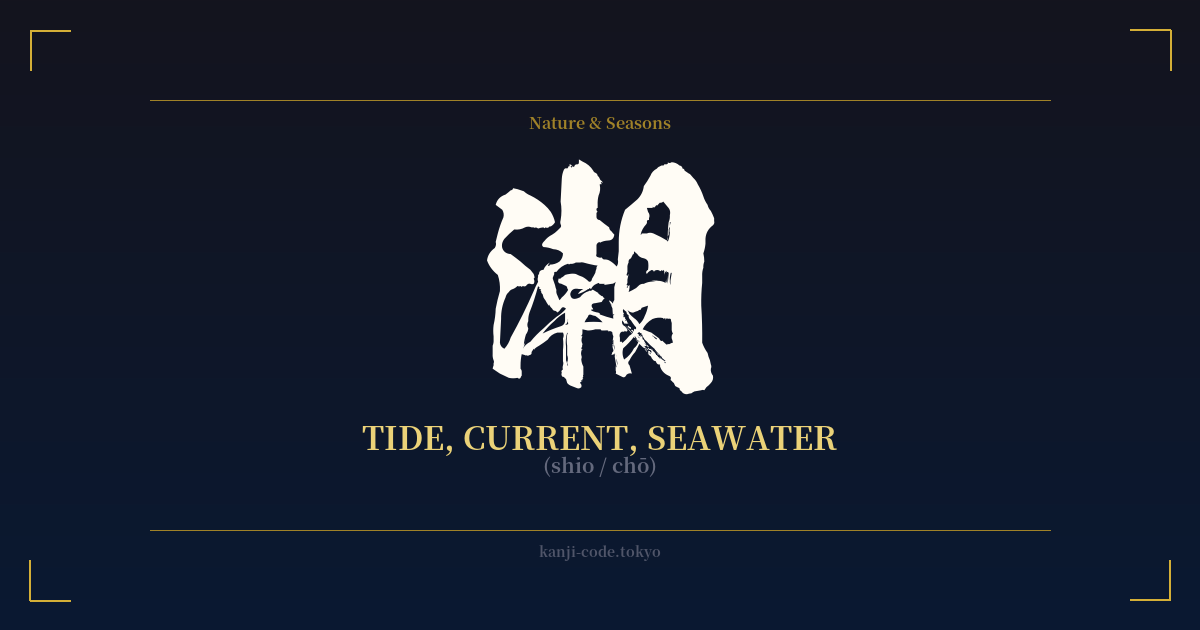
✍️ 潮 (shio / chō) — Cultural Context
The kanji 潮 (shio) is a character deeply embedded in the Japanese psyche, born from a culture shaped by the sea. As an island nation, Japan's relationship with the ocean is one of profound respect, reliance, and awe. At its most literal level, 潮 represents the tide—the rhythmic, twice-daily rise and fall of sea levels governed by the moon. It is the seawater itself, the great currents that circulate the globe.
This connection is woven into Shintoism, Japan's indigenous religion, where the sea is home to powerful kami (deities). Watatsumi, the great sea god, controls the tides, and the mythological story of the tide jewels—one to raise the waters, one to lower them—illustrates the immense power attributed to this natural force. The ebb and flow of the tide, `manchō` (満潮, high tide) and `kanchō` (干潮, low tide), dictate the lives of fishermen and coastal communities, marking the rhythm of their days.
The character's construction offers a beautiful visual poem. On the left is the `sanzui` (氵) radical, the unmistakable signifier of water. On the right is 朝 (asa or chō), the character for “morning.” Together, they evoke the image of the morning tide, a fresh, powerful, and cyclical event that greets the dawn. This etymology captures the essence of 潮 as a recurring, life-giving force.
Beyond its literal meaning, 潮 carries a powerful metaphorical weight. It is used to describe the “tide of the times” (時代の潮, jidai no shio), signifying the prevailing trends, moods, and movements of an era. To “ride the tide” is to seize an opportunity, while to go against it is to struggle against an overwhelming force. The common phrase `shioki` (潮時) means “the opportune moment.” It reflects a philosophy of waiting for the right conditions, of understanding that timing, like the tide, is a natural force that should be respected rather than fought.
In this sense, 潮 speaks to a worldview that embraces cycles, change, and impermanence, concepts central to Buddhist thought in Japan. It is not simply water, but a symbol of the unstoppable flow of life, the passing of time, and the moments of opportunity that arise and recede. It is a reminder of nature's immense power and the wisdom in aligning oneself with its rhythm.
🖌️ Font Styles for 潮
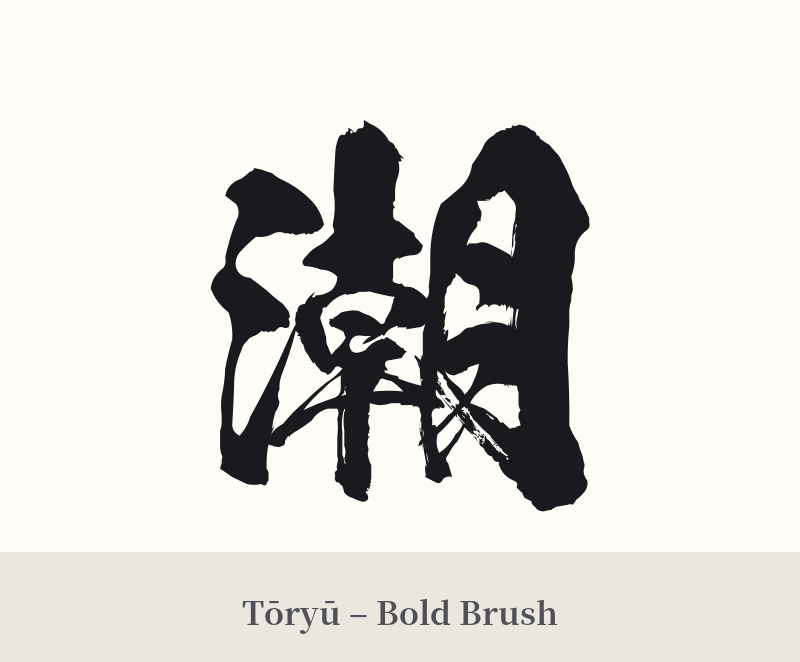
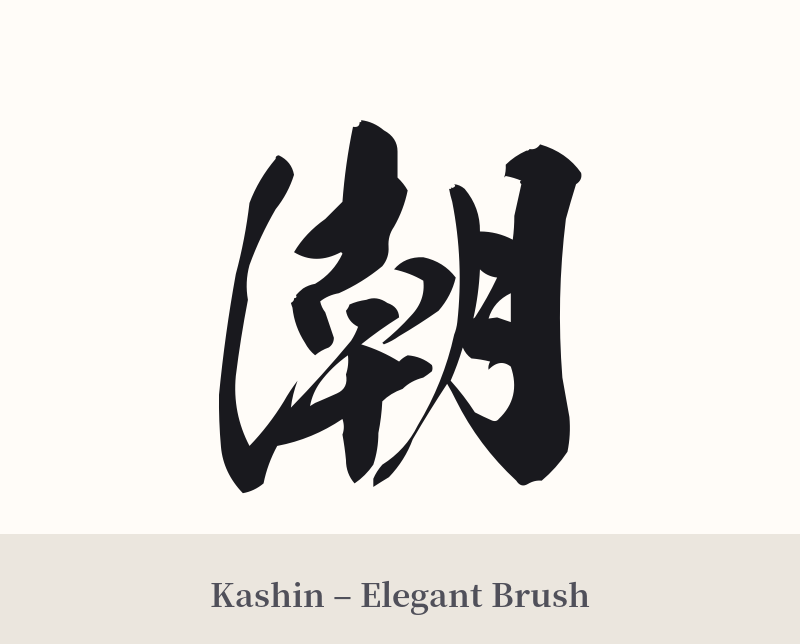
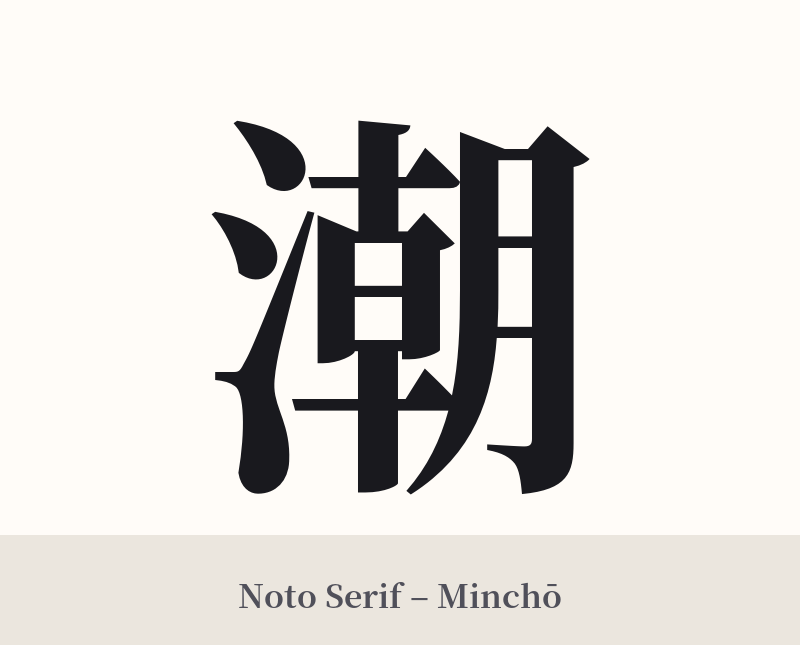
The same kanji can look dramatically different depending on the calligraphy style. Choose a font that matches the mood you want for your tattoo or design.
🎨 Tattoo Suitability
📐 Tattoo Design Guide
The kanji 潮 offers a visually compelling and meaningful choice for a tattoo. Its balance of the simple water radical and the more complex character for 'morning' creates a dynamic image.
– Placement: This character works well in vertical orientations. Consider the forearm, calf, or along the spine. For a horizontal placement, the back of the neck or across the shoulder blade provides a good canvas that allows the details to shine.
– Style: A bold, strong `kaisho` (block script) will emphasize its power and structural beauty. For a more fluid and organic feel, consider a `gyōsho` (semi-cursive) or `sōsho` (cursive) style, where the strokes can mimic the flow and movement of water.
– Visual Companions: While 潮 is strong enough to stand alone, it can be beautifully integrated into a larger piece. Consider pairing it with traditional Japanese waves (nami), a full moon to represent the source of the tide's power, or a koi fish swimming with or against the current. The character can serve as the thematic heart of a larger oceanic scene.
Comments