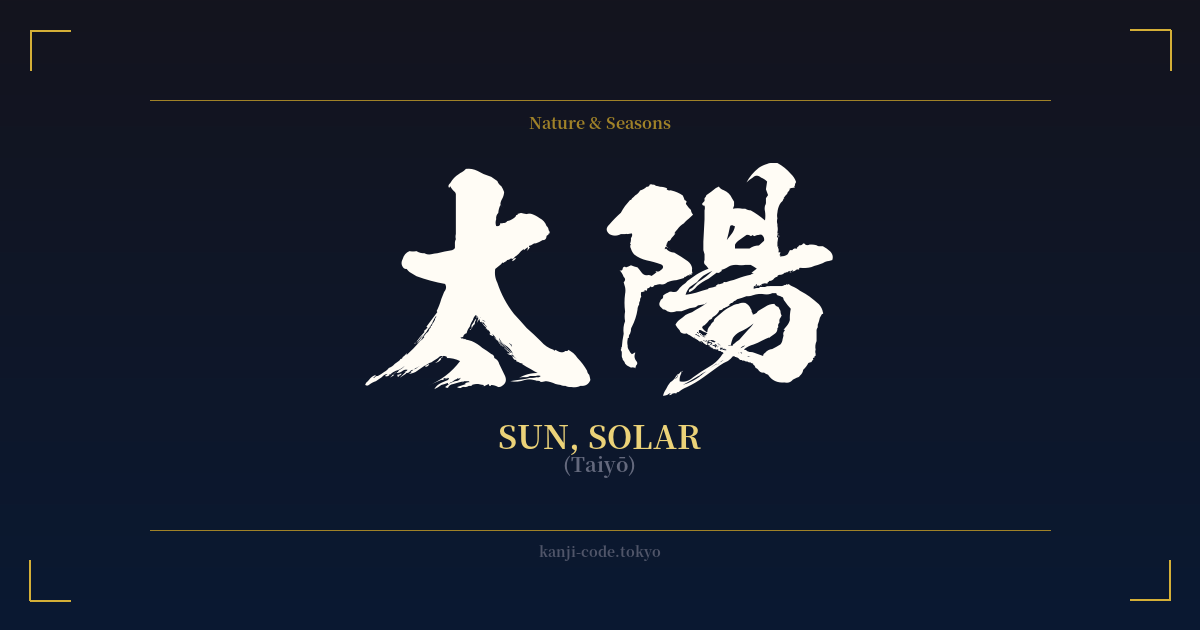
✍️ 太陽 (Taiyō) — Cultural Context
太陽 (Taiyō) is the Japanese word for the Sun, the celestial body that gives life to our world. But in Japan, its significance transcends astronomy. The characters themselves offer a glimpse into this depth: 太 (tai) means "great" or "grand," and 陽 (yō) represents "sunshine" or the "yang" principle. Together, they form "The Great Sunshine," a name that feels both poetic and powerful.
This reverence for the sun is woven into the very fabric of Japanese culture and identity. The country's name, 日本 (Nihon or Nippon), is often translated as "The Land of the Rising Sun." This name reflects the ancient belief that Japan was among the first lands to be greeted by the morning sun.
The most profound connection is found in Shinto, Japan's indigenous religion. The sun goddess, Amaterasu Ōmikami, is the chief deity and the mythical ancestor of the Japanese Imperial Family. The Ise Grand Shrine, Japan's most sacred Shinto shrine, is dedicated to her. This divine lineage makes the sun not just a star, but a symbol of the nation's spiritual origins and imperial heritage.
The national flag of Japan, known as the 日章旗 (Nisshōki) or more commonly the 日の丸 (Hinomaru, "circle of the sun"), is a direct and simple representation of this. The red disc on a white field is a minimalist yet potent symbol of the sun, embodying the nation's name and its cultural heart.
Beyond mythology, 太陽 is a key component of East Asian philosophy, particularly the concept of Yin and Yang (陰陽, In'yō in Japanese). 陽 (yō) is the embodiment of the yang principle: light, warmth, activity, masculinity, and the positive. It stands in contrast to its counterpart, 陰 (in), which represents darkness, cold, passivity, and the feminine, often associated with the moon (月, Tsuki). 太陽, therefore, is not just the physical sun but a fundamental force of active, life-giving energy in the cosmos.
In everyday life, 太陽 represents hope, vitality, and unwavering power. It is a symbol of clarity that dispels shadows and a source of warmth that nurtures growth. To embrace the word 太陽 is to connect with a concept that is at once universally understood and uniquely Japanese.
🖌️ Font Styles for 太陽
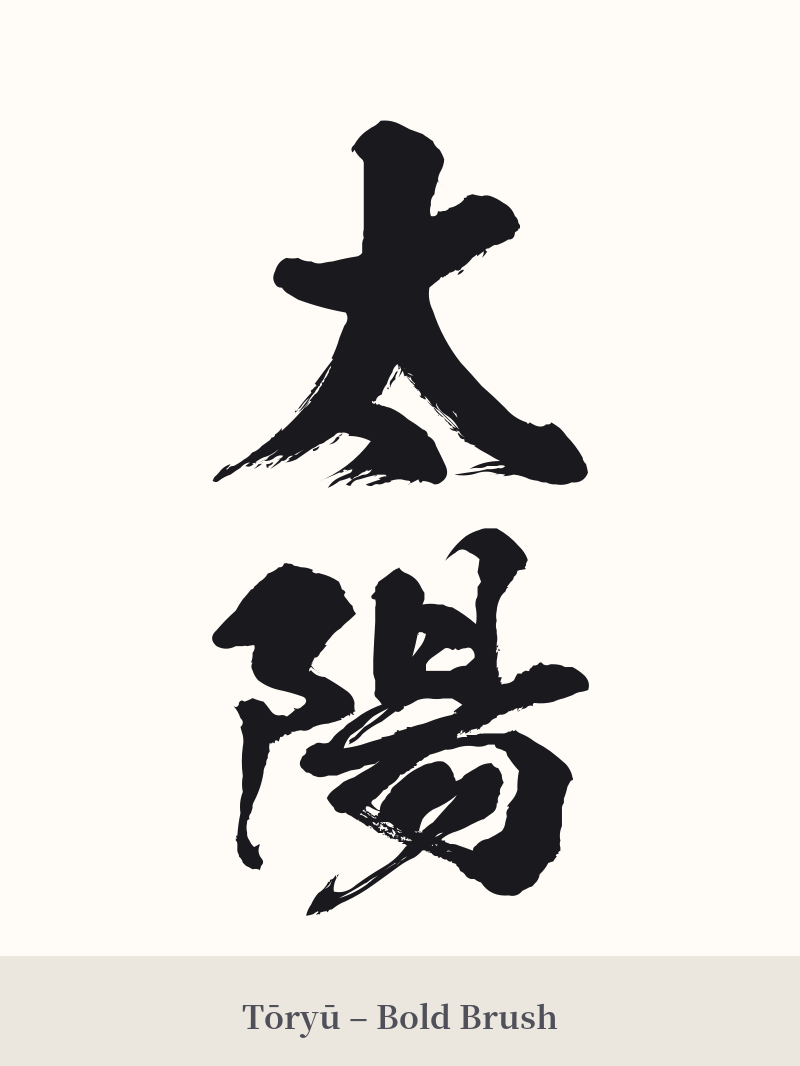
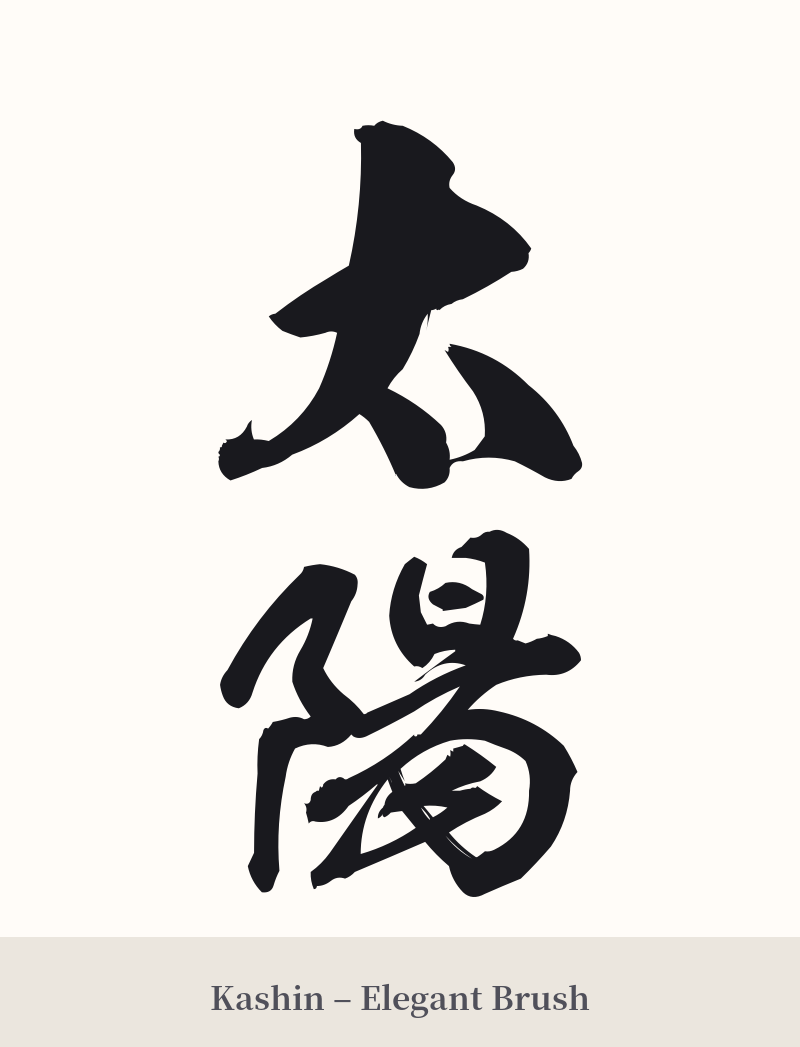
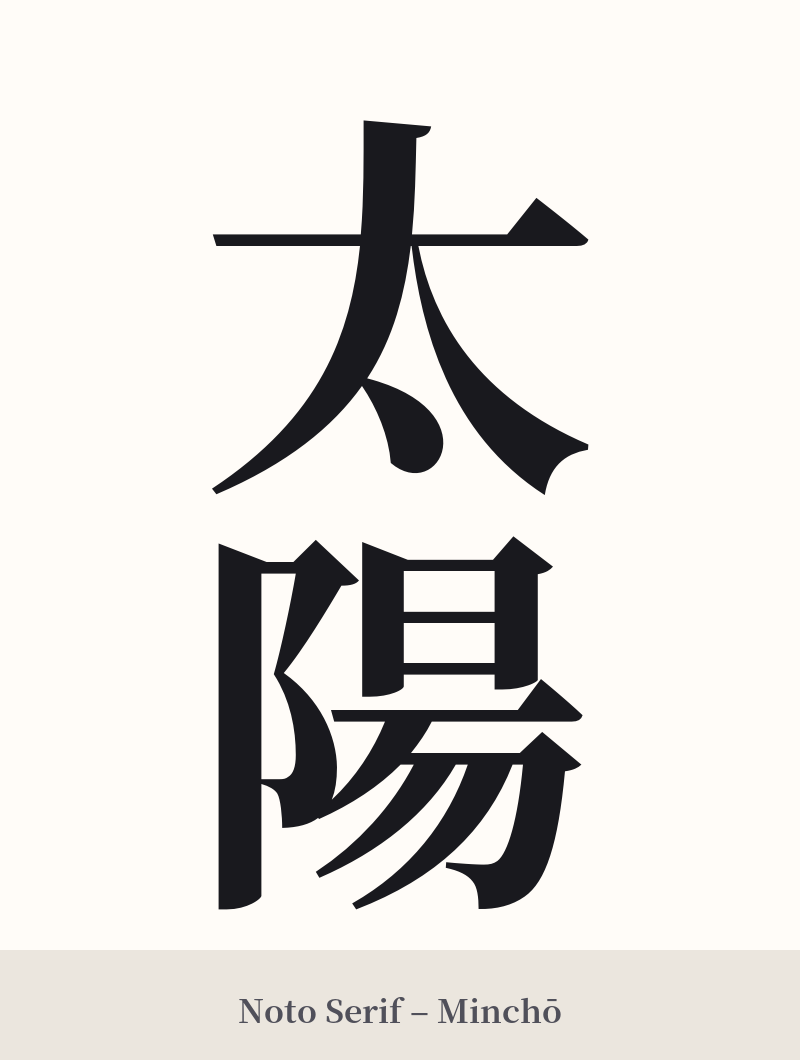
The same kanji can look dramatically different depending on the calligraphy style. Choose a font that matches the mood you want for your tattoo or design.
🎨 Tattoo Suitability
📐 Tattoo Design Guide
The kanji 太陽 offers a balanced and powerful visual for a tattoo. Its combination of a simple character and a more complex one creates a dynamic aesthetic.
– Placement: A vertical orientation is classic and works beautifully along the forearm, bicep, calf, or spine. For a horizontal design, the chest, upper back, or across the ribs are strong placements.
– Font Styles: A bold, semi-cursive calligraphy style (gyōsho) can emphasize the energy and power of the sun. For a more modern and clean look, a crisp Mincho or Gothic typeface provides excellent clarity and structure.
– Visual Tips: Consider incorporating a red or orange element, such as an Enso circle behind the kanji or a single splash of color, to evoke the sun's fiery nature. The artist must pay close attention to the negative space within the 陽 character to ensure it remains legible as the tattoo ages. The design can also be integrated with other Japanese motifs like waves, clouds, or a dragon to create a larger, more narrative piece.
Comments